PART 3: The Knot That Rang the Bell 058
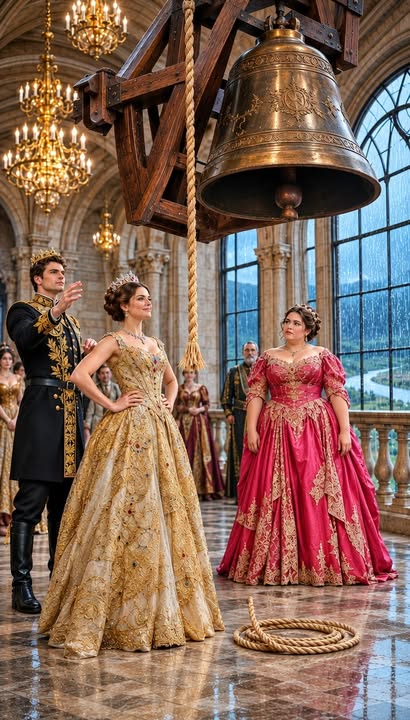
Part 3 – The Record Beneath the Dust
“That cannot be right,” the prince whispered.
But the date on the paper came months before his father had died.
Lena kept her hands folded in her lap, resisting the urge to reach for the fragile slip again.
The prince held it by its edges, as if a careless touch might turn the ink to dust.
Amara had not yet arrived; they had agreed to meet the following morning, and the gallery’s tall windows were dark now, reflecting only the lamplight and their uncertain faces.
“Could the date refer to something other than the rope?” Lena asked.
“It might,” he said, though he sounded unconvinced.
He turned the paper toward the light.
The seal was blurred, but its outer ring was unmistakable, and the shape pressed into the wax had been recorded in the palace archives for generations.
His father’s seal.
“Where did you say you found this?” he asked.
“Behind the bracket,” Lena replied. “It may have been caught there for years.”
The prince looked toward the bell wheel.
“Or someone put it there recently.”
Lena studied the dust along the bracket and the narrow space behind it.
The paper had left a clean outline where it had rested, but there was no way to tell how long it had been tucked away.
“Should we call the archivist?” she asked.
“Not tonight.”
He folded the paper along its old creases, then seemed to think better of it and opened it again.
“I want to know what this is before it becomes a story in the palace corridors.”
“Keeping it quiet doesn’t make it less real.”
“No,” he said. “But it may give us a chance to understand it before people decide what it means.”
Lena heard the worry beneath his careful words.
He was not asking her to help conceal the paper, only to keep an uncertain clue from becoming a verdict.
“Then let’s understand it,” she said.
The prince nodded, though his attention remained fixed on the faded signature.
He placed the slip between two clean sheets of paper from a writing desk and carried it to the small office adjoining the gallery.
There, they agreed to meet with Amara and the archivist in the morning.
Before Lena left the palace, she glanced back at the bell.
The knot she had tied remained firm around the two different ropes, a practical answer to one problem.
The paper was another kind of problem, and it had no simple shape to test with her hands.
Morning brought a pale, wind-brushed sky and the smell of wet stone.
Lena arrived at the west gallery shortly after the palace clock struck nine.
Amara was already there, seated at a narrow table with her gloves folded beside her.
Her champagne-gold gown had been replaced by a dark green traveling dress, severe enough for work but still elegant, and her hair was pinned back without the jeweled comb she had worn the day before.
“I hope you don’t mind that I came early,” she said.
“I’ve been looking at the bell from the doorway for ten minutes,” Lena replied. “So I can’t claim to be more patient.”
Amara’s smile appeared and faded.
“Did you learn anything after we left?”
Lena hesitated.
“The prince found a paper caught behind the wheel bracket.”
“What kind of paper?”
“A maintenance note, perhaps.”
Amara’s gaze sharpened, but she did not press.
The prince entered a moment later, carrying the protected slip inside a shallow wooden case.
Behind him came an elderly archivist with silver spectacles and a leather portfolio under one arm.
“This is Master Ivers,” the prince said. “He has cared for the palace records longer than I’ve been alive.”
“Not longer than the palace has needed them,” the archivist replied, setting down his portfolio. “Though there have been years when it seemed we were keeping more dust than history.”
His dry humor eased the room slightly.
He glanced at the three of them.
“His Highness tells me you found a document near the bell.”
The prince opened the case and let the archivist inspect the paper without touching it.
Master Ivers bent over the faded lines.
For a few moments, he said nothing.
Then he adjusted his spectacles and looked at the prince.
“The date is the ninth of Frostfall, twenty-two years ago,” he said. “The seal appears to be His Late Majesty’s.”
“That was before he died,” the prince said.
“By several months.”
Amara leaned closer to the case.
“Can you read the writing?”
“Some of it,” the archivist replied. “The ink has faded, and the lower edge is missing.”
He tilted the case so the light fell across the page.
“‘New line supplied for the west bell,’” he read slowly. “‘Old hemp retained for the upper pull.’ Then there is a number, likely an account reference.”
Lena looked from the paper to the ropes.
“So the thinner rope was replaced recently,” she said. “But the old hemp was left in place.”
“That is what the note says.”
“Was there a reason?”
Master Ivers opened his portfolio and drew out a narrow ledger.
“I can find the account reference, if the entry survives.”
He laid the volume on the table.
Its spine had been repaired more than once, and its pages smelled faintly of leather, paste, and the dry air of rooms rarely opened.
The prince stood beside him, shoulders held straight.
Amara watched the ledger with an expression Lena could not read.
“Do you recognize the account number?” the archivist asked.
“No,” the prince answered.
“Perhaps Lady Vale does,” Lena said.
Amara looked at her.
“You mentioned your family knew the household accounts.”
“I said we supplied the palace,” Amara replied. “That doesn’t mean I know every account.”
The words were not sharp, but the warmth between them cooled.
Lena felt the change immediately.
She had meant to invite Amara into the search, not claim her as an authority.
“I’m sorry,” she said. “I thought you might recognize the notation.”
Amara’s eyes softened by a fraction.
“It’s all right. I should have explained more carefully.”
The archivist turned several pages, found an index, and ran one gloved finger down its column.
“Here,” he said. “The number belongs to the west tower maintenance account.”
He turned to a page near the middle of the ledger.
The entry was brief: a line purchased, delivery acknowledged, old rope retained.
Beneath it was a name and a signature.
Amara went very still.
The prince noticed.
“Do you know the name?” he asked.
She leaned closer, though she already seemed to know the answer.
“It is Vale,” she said.
“Your family’s name?”
“My great-grandfather’s. He managed the household supply contracts at the time.”
A silence gathered around the table.
Lena could see Amara making the same calculation she was: a Vale ancestor had been involved in the replacement of the line, and a royal seal had authorized it.
Neither fact explained why the bell might have been neglected, but together they made the past feel less distant.
“Does the entry say he chose the rope?” Amara asked.
“No,” said Master Ivers. “Only that he acknowledged its delivery.”
“Then it doesn’t tell us what he knew.”
“No,” the archivist agreed. “It doesn’t.”
The prince studied the ledger.
“Could the old hemp have been inspected when the new line arrived?”
“Possibly,” said Master Ivers. “There may be another record.”
“Then we should find it.”
The determination in his voice sounded almost like relief.
A question had become a task, and a task was easier to hold than a suspicion.
The archivist began searching the index again.
Lena leaned over the table, following the columns.
The prince watched the ledger but did not touch it.
Amara stood with her hands clasped, her gaze fixed on her ancestor’s name.
“I didn’t know he signed for tower supplies,” she said.
“You don’t have to defend him,” Lena replied.
“I wasn’t.”
The response came too quickly.
Amara turned toward her.
“I was only saying I didn’t know.”
“I understand.”
But Amara looked as though she did not believe Lena did.
“I don’t want you to think I’m trying to protect my family,” she said.
“I don’t think that.”
“You said I didn’t have to defend him.”
“I meant that you don’t have to answer for everything your family did.”
Amara’s shoulders eased slightly.
The prince looked up from the ledger.
“None of us knows yet what anyone did,” he said. “We should be careful not to make the names carry more than the records can prove.”
His voice was measured, but his eyes kept returning to the royal seal.
Lena understood why.
His father’s name was not merely an entry in a ledger; it was part of the story he had grown up inside.
The prince had spoken of him as careful, and perhaps he had been.
But care was not proof of innocence, any more than a family name was proof of guilt.
Master Ivers found a second reference and asked them to wait while he retrieved another volume from the archive room.
The prince went with him.
Amara remained at the table.
Lena stood beside her, listening to rain begin again against the windows.
“You don’t have to stay if this is becoming uncomfortable,” Lena said.
“It became uncomfortable yesterday when I asked whether you could fix a problem the tower staff couldn’t.” Amara glanced at her. “This is different.”
“Is it?”
“Yes. Yesterday I was embarrassed because I had failed. Today I’m worried I’ll be asked to carry an old mistake I knew nothing about.”
Lena took that in.
“I’m not asking you to carry it.”
“I know. But other people may.”
The words held no accusation, only a clear awareness of how quickly a family name could become a conclusion.
Lena looked at the open ledger.
“Then we’ll try to keep asking what the evidence actually says.”
Amara let out a breath.
“You say that as though evidence is always allowed to speak for itself.”
“It isn’t?”
“Not when people have already decided what they need it to say.”
Before Lena could answer, the prince returned with Master Ivers and a second ledger.
The archivist opened it to a page marked by a strip of faded blue ribbon.
“This one concerns inspections,” he said. “The entry for the same month says the west bell was tested and found serviceable.”
“By whom?” Lena asked.
“Tower staff,” he replied, scanning the lines. “The keeper’s name is difficult to read.”
The prince bent over the page.
“Could it be Orlan?”
“Possibly.”
He looked at the name for a long moment.
“I remember the keeper,” he said. “He retired when I was young.”
“Would you be able to contact him?” Amara asked.
“If he is still living, yes.”
The prince’s attention lingered on the entry.
“Was there a later inspection?”
Master Ivers turned several pages, checking the dates.
“Not in this volume.”
“That seems unlikely,” said Amara. “The bell is listed as tested every year.”
“It may be recorded elsewhere.”
“Or the record is missing,” Lena said.
Master Ivers gave her a small nod.
“That is possible.”
The archivist returned to the index, searching for another reference.
Lena traced the columns with her eyes.
A note beside the inspection entry pointed to a weather ledger, stored with the records of repairs and storm damage.
“Would that include reports from the valley?” she asked.
“Sometimes,” Master Ivers said. “If a weather event affected palace property or public works.”
“Can we see it?”
The archivist studied the prince.
“Of course, if His Highness approves.”
“Bring it,” the prince said.
The weather ledger arrived with its corner cloth worn through and a water stain across the lower half of the cover.
Master Ivers turned its pages slowly.
There were entries about roof leaks, fallen branches, a damaged footbridge, and repairs to the river stairs.
Then, midway through the volume, he stopped.
The writing on that page had been blurred by damp.
He leaned closer, making out each line with care.
“Here is a note about a flood,” he said. “The spring flood, eight years before the prince’s father died.”
Lena felt the prince stiffen beside her.
The archivist read the entry twice.
“‘Lower river rose above the marked stones. West bell heard at second watch. No damage to palace property.’”
“Was anyone injured?” Amara asked.
“No mention of it.”
“Does the entry say who heard the bell?” Lena asked.
“No.”
The prince’s gaze had fixed on the date.
“Was there an official flood report?” he asked.
Master Ivers searched the index.
“There should have been.”
“Should have been?”
The archivist frowned at the page.
“I don’t see a reference number.”
Amara moved closer.
“Could the report have been filed under the river authority instead of the palace?”
“It could,” Master Ivers said. “But this ledger usually cross-references those reports.”
Lena pointed to a faint mark near the margin.
“Is that another number?”
The archivist angled the book toward the window.
The mark was little more than a line of ink, water-blurred until it looked like a crease.
“Perhaps,” he said.
He turned several pages and examined the back of the leaf.
The paper had darkened along one edge, but a few words remained visible through the damaged sheet.
Master Ivers’s expression changed.
“What is it?” the prince asked.
“I can’t be certain.”
He bent lower.
“Here,” he said at last. “A note in different ink. ‘Bell failed to carry through rain. Reported to the keeper.’”
The room seemed to tighten around the words.
Lena looked from the faded note to the official entry.
The ledger said the bell had been heard.
The damage on the next page suggested that someone had written the opposite.
“Can you read the rest?” Amara asked.
“Not clearly. There is a date, perhaps the day before the official entry.”
“And the report number?” the prince asked.
Master Ivers turned back to the index.
“No record of one.”
The prince reached for the edge of the table, then stopped before his hand touched it.
His face had gone pale, but his voice stayed even.
“The official report says the bell sounded.”
“Yes,” said the archivist.
“And this note says it failed.”
“It appears to.”
“Could the ink have transferred from another page?”
“Not in those words.”
The prince’s eyes moved to the seal on the paper from behind the wheel, still protected in its case.
For a moment, Lena thought he might ask the archivist to close the ledger.
Instead, he stepped back.
“Find the original report,” he said. “Search the river authority records, the tower logs, every copy that exists.”
“I will,” Master Ivers replied.
“And no conclusions until we have them.”
The words sounded reasonable.
Still, Lena heard the strain beneath them.
Amara was watching the prince, not the records.
“Your Highness,” she said gently, “the note may be incomplete, but it is evidence that the official version might not be the whole story.”
“I understand that.”
“I don’t mean your father is responsible.”
“I know what you mean.”
“But you’re looking at the seal as if it has already made up its mind.”
He looked at her.
For a moment, his expression was not defensive so much as hurt.
“My father is not here to answer for himself.”
“No,” Amara said. “He isn’t.”
“And the people who wrote these pages are not here either.”
“That is why we need the full record.”
The prince turned away from her and walked to the window.
Rain whispered against the glass.
Lena wanted to ease the silence, but any comfort she offered would have been a kind of guess.
The paper had carried his father’s seal.
The official report contradicted the weathered note.
Amara’s ancestor had signed for the replacement rope, though no one knew whether he had understood the condition of the bell.
There was not enough to accuse anyone.
There was enough to make trust harder.
Master Ivers closed the weather ledger carefully.
“I’ll begin with the river authority’s archive,” he said. “Some of the records were moved to the old municipal office.”
“Can I see the index?” Amara asked.
The archivist looked to the prince.
“You may,” he said.
“I’d like to look for the supply references from my family’s records. If my ancestor signed for the line, there may be other correspondence.”
The prince nodded, but his attention stayed on the rain.
“Do what you think is useful.”
Amara studied him.
“Would you prefer I not?”
“I didn’t say that.”
“You said it as though the search were something I had asked permission to do.”
“I’m trying not to presume.”
“And I’m trying not to be treated as though my family name makes me less welcome at the table.”
The prince turned.
“I have not treated you that way.”
“No,” she said. “Not deliberately.”
The distinction landed between them.
Lena saw the effort it took the prince not to answer too quickly.
He seemed to hear the truth in her words, even if it was not the whole truth.
“I’m sorry,” he said. “I’m afraid of what we’ll find, and I’ve let that make me careful in the wrong direction.”
Amara’s expression softened, but the hurt did not vanish.
“Then be careful with the records,” she said. “Not with me.”
The prince bowed his head.
“I’ll try.”
The meeting broke apart slowly, each of them gathering a different piece of the past.
Master Ivers carried the ledgers back to the archive room.
Amara remained to copy the account numbers and dates.
Lena helped her hold the page flat while she made notes.
Neither woman spoke until the archivist had left.
“Do you think my ancestor knew?” Amara asked.
“I don’t know.”
“Do you think the prince’s father knew?”
“I don’t know that either.”
Amara looked down at her notes.
“I wanted to understand what I had missed with the knot,” she said. “Now I’m not sure whether understanding the past is something any of us can do without hurting someone.”
“Maybe it hurts because the people involved mattered.”
“That’s not always a comfort.”
“No.”
They looked at each other, sharing the uncertainty without trying to make it smaller.
When Amara gathered her papers, she did not take the ledger with her.
“I’ll ask my family to search our old supply accounts,” she said. “If there’s correspondence, it may tell us whether the rope was ordered as a full replacement or only as a patch.”
“Would they help?”
“My aunt will. She dislikes mysteries when they interfere with an orderly archive.”
A faint smile returned.
“I’ll see you tomorrow,” Lena said.
“Unless the records decide otherwise.”
“They don’t get to decide whether you’re welcome.”
Amara met her eyes.
“Thank you.”
The prince stood near the gallery doors, still watching the rain.
Lena paused beside him.
“Do you want me to stay?” she asked.
He looked toward the bell, then at the case containing the royal-sealed paper.
“I don’t know.”
“Then I’ll come back tomorrow.”
“That may be best.”
His answer was not cold, but it left no room for more.
Lena went down the palace steps alone.
By midday, she was back at the west gallery with the coil of spare line she had promised to bring, hoping to compare it with the new rope and make a note of how its fibers had changed with damp.
The gallery was empty.
She set the line beside the wheel and began writing down measurements, careful not to disturb the knot she had tied the day before.
The prince entered quietly, carrying no crown this time.
“Master Ivers found another reference,” he said.
Lena looked up.
“From the river authority?”
“Not yet. From the palace index.”
He held out a small card.
The archivist’s handwriting filled one side, with a single file number circled twice.
“The original flood report may have been stored under household correspondence,” he said. “It was not listed with the public works records.”
“Why not?”
“I don’t know.”
They looked toward the archive room.
“Has Amara seen this?” Lena asked.
“She’s searching her family’s records today.”
“Should we ask her to join us?”
The prince paused.
“Yes,” he said. “We should.”
He sent a message to her family’s town house, then waited with Lena near the west gallery.
The minutes stretched.
A servant brought tea neither of them drank.
At last, Amara arrived, her green dress damp at the shoulders from the rain.
“I came as quickly as I could,” she said. “My aunt found a box of old supply letters, though she hasn’t yet found anything about the bell.”
“What did the archivist discover?” she asked.
The prince showed her the index card.
Amara read the file number.
“Household correspondence,” she repeated. “That could be anything.”
“It could,” he said. “The archive room has the file.”
Master Ivers met them there and unlocked a narrow cabinet.
He lifted out a bundle of papers tied with faded blue cord.
The label read: West Household—River Season, Miscellaneous.
“Not the most helpful description,” Amara observed.
“The palace has always trusted future generations to be patient,” the archivist said.
He untied the cord.
The first letters concerned provisions for the lower garden and the repair of a stone channel.
The next were written during the spring flood eight years before the prince’s father died.
One page had been folded in half, its outer edge worn almost through.
Master Ivers examined the ink and turned it toward the window.
“This may be the report we’re looking for.”
The prince leaned over the table.
The handwriting was cramped, with a line of water damage down the right side.
Master Ivers read silently at first.
Then he glanced at the prince.
“What does it say?” Lena asked.
“It is a copy of a report concerning the flood,” he replied. “The writer says the river rose beyond the lower markers and that the west bell was sounded.”
“Does it say who sounded it?” Amara asked.
“Not on this page.”
“Does it mention the failure recorded in the weather ledger?”
“No.”
The prince’s jaw tightened.
“Is there a signature?”
Master Ivers tilted the paper.
“The lower part is missing.”
Amara stared at the torn edge.
“Can you tell whether the page was torn deliberately?”
“I can’t.”
The archivist turned the sheet over.
On the back, in a lighter hand, someone had added a note.
Only a few words remained, their ink faint but legible.
Master Ivers read them once, then looked again as if he hoped the letters might arrange themselves into something else.
“What is it?” Lena asked.
He did not answer immediately.
The prince reached for the table, fingers resting against the edge.
“Read it,” he said.
Master Ivers drew a careful breath.
“‘Report prepared after instruction from His Majesty.’”
No one moved.
The prince’s gaze fixed on the words.
His father’s seal on the rope order.
The false-sounding claim that the bell had carried through the rain.
The hidden note about a direct instruction.
Amara looked at the damaged page, then at the prince.
“Does it say what the instruction was?”
Master Ivers searched the remaining lines.
“No.”
The prince withdrew his hand from the table.
“Then we have a phrase without its context.”
“Yes,” said the archivist. “That is all it proves.”
“His Majesty may have instructed the clerk to prepare an ordinary report,” the prince said.
“He may have,” Amara replied.
“Or the note may refer to some other matter.”
“It may.”
Her voice was gentle, but her eyes did not leave the page.
The prince looked at the empty space where the signature should have been.
Lena felt the familiar pull toward a practical task, something measurable and repairable.
But no knot could join these scraps into a trustworthy account.
“Can we trace the writer?” she asked.
“Perhaps,” said Master Ivers. “If the hand matches another document.”
“And the missing page?”
“The file may have been split or miscatalogued. I’ll search the adjacent bundles.”
Amara touched the table near the paper, careful not to touch the page itself.
“My ancestor’s signature may be on the report,” she said. “If he signed it, I want to know whether he was signing what he saw or what someone told him to write.”
The prince’s expression shifted.
“Why would you think he signed it?”
“Because our family name is already on the rope entry. If he was involved in the official account, I’d rather find that out than spend the rest of my life hoping he wasn’t.”
The words were steady, but Lena heard the effort beneath them.
The prince looked at her for a long moment.
“I don’t want you blamed for a choice you didn’t make,” he said.
“I know.”
“And I don’t want my father judged from a fragment.”
“Neither do I.”
“Then we agree on that.”
“We agree that we need more than fragments,” Amara replied.
The prince nodded.
He picked up the index card and set it beside the old report.
“We’ll find the rest.”
There was resolve in the words, but also fear.
Master Ivers began sorting the bundles, laying each letter in date order.
Lena helped him compare the papers, while Amara copied the file references and the prince examined the faded handwriting.
For nearly an hour, they worked without speaking.
The room’s quiet was filled by the soft slide of paper, the occasional turn of a page, and the rain against the high windows.
Then Master Ivers stopped.
He had uncovered a narrow, folded sheet tucked beneath the backing of the bundle.
Unlike the report, it had been folded more than once and secured with a thread that had nearly rotted away.
The archivist placed it on the table.
The paper was marked with an old water stain.
On its outer fold, someone had written a single name.
Amara leaned closer.
The letters were faded but unmistakable.
Vale.
Beneath the name was a date from the night of the flood.
**–END OF PART 3–CLICK “NEXT” AT THE BOTTOM OF THE PAGE TO CONTINUE READING**
* * *
[PREVIOUS: PART 2](https://storyly.idolsgift.com/blog/part-2-the-knot-that-rang-the-bell-058) | [NEXT: PART 4](https://storyly.idolsgift.com/blog/part-4-the-knot-that-rang-the-bell-058)
✓ Lynn R. Adams
Part 3 – The Record Beneath the Dust “That cannot be right,” the prince whispered. But the date on the paper came months before his father had died. Lena kept her hands folded in her lap, resisting…