PART 3: The Key Brenda Couldn’t Explain 035
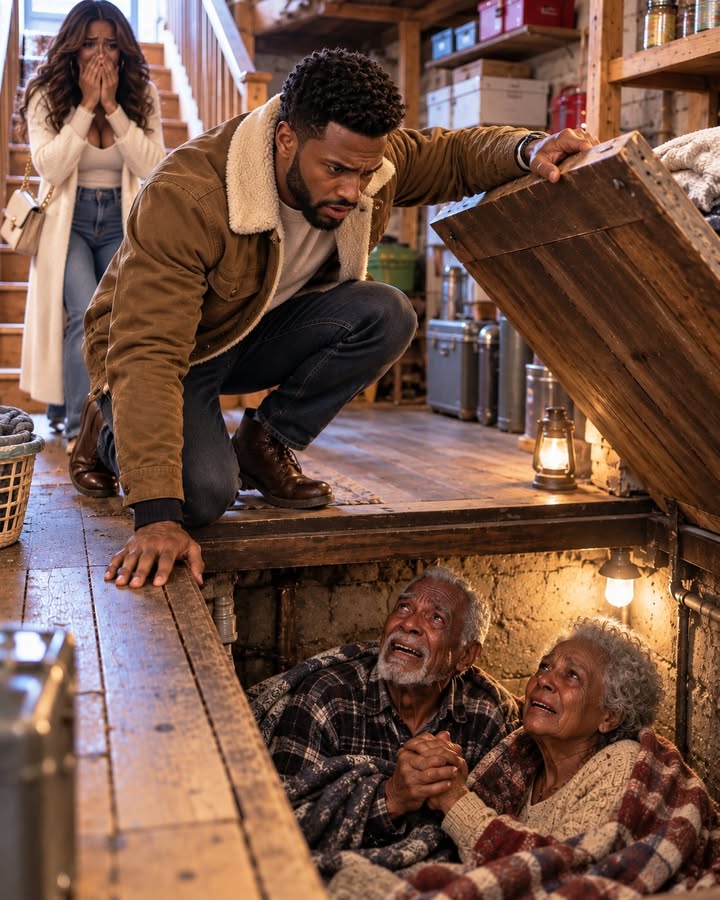
Part 3 – The Room Beneath the Kitchen
“Don’t let Brenda take the key.”
My mother’s whisper seemed to pass through the wood and settle somewhere behind my ribs.
I crouched beside the basement door, one hand flat against it, listening for the sound of her breathing.
“Mom, it’s me,” I said. “I’m here.”
“I know.”
Her voice was thin, but unmistakably hers.
“Are you hurt?”
“No.”
“Is Dad with you?”
A pause followed, long enough to make me glance toward the windows, though I knew Brenda was still away.
“He’s here,” Mom said at last. “He’s tired.”
“Can you open the door?”
“I can’t.”
I looked at the latch and understood what I had missed.
The door was locked from the other side, as I had suspected, but the mechanism was old, its metal tongue visible through a narrow gap in the frame.
“Do you know where the key is?” I asked.
“Brenda has it.”
“She’s gone for now.”
“Then find another one.”
I leaned closer to the wood.
“Is there a spare?”
“Your father used to keep one with his tools.”
A memory surfaced of Dad showing me a little tin box in the basement when I was a boy, explaining that a person should never trust a single key to do the work of two.
“I’ll look for it,” I said.
“Don’t tell Brenda.”
“I won’t.”
Mom’s breathing sounded uneven, though she had said she wasn’t hurt.
“Shawn,” she whispered, “she thinks she’s helping.”
“I know she does.”
“I’m not sure she understands what she’s done.”
Before I could ask what she meant, something shifted on the other side of the door.
Mom drew back, and the latch clicked into place again.
I stood slowly, my knees stiff from the cold floor.
The house looked exactly as it had when I first returned: quiet, familiar, full of ordinary things that belonged to people who were supposed to be living their ordinary lives.
Now every familiar object seemed to point toward a hidden room.
I called George.
“She spoke to me through the door,” I told him.
“Your mother?”
“Yes.”
“Are they injured?”
“She says no, but she sounds weak.”
“Have you called emergency services?”
“Not yet.”
There was a brief pause.
“Shawn, if you believe they’re in immediate danger, call now.”
“I’m trying to get the door open first.”
“Why?”
“Because I don’t want to frighten them or make this worse before I know what’s happening.”
“I understand,” he said. “But don’t let your need to understand become a reason to wait if they need help.”
His words were gentle, but they stayed with me.
I promised I would call if I heard that either of them was unwell, then ended the conversation and began searching for Dad’s spare key.
I started in the mudroom, where he used to keep gardening gloves and small tools in a cabinet with a sticky door.
The drawers held rubber bands, batteries, old receipts, and a tangled collection of screws.
Nothing that looked like a key.
In the garage, I found his workbench much as I remembered it, the surface crowded with empty jars and neatly labeled boxes whose handwriting had grown less steady over the years.
I searched each one carefully.
There were keys to old padlocks, a brass key for the shed, and a tiny key that belonged to a cash box I had never seen.
The spare for the basement was nowhere among them.
By noon, the light outside had turned the color of wet cement.
I went back inside and stood at the kitchen sink, trying to decide whether to call Nancy, George, or the police.
Before I could choose, a car door closed in the driveway.
I looked through the window and saw George walking up the path.
He had brought no coat, though the wind pressed at his jacket as he crossed the yard.
I opened the front door before he could knock.
“You said not to come in unless you called,” he said.
“I did.”
“I heard nothing.”
“I changed my mind.”
George stepped inside, his eyes immediately moving toward the kitchen.
“Did you hear from them again?”
“Not since my mother spoke.”
“Can I listen?”
I led him to the basement door.
He bent down, resting one hand against the frame.
For several seconds, the house was silent.
Then a faint sound came from below, like someone shifting a chair across a floor.
George straightened.
“That’s not a pipe.”
“No.”
“Can you open it?”
“Not yet.”
I told him about the spare key in Dad’s tools and showed him the drawers I had searched.
George studied the basement door.
“Your father was particular about his tools,” he said. “He might have kept a key somewhere he thought nobody would look.”
“Where would that be?”
“Somewhere he considered obvious.”
That sounded like Dad.
We returned to the garage and examined the workbench together.
George pulled open a narrow drawer beneath the vise and found a rag folded over an old tin of screws.
Behind the tin, there was a small wooden box with a dented lid.
I recognized it as the box Dad used to store fishing hooks, though I had not seen it in years.
Inside lay three keys, a blunt pencil, and a folded paper label marked BASEMENT in my father’s handwriting.
For a moment, neither George nor I moved.
Then I picked up the key.
It was dark with age and lighter than Brenda’s newer one.
“Maybe it doesn’t work anymore,” George said.
“Maybe.”
“Do you want me to stay here while you try it?”
“Yes.”
“Then let’s call emergency services before we open the door.”
The suggestion surprised me, though it was sensible.
I looked down at the key in my palm.
“If they’re frightened, an ambulance crew could make this harder for them.”
“If they need care, waiting could make it harder for them.”
I thought of my mother’s weak voice.
“Let’s try the door first,” I said. “If they need help, I’ll call immediately.”
George nodded, but he did not look convinced.
We went back to the kitchen.
I crouched before the basement door and slid the old key into the lock.
For a moment, it resisted.
Then the mechanism turned with a dry click.
The door opened only a few inches before another latch stopped it.
I could see a narrow gap beyond the door, filled with darkness and the smell of stale air.
“Mom?” I called.
“It’s open?” she asked.
“The top lock is.”
“Wait.”
I heard movement below, followed by a low murmur I could not make out.
Then Mom returned.
“Your father needs a moment.”
“Is he all right?”
“He says he is.”
George stood quietly behind me, keeping his distance from the door.
I could have pushed against it, but my mother had asked me to wait.
So I waited, with the old key still in the lock and my hand resting on the edge of the door.
After a minute, Mom said, “You can open it now.”
I eased the door inward.
A narrow flight of stairs descended into the basement, lit by a single bare bulb near the bottom.
The air smelled of dust, laundry soap, and something warm that might have been soup.
I looked down and saw my mother standing at the foot of the stairs.
Her hair was flattened on one side, and a knitted cardigan hung loose around her shoulders.
She looked thinner than I remembered, but she was on her feet.
Behind her, Dad sat in a chair beside a small folding table.
His face was pale, and his hands rested on a blanket over his knees.
He looked up at me.
For a moment, neither of us spoke.
Then he said, “You’re home.”
I descended two steps before stopping.
“Dad.”
He lifted one hand, as if to reassure me that everything was all right.
The gesture was familiar.
The rest of him was not.
A makeshift room occupied the far end of the basement, arranged between shelves of old paint cans and stacked boxes.
There was a narrow bed, a space heater, two chairs, and a small table holding a kettle, a few dishes, and a basket of clean clothes.
The window near the ceiling had been covered with cardboard.
A short, untidy stack of blankets sat beside the bed.
Nothing appeared broken or filthy, and neither of my parents seemed to have been physically harmed.
But the room was too small for two people to live in, and the single bulb cast the corners in a weak yellow light.
“How long have you been down here?” I asked.
Mom looked at Dad before answering.
“Not every day.”
“That isn’t what I asked.”
Dad lowered his eyes.
“Since the fall,” Mom said.
I gripped the railing.
“Seven months?”
“It wasn’t like this at first,” she said. “Brenda said we should stay down here while she got the upstairs ready.”
I looked at the narrow room again.
“What was she getting ready?”
“She said the house needed work.”
“Was it supposed to be temporary?”
Mom’s lips pressed together.
“That’s what we were told.”
Dad shifted in his chair.
“Your sister was trying to keep us together,” he said.
“By locking you in the basement?”
“No one locked us in.”
The words came quickly, but he did not meet my eyes.
I looked at the closed door at the top of the stairs.
“Then why couldn’t you open it?”
Dad’s jaw tightened.
Mom answered for him.
“Brenda said it was safer this way.”
I glanced at the latch, then at the room.
“Safer from what?”
“Dad was confused after his fall,” Mom said. “He would try to go outside at night.”
“I went outside once,” Dad murmured.
“You were looking for the garage,” Mom replied.
“I knew where the garage was.”
“You thought the house was on the other side of the road.”
Dad’s hands closed over the blanket.
The quiet between them was not hostile, but it held a weariness I could not mistake.
I looked at my father, wanting to ask how much of his confusion he remembered and how much had been filled in for him by others.
Instead, I asked the question that felt more urgent.
“Did you have enough to eat?”
Mom glanced at the table.
“Brenda brought food.”
“How often?”
“Most days.”
“Most days?”
“She’s been busy,” Mom said quickly. “She has a lot to manage.”
I thought of the single used plate I had found upstairs and understood why there had been no signs of two people eating.
The answer did not satisfy me, but I could see my mother trying to protect Brenda from the shape of the truth.
“Did either of you need medical care?” I asked.
“We needed a doctor,” Mom said.
Her honesty surprised me.
“Then why didn’t you tell someone?”
“We thought we would be upstairs again soon.”
“Did Brenda say that?”
“She said it at first.”
“And later?”
Mom looked toward the bed.
“Later she said that if anyone came, they might decide your father couldn’t stay here.”
I looked at Dad.
“Did you ask her to keep your memory problems from me?”
He raised his eyes at last.
“I asked her not to make a fuss.”
“That’s not the same thing.”
“No,” he said. “It isn’t.”
The admission seemed to cost him something.
I came down the remaining steps and approached him slowly.
“Dad, I’m not here to take your choices away.”
“Everyone says that before they start making choices for you.”
“I’m not everyone.”
He studied my face, looking for a promise he could trust.
“I thought if you knew I was getting forgetful, you’d come back and decide I couldn’t live here,” he said.
“I should have been here whether you were forgetful or not.”
“That’s easy to say now.”
“You’re right.”
His gaze flickered to George, who had remained near the doorway at the top of the stairs.
Dad looked uncertain.
“Who’s that?”
“George,” I said. “He’s been looking out for you.”
Dad gave him a faint nod.
“I know George.”
“Not always,” Mom said softly.
Dad’s expression tightened.
“I know him.”
“Dad,” I said, “it’s all right if you don’t remember something.”
He looked away, his face closing.
The words had been meant as comfort, but I could hear how they might have sounded to him: a declaration that his fear had already come true.
Mom came to stand beside his chair.
“He’s tired,” she said.
I wanted to ask whether she was tired too, but she had spent enough time answering questions for the morning.
I looked around the room again and noticed a small stack of envelopes beside the kettle.
Some were addressed to my mother, some to my father.
One bore my name in familiar handwriting.
I knew it was the letter I had seen upstairs.
“Are these the things you kept from me?” I asked.
Mom followed my gaze.
“There were a few letters.”
“Why weren’t they mailed?”
“Brenda said she would send them.”
“When?”
“After the house was settled.”
I turned toward the staircase.
“Did she tell you my number had changed?”
Mom’s eyes widened.
“She said your old phone was disconnected.”
“My number hasn’t changed.”
“I know that now.”
The revelation hit me with a quiet force.
“Did you try to call?”
“We tried several times,” she said. “The first few times, nobody answered.”
I felt an unexpected sting of guilt, though I knew I had not received the calls.
I pictured my old phone, the one I had replaced years earlier and left in a drawer at my apartment.
Had messages gone there?
Had my parents tried to reach me and believed the silence was mine?
“Did you leave a message?” I asked.
Mom looked toward the envelopes.
“Your father did.”
“What did it say?”
“I don’t remember exactly.”
Dad frowned.
“I left a message?”
“You did,” Mom said.
“I don’t remember.”
She touched his shoulder.
“That’s all right.”
I glanced again at the letters.
There were several, some sealed and others opened, all worn at the edges from being handled.
“Why keep them?” I asked.
“I couldn’t throw them away,” Mom said. “They were the only proof that we had tried.”
I could not find an answer that did not make the room feel smaller.
George cleared his throat from above.
“Shawn, we should call for medical help.”
Dad looked toward him, then toward me.
“I’m fine.”
“You may be,” I said. “But you fell and have been living in a basement room. We need a doctor to make sure.”
“I don’t want to go to a hospital.”
“Then we’ll talk through the options with a medical professional.”
“I don’t want strangers deciding everything.”
“No one should decide everything without you.”
He studied me again.
“Do you promise?”
“I promise to listen.”
It was not a promise that nothing would change, but it was the one I could honestly give.
Dad nodded once.
I took out my phone and called emergency services, explaining that my elderly parents were downstairs, weak but conscious, and that my father had a history of a serious fall and worsening confusion.
The dispatcher asked a series of questions, and I answered as carefully as I could.
Mom sat beside Dad while we waited.
George remained near the stairs, giving us room but staying close enough to help.
When I ended the call, Dad had leaned back in his chair, his eyes closed.
Mom held his hand.
“I’m sorry I wasn’t here,” I said.
She turned toward me.
“Your sister said you were busy.”
“I was.”
“She said you didn’t want us to worry about you.”
“I never said that.”
“I know.”
Her answer was quiet, but it carried the weight of a long time spent believing otherwise.
I sat on the edge of the bed.
“Did you know Brenda was using the money I sent?”
“She paid the bills,” Mom said.
“That isn’t what I asked.”
“I don’t know exactly what she did with it.”
“Did you know she had debts?”
Mom looked startled.
“No.”
I looked back at the room and remembered Brenda’s expensive clothes, the careful way she had spoken about managing the house, and the avoidance in her eyes when I asked how she had handled the money.
The transfers had been meant for my parents’ care.
I had never checked whether they were getting what they needed.
Brenda had been the one with access, and I had let trust stand in for attention.
I heard a car pull into the driveway upstairs.
George turned toward the sound.
“Is that the ambulance?” I asked.
He stepped away from the stairwell and looked through the small window beside the door.
“No,” he said. “It’s Brenda.”
The sound of the front door opening followed, then the quick, uneven rhythm of her footsteps in the kitchen.
Mom tightened her hold on Dad’s hand.
I stood and moved toward the stairs.
Brenda appeared at the top before I reached them.
She stopped when she saw the open door, the key in my hand, and George behind me.
For one suspended moment, she looked less angry than devastated.
Then her eyes passed over my shoulder and found our parents in the cramped room below.
She pressed one hand to her mouth.
“I told you not to open it,” she whispered.
I stepped aside.
“Mom asked me not to let you take the key.”
Brenda’s face went pale.
“I wasn’t going to take it from her.”
Mom looked up from beside Dad.
“You said Shawn had changed his number,” she said.
Brenda’s eyes closed briefly.
“I thought it would be better if you didn’t call him while Dad was confused.”
“Why?” I asked.
She looked at me, and in that instant I understood that the answer would not be simple.
“I thought if he came back, he’d take them away.”
“I was never going to take them away.”
“You say that now.”
“I should have been here more, but you could have told me the truth.”
“I tried to keep everything together.”
“By putting them down here?”
“Not at first.”
The words hung in the narrow stairwell.
Dad opened his eyes.
“Brenda,” he said, “come sit down.”
She did not move.
“Dad, I’m sorry,” she whispered.
He looked at her with tired confusion.
“For what?”
Brenda’s face crumpled, but she steadied herself before any tears could fall.
The siren of an approaching ambulance sounded faintly in the distance.
“Did you use the money I sent for their care?” I asked.
Her gaze dropped to the floor.
“Most of it went to the house.”
“And the rest?”
“I had debts.”
“How much?”
“Shawn, not now.”
“How much?”
“Enough that I thought I could pay it back before anyone noticed.”
Mom’s hand tightened around Dad’s.
I felt the last few hours rearrange themselves in my mind.
Brenda had not only hidden our parents’ condition; she had hidden the money, the letters, the calls, and the fact that she could no longer manage the situation alone.
Yet the fear in her face was real, and so was the shame.
“I’m not asking so I can punish you,” I said. “I need to know what happened.”
“I know.”
“Then tell me.”
She looked past me toward the basement room.
For the first time since I had arrived, she seemed to see it as we did: the folded blankets, the covered window, the chairs set too close together, the little table made to look like a home.
“I thought I had more time,” she said.
The ambulance pulled into the driveway.
George went to answer the door.
Brenda came down one step, then stopped when Dad called her name.
“Brenda.”
She looked back.
“I didn’t ask you to keep us from Shawn,” Dad said.
Her face tightened.
“You told me not to let him see you like that.”
“I was ashamed.”
“I was trying to protect you.”
“You were trying to protect the picture you had of me.”
Brenda lowered her eyes.
“I’m sorry.”
Dad’s expression softened, though it did not erase what lay between them.
“I know you are,” he said.
Mom looked from Brenda to me.
“Whatever happens now, don’t make this another thing you both carry alone.”
The words settled over the room as the paramedics entered the house.
One of them introduced herself and asked to speak with Dad.
He agreed, though he glanced at Brenda before answering each question, as if waiting for her to tell him what he remembered.
When they helped him stand, his knees trembled.
Brenda reached for him at the same time I did.
For a moment, our hands met beneath his arm.
Neither of us pulled away.
At the hospital, a doctor examined Dad and ordered tests while Mom sat beside him, exhausted but attentive.
The doctor explained that Dad was dehydrated and weak, and that his fall and memory changes needed proper follow-up.
He did not say that Dad could never return home.
He did not say that anyone needed to be taken away forever.
He said there were options, and that the family should be included in making a safe plan.
Brenda sat apart from us in the waiting area, her coat still on, her hands folded in her lap.
I wanted to sit beside her, but I could not yet make myself cross the space.
George had gone back to the house after giving the paramedics his account of how long our parents had been missing from the neighborhood.
Before he left, he told us he would call Nancy.
The name brought the morning back to me.
“Why did you fire her?” I asked Brenda.
She rubbed her thumb along the edge of one fingernail.
“She told me the arrangement wasn’t safe.”
“Was she right?”
“Yes.”
The answer was so direct that I did not know what to do with it.
“She said you needed help.”
“She did.”
“And you sent her away.”
“I thought she would report us.”
“Were you afraid of what she would say?”
“I was afraid she would make the decision for us.”
“Did she try to?”
“No.”
Brenda’s voice fell to a whisper.
“She tried to make me understand that keeping them quiet wasn’t the same as keeping them safe.”
A nurse came through the doors and said our mother was asking for me.
I rose at once.
Brenda stayed seated.
“She wants you too,” I told her.
“I don’t know if she does.”
“She asked for both of us.”
Brenda hesitated, then stood.
We entered Dad’s room together.
Mom sat beside his bed, holding something small in her palm.
When she saw us, she looked first at me and then at Brenda.
“I found this in the lining of my old purse,” she said.
She opened her hand.
A little plastic case lay there, scratched and yellowed with age.
“What is it?” I asked.
“My old phone,” she said. “I kept it after the battery died.”
Brenda’s face went still.
Mom looked at the case as if the past were hidden inside it.
“I remembered there was a message from you,” she said to me. “Your father had called, but I didn’t know if the recording was still there.”
I looked from the phone to Brenda.
She had told me my number had changed.
She had told our parents it was disconnected.
The first ambulance had brought us to the hospital, but the small object in my mother’s hand seemed to open a different kind of door.
“Did you listen to it?” I asked.
“Not for a long time,” Mom said. “I was afraid it would be another message saying you hadn’t called.”
She handed me the phone.
It was old enough that I barely recognized the model, but I remembered owning one just like it.
My mother’s fingers rested on the case for a moment before she let go.
“Maybe it’s nothing,” she said.
Brenda looked at the phone, then at me.
Her eyes were full of fear, but this time it was not fear of what I might find in the basement.
It was fear of what my father had said before she ever put a lock on the door.
**–END OF PART 3–CLICK “NEXT” AT THE BOTTOM OF THE PAGE TO CONTINUE READING**
* * *
[PREVIOUS: PART 2](https://puretales.idolsgift.com/blog/part-2-the-key-brenda-couldn-t-explain-035) | [NEXT: PART 4](https://puretales.idolsgift.com/blog/part-4-the-key-brenda-couldn-t-explain-035)
✓ Lynn R. Adams
Part 3 – The Room Beneath the Kitchen “Don’t let Brenda take the key.” My mother’s whisper seemed to pass through the wood and settle somewhere behind my ribs. I crouched beside the basement door, …