PART 3: The Hand That Remembered 057
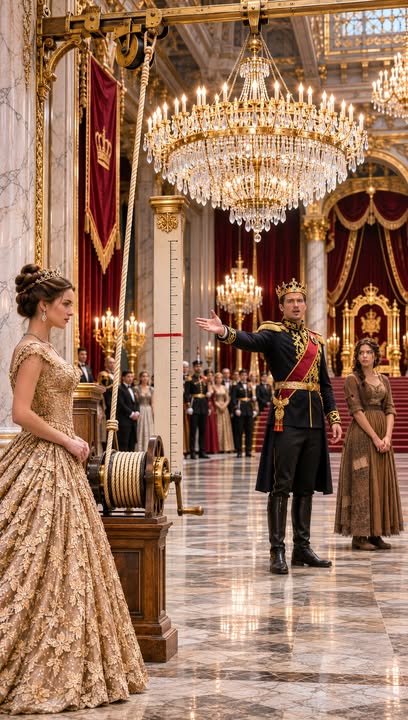
Part 3 – The Mark Beneath the Drum
The engineer’s words seemed to settle over the hall more heavily than the chandelier itself.
Elara set down her glass before it slipped from her hands.
“A mark is not a name,” she said, keeping her voice steady.
“No,” Master Harlan replied. “But it may give us a place to begin.”
Prince Adrian glanced from the engineer to the fixture.
“Then we will begin carefully,” he said. “The chandelier stays where it is until we know more.”
The judges exchanged looks.
One of them began to protest that the competition schedule—
Adrian silenced the objection with a quiet lift of his hand.
“A schedule is not more important than the safety of everyone beneath that chandelier.”
His words were calm, but no one argued again.
Elara watched him, wondering whether he understood how unusual it was to hear a prince speak of safety before ceremony.
Master Harlan turned to her.
“If you are willing, I would like you to join the engineers when we inspect the mechanism.”
Elara looked down at her patched sleeves.
“I am not an engineer.”
“You noticed what we did not,” he said. “That is reason enough to ask.”
The invitation unsettled her more than the applause had.
She had been praised for a task she understood, but an inspection sounded like a doorway into matters she had never been permitted to touch.
“I should return to my duties,” she said.
“Your duties can wait until tomorrow,” Adrian replied. “The palace will manage without you for one afternoon.”
It was meant kindly, yet Elara felt the weight of the court watching to see what she would do.
She did not want to be treated like a curiosity brought out for a celebration.
“I will help inspect it,” she said at last. “If I can return to the storeroom afterward.”
“Of course,” Adrian said.
Master Harlan bowed. “Then we will meet in the west workshop at first light.”
Lady Celestine stepped forward before Elara could answer.
“May I come as well?”
The request surprised the nobles more than Elara’s had.
Celestine glanced toward the chandelier, then toward the measuring column where the red mark still showed beneath its rim.
“My family’s estate supplied the pulleys for the competition,” she said. “I would like to know whether anything about them needs attention.”
One of the judges frowned.
“Lady Celestine, the equipment was inspected.”
“I know,” she replied. “I am not questioning the inspection. I am asking to understand it.”
Her voice was composed, though Elara noticed that she had folded her hands tightly together.
Adrian looked to Master Harlan.
“The inspection can accommodate another pair of eyes,” the engineer said. “So long as everyone leaves the tools to the people trained to use them.”
“I can do that,” Celestine said.
The answer came without offense.
Elara found herself reassessing her.
The noblewoman who had laughed at her had not vanished; the embarrassment and pride were still there, bright as the stones on her gown.
But something else had appeared beside them: a wish to know the truth, even if it proved uncomfortable.
The court began to break into smaller conversations.
Attendants checked the ropes and secured the area around the chandelier, while the judges quietly revised the order of the next competition.
Adrian remained beside Elara as Master Harlan went to confer with the other engineers.
“You need not join us merely because I invited you,” he said.
“I know.”
“Then why did you agree?”
She considered the question.
“Because I want to know whether the mechanism is as sound as it looked.”
“And because of the maker’s mark?”
Elara’s hand drifted toward the seam of her skirt, where the small brass token was hidden in the lining of her work basket, several corridors away.
“Perhaps.”
Adrian did not ask her to explain.
That, more than his invitation, made her feel she could answer honestly.
“Do you often keep such things to yourself?” he asked.
“Only the things I cannot yet understand.”
He smiled faintly. “That sounds like a difficult way to live.”
“It is a useful way to work.”
The prince’s smile grew, but he did not turn the exchange into a joke.
Then a page approached to remind him of his duties, and Elara took the opportunity to leave.
She returned to the storeroom with the applause still echoing faintly in her thoughts.
The room seemed smaller than it had that morning.
Folded linen filled the shelves, and dust floated in the stripe of light that came through the high window.
Her work basket sat beneath the table where she had left it.
Elara knelt and opened the small inner pocket.
The brass token rested inside, wrapped in the faded linen her father had used.
She had carried it for years without knowing why it mattered.
On one side, a crown sat above a wheel, its tiny spokes worn smooth by time.
She had never seen the mark clearly beneath the chandelier’s drum, but Master Harlan’s certainty had unsettled her.
If her father had belonged to the royal workshop, why had he never told her?
And if he had been a royal engineer, why had she grown up believing he was simply a repairman who worked wherever he was needed?
She rubbed the token with the edge of her thumb.
A memory returned, not of the storeroom, but of her father at their kitchen table, turning the brass piece over in his palm.
He had looked tired that evening.
When she asked what it was, he had said only, “A reminder that every machine has a history.”
She had been nine years old.
She had wanted to ask more, but her mother had called her away to help with supper.
After that, the question seemed to have no proper moment.
When Tomas died, the token became one of the few things she had kept.
Elara returned it to its linen wrapping and secured the pocket.
She would not carry it into the workshop merely because an old mark had made others curious.
It belonged to her father.
She would decide what to reveal, and when.
The next morning, the west workshop smelled of oil, warm wood, and metal filings.
Long benches stood beneath high windows, crowded with neatly arranged tools.
Drawings were pinned along one wall, and old gears rested on shelves like the bones of machines too large to fit in the room.
Master Harlan stood beside the central worktable with two younger engineers.
Celestine had arrived before Elara.
She wore a simpler dress than the one she had worn in the throne hall, though even her traveling cloak looked finer than anything Elara owned.
The noblewoman was studying a pulley block set on the table.
When Elara entered, Celestine straightened.
“Good morning.”
“Good morning.”
A pause followed.
Celestine glanced at the pulley block.
“I thought I might learn something before the inspection began,” she said. “My family’s estate has maintained equipment for generations, but I have never asked how we know a pulley is still fit for use.”
“That is a good question,” Master Harlan said from across the room. “Most people ask only when it fails.”
Celestine gave a small, rueful smile.
“I have been one of those people.”
Elara understood the admission was meant for her as much as for the engineer.
She did not know what to say, so she moved to the worktable.
A heavy cloth had been spread over it, and a set of drawings lay beneath a glass weight.
The engineers had brought a smaller model of the chandelier’s winding drum, along with several pieces of rope and a locking plate.
Master Harlan explained the inspection as they worked.
They would examine the drum’s teeth for wear, the lock for deformation, and the ropes for fraying or uneven tension.
They would also inspect the upper assembly before deciding whether it could safely be raised.
Elara listened closely.
The words made sense, but the tools and measurements belonged to a world she had only watched from a distance.
When Master Harlan handed her a small lamp, she took it carefully.
“Could you hold the light beneath this plate?” he asked.
She positioned it while he leaned over the mechanism.
The beam caught a shallow mark near the base of the drum.
Elara’s breath stopped.
“There,” she said.
The engineer looked where she pointed.
Beneath a smear of old grease, the mark was stamped into the metal: a crown above a wheel.
The tiny spokes were distinct, though one side of the crown had been worn almost flat.
Master Harlan’s face changed.
“That is the royal workshop mark.”
Celestine came closer, careful not to touch the plate.
“Is it the same as the token?”
Elara had not taken the token out.
She wondered whether the question had been a guess or whether she had given away more than she realized.
“I have one like it,” she said.
Master Harlan examined the stamp through a small magnifying lens.
“The form is older than the current workshop seal,” he said. “It may have been used by an individual mechanic or a small team.”
“Could it tell us who made the drum?” Adrian asked.
The prince had entered without ceremony, accompanied by an aide who remained near the door.
Master Harlan stood and bowed.
“It could narrow the date, Your Highness. It cannot identify a person by itself.”
Elara kept her eyes on the stamp.
The brass token in her basket seemed suddenly heavier than metal.
Adrian noticed her silence.
“You do not have to show it to us,” he said.
“I know.”
The answer came more sharply than she intended.
She drew a breath and softened her voice.
“I would like to understand the mark first.”
“Then we will try to learn what we can without it,” Adrian said.
Master Harlan asked one of the younger engineers to bring the workshop register.
While they waited, the inspection continued.
The drum turned smoothly under a light test.
The teeth showed ordinary wear, but no cracks.
The locking plate sat firmly against its brackets, and the pin entered the hole without catching.
The pulley blocks were another matter.
One was well made, but its bearing had been replaced recently.
The new metal was polished, while the surrounding frame bore the dull finish of years of use.
Celestine leaned closer.
“Could that be from my family’s estate?”
“Perhaps,” said Master Harlan. “The competition equipment was supplied through several contractors. We need to check the records.”
A young clerk arrived with a narrow ledger tucked under one arm.
The pages were worn at the edges, the writing crowded and faint.
Master Harlan searched through the entries until he found the note for the chandelier’s recent servicing.
He read it once, then looked again.
“What is it?” Celestine asked.
“The pulley assemblies were inspected and refitted six weeks ago.”
“By whom?”
The engineer turned the ledger toward the light.
“The Ashcombe estate workshop.”
Celestine’s face lost its color.
“That is my family’s estate.”
“I thought your family supplied only the decorative fittings,” Adrian said.
“So did I,” Celestine replied. “The workshop handles repairs for several royal contracts, but I was never told this equipment was among them.”
Her gaze stayed on the line in the ledger.
“Who signed for the work?”
Master Harlan traced the entry with one finger.
“Your estate’s foreman, Mister Vale.”
Celestine looked up.
“Was anything reported?”
“No fault is listed.”
“Does that mean nothing was wrong?”
“It means the record does not say.”
The answer was honest, and the lack of certainty seemed to frighten her more than an accusation would have.
Elara watched Celestine’s fingers tighten around the edge of the table.
“Do you think my family caused the danger?” she asked.
“I don’t know,” Elara said.
Celestine nodded once.
“I would rather hear that than be comforted with a guess.”
Master Harlan closed the ledger.
“The chandelier moved safely yesterday because the drum and lock held,” he said. “The pulley assembly still needs a full inspection before we raise it.”
“Then we should do that,” Celestine replied.
The words came quickly, without a glance toward the prince.
“If the records are incomplete, we need to find out what was done and why.”
Adrian’s expression softened.
“I agree.”
Celestine looked down at her hands.
“If the work was careless, it will reflect on my family.”
“And if it was sound?” Elara asked.
“Then I will have worried for nothing.”
“You would still have helped us understand the equipment.”
Celestine met her eyes.
“I did not expect you to make this easy for me.”
“I’m not trying to.”
A surprised laugh escaped Celestine, small but genuine.
For the first time, Elara saw the woman beneath the title and the gemstones: someone who had been taught to treat family standing as a responsibility, and who feared that asking questions might expose a failure she had not made.
“I am sorry,” Celestine said. “Not just for laughing yesterday. I saw your clothes and assumed I knew how much you understood.”
Elara rested the lamp on the table.
“I have made assumptions too.”
“About me?”
“About people who have never had to carry their own tools.”
Celestine glanced at her fine sleeves.
“That seems fair.”
“It isn’t always.”
“No,” Celestine said. “But perhaps it is worth remembering.”
Their apology did not erase what had happened.
It did, however, leave space for something else to begin.
Master Harlan turned back to the ledger.
“We should compare this entry with the workshop’s copy. Then we can inspect the pulley blocks themselves.”
Elara looked again at the maker’s stamp.
The mark seemed smaller now that she had seen it clearly, and more dangerous for being so ordinary.
A tiny shape pressed into metal could connect her father to a royal workshop.
It could also be nothing more than evidence that he had once repaired a piece of palace equipment.
The engineer lifted the cloth beneath the drum to examine the lower mounting.
A second mark appeared on the underside of the iron plate.
This one had been hidden by dust and years of grease.
Elara leaned closer.
It was not another royal seal.
It was a series of letters, faint but legible.
Master Harlan wiped the plate gently with a clean cloth.
The first letter was an E.
The next was difficult to make out.
Then came a T, followed by an older form of a maker’s date.
“Does that say anything to you?” Adrian asked.
Master Harlan bent over the plate.
“It may be a workshop notation. The records could help us interpret it.”
The clerk opened the ledger again, searching for a date.
Celestine watched the marks in silence.
Elara felt the brass token in her basket as if it were pressed against her ribs.
She had not brought it into the room, and yet every part of her seemed to have brought it along.
At last, the clerk found the entry and laid the ledger open beside the drum.
A line of faded handwriting described the installation of the winding system.
Master Harlan read it under his breath, then stopped.
“What does it say?” Adrian asked.
The engineer’s gaze moved to Elara.
“It says the drum was built by the royal workshop,” he replied. “But the initials beside the order are not those of the workshop foreman.”
Elara could hear the room’s quiet more clearly than the distant sounds of the palace.
“What initials are they?” she asked.
Master Harlan looked down at the ledger again.
“E.T.”
Celestine’s eyes widened.
Adrian turned toward Elara, but he did not speak for her.
Master Harlan placed one finger beside the entry.
“The record says the design was submitted by a mechanic named Tomas, though the surname is missing from this page.”
Elara felt the world narrow to the cramped line of ink.
Her father had never told her he designed anything.
He had never said he had belonged to the royal workshop.
And yet the mark beneath the drum bore his initials, while the token in her basket carried the same crown and wheel.
Master Harlan looked from the ledger to the chandelier’s model.
“If Tomas was the designer,” he said, “we need to know why his name disappears from the later records.”
**–END OF PART 3–CLICK “NEXT” AT THE BOTTOM OF THE PAGE TO CONTINUE READING**
* * *
[PREVIOUS: PART 2](https://storyly.idolsgift.com/blog/part-2-the-hand-that-remembered-057) | [NEXT: PART 4](https://storyly.idolsgift.com/blog/part-4-the-hand-that-remembered-057)
✓ Lynn R. Adams
Part 3 – The Mark Beneath the Drum The engineer’s words seemed to settle over the hall more heavily than the chandelier itself. Elara set down her glass before it slipped from her hands. “A mark is…