Part 3 – THE GIANT BRIDE AND THE VULTURE’S CURSE-039
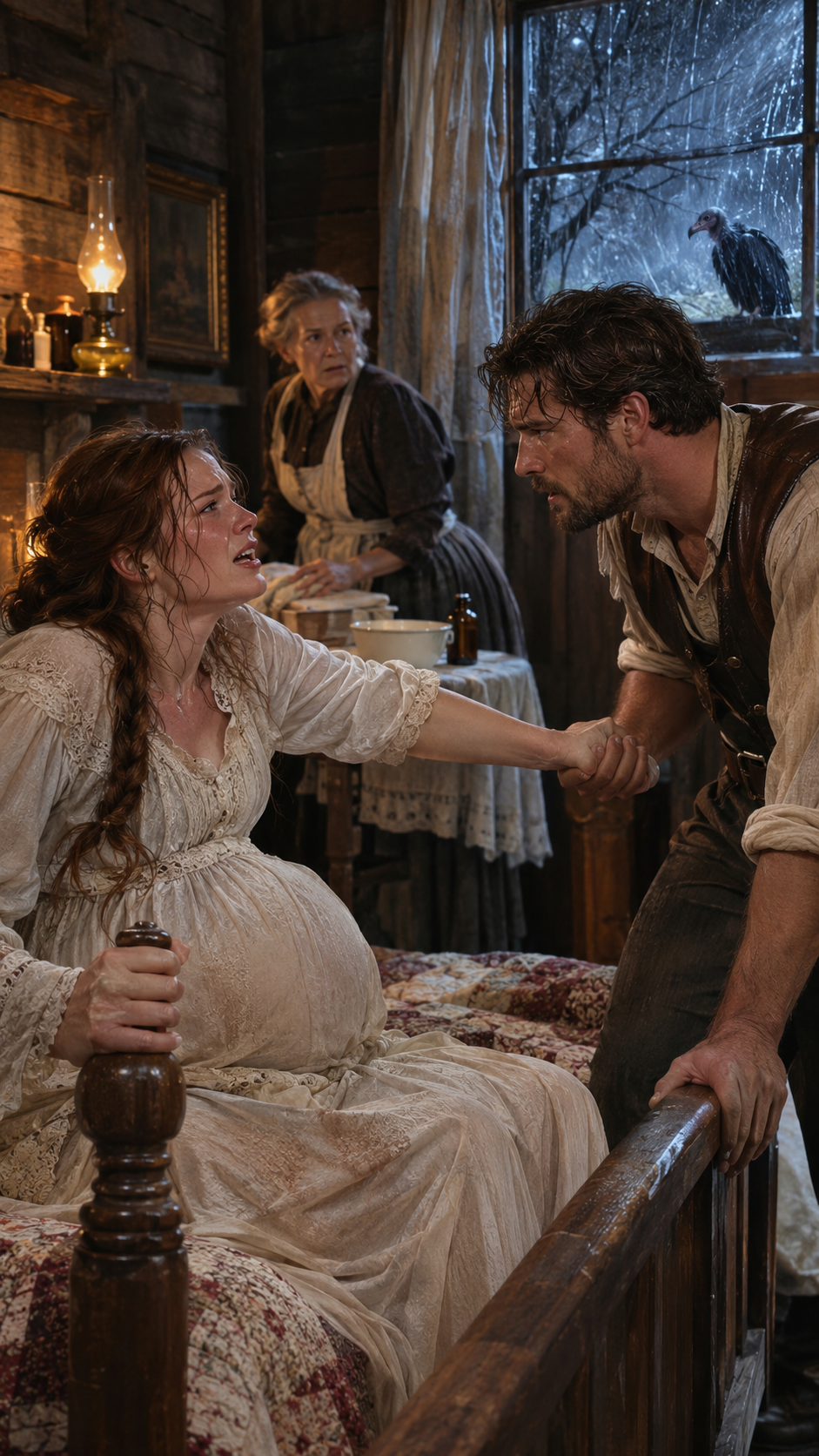
Part 3 – The Room That Remembered
Part 3
For three days, Silas refused to enter the east bedroom alone.
Magnolia noticed.
He would stand in the doorway, jaw tight, staring at the stove, the old cradle, and the boarded window.
Then he would find some reason to leave.
A fence needed checking.
A horse required shoeing.
A gate hinge suddenly became urgent.
Magnolia knew avoidance when she saw it.
She had practiced it herself for years.
After Robert Ashford abandoned her at the altar, Magnolia had stopped walking past churches whenever bells were ringing.
After the doctors told her she might never carry a child, she avoided parks where mothers pushed babies in carriages.
She had told herself those choices were practical.
They were not.
They were fear wearing sensible clothes.
On the fourth morning, Magnolia found Silas preparing to ride toward the north pasture.
She blocked the barn door.
Silas sighed.
“Move.”
“No.”
“I have work.”
“So does the east bedroom.”
“The chimney can wait.”
“The chimney waited for three generations.”
Silas looked away.
Magnolia crossed her arms.
It was a posture that had frightened more than one Philadelphia shopkeeper.
Silas remained unimpressed.
“I know what you’re doing.”
“Good.”
“I don’t want to talk about it.”
“I know.”
“That usually means you stop.”
“It usually means I begin.”
His mouth twitched despite himself.
Then the humor disappeared.
“My mother knew.”
Magnolia softened.
“Yes.”
“She knew.”
“We don’t know what she knew.”
“She hid a letter in the chimney.”
“She may have hidden it somewhere else and someone moved it.”
“Who?”
“I don’t know.”
“Exactly.”
He turned away.
Magnolia stepped closer.
“Silas.”
He rested both hands on a stall gate.
“My father spent his life believing his first child died because something followed this family.”
Magnolia listened.
“He wouldn’t say my brother’s name.”
“What was it?”
“Thomas.”
The word sounded strange in Silas’s mouth, as though it had been waiting years to be spoken.
“I found his wooden horse when I was seven. I asked who it belonged to. My father took it from me and burned it.”
Magnolia’s chest tightened.
Silas continued.
“He wasn’t cruel. Not usually. He was frightened.”
“There’s a difference between frightened and right.”
Silas looked at her.
She held his gaze.
“What did your mother believe?”
“I thought she believed the curse too.”
“Maybe she did.”
“Then why write that letter?”
“We find out.”
He gave a weary laugh.
“You make everything sound simple.”
“No. I make everything sound possible.”
That finally reached him.
By afternoon, Silas had sent for Gideon Pike, a retired mason who lived twelve miles south.
Gideon arrived the next morning with a leather bag of tools and a face deeply suspicious of all chimneys.
He was nearly seventy, small enough that Magnolia could have lifted him without difficulty, and entirely untroubled by her height.
He inspected the stove.
Then the pipe.
Then the fireplace above it.
Finally, he climbed onto the roof.
When he came down, soot covered his beard.
“Well?” Silas asked.
Gideon spat into the dirt.
“This chimney is older than honesty.”
“That bad?”
“Worse.”
He explained that the inner flue had cracked years earlier.
A later repair had narrowed the passage.
Another brick had fallen inward.
In certain winds, smoke would struggle to rise.
Some would remain inside.
“You’d smell it,” Silas said.
“Sometimes.”
“Sometimes?”
Gideon shrugged.
“Depends what’s burning and how badly it draws. A low fire can be more treacherous than a roaring one.”
Magnolia looked toward the house.
“Could it kill a newborn?”
Gideon’s expression lost its humor.
“Could kill a grown man if the room were closed tight enough.”
Silas sat down on the chopping block.
Nobody spoke.
The old family legend seemed to shift before them.
Not disappear.
Not yet.
But shift.
That afternoon, Magnolia carried her daughter—whom they had finally named Clara Miriam Thornwood—through the ranch house while Silas and Gideon dismantled part of the east wall.
Clara for Magnolia’s grandmother.
Miriam for Silas’s mother.
Silas had cried when Magnolia suggested it.
He pretended he had dust in his eye.
Magnolia reminded him he had used the same excuse when Clara was born.
The infant had already changed the house.
There were blankets everywhere.
Tiny stockings dried beside the stove.
Silas, who once insisted every tool have a proper place, now regularly discovered baby cloths in his pockets.
He claimed not to know how they got there.
Magnolia knew better.
At sunset, Gideon called them.
They entered the east room together.
A section of plaster had been removed.
Behind it lay the old brick flue.
Across several bricks were faint pencil marks.
Names.
Dates.
Measurements.
Children’s heights, Magnolia realized.
Generations of Thornwoods had been measured against that wall.
Silas touched one line.
SILAS – AGE 8.
Below it—
THOMAS.
No age.
Just the name.
Silas stared.
“My father never mentioned that.”
Magnolia moved closer.
Another line had been written lower on the wall in a different hand.
MIRIAM T. – DO NOT USE THIS ROOM WITH A FIRE.
Gideon removed his hat.
Silas reached out.
His fingers hovered over his mother’s warning.
“She knew.”
This time Magnolia could not argue.
“Yes.”
“Why didn’t she tell me?”
“Maybe she tried.”
They searched until dark.
Behind another section of plaster they found a small tin box.
Inside were three letters.
A photograph.
And a page torn from a diary.
The photograph showed a young woman Magnolia recognized immediately as Miriam Thornwood.
Beside her stood a man who must have been Silas’s father.
Between them was a little boy.
Thomas.
Silas sat on the floor.
For years his brother had been only an absence.
Now suddenly he had eyes.
Hair.
A solemn little mouth.
“He was alive long enough for a photograph.”
Magnolia knelt.
Silas turned the image over.
Two words were written on the back.
Four hours.
Silas’s expression changed.
“The story says every firstborn died before sunrise.”
“Four hours could still be before sunrise.”
“He was photographed?”
Magnolia understood.
Photography in the nearest town required preparation.
Unless the photographer had already been at the ranch.
Gideon pointed toward the diary page.
Silas unfolded it.
The writing was Miriam’s.
December 11.
Thomas was born shortly after midnight. Strong voice. Good color. Jacob held him by the fire and said the curse had been broken.
At three, Thomas became sleepy.
At four, his lips turned dark.
I carried him into the hall and he improved.
Jacob believed the hall was colder and returned him to the room.
By dawn he was gone.
Silas stopped.
He could not continue.
Magnolia read the final lines aloud.
The fire smoked all night.
I have told Jacob.
He says grief is making me invent reasons.
But I know what I saw.
Silas pressed the heel of his hand against his eyes.
Magnolia sat beside him.
For several minutes, neither spoke.
Finally he said, “My father brought him back.”
“Your father didn’t know.”
“My mother told him.”
“She suspected.”
“He didn’t listen.”
“That is not the same as wanting Thomas harmed.”
Silas looked at the photograph.
“No.”
The word was reluctant.
Pain rarely surrendered to logic quickly.
Magnolia understood that too.
That evening, they carried everything to the kitchen table.
Mrs. Bell joined them.
So did Gideon.
The four compared dates from the family Bible.
Three firstborn deaths.
Three winter births.
Three nights spent in the east bedroom.
No later Thornwood child had been delivered there.
After each death, the mother had refused to return.
The “curse” had a pattern.
Not blood.
Not birds.
A room.
Yet one question remained.
“The vulture,” Silas said.
Nobody answered.
Mrs. Bell poured coffee.
“Birds behave strangely around windows.”
“Three knocks?”
“People remember patterns after grief.”
“Every generation?”
“Stories improve with repetition.”
Magnolia smiled faintly.
Silas did not.
That night, Clara slept in a basket beside their bed.
Magnolia woke twice to find Silas leaning over her.
“She’s breathing,” Magnolia whispered.
“I know.”
“Then sleep.”
“I will.”
“You’re staring.”
“I’m checking.”
“Every two minutes?”
“Three.”
Magnolia reached out and pulled him back beneath the quilt.
In the darkness, Silas whispered, “I asked you for an heir.”
Magnolia opened her eyes.
“What?”
“The telegram.”
“I remember.”
“I wrote that I wanted a woman who could work the land and give me an heir.”
“You were not romantic.”
“I was worse than that.”
“You were lonely.”
“I made you sound like livestock.”
Magnolia was quiet.
Silas continued.
“I didn’t know you. I didn’t know whether you liked books or music or mornings. I didn’t know you laughed when you were angry. I didn’t know you hated turnips.”
“Everyone should hate turnips.”
“I thought I needed a wife for a purpose.”
His voice tightened.
“And now I look at Clara and think about all the people in this family who saw children as heirs before they saw them as children.”
Magnolia found his hand beneath the blanket.
“You changed.”
“Did I?”
“Yes.”
“When?”
She squeezed his fingers.
“The day you let me fix that gate without telling me I was too strong.”
He laughed quietly.
“That was the beginning?”
“It helped.”
Silence settled comfortably between them.
Then, from the other side of the house—
Tap.
Silas froze.
Tap.
Magnolia sat up.
Tap.
Three knocks.
The vulture.
Silas reached for the lamp.
Magnolia stopped him.
“No.”
“What?”
“We are not running toward a window every time a bird gets bored.”
Another tap came.
Not from the bedroom.
From the kitchen.
Magnolia lifted the lamp.
They walked together.
Clara slept in Silas’s arms.
At the kitchen window sat the black vulture.
In the moonlight, it looked almost silver around the neck.
It pecked once at the glass.
Then turned its head.
Something was tied around one leg.
Magnolia moved closer.
A narrow strip of faded cloth.
Blue.
Silas stared.
“I know that cloth.”
“From where?”
He disappeared into the hall.
When he returned, he held the photograph of his mother and Thomas.
Miriam Thornwood wore a blue ribbon around her collar.
Same color.
Same faded pattern.
Silas looked from the photograph to the bird.
“That ribbon belonged to my mother.”
Magnolia stared through the glass.
The vulture lifted its wings and vanished toward the dead cottonwood.
The following morning, they rode to see the only person still alive who might know why Miriam Thornwood’s ribbon had ended up tied around a vulture’s leg.
Esther Vale.
The elderly neighbor who had first warned Magnolia about the curse.
When Esther opened her door and saw the blue cloth in Silas’s hand, she did not look surprised.
She looked afraid.
“Where did you get that?”
“From the vulture.”
Esther closed her eyes.
Silas stepped forward.
“You know what this is.”
Esther said nothing.
“Mrs. Vale.”
At last she opened the door wider.
“Come inside.”
Silas did not move.
“Tell me.”
Esther looked at Magnolia.
Then at baby Clara.
Then finally at Silas.
“Your mother gave me that ribbon the night she died.”
Silas’s face drained of color.
Esther’s next words left him completely still.
“And she made me promise that if your first child survived until sunrise, I was finally to tell you the truth.”
**–END OF PART 3–CLICK “NEXT” AT THE BOTTOM OF THE PAGE TO CONTINUE READING**
✓ Lynn R. Adams
Part 3 – The Room That Remembered Part 3 For three days, Silas refused to enter the east bedroom alone. Magnolia noticed. He would stand in the doorway, jaw tight, staring at the stove, the old cr…