PART 3: The Gate Rose, but Emma Asked for Time 057
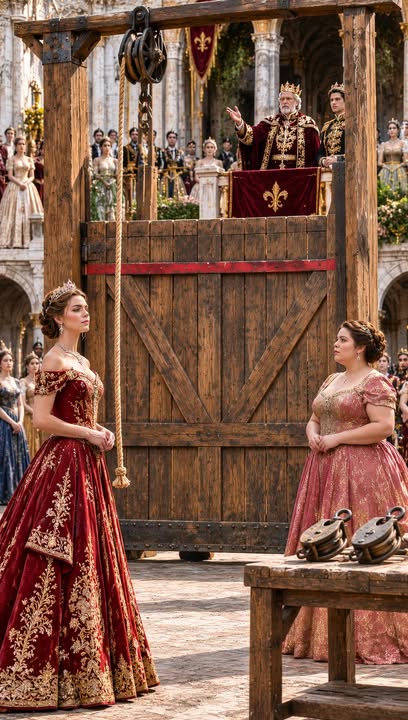
Part 3 – The Mark Beneath the Grease
“Then why,” Alexander asked quietly, “does it carry your father’s mark at all?”
Emma kept her eyes on the pulley.
The angled notch seemed to draw her backward through years of memory: her father at a workbench, sleeves rolled past his elbows, explaining how a small mark could tell a repairer whether a part had been checked.
“He inspected dozens of pieces in the palace,” she said at last. “A mark like this would tell him which ones he had fitted himself.”
“Would he have marked a spare pulley?” Alexander asked.
“If he repaired it, yes. But this one…” She turned it gently. “I don’t remember seeing it on the gate.”
The mechanic leaned closer, careful not to touch the wheel.
“Your father worked on the gate during the year the west hinge cracked,” he said. “He may have repaired a pulley as well.”
“He may have,” Emma replied. “I was young. I remember the workshop more clearly than every part he handled.”
She looked again at the newer line beside the old notch.
“But this second mark is different. It was cut later.”
Alexander glanced toward the mechanic.
“Could it be a storekeeper’s mark?”
“Not one I recognize,” the mechanic said. “The palace uses painted numbers for inventory. We don’t cut marks into the metal.”
Victoria had been standing behind them in silence.
Now she moved nearer, her expression guarded.
“Could the mark have been made during the challenge?” she asked.
The mechanic shook his head.
“Not without removing the wheel from the table and using a file.”
“Could someone have done that before we arrived?”
“It’s possible,” he said. “But I inspected both pulleys this morning. I saw no reason to examine the hubs closely.”
Victoria’s gaze settled on Emma.
“You think someone changed it to make it look as though your father had been here?”
“I don’t know what to think,” Emma said. “That is why I don’t want to guess.”
The answer seemed to unsettle Victoria more than an accusation would have.
Alexander asked the mechanic to wrap the pulley in a clean cloth and keep it in the royal workshop, where it could be examined without further handling.
He then sent for the palace clerk responsible for challenge equipment.
The clerk arrived with a slate in hand and a crease of worry between his brows.
“The spare pulleys came from the east storehouse,” he explained. “They were brought to the courtyard at dawn.”
“Who signed them out?” Alexander asked.
The clerk consulted his slate.
“Master Pell, the storekeeper.”
“Is he here?”
“He is in the lower stores, Your Highness.”
Alexander nodded to an attendant, who went to fetch him.
While they waited, Emma studied the pulley’s cloth wrapping.
She felt no triumph at the thought that it might connect her father to the gate.
If anything, the mark had opened a door she had hoped to find, only to leave her unsure of what waited behind it.
Her father had been accused of taking royal funds.
A mark bearing his hand might support her memories of his work, but it could also lead to evidence she had never wanted to see.
Alexander seemed to understand the uncertainty in her face.
“You don’t have to examine any records today,” he said quietly.
“I’ve waited years,” Emma replied. “But I don’t want to rush into a conclusion because I want it to be true.”
“Then we’ll take it one step at a time.”
Victoria shifted her weight.
“Perhaps this is only an old repair mark,” she said. “The pulley may have been stored for years.”
“That is possible,” Emma said.
Victoria looked relieved for half a moment, then seemed to notice the distance between them.
“I didn’t mean that your father had done anything wrong.”
“I know.”
The apology from the garden had not erased what Victoria had said in the courtyard, but Emma sensed that she was trying to choose her words more carefully now.
Master Pell arrived with the attendant.
He was a narrow-shouldered man in his late fifties, with silver hair brushed neatly back and a small leather ledger tucked beneath one arm.
When he saw the wrapped pulley on the table, his expression tightened.
“Do you know this piece?” Alexander asked.
“I know the inventory number,” Pell replied. “It came from the old stores.”
“Was it ever repaired by palace maintenance?”
“I couldn’t say without checking the records.”
“Then let us check them.”
The storekeeper opened his ledger and ran one finger down a column of entries.
“This pulley was listed as part of a set transferred from the west workshop,” he said. “The transfer was made fourteen years ago.”
Emma’s breath caught.
“My father was still working here then.”
Pell nodded.
“Yes, miss. The entry says the set was inspected before storage.”
“By whom?”
He searched the page.
“The name isn’t recorded. Only the maintenance department.”
“Would my father have been responsible?”
“He was one of the senior repair workers,” Pell said. “He could have been.”
Emma rested a hand on the edge of the table.
The possibility that her father had inspected the pulley felt almost more painful than reassuring.
If he had handled it, then the old mark was real.
But if someone had later added the second mark, what did that say about the reason the pulley had been brought out today?
“Did you know it was part of the challenge equipment?” Alexander asked.
“No, Your Highness. I was told to send two spare pulleys to the courtyard.”
“Who told you?”
Pell turned back a page in the ledger.
“I received the request yesterday afternoon. It carried the quartermaster’s seal.”
“Who brought it?”
“A palace runner. I don’t know his name.”
Alexander’s attention sharpened.
“Can we see the request?”
“I keep the signed requests with the inventory sheets.”
Pell found the folded paper tucked into the back of his ledger.
It bore the quartermaster’s seal and a short instruction to prepare two working pulleys for the royal challenge.
The signature at the bottom was difficult to read.
Emma leaned in, though she could not make it out.
“Is that the quartermaster’s hand?” Alexander asked.
“It appears to be,” Pell replied. “I can’t be certain. The office sends requests under his seal when he is away.”
“Was he away yesterday?”
“I believe he was inspecting the northern road.”
Alexander looked toward the clerk.
“Find out who delivered this.”
The clerk bowed and hurried off.
The king’s arrival quieted the remaining attendants.
He had been informed of the pulley and came directly from the palace, without the formal procession that usually followed him.
His expression was composed, but the concern in his eyes was plain.
“Emma,” he said, “I am sorry that your family’s old trouble has followed you into this courtyard.”
“It hasn’t followed me, Your Majesty,” she replied. “It was here before I arrived.”
The king accepted the correction with a small inclination of his head.
“Then we will look into it properly.”
He listened as Alexander explained the pulley’s marks, the old storage entry, and the unsigned certainty surrounding the request.
When he heard that Emma’s father might have inspected the wheel fourteen years earlier, his gaze softened.
“Your father served the palace for many years,” he said. “I remember his name, though I never knew him well.”
“He loved the work,” Emma said.
“I have no reason to doubt that.”
The king’s words were kind, but Emma could not let herself be comforted by them.
“Kindness is not proof,” she said.
“No,” he agreed. “It is not.”
The king ordered that the pulley and the request be placed in the archives under seal.
He also instructed Alexander to review the maintenance and payment records from the year Emma’s father had been dismissed.
“The inquiry must be impartial,” the king said. “No conclusion should be reached because the accused is your father, Emma, or because you have won a place in this palace.”
“I would ask for nothing less,” Emma replied.
The king studied her for a moment, then turned to Alexander.
“Make certain the archivist understands that the records are to be preserved exactly as they are found.”
Alexander bowed.
“Of course.”
The king departed to meet the ministers waiting in the audience hall.
Victoria remained in the courtyard after the others dispersed.
The last of the spectators had gone, and the challenge banners stirred in the afternoon breeze.
“May I speak with you?” she asked Emma.
Emma hesitated, then nodded.
Alexander stayed nearby but stepped toward the gate, allowing the two women a little privacy.
Victoria looked down at her gloved hands.
“I was angry when you won,” she said. “Not because you had done anything wrong, but because everyone had been watching me fail.”
“That must have been difficult,” Emma said.
“It was humiliating.” Victoria drew a slow breath. “But I made it worse by trying to make you feel small.”
Emma did not rush to reassure her.
Victoria continued.
“I was raised to believe that being admired was the same as being valued. I know that sounds foolish.”
“It sounds lonely,” Emma said.
Victoria looked up, startled.
For a moment, the bright confidence she wore like jewelry seemed to fall away.
“My father has spent years arranging the future he thinks I should have,” she said. “I thought winning the challenge would prove I could choose something for myself.”
“Did you want to marry Alexander?”
Victoria’s mouth opened, then closed.
“I wanted to be the sort of woman everyone expected to want him,” she admitted. “I’m not sure those are the same thing.”
Emma thought of her own answer to the king.
She had come to be heard, not to be given a crown.
“Then perhaps you still have a choice to make,” she said.
Victoria gave a faint, rueful smile.
“I suppose we both do.”
There was no sudden warmth between them, no easy forgetting of the insult in the courtyard.
But when Victoria offered her hand, Emma accepted it.
Victoria’s fingers were cool through the glove.
“Thank you for listening,” Victoria said.
“Thank you for saying what you meant.”
Later that afternoon, Alexander met Emma in the palace library.
The room was long and high-ceilinged, with shelves of bound records rising to a carved gallery.
Dustless sunlight fell across the reading tables, and the steady scent of leather and old paper made the palace seem older than its marble walls.
An archivist named Mr. Vale had arranged several boxes on a table.
He was a careful, quiet man who asked Emma to confirm her father’s full name before opening the first folder.
“Thomas Hale,” she said. “He worked in maintenance for nearly twenty years.”
Mr. Vale checked the label.
“I have the dismissal notice, two inventory lists, and a summary of the payment accounts for that year.”
Emma’s shoulders tensed at the mention of the payment accounts.
Alexander noticed.
“We can stop whenever you like,” he said.
“I don’t want to stop before we know what’s there.”
Mr. Vale opened the first folder.
The dismissal notice was the same document Emma had carried to the palace, though the original bore darker ink and a raised royal seal.
It stated that Thomas Hale had been removed from his post following an inquiry into missing maintenance funds.
No details were given.
The next sheet recorded the date his wages had ended.
Emma pressed her lips together.
She had once memorized that date without meaning to.
It was the day her mother had stopped lighting the small lamp in the kitchen before dusk, to save oil.
Mr. Vale turned to the inventory lists.
“Your father was assigned to the west gate, the water pumps, and several of the service lifts,” he said.
Emma bent over the page.
There were entries in a neat clerical hand, followed by brief notes in darker ink.
She recognized her father’s writing immediately.
The letters leaned slightly forward, and he made the number four with an open top.
“He wrote those notes,” she whispered.
Alexander stood beside her, giving her space to read.
One entry described a cracked wheel replaced at the west gate.
Another listed two lengths of iron chain and a wooden brace.
The dates matched the year she remembered her father spending long evenings at the palace.
“He came home with his sleeves smelling of oil,” Emma said. “My mother used to complain that he left marks on the kitchen towels.”
The memory brought a small smile to her face, then faded.
Mr. Vale removed another sheet from the folder.
“This is the payment summary,” he said. “It records a sum issued to Thomas Hale shortly before his dismissal.”
Emma went still.
The line was brief.
A payment of forty-two crowns had been entered beside her father’s name, dated three weeks before the dismissal notice.
Alexander read it twice.
“Was this marked as wages?” he asked.
“No,” the archivist replied. “It was listed separately under maintenance disbursements.”
Emma’s mouth had gone dry.
“Why would he receive that amount?”
Mr. Vale searched the pages beneath it.
“I don’t have the corresponding voucher in this folder.”
“Could it have been a reimbursement?” Alexander asked.
“It could have been,” said Mr. Vale. “But the line does not say.”
Emma stared at the entry.
Forty-two crowns.
Her father had once shown her a page of figures at the kitchen table, teaching her to add columns while her mother mended a coat.
She remembered the warmth of the lamp, the rasp of his pencil, the way he stopped when she asked why one amount had been crossed out.
He had told her that accounts were like machines: if a part did not fit, you had to find out where the strain was going.
She had not remembered that conversation for years.
“Did he tell you about the payment?” Alexander asked gently.
“No.”
“Did your family ever have forty-two crowns?”
Emma closed her eyes briefly.
“We had enough to pay rent and buy coal. Sometimes there was a little left over.”
“Could your father have been paid for additional work?” Alexander asked.
“I don’t know.”
She disliked how quickly uncertainty spread through her, how it seemed to find a place in every memory.
Her father had loved his work.
He had been proud of his careful hands.
But love and pride were not evidence, and neither was a daughter’s belief.
“I promised I would accept the truth,” Emma said. “I meant it.”
Alexander did not answer with reassurance.
He simply stood beside her while she studied the ledger again.
The payment entry had been written in the same hand as the other totals, but a narrow line beneath it appeared darker than the page around it.
Mr. Vale noticed Emma’s attention.
“That may be an ink correction,” he said. “The accounts were copied into this summary from an earlier register.”
“Where is the earlier register?”
“In the main archive, if it survived the transfer.”
“Can we look for it?”
“Yes, but it may take some time.”
Alexander turned to the archivist.
“Please search for every original ledger connected to maintenance disbursements in that year.”
Mr. Vale nodded.
“I’ll begin immediately.”
Before he left, Emma asked whether she could see the inventory entry for the gate repair again.
The archivist laid it beside the payment summary.
Her father’s name appeared in both records, though in different hands.
One showed the work he had performed.
The other showed money paid to him.
The two pages seemed to draw closer together on the table, though no one had moved them.
“I don’t want you to think I came here expecting everyone to agree with me,” Emma said.
“I don’t,” Alexander replied. “You have been more careful than most people would be.”
“I’m afraid carefulness won’t make the answer hurt less.”
“No,” he said. “But it may make it possible to trust the answer when we find it.”
Emma looked at him.
There was no easy promise in his expression, no attempt to rescue her from what the documents might say.
For that, she felt more grateful than she knew how to tell him.
The archivist returned after a short search with a thin bundle of folded papers.
“I found the gate repair voucher,” he said. “It was filed separately from the summary.”
Emma’s heart began to beat harder.
Mr. Vale placed the voucher on the table.
It bore a list of materials used to repair the west gate, including an iron pin, two lengths of chain, and a replacement wheel.
At the bottom, the total came to forty-two crowns.
The line for the person receiving the payment carried Thomas Hale’s signature.
Emma stared at it.
The signature looked like her father’s.
“That may explain the payment,” Alexander said.
“It may,” Emma replied.
Her relief did not arrive as she had imagined it.
The voucher suggested that her father had been paid for materials, exactly as he might have told her if he had wanted to explain.
But the signature could not answer why the account summary had connected the money to missing funds.
Nor could it explain the strange newer mark on the pulley.
Mr. Vale tapped the voucher lightly.
“The date is difficult to read,” he said. “It appears to be the seventeenth day of the month.”
The payment summary showed the twenty-first.
“That is four days apart,” Alexander observed.
“Perhaps the summary records the date the payment was entered rather than the date it was received.”
“It could.”
Emma leaned closer to the voucher.
At the lower edge, almost hidden beneath a fold, was a faded note in the margin.
She could make out only a few words.
“Gate… materials… west…”
Mr. Vale adjusted the lamp.
The writing remained faint.
“I’ll see whether the archive can lift the crease without damaging it,” he said.
“Please do,” Emma replied.
The archivist secured the voucher between two protective sheets and carried it to a side desk.
For a while, Emma and Alexander said nothing.
Beyond the library windows, evening light stretched across the palace gardens.
The day had begun with Emma pulling a gate open before hundreds of people.
Now she felt as though another gate had appeared in front of her, one she could not lift by strength or cleverness.
Alexander reached for the inventory sheet.
“Look at this notation,” he said.
Near the entry for the replacement wheel was a small symbol, a short diagonal cut drawn beside the number.
Emma’s breath caught.
“It resembles the mark on the pulley.”
“It may be a record of the same repair,” he said.
“Or a similar mark.”
She examined it carefully.
Her father had sometimes drawn the notch in the margin of his work notes to show that he had checked a part.
The symbol on the paper was slightly more upright than the one cut into the metal.
“Do you think the pulley was the wheel mentioned here?” Alexander asked.
“It could have been part of the same repair. But the entry calls it a replacement wheel, not a spare.”
Mr. Vale returned from the side desk.
“I can make out more of the note,” he said. “It says the materials were supplied through the royal stores, and that the payment was to be reimbursed after inspection.”
“Reimbursed by whom?” Alexander asked.
“The note does not name anyone. The original accounting register may.”
Emma turned back to the payment summary.
The sum beside her father’s name now seemed less like an accusation than a question written in a language she could not fully read.
“Can we see the original register tonight?” Alexander asked.
“I can search the next archive room,” Mr. Vale said. “But if the earlier books were moved, it may take several hours.”
“Then we’ll continue tomorrow,” Emma said. “I don’t want the papers handled carelessly because I’m impatient.”
Alexander gave her a look of quiet approval.
They had just gathered the loose sheets when the archivist’s assistant entered with a narrow, dust-covered book.
“I found this behind the lower shelf,” he said. “It was stored with the gate maintenance records.”
Mr. Vale took the book and examined its worn spine.
“This is older than the summary,” he said. “It may be the original register.”
He opened it to a page marked by a frayed ribbon.
Emma moved closer.
The handwriting was cramped but legible.
A line beneath Thomas Hale’s name recorded the forty-two crowns as payment for gate materials, matching the voucher.
Then, in the margin beside the entry, another note had been added in darker ink.
Mr. Vale bent nearer, his brow furrowing.
“What does it say?” Alexander asked.
The archivist’s finger followed the line.
“It reads, ‘Received in full by order of the treasurer.’”
Emma felt a chill move through her, though the library was warm.
The note did not prove her father had stolen anything.
It did not even say he had taken the money.
But the words made the payment sound final, as though someone had closed the account.
Mr. Vale turned the page and looked at the facing column.
“There is another entry here,” he said.
He leaned closer to the narrow script.
“This one is dated four days later.”
“What does it record?” Emma asked.
Mr. Vale’s expression changed.
“It appears to be a second payment of forty-two crowns,” he said. “The same amount, listed under your father’s name.”
Alexander looked from the page to the voucher.
“Was the first payment issued to him, and the second one too?”
The archivist turned the book toward the light.
“That is what the entry seems to say.”
Emma stared at her father’s name, written twice beside the same amount.
The first payment had been for materials used to repair the gate.
The second bore a tiny mark in the margin that she did not recognize.
And beneath it, in unfamiliar ink, someone had written the words:
“Outstanding balance transferred to the royal account.”
**–END OF PART 3–CLICK “NEXT” AT THE BOTTOM OF THE PAGE TO CONTINUE READING**
* * *
[PREVIOUS: PART 2](https://storyly.idolsgift.com/blog/part-2-the-gate-rose-but-emma-asked-for-time-057) | [NEXT: PART 4](https://storyly.idolsgift.com/blog/part-4-the-gate-rose-but-emma-asked-for-time-057)
✓ Lynn R. Adams
Part 3 – The Mark Beneath the Grease “Then why,” Alexander asked quietly, “does it carry your father’s mark at all?” Emma kept her eyes on the pulley. The angled notch seemed to draw her backward t…