PART 3: The Flame That Wouldn’t Bend 069
Part 3 – The Mark Beneath the Flame
“Did you say a crown over a wheel?”
Adrian’s question hung between them, quiet but suddenly weighted.
Elara set her teacup down.
“Yes,” she said. “Though I may have mistaken the shape.”
He turned from the window, his expression careful.
“Would you be willing to look at the holder with me?”
“If the candle is still in the ballroom.”
“It is.”
“And if the court has not already carried it away to examine it.”
“I asked the attendants to leave the arrangement untouched.”
Elara studied his face.
“You asked them before you knew about the mark.”
“I did.”
“Why?”
“Because the candle was the only part of the challenge I could not explain.”
He did not sound pleased with himself for admitting it.
That made Elara trust the admission more than she might otherwise have.
She rose and followed him back toward the ballroom.
The palace had grown quieter in the intervening minutes, though the great room remained bright with chandeliers and candlelight.
A few courtiers still lingered near the doors, speaking in low voices, and the royal attendants had begun to clear the refreshments from the side tables.
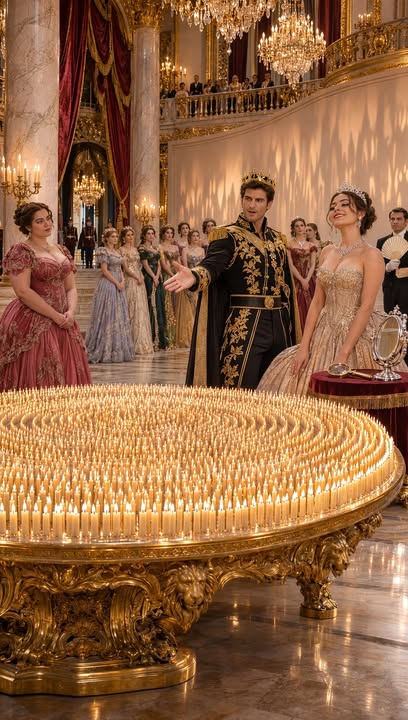
The ten thousand flames continued to burn across the circular table, no longer the center of a spectacle but an immense, patient sea of light.
An attendant stood beside the arrangement, waiting for instructions.
“Your Highness,” he said, bowing.
“The table remains as you requested.”
“Thank you, Tomas.”
Adrian looked to Elara.
“Would you show me which holder you meant?”
She approached the outer edge of the table, where the candles stood in orderly rings.
The candle she had identified seemed smaller now, its flame nearly lost among the many others.
Still, she recognized the brass holder, darkened at its base, with the slender glass guard curving around the wick.
“That one,” she said.
Tomas reached for a pair of heatproof gloves.
“I can lift it, if Your Highness wishes.”
“Please,” Adrian replied.
“Carefully.”
The attendant lifted the candle from its place and set it on a shallow tray.
Elara leaned closer without touching it.
From above, the glass guard was almost impossible to see.
A thin line caught the light when she shifted her head, then disappeared again.
Tomas turned the holder so that its base faced them.
There, just above the rim, was a worn stamp.
A small crown sat over a wheel.
The mark was shallow and softened by years of polishing, but Elara had remembered it correctly.
Adrian bent to inspect it.
“I know that symbol,” he said.
“Where have you seen it?” Elara asked.
“In my father’s study.”
He straightened, as if he had caught himself saying more than he intended.
“On a panel of old tools from the royal workshops.”
Tomas looked from the stamp to the prince.
“Then this must be one of the palace pieces.”
“Perhaps,” Adrian said.
“Could you check the inventory records for this holder?”
Tomas bowed.
“I’ll ask the storekeeper first thing in the morning.”
“Not the general inventory,” Elara said.
Both men looked at her.
“If the mark is worn, the record may not describe the candle by its stamp.”
She pointed to the brass stem.
“There may be an old number underneath, where the wax has gathered.”
Tomas turned the holder again and wiped its base with a clean cloth.
A small number emerged beside the stamp, scarcely more than a pair of lines.
“Thirty-seven,” he read.
“Or perhaps seventy-three.”
“It’s been rubbed almost away.”
“Thirty-seven,” Adrian said.
“I think.”
Elara watched him.
“You’ve seen that number before too?”
“I can’t say.”
His answer came too quickly to be quite comfortable, but he seemed equally uneasy with it.
“Will the storekeeper know?” Tomas asked.
“He may,” Adrian replied.
“Please make the inquiry discreetly.”
Tomas bowed again and carried the holder away.
Elara remained beside the table, her eyes following the candle’s flame.
“Do you think someone chose it because of the guard?” she asked.
“I don’t know.”
“Could it have been placed there by accident?”
“It could have.”
“Then why investigate it?”
“Because there are too many things I cannot answer.”
His gaze moved over the circles of candlelight.
“I was told the challenge had been used before, but no one explained where it began.”
“You said your mother set puzzles for you at supper.”
“Yes.”
“Was this one of hers?”
“I don’t remember.”
He said it with a strain that made the answer sound less like forgetfulness than a memory he had never learned how to approach.
Elara did not press him.
Across the ballroom, the champagne-gold noblewoman stood beside a tall window, speaking with a companion.
She had changed out of the poised certainty she had worn before her failed attempt.
Her hands were clasped, and she seemed to be listening more than talking.
When she noticed Elara watching, she looked away.
Adrian followed Elara’s gaze.
“Lady Celestine,” he said.
“She has not gone yet.”
“Perhaps she is waiting for you.”
“Why would she be?”
“I don’t know.”
Elara turned back toward the table.
“Neither do I.”
A soft scrape sounded behind them.
Lady Celestine had crossed the ballroom and stopped at a respectful distance.
For the first time that evening, the jeweled magnifying glass was nowhere in sight.
“Your Highness,” she said.
Then she looked at Elara.
“Lady Elara.”
Her voice was controlled, but not cold.
“I wanted to speak to you before the night ended.”
Elara inclined her head.
“Of course.”
Celestine drew a slow breath.
“What I said earlier was unkind.”
The words seemed difficult for her, though she did not avoid them.
“I was embarrassed after my own attempt failed, and I let that embarrassment become an excuse to make you smaller in front of everyone.”
Elara held her gaze.
“You didn’t make me smaller.”
“That doesn’t make what I said acceptable.”
“No,” Elara said.
“It doesn’t.”
The answer left Celestine with no easy path toward pretending the matter had been settled.
Her chin lowered slightly.
“I’m sorry.”
The apology was plain, without a smile asking Elara to reassure her.
Elara searched her expression for some hint of performance, but found only discomfort and a kind of stubborn honesty.
“I appreciate you saying that,” Elara replied.
“I’m not ready to forget it.”
“I wouldn’t expect you to.”
Celestine glanced toward the candle on its tray.
“May I see the holder?”
Adrian gestured to it.
Celestine leaned forward, careful not to touch the brass.
“The guard is very fine,” she said.
“Was it always part of the holder?”
“That’s what we’re trying to learn,” Adrian replied.
“Your family has old records, doesn’t it?” Elara asked.
Celestine’s eyebrows lifted a fraction.
“My family keeps records of its purchases and inheritances.”
“I don’t know whether that will help.”
“It might,” Adrian said.
“If you could ask someone to look for a reference to the royal workshops.”
Celestine studied him.
“Is this connected to the challenge, or to something older?”
“I’m not certain.”
“Then I would rather not tell my family to go searching for a mystery they cannot name.”
Her answer was measured, but Elara heard the caution beneath it.
Adrian nodded.
“That is fair.”
Celestine’s gaze moved to Elara.
“I have read about the palace lamp rooms,” she said.
“Not recently, but I remember a mention of them in an old household journal.”
“Do you know what was written?”
“No.”
“Only that the people who kept the lamps were responsible for repairs as well as cleaning.”
Elara had the curious feeling that Celestine was offering a fact, then waiting to see whether Elara would accept it as an olive branch.
“My mother worked there,” she said.
“So you told the prince.”
A brief silence followed.
Celestine’s face shifted.
“I’m sorry.”
“You already apologized.”
“I’m sorry for asking as if I had not heard.”
Elara was surprised by the distinction, and by the effort behind it.
“You don’t need to make every sentence perfect,” she said.
“No,” Celestine replied.
“But I should try to hear the person I’m speaking to.”
Something in Elara’s shoulders loosened, though not enough for trust to settle.
Adrian glanced between them.
“We could use another pair of eyes,” he said.
“Only if Lady Celestine wishes to help.”
Celestine looked taken aback.
“After what I said?”
“Precisely because of it,” Elara answered before Adrian could.
“If we’re trying to understand what happened, I would rather have someone here who knows how easily appearances can mislead.”
Celestine’s expression sharpened, then softened again.
“You think I know that because I failed?”
“I think you know it because you tried to make the answer look certain before it was.”
The words were not gentle, but neither were they meant to wound.
For a moment, the ballroom seemed to grow quieter around them.
Celestine accepted the truth with a small nod.
“That is fair.”
Adrian lifted the holder’s tray.
“If we are going to investigate it, the records office is still open.”
Elara looked toward the great windows.
The night had deepened, and the candles threw long gold reflections across the polished floor.
“It’s late.”
“The records keeper stays in the east wing until midnight,” Adrian said.
“I can ask him to find the old workshop ledgers.”
“You can ask,” Elara replied.
“But he may not want to take orders from someone who has just been announced as a possible bride.”
Adrian’s mouth tightened.
“You’re right.”
His answer carried no offense.
“Then I’ll go with you and explain that we’re looking for information about a palace object.”
Celestine raised an eyebrow.
“That may be the first time I’ve heard a prince say he should not rely on his title.”
“It won’t be the last, if I remember what I said.”
The records keeper, Master Fenwick, met them in the east wing with a small lamp in his hand and a wool shawl over his shoulders.
His room smelled of dust, ink, and old leather.
Shelves rose along every wall, crowded with narrow ledgers, rolled plans, and bundles of correspondence tied with fading ribbon.
He listened to Adrian’s request, then looked at Elara and Celestine.
“An old brass holder, marked with a crown above a wheel?”
“Yes,” Adrian said.
“Possibly number thirty-seven.”
Master Fenwick adjusted his spectacles.
“The workshop mark changed its design twice in the last century.”
“Do you know which version it is?” Elara asked.
“Not from that description alone.”
He crossed to a tall cabinet and ran a finger along the ledger spines.
“Old royal workshop records are kept by year, not by object.”
“That was sensible at the time,” he added, “though it rarely feels so when one needs a particular answer.”
He selected three volumes and carried them to a broad table.
The pages were thin and yellowing, written in several different hands.
Adrian stood at the head of the table, while Elara and Celestine took the two chairs beside it.
Master Fenwick opened the first ledger.
“This one covers repairs made during the late queen’s reign,” he said.
“If the holder was already old by then, we may find it mentioned.”
Elara looked down at the entries.
The neat columns recorded date, object, work completed, and the name or initials of the person who had requested it.
She knew the familiar abbreviations for wick trimmers, lantern hooks, and glass chimneys.
She had copied such lists as a girl, sitting at a small desk while her mother worked nearby.
“Could I see that page?” Elara asked.
Master Fenwick moved the ledger toward her.
She read the entries slowly.
A cracked sconce repaired.
Two brass lamps polished.
A dozen candle cups fitted with new collars.
Nothing about the holder.
The second ledger brought no better luck.
By the time they reached the third, the room had grown warmer from the small stove and the concentration of four people leaning over paper.
Celestine rubbed her temple.
“I’m beginning to understand why you tried a magnifying glass.”
“It didn’t help you,” Elara said.
“No,” Celestine replied.
“But it made me feel as though I had a plan.”
Elara looked at her, and Celestine gave a rueful half-smile.
“I suppose that isn’t the same as having one.”
“No.”
Their eyes met over the open ledger.
This time, Celestine did not look away first.
At last, Elara found an entry in a narrow column that had been crowded close to the binding.
The ink had faded, but the words remained legible.
“Repair to holder, workshop mark thirty-seven,” she read.
“Glass shield reseated and brass collar tightened.”
Adrian bent over her shoulder.
“Do you see a name?”
“Not on this line.”
Elara turned the page carefully.
“There’s a continuation here.”
Master Fenwick leaned closer.
“Ah.”
The next line began beneath the date, written in a different hand.
“Requested by—”
The name had been smudged where the page had once caught against something damp.
Elara tilted the ledger toward the lamp.
“Can you read it?” Adrian asked.
“Not all of it.”
She followed the remaining strokes.
“The first letter may be an M.”
The next seemed to be an a, though its tail had almost disappeared.
Celestine moved closer but did not touch the page.
“Could it be a family name?”
“It could,” Elara said.
“Or a first name.”
Master Fenwick turned to a small index at the back of the ledger.
“The requests were usually filed under the household member who made them,” he said.
“If the name is incomplete, the date may help.”
He checked the index, then searched the list beneath the letter M.
“Marian,” he said at last.
“Marian Vale.”
Elara’s fingers went still on the edge of the page.
Adrian looked at her.
“Your mother?”
“My mother’s name was Marian Vale.”
The room seemed to contract around the table.
Elara had heard that name spoken often in the servants’ quarters, but never beside a royal workshop mark.
She leaned closer to the ledger, searching for a second entry that might confirm it.
There was one.
The repair had been requested eight years before Elara was born.
A note in the margin read: “Protective glass to remain with holder; commission approved.”
“Your mother requested the glass guard,” Adrian said.
“Yes.”
The words came out quietly.
Elara looked at the line again, as if the letters might rearrange themselves into something less personal.
Her mother had repaired lamps throughout the palace.
There was nothing strange in her name appearing in a maintenance ledger.
Yet this was not a loose chimney or a new wick.
She had asked to preserve the very feature that made the candle behave differently from every other flame.
Celestine’s expression had lost its practiced composure.
“Could your mother have known that holder would be used in the challenge?” she asked.
“I don’t know.”
Elara kept her eyes on the page.
“She might have repaired it long before the challenge was imagined.”
“Then why record that the glass should remain?” Adrian asked.
“Because it was useful,” Elara replied.
“Because it protected the wick.”
“That could be all.”
She heard the uncertainty in her own voice.
Adrian did not try to answer for her.
Master Fenwick turned another page.
“I can find no later repair record for that holder.”
“So the guard is old,” Celestine said.
“It was not added for tonight.”
The discovery should have relieved Elara.
Instead, it made the question feel closer to her.
Her mother had not placed the candle on the table that evening, but she had helped shape it decades earlier.
Why this holder?
Why that particular repair?
And why had Adrian’s father chosen to use a candle arrangement whose most important detail had been preserved by a woman who worked in the lamp rooms?
Master Fenwick closed the ledger.
“His Majesty may know more about the workshop mark,” he said.
“The old royal seal was often used on objects made for the queen’s apartments.”
Adrian’s jaw tightened.
“My father knows the seal.”
“Then he may know whether the holder was part of the challenge before tonight,” Elara said.
“Perhaps.”
“Will you ask him?”
“I will.”
The answer came after a pause.
Celestine watched him carefully.
“Your father asked you to join him earlier,” she said.
“What did he say?”
“That the challenge should remind the court to look beyond appearances.”
“That sounds reasonable.”
“It did.”
Adrian looked down at the closed ledger.
“But?”
“But I’m beginning to wonder whether he chose the words carefully because he wanted us to hear them.”
Elara felt the old unease return.
“Did he know the holder was there?”
“I don’t know.”
“You don’t have to protect him from a question,” she said.
Adrian lifted his eyes to hers.
“I’m not trying to protect him.”
“Then what are you trying to protect?”
For a moment, he looked very young beneath the candlelight.
“The part of my mother’s memory I can still trust.”
No one at the table answered.
Elara understood too well how a person could become less a person and more a collection of stories others repeated about them.
Her mother had been a name on a page until tonight.
Now she was part of a mystery that might reach into the royal family.
Adrian looked toward Master Fenwick.
“Would you make a copy of the entry?”
“Of course.”
“And keep the ledger here until I return?”
The records keeper nodded.
“I’ll leave it in the cabinet.”
Elara stood.
“I should go back to the lamp room.”
“You’ve done enough for tonight,” Adrian said.
“I still have work to finish.”
He seemed about to object, then stopped himself.
“Of course.”
Celestine rose as well.
“May I walk with you?”
Elara hesitated.
“You don’t have to.”
“I know.”
The answer was quiet and matter-of-fact.
“I would like to.”
Elara looked to Adrian.
He offered no suggestion, only a small nod that left the decision to her.
“All right,” she said.
Celestine waited while Elara gathered her shawl from the chair.
As they left the records room, Adrian remained behind with Master Fenwick, already asking what other workshop books might mention the holder.
The corridor was dimmer than the ballroom, its lamps spaced far apart.
Celestine walked beside Elara without trying to fill the silence.
At the turn toward the servants’ passages, she spoke.
“I did not expect to learn that tonight.”
“Neither did I.”
“Does it change what you think about the challenge?”
“I don’t know.”
Elara rested one hand on the rail as they descended the narrow stairs.
“My mother repaired a holder.”
“That does not prove she had anything to do with the challenge.”
“No.”
“But you think she might have.”
“I think she may have known more about it than I did.”
Celestine nodded.
“Would you want her to have been involved?”
The question followed Elara down the stairwell.
She pictured her mother in the lamp room, sleeves rolled back, a small tool in one hand and a patient frown on her face.
She remembered being little enough to sit on an overturned crate while Marian taught her how to trim a wick without breaking it.
“I want to know what she believed she was doing,” Elara said.
“That isn’t the same as wanting her to have been part of the challenge.”
“No.”
Celestine did not ask another question.
At the lower landing, she stopped.
“I should return to the ballroom.”
Elara turned toward her.
“Thank you for walking with me.”
“You’re welcome.”
Celestine seemed to consider the words she had offered earlier.
“Your answer about the candle was better than mine.”
“That doesn’t make you a bad person.”
“I didn’t ask whether it did.”
“No,” Elara said.
“But you looked as though you had.”
A small, surprised laugh escaped Celestine.
“I suppose I did.”
She straightened, and for a moment her old elegance returned, though without its earlier sharpness.
“I would like to help with the records tomorrow, if you’ll allow it.”
“I’ll think about it.”
“That’s fair.”
Celestine inclined her head and went back up the stairs.
Elara continued alone.
The lamp room was empty when she entered.
She set her shawl on the worktable and lit a small wick lamp, its modest flame steady in the still air.
The ledger’s words followed her.
Marian Vale.
Glass shield to remain.
She had known her mother’s hands, her voice, the way she hummed when she worked.
She had not known that Marian’s name lay in the palace records beside a royal mark.
A knock came at the door.
Elara turned, expecting Marta.
Instead, King Rowan stood in the doorway, his expression composed but his eyes fixed on the lamp burning on the table.
“Elara,” he said.
She curtsied.
“Your Majesty.”
“I hope I am not interrupting.”
“No, Your Majesty.”
He stepped into the room and glanced at the tools she had arranged.
“I have just come from the records office.”
Elara’s fingers rested against the table’s edge.
“Then you know what we found.”
“I do.”
The king’s voice held no anger.
That was almost more unsettling than anger would have been.
“You knew my mother had repaired the holder.”
“I knew she worked on it, yes.”
“Did you know she requested that the glass guard remain?”
“I did.”
Elara searched his face.
“Why?”
The king drew a quiet breath.
“Your mother was careful with the palace’s old objects.”
“She often saw uses for them that others had overlooked.”
“That does not answer why this one was kept.”
“No,” he said.
“It does not.”
He crossed to the lamp on the table but did not touch it.
“Your mother was a thoughtful woman.”
“What else did she do?”
The king looked at the flame.
For the first time, his composure seemed to falter.
“More than most people knew.”
Elara waited.
His gaze moved from the lamp to her face.
“Some things are better understood in their proper order,” he said.
“Your Majesty,” she replied, “I have been told that before.”
A flicker of regret crossed his expression.
“I can see why you would be tired of hearing it.”
“Are you going to tell me what she did?”
“Not tonight.”
He started toward the door, then paused.
“Elara, the challenge was never intended to put you in an uncomfortable position.”
“Then why did you allow it to become a contest for a bride?”
The king turned back.
He did not answer at once.
“I believed the court needed a public measure of judgment,” he said.
“And I thought the tradition would honor the queen.”
“Did you ask what she would have wanted?”
The question landed gently, but the king went still.
“I thought I knew.”
Elara held his gaze.
“And now?”
His eyes dropped to the lamp flame.
“Now I am not so certain.”
A footstep sounded in the corridor behind him.
Adrian appeared at the doorway, a folded paper in his hand.
“Father,” he said.
The king glanced at the paper.
“What is that?”
“A copy of the ledger entry.”
Adrian stepped into the room and handed it to Elara.
She looked down.
The workshop mark had been drawn beside the words in Master Fenwick’s careful hand.
A second note appeared beneath the copied entry, one that Elara had not seen in the original ledger.
The records keeper had added it from the index.
“Additional papers filed under Marian Vale,” she read.
“See correspondence concerning the queen’s candle lesson.”
The lamp’s flame trembled as a draft slipped beneath the door.
Elara looked up at Adrian.
The king’s face had gone pale beneath its calm.
And for the first time, he seemed less troubled by the name of the holder than by the words that came after it.
**–END OF PART 3–CLICK “NEXT” AT THE BOTTOM OF THE PAGE TO CONTINUE READING**
* * *
[PREVIOUS: PART 2](https://storyly.idolsgift.com/blog/part-2-the-flame-that-wouldn-t-bend-069) | [NEXT: PART 4](https://storyly.idolsgift.com/blog/part-4-the-flame-that-wouldn-t-bend-069)
✓ Lynn R. Adams
Part 3 – The Mark Beneath the Flame “Did you say a crown over a wheel?” Adrian’s question hung between them, quiet but suddenly weighted. Elara set her teacup down. “Yes,” she said. “Though I may …