PART 3: The Dance That Remembered 070
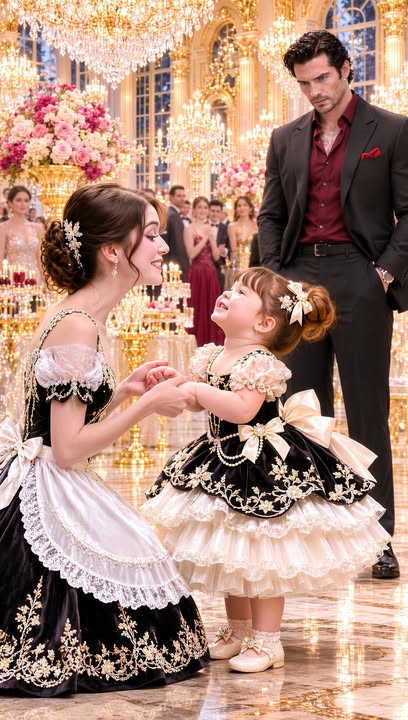
Part 3 – The Photograph Between Them
The name on the note stayed with me long after I set it down.
Elena.
I traced the faded letters with one finger, careful not to smudge the ink, and wondered how long my mother had carried the name in silence.
The ribbon beside the note was pale blue, soft with age, and threaded through a tiny silver bead shaped like a crescent moon.
I had seen it before.
Not in a photograph, but in my own memory: a glimmer at my mother’s wrist as she hummed and showed me how to turn.
I sat at the kitchen table until the room grew cold around me.
The next morning, I called my supervisor and asked if I could leave early after my shift.
She listened to the explanation that I had been invited to give Sofia a dance lesson, then made a sound that was half sigh and half laugh.
“Emily, you were hired to serve champagne, not become a private dance instructor for the Morettis.”
“I know.”
“And you still want to go?”
I looked at the note beside my coffee.
“Yes.”
There was a pause.
“Then I’ll cover your last hour,” she said. “But keep your boundaries clear.”
“I will.”
“And if anything feels uncomfortable, you leave.”
“I promise.”
That afternoon, I returned to the hotel in a simple dress and flat shoes, carrying no tray and wearing no uniform.
It felt strange to enter through the main doors as a guest, even though I wasn’t one.
A member of the staff escorted me to a quiet reception room overlooking the gardens, where Sofia waited beside a small portable speaker.
She had changed out of her gala gown and wore a soft gray sweater and dark trousers.
When she saw me, her face brightened.
“You came.”
“I said I would.”
“I know, but people say things when they’re being polite.”
“I try not to.”
She smiled and reached for the speaker.
“I asked Dad if we could use this room. He said it was quieter than the ballroom.”
“Does he know I’m here?”
“He asked the hotel staff to show you in.”
Sofia’s answer was simple, but I noticed the careful way she said it.
She was still trying to understand her father’s feelings about the dance, and perhaps mine.
“Before we start,” I said, “I want to be sure you’re doing this because you want to, not because you think you need to remember something.”
Sofia considered that.
“I want to learn it because it feels like a part of my mother I can touch.”
Her words reached me more deeply than I expected.
“Then we’ll take our time.”
She set the speaker down and took her place on the open stretch of carpet.
I showed her the steps my mother had taught me, beginning with the easy ones: a measured step to the left, a pause, a gentle shift of weight, then a turn.
Sofia watched each movement carefully.
She was earnest and quick to learn, though she sometimes moved too fast, eager to get to the part she remembered.
“Don’t rush the turn,” I told her. “Let the music arrive first.”
“What if I can’t hear it?”
“You don’t have to hear it with your ears.”
I tapped the rhythm against my palm.
“Sometimes you feel it here.”
She placed her hand lightly over her chest, then laughed at herself.
“That sounded like something my mother would say.”
“Maybe she would have.”
Sofia tried the sequence again, this time with smaller steps.
When she reached the moon turn, her hand rose above her head and circled her wrist with a tenderness that seemed to surprise her.
She stopped.
“That felt familiar.”
“Do you remember the movement?”
“No. But I remember being safe.”
She lowered her hand and looked at me.
“Do you think your mother ever danced it with my mother?”
“I don’t know.”
“Could you ask her?”
The question opened a quiet ache in me.
“I wish I could.”
Sofia’s expression softened.
“I’m sorry.”
“It’s all right.”
She didn’t insist that it was, and I was grateful.
We worked for nearly an hour.
By the time we finished, she could move through the first part of the routine without looking down at her feet.
Her smile grew more confident with each attempt.
“You’re a good teacher,” she said.
“I’ve had good students.”
“Have you taught anyone else?”
“Not really.”
“Then I’m honored to be your first.”
I laughed, but the words stayed with me.
When we left the reception room, Vincent was waiting in the corridor.
He wore a charcoal suit without a tie, and the careful set of his shoulders made him seem less like a man at a gala and more like a father who had been trying not to hover.
“How did it go?” he asked Sofia.
“I learned the moon turn.”
“Already?”
“Emily is a good teacher.”
Vincent looked at me.
“Thank you for coming.”
“She did the work,” I said. “I only counted.”
Sofia gave him a playful look.
“She’s being modest.”
Vincent’s smile appeared briefly, then faded as he glanced at my hands.
I had brought the blue ribbon and note in my coat pocket.
I hadn’t planned to show him.
But I had spent the whole lesson wondering what he would recognize, and the longer I waited, the more the secret seemed to belong to all three of us.
“There’s something I found,” I said.
Vincent’s expression sharpened, not with suspicion but attention.
I took out the note and ribbon.
He read the two lines once, then again.
“For Emily, when she’s old enough to ask about the moon turn,” he murmured.
Sofia leaned closer.
“Your mother left that for you?”
“Yes.”
Vincent touched neither the paper nor the ribbon.
“May I ask where you found it?”
“In a box of her photographs.”
“Did you find anything else?”
“Not yet.”
The small crescent bead caught the light.
Sofia drew in a breath.
“Mom wore one like that.”
“Are you sure?” I asked.
“I think so.”
She looked at her father, seeking confirmation.
Vincent studied the bead.
“Elena had a bracelet with a small silver moon,” he said. “She wore it for years.”
My fingers closed around the ribbon.
“Then they knew each other.”
“It seems likely,” he replied.
His tone was careful, but his gaze had turned distant.
Sofia looked between us.
“Why would they keep it a secret?”
“Perhaps it wasn’t a secret,” Vincent said. “Perhaps they simply lost touch.”
“Then why did Mom never tell you?”
He looked toward his daughter.
“Your mother shared what she wanted to share. I didn’t ask her to explain every part of her life.”
“That doesn’t answer the question.”
“No,” he said quietly. “It doesn’t.”
I felt the space between us change.
Until then, I had thought of the mystery as a path leading toward something we might uncover together.
Now I could sense that every discovery would touch parts of Vincent’s marriage that had never been mine to examine.
“I don’t want to make this harder for you,” I said.
Vincent’s eyes met mine.
“I asked you to look.”
“You asked me to see whether there was a connection. You didn’t ask me to bring up painful things.”
“Sometimes those are the same thing.”
Sofia rested one hand on the ribbon.
“I want to know,” she said. “Not because I want to upset Dad. I just want to know why I remember being held while someone hummed the dance.”
Vincent covered her hand with his.
“You have every right to ask.”
Sofia looked surprised by the answer, as if she had expected him to resist.
“I don’t know what we’ll find,” he continued. “But we can look at it together, if Emily is willing.”
I glanced at the note.
“I’ll search the rest of the box.”
He nodded.
“Thank you.”
The next few days took on an unusual rhythm.
I worked my shifts at the hotel, and when Sofia had time, we practiced in the same quiet room.
The dance grew clearer as we repeated it.
My mother had taught me only fragments, but those fragments fit together more naturally than I expected.
A side step became a slow sway.
The sway became a turn.
The moon turn led into a brief pause where the dancer’s hand rested near the heart.
Sofia never tried to force a memory.
She allowed the movements to speak for themselves.
Sometimes she laughed when she stepped on her own feet.
Sometimes she became so quiet that I stopped counting and let her listen to the room.
Vincent did not join the lessons, but once or twice I saw him watching through the open doorway.
He never interrupted.
After the third lesson, he asked if I had found anything else in my mother’s belongings.
“Not yet,” I told him.
“I don’t want you to feel pressured.”
“I appreciate that.”
“I mean it.”
“I know.”
It was the first time I believed him without having to remind myself that he was a powerful man.
The same evening, Sofia asked me if I had ever wanted to teach dance.
“I wanted to,” I said. “When I was younger.”
“What stopped you?”
“Money, mostly. I worked while I was in school, then after my mother died I needed a steady job.”
“You could still teach.”
“Maybe.”
“You should.”
“I wouldn’t know where to start.”
“Start with me.”
She said it so simply that I couldn’t help smiling.
“Maybe I will.”
A week after the gala, my supervisor gave me the following afternoon off.
I went home and pulled the photograph box from the closet again.
This time, I went through it slowly.
I sorted the pictures into small piles by year, looking at the backgrounds as carefully as the faces.
There were a few of my mother at charity events, dressed in a dark blouse or a simple skirt, always standing slightly to the side of the group.
She had rarely spoken about those years.
In one photograph, she stood beside a woman with dark, wavy hair.
I nearly passed it over.
Then I noticed the woman’s hand resting on my mother’s shoulder.
Around her wrist was a narrow bracelet with a small silver moon.
I brought the picture close to the window.
The woman was younger than I remembered anyone looking in old photographs, but the face was unmistakable.
Elena.
The date printed on the back was blurred, though the year remained legible.
It had been taken long before I was born.
A charity performance, the back of the photograph said.
I sat down hard on the edge of the chair.
There was no note about where the performance had taken place or who else had been there.
Still, the photograph showed them together, smiling as if the world were simple.
My mother’s wrist was turned toward the camera.
A matching bracelet circled it.
The next day, I brought the photograph to the hotel.
I found Vincent and Sofia in the reception room, where Sofia was attempting the whole sequence without my help.
When she spotted me, she grinned.
“I nearly got it.”
“You did,” I said. “You only rushed the last turn.”
She saw the photograph in my hand and came closer.
“Is that your mother?”
“Yes.”
“And the other woman?”
“Elena.”
Vincent stood very still.
I placed the photograph on the table.
He leaned over it, studying the two young women.
For a moment, the polished calm he wore around other people fell away.
His fingers hovered above Elena’s face, then stopped.
“She looks happy,” Sofia said.
“She was,” Vincent replied.
The words were tender, but there was a quiet sadness beneath them.
He examined the matching bracelets.
“I remember this one.”
“Did Elena tell you who made them?” I asked.
“No.”
“Did she ever mention my mother?”
He lowered himself into a chair.
“No.”
Sofia sat beside him.
“Do you remember when they lost touch?”
Vincent took his time before answering.
“Elena disappeared from my life for a while before we married.”
The room seemed to grow still.
“What do you mean, disappeared?” Sofia asked.
“She left New York for several months. She told me she needed time to settle something from her past.”
“Did she say where she was going?”
“Not exactly.”
“Did you know my mother was with her?” I asked.
“No.”
His gaze returned to the photograph.
“I assumed she had gone to see old friends. She came back, and we married later. I never asked her to explain the months she was away.”
“Why not?” Sofia asked.
“Because she seemed relieved to be home, and I believed that was enough.”
He paused.
“Perhaps I thought asking would take something from her.”
Sofia’s hand found his on the table.
“And now?”
“Now I wish I had asked.”
I understood the shape of his regret.
It wasn’t that he had failed to guess the right secret.
It was that he had once loved Elena enough to give her privacy, and now had no way to know what that privacy had held.
I looked down at the photograph.
The date was several years before Sofia’s birth.
“Was this before you met?” I asked.
“No,” Vincent said. “I knew Elena by then. We were together.”
“Then why would she leave without explaining?”
He looked at me, and for the first time I saw uncertainty turn carefully into caution.
“I don’t know.”
The honesty was not comforting.
It was only honest.
Sofia turned the photograph toward herself.
“Mom wore the same bracelet as your mother.”
“Yes.”
“Maybe they made them together.”
“Maybe.”
“Did you ever see Elena wear it after she came back?”
Vincent’s eyes narrowed slightly, as though searching an old memory.
“I don’t remember.”
The silence that followed was not empty.
It was full of details none of us could reach.
A soft knock sounded at the door, and a hotel attendant announced that a retired musician had arrived to speak with Vincent.
Vincent rose.
“I asked him to come,” he explained. “He played at the gala for years and knew Elena.”
“Can we stay?” Sofia asked.
“Of course.”
The musician was an elderly man named Mr. Bellini, with silver hair and a careful manner.
He greeted Sofia warmly, then noticed the photograph on the table.
His face changed.
“Where did you find that?”
“It belonged to my mother,” I said.
He leaned closer, but did not pick it up.
“I remember that night.”
“You do?” Vincent asked.
“Very well. Elena had asked for a particular tune, something gentle enough to dance to with a child.”
Sofia sat forward.
“A child?”
Mr. Bellini glanced at Vincent.
“I assumed it was a niece or a friend’s little one. Elena didn’t explain.”
Vincent’s expression tightened.
“Was the child there that night?”
“Not at the performance. Elena spoke about her earlier.”
“What did she say?” Sofia asked.
Mr. Bellini folded his hands over the top of his cane.
“She said there was a young girl she wanted to protect.”
The words seemed to settle over the room.
I looked at Vincent.
His attention had sharpened, though he made no move to interrupt.
“Did she say who the girl was?” I asked.
“No. She only said she hoped the child would grow up with a chance to be ordinary.”
Sofia’s fingers curled around the edge of the photograph.
“How old was the girl?”
“Very young, I think. Elena said the child was little enough to be carried.”
Vincent’s face had gone pale again, but this time he did not look at me as if I had summoned a ghost.
He looked as if he were listening for a voice he had once failed to hear.
“Did she say anything else?” he asked.
Mr. Bellini seemed to search his memory.
“She told me she had a friend she trusted with the child.”
The room grew quiet.
“A friend?” I repeated.
“That was the word she used.”
Vincent looked at the photograph of Elena and my mother, their matching bracelets bright against their wrists.
He seemed to be seeing the picture in a new way.
“What else did she say?” Sofia asked.
Mr. Bellini’s eyes moved to her face.
“Only that her friend had promised to keep the girl safe.”
Sofia glanced at her father.
“Dad?”
“I don’t know what it means,” Vincent said.
But his voice held none of the certainty he had shown at the gala.
I reached for the photograph, then stopped.
The image had once seemed like proof of a friendship.
Now it felt like the first page of a story none of us remembered being told.
A story involving a young girl, an absent mother, and the woman whose lullaby my mother had passed on to me.
The question that had followed me since the ballroom suddenly seemed too small.
It wasn’t only how my mother had learned the dance.
It was what she had been trusted to protect.
**–END OF PART 3–CLICK “NEXT” AT THE BOTTOM OF THE PAGE TO CONTINUE READING**
* * *
[PREVIOUS: PART 2](https://storyly.idolsgift.com/blog/part-2-the-dance-that-remembered-070) | [NEXT: PART 4](https://storyly.idolsgift.com/blog/part-4-the-dance-that-remembered-070)
✓ Lynn R. Adams
Part 3 – The Photograph Between Them The name on the note stayed with me long after I set it down. Elena. I traced the faded letters with one finger, careful not to smudge the ink, and wondered how…