PART 3: The Card at the Window 055
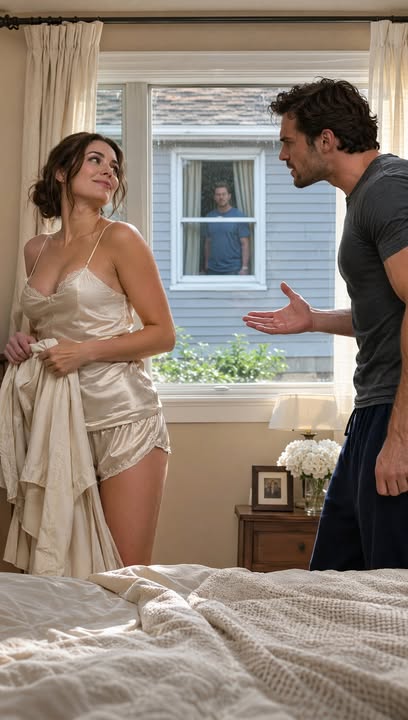
Part 3 – The Photograph Between Them
“My name,” my wife repeated, barely above a whisper.
Martin nodded and drew his hand back from the envelope.
“I don’t know why Claire wrote it there,” he said. “I only know the note was tucked behind the photograph.”
My wife looked at me, and I felt her fingers find mine beneath the coffee table.
Martin opened the envelope carefully, as if the paper inside might crumble at the slightest hurry.
He drew out a photograph, its edges softened by time, and placed it on the table between us.
The image showed two young women standing beside a wooden fence beneath a tree heavy with leaves.
One had dark, wavy hair and a serious expression that my wife recognized at once.
“That’s my mother,” she said.
The other woman was shorter, with a wide, bright smile and one hand resting on Elaine’s shoulder.
“Claire,” Martin said.
My wife studied the picture without touching it.
Her mother looked younger than she had ever seen her, younger even than in the few photographs from before her marriage.
There was a kind of openness in her face that my wife had never associated with the woman who raised her.
“Where was this taken?” I asked.
“Cedar Falls, I think,” Martin said. “The back of the photograph was blank.”
My wife leaned closer.
“Do you know when?”
“Not precisely. My sister was born in 1949, and I believe she was in her early twenties here.”
He glanced at the photograph with an affection that seemed to come from long practice.
“She kept it in her bedroom, first in a frame and later in a drawer.”
My wife’s gaze moved from her mother to Claire.
“Were they close?”
“I think so,” Martin said. “But I was young when they knew each other. I heard your mother’s name now and then, though Claire didn’t talk much about the years before she married.”
“You never met her?”
“Not that I remember.”
He said it without evasion, and my wife’s expression softened a little.
She lifted the photograph at last, holding it by the corners.
The paper trembled in her fingers.
“I’ve never seen this,” she said.
“I’m sorry,” Martin replied. “I thought it might be yours to have.”
For a moment, she seemed not to hear him.
She was looking at her mother’s face, as if the picture might offer an explanation for all the parts of Elaine’s life that had remained out of reach.
“Could I look at the note?” she asked.
“Of course.”
Martin took a folded sheet of pale paper from the envelope and placed it beside the photograph.
It had been folded several times, and the creases were worn almost through.
My wife hesitated before unfolding it.
The handwriting was neat and slanted, but age and faded ink made the words difficult to read.
She bent toward the page.
“Can you make it out?” I asked.
“Some of it.”
She traced a line with her eyes, careful not to touch the ink.
“‘For Claire, so you’ll remember…’”
The rest was blurred.
She turned the paper slightly toward the window, where the morning light fell across it.
“‘…you were there when I needed…’” she read. “And then it fades.”
“Do you recognize the handwriting?” Martin asked.
My wife shook her head.
“I don’t know. I’ve seen my mother write cards and grocery lists, but that was years ago.”
She read the note again, slower this time.
The words did not seem to offer much, but the way she held herself suggested they had already opened something inside her.
I watched Martin watching her, and I felt the old unease return—not because he seemed threatening, but because the two of them shared a history that had begun before I existed and before my wife could remember.
The photograph had made it real.
“You said you had found this in a box of your sister’s things,” I said.
“Yes.”
“Was there anything else?”
Martin glanced at the envelope.
“There were a few letters. I didn’t want to bring them without knowing whether your wife wanted to see them.”
My wife kept her eyes on the note.
“Did they mention my mother?”
“Some of them did.”
“Why didn’t you bring them?”
“I thought the photograph was a gentler place to start.”
She looked up at him.
“Did you read the letters?”
“Some.”
“And what did they say?”
Martin folded his hands in his lap.
“They made it clear that Claire and your mother knew each other well.”
My wife waited for him to continue.
He did not.
“Is that all?”
“I don’t want to tell you something I can’t support. I don’t know the whole story yet.”
“You said they were close.”
“I believe they were.”
“Why?”
“Because Claire kept the picture close. Because she wrote about Elaine in letters. And because there was a note with your name on it.”
My wife’s face changed at that.
“My name?”
Martin nodded.
“I don’t know why it was there. I haven’t found another explanation.”
The room felt smaller, though the morning sun made it bright.
My wife looked down at the photograph again.
I wanted to ask what the letters said, to press Martin until the fragments formed a story we could understand.
But I could see my wife trying to take in the picture, the note, and the fact that her mother had kept an entire chapter of her life closed.
“How many letters?” she asked.
“Four that mention Elaine, and a few more that might be from the same period.”
“Could we read them?”
“Not today, if you’d rather not.”
“I do want to read them.”
She placed the note beside the photograph and straightened, as if she were gathering herself.
“But not all at once.”
“Of course,” Martin said.
I looked at my wife.
“Are you sure?”
She took a breath.
“I’m sure I want to know whether there’s more.”
Her answer was steady, though her hand had closed around mine.
Martin said he would bring the letters another day, once he had made copies and checked that the originals were safe.
Before he left, he repeated his apology for the window.
This time, my wife answered before I could.
“Thank you for saying that,” she told him. “But please don’t stand there again.”
“I won’t.”
“And if you have something to show us, you can knock.”
“I understand.”
We walked him to the front door together.
When it closed behind him, the house seemed to settle into silence.
My wife carried the photograph to the living room window but kept it turned toward herself.
“Are you all right?” I asked.
“I don’t know.”
She studied the picture again.
“I spent years thinking I knew what my mother’s life looked like before me.”
“Maybe you knew some of it.”
“Maybe.”
Her thumb rested near the edge of the photograph.
“She never mentioned Claire.”
“Do you think she wanted to forget her?”
“I don’t know.”
That was the trouble with every question now.
Each answer led to another uncertainty, and each uncertainty seemed to touch something tender in my wife.
I wanted to take the photograph from her, to put it somewhere safe, to protect her from whatever it might bring back.
Instead, I asked, “Would you like to be alone for a while?”
She looked at me with a faint, grateful smile.
“No. I’d like you to stay.”
So I stayed beside her while she examined the picture, and the two young women stared back at us from another life.
That afternoon, we drove to Cedar Falls.
The town was a little over an hour away, close enough for a day trip and far enough that my wife had not visited in years.
She had grown up there only briefly, after her mother returned from the city, but she remembered the library, the old courthouse, and a bakery that had since become a pharmacy.
“I don’t know what I’m looking for,” she said as we crossed the town line.
“Maybe just a place to think.”
She nodded, watching the low buildings and familiar tree-lined streets pass beyond the window.
We stopped at the public library because it was one of the few places she remembered clearly.
Inside, the air smelled of paper and lemon polish.
My wife walked slowly through the local-history room, reading the labels on shelves filled with old yearbooks, town directories, and newspaper clippings.
She did not find Claire’s name, but she found a photograph of the high school class from the early seventies.
Her mother was not in it.
A librarian helped us search a digital archive for references to Elaine’s family, but the records were sparse.
Names appeared in small notices—a church supper, a graduation, a wedding announcement—and nothing that explained why a young woman named Claire had kept Elaine’s photograph beside her bed.
On the drive home, my wife turned the old photograph over in her hands.
“It’s strange,” she said.
“What is?”
“I always thought my mother was private because she was naturally reserved.”
“Maybe she was.”
“But now I wonder whether she was trying to keep something from following her.”
I looked over at her.
“Martin said he didn’t know the whole story.”
“I know.”
“Maybe there isn’t a terrible story. Maybe they were just friends.”
“I hope so.”
She said it softly, with no attempt to make herself believe it.
When we reached home, we agreed to call Martin the next day and arrange another meeting.
I thought that would be the end of the discoveries for a while.
I was wrong.
The next evening, I came home early and found my wife at the kitchen table, reading a message on her phone.
She looked up when I entered.
“Martin called,” she said.
“What happened?”
“He found another photograph.”
She set her phone down.
“He says it might explain why Claire kept the note.”
I removed my coat and hung it by the door.
“Did he say what was in it?”
“He said he’d rather show us in person.”
My first response was caution.
“Did you tell him not to come over without asking?”
“He wasn’t planning to. I suggested we meet at the café downtown tomorrow.”
“That sounds sensible.”
She gave me a small smile.
“I told him we’d both be there.”
“Good.”
We met him the following afternoon at a quiet café on the edge of town.
The weather had turned bright and warm, and the patio tables were full, so we chose a seat inside near the front windows.
Martin arrived carrying a flat folder.
He greeted us, then waited for my wife to invite him to sit.
That small pause mattered to me.
It showed he had heard what we had said.
“I brought copies,” he said, opening the folder. “The originals are at home.”
He placed a second photograph on the table.
This one showed the two women sitting on a low stone wall, their heads tilted close together as if someone had just told them a joke.
My wife looked at her mother’s expression and gave a startled laugh.
“I’ve never seen her look like that.”
“Like what?” I asked.
“Like she was about to laugh.”
She turned the photograph toward the light.
Behind them, the edge of a building was visible, along with a painted sign whose lettering had mostly faded.
Martin leaned in slightly, but kept his hands on his side of the table.
“I think this was taken behind the old community hall,” he said. “Claire used to volunteer there.”
“You told us she and my mother were friends,” my wife said. “Was that all they did together?”
“I don’t know everything they did together.”
“But you’ve read the letters.”
“Yes.”
“Then what do they say?”
Martin looked down at the folder.
“They say your mother was going through a difficult time.”
“What kind of difficult time?”
“I don’t know if I should answer that without the letters in front of us.”
My wife sat back.
“You said you didn’t want to tell me something you couldn’t support. I understand that. But you can’t keep hinting at a story and then asking me to wait.”
“I’m not trying to keep it from you.”
“I know. But it feels like you know more than you’re saying.”
Martin considered that.
“You’re right,” he said. “I have seen more. I should have been clearer.”
He looked at the photograph, then back at her.
“Claire wrote that Elaine had left a relationship that frightened her. She didn’t say much about the person she left, and I don’t know what happened.”
My wife went very still.
I felt the chair beneath me become suddenly uncomfortable.
“She never told me that,” my wife said.
“I’m sorry.”
“Did she say my father was involved?”
“No.”
“Did she say I was?”
Martin shook his head.
“I don’t know. The letters don’t explain enough for me to be certain.”
Her fingers pressed against the table.
“Then why bring it up?”
“Because you asked what kind of difficult time.”
“And you thought it would be better to tell me in a café?”
“I thought it was better to tell you carefully.”
My wife looked away toward the window.
I could see her working to keep her voice calm.
“I don’t know whether I want to read the letters now,” she said.
“That’s your choice,” Martin replied.
“Were you watching me because you thought I might remember something?”
“No,” he said quickly. “I was trying to get your attention because I thought you might recognize your mother’s writing. I should have come to the door, and I should have stopped when you seemed uncomfortable.”
My wife looked back at him.
“Did you see me changing?”
Martin’s face grew solemn.
“I saw you move around the room, yes. I didn’t understand that you were changing until I realized how it must look from outside.”
“That’s not the same as answering the question.”
“No,” he said. “I don’t know what I saw clearly. I’m sorry for putting you in the position of asking.”
I felt anger stir in me, though I could tell he was not trying to evade her.
“Your intentions may have been good,” I said. “But we saw you there, more than once. We couldn’t know what you were thinking.”
“I understand,” Martin said. “I’m sorry to both of you.”
My wife looked down at the photograph again.
“I left the curtains open because I wanted to see if you’d try to speak to me,” she said. “I wanted to handle it myself.”
She took a breath.
“I wasn’t inviting you to watch me. I wasn’t sure what you could see, and I should have closed them.”
“I’m sorry,” Martin said.
“And I’m sorry I acted like my husband was making a fuss over nothing.”
I turned toward her.
“You don’t have to apologize for my feelings.”
“I do have to apologize for dismissing them.”
Her voice softened.
“I was worried that if I told you the truth, you’d think I was curious about the attention.”
“I did think that,” I admitted. “Because I didn’t know what else to think.”
She nodded.
“I should have told you there was more to it.”
Martin looked between us, then lowered his eyes.
“I’m sorry my actions put a strain between you.”
They were not the words I had expected from him, and they made it harder to hold on to my suspicion without turning him into someone he was not.
Still, an apology did not erase what had happened.
“We need time to decide whether we want to read the letters,” I said.
“Of course.”
“And the window stays out of it.”
“Yes.”
“If you want to share anything, you contact us directly.”
“I will.”
My wife gathered the photographs into the folder, keeping the copies we had agreed she could take.
“Thank you for telling me what you know,” she said to Martin. “I need to think about it before we go further.”
“Take as long as you need.”
We left the café together.
Martin remained behind to finish his tea, and my wife and I walked along the sidewalk without speaking.
At the car, she stopped with one hand on the door.
“Do you believe him?” she asked.
“I believe he’s sorry.”
“That wasn’t what I asked.”
I thought about the photograph, the words in the letter, and the years of unanswered questions that had just appeared in front of us.
“I believe he’s trying to tell us what he knows,” I said. “I don’t know whether he understands all of it himself.”
She looked back toward the café.
“Neither do I.”
On the drive home, the photographs rested in a folder on her lap.
The one showing her mother laughing had changed something, though neither of us could say what.
It had made Elaine seem less like a portrait on a shelf and more like a person with friendships, fears, and memories of her own.
When we got home, my wife took the folder to the living room and placed it beside the photograph Martin had first shown us.
She stood over the two images for a long time.
Then she went to the hall closet and reached up to the highest shelf.
“There’s a box here,” she said.
She pulled down a small, dust-covered carton with no label.
“I found it after my mother died,” she added. “I thought it was just old household things.”
She lifted the lid.
Inside lay a few folded scarves, a bundle of yellowed envelopes, and a small wooden frame wrapped in tissue.
My wife’s hand stopped over the frame.
“I remember this,” she said. “She kept it in her closet.”
She carefully removed the tissue.
The photograph inside showed her mother and Claire again, standing by the same wooden fence.
But this time, the picture had been turned over and written on.
My wife read the faded words aloud.
“‘For Elaine, with love. If the day ever comes when you need a friend, you know where to find me.’”
She turned the frame over.
On the back, beneath the message, was a date.
And beside it, in her mother’s handwriting, a name my wife had never heard before.
**–END OF PART 3–CLICK “NEXT” AT THE BOTTOM OF THE PAGE TO CONTINUE READING**
* * *
[PREVIOUS: PART 2](https://storyly.idolsgift.com/blog/part-2-the-card-at-the-window-055) | [NEXT: PART 4](https://storyly.idolsgift.com/blog/part-4-the-card-at-the-window-055)
✓ Lynn R. Adams
Part 3 – The Photograph Between Them “My name,” my wife repeated, barely above a whisper. Martin nodded and drew his hand back from the envelope. “I don’t know why Claire wrote it there,” he said. …