PART 3: The Bluebird Beside the Ring 047
Part 3 – The Photograph with a Hidden Face
The bluebird seemed to hover above the three figures, its wings drawn in two uncertain strokes of blue.
Lily held the picture up for Emily and me to admire, then set it on the desk beside the velvet box.
“Now it knows where we are,” she said.
“Where are we?” I asked.
“Here.”
She said it as if that settled everything.
Emily tucked the photograph of Sofia into her pocket and touched Lily’s shoulder.
“Come on, sweetheart. We need to get back to the tutor.”
Lily glanced at the bluebird on her drawing.
“Can I leave it with Mister Vincent?”
“Only if he promises not to lose it.”
“I promise,” I said.
Lily gave me a solemn nod, then followed her mother out.
I watched them go, the sound of their footsteps fading down the hall.
The study seemed larger after they left, but not emptier.
On my desk, the small bluebird key rested beside the drawing, its tarnished wings catching a narrow line of light.
I had spent five years believing the ring was the only thing in that box that mattered.
Now the key felt like a question I had postponed too long.
Anthony found me there a few minutes later.
He glanced at the drawing before looking at my face.
“Lily’s work?”
“She says it’s family art.”
His expression softened.
“I can see why you kept it.”
“I haven’t kept anything yet.”
“But you intend to.”
I turned the key over in my hand.
“Emily found a photograph of Sofia. Rosa may have been in it.”
“That’s a connection.”
“It may be.”
“You want me to look through the old household records.”
“I want you to see whether we still have records, not search Emily’s belongings or make assumptions about her mother.”
“I understand.”
“Start with the household staff lists from the years Sofia lived here.”
Anthony nodded.
“Anything else?”
“Look for Rosa Carter, and for any mention of a seamstress named Rosa. If you find something, bring it to me before you draw conclusions.”
“I will.”
He started toward the door, then paused.
“Vincent, if Rosa worked here, it doesn’t mean she was involved in anything.”
“I know.”
“You’re asking about her because of the key.”
“I’m asking because I want to understand what the key has to do with Sofia.”
Anthony considered that, then gave a quiet nod.
“I’ll be careful.”
When he left, I looked again at the mark on the key.
The R was faint, but it was there.
I wondered how long it had been waiting for someone to notice.
The days that followed settled into a routine I had not expected to welcome.
Emily brought Lily to breakfast before preschool when their schedule allowed, and Lily often arrived with a new drawing or a question that no adult could have predicted.
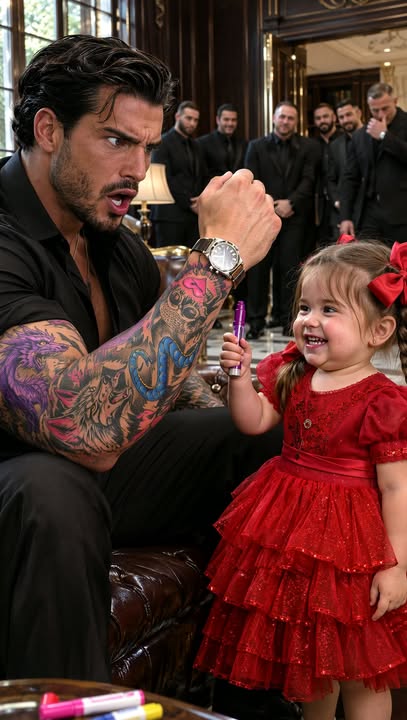
Some mornings she asked whether my tattoos still hurt from the coloring.
Other mornings she wanted to know if the guards had names before they became guards.
Anthony, to his credit, answered her questions with more patience than he showed most people.
He even let her give him a paper badge that read “Assistant to the Princess.”
“You’re taking this very seriously,” I told him after she left for the day.
“It’s an important appointment,” he replied.
His straight face did not quite hide his amusement.
The pink heart on my wrist faded a little more each day.
I had told myself I would wash it off when it became inconvenient.
I did not wash it off.
Emily noticed.
“You know,” she said one morning as she set a cup of coffee beside me, “permanent ink usually survives a little marker.”
“Does it?”
“Apparently.”
“I thought it might be safer to wait.”
“Safer for whom?”
“Anyone who might object to being asked to redo the heart.”
She shook her head, smiling despite herself.
“I think Lily would consider it an honor.”
The ease between us had begun to grow, but it remained delicate.
We spoke about books, the weather, and the small repairs needed around the house.
Sometimes she told me a story about Rosa, carefully chosen and brief, as if she were testing how much of her family history she could place in the room without it being taken from her.
I listened.
I tried not to turn each detail into evidence.
It was harder than I wanted to admit.
One afternoon, Emily came to the study holding a shallow cardboard box.
“I brought some of my mother’s things,” she said.
I stood up.
“You don’t have to show me anything you’d rather keep private.”
“I know.”
She placed the box on the edge of the desk but did not open it.
“I thought it might be easier to look through them here, with the photograph nearby.”
“If you’re sure.”
“I’m sure.”
She took a breath and lifted the lid.
Inside were sewing notions, folded patterns, a small pincushion, and a few envelopes bound with a faded green ribbon.
The familiar, practical objects made the room feel suddenly less like my study and more like a place where someone’s life had been set down carefully.
Emily lifted the pincushion.
“It’s the one she used when I was little.”
She turned it over, showing me the worn fabric and the threadbare corner where pins had been pushed in and pulled out for years.
“She made my school dresses on it. She’d let me pick the buttons, even when I picked the wrong ones.”
“What was the wrong kind?”
“Ones that didn’t match.”
“Did she make you wear them anyway?”
“She did. She said clothes didn’t have to match as long as the person wearing them was happy.”
The answer sounded like Rosa.
I could not explain why.
Emily set the pincushion down and began sorting through the papers.
There were old receipts, pattern instructions, and handwritten notes in a slanted script.
The envelopes were unsealed, their edges softened by time.
“Have you read these before?” I asked.
“Some of them. They’re mostly about bills, work, and relatives I never met.”
“Would you like me to leave?”
“No. I asked you to be here.”
She lifted one letter and scanned it, then placed it aside.
I noticed how carefully she moved each sheet, never rushing past anything that might matter.
It reminded me of how I handled the bluebird key.
After several minutes, she found a photograph tucked between two patterns.
The image showed Rosa as a younger woman standing in a garden.
Her hair was pinned beneath a scarf, and she wore a simple coat with one hand resting on a little girl’s shoulder.
The child was Emily.
Emily’s expression changed as she looked at it.
“I’d forgotten this one.”
She ran her thumb lightly over the photograph’s edge.
“You were about six?”
“Maybe seven. I remember the coat, but not the picture.”
I came around the desk, stopping beside her.
“I’m sorry you lost so many of her things after she died.”
“I didn’t lose them all,” she said. “I just wasn’t ready to look at them.”
“That makes sense.”
“I used to think that if I opened a box, I’d have to feel everything in it at once.”
“And now?”
“Now I think the things are patient.”
Her words stayed with me.
I thought of the ring locked away in my desk, waiting for me to decide whether remembering Sofia meant freezing my life around her.
Emily continued sorting.
At the bottom of the box, beneath a folded length of blue fabric, she found a thin notebook.
The cover was worn smooth, and the spine had been repaired with thread.
“Do you know what this is?” I asked.
“My mother’s sewing ledger.”
She opened it carefully.
The pages listed names, dates, measurements, and small notes about repairs.
The writing was neat and practical, each entry separated by a line.
Emily turned several pages.
“There are names here I don’t recognize.”
She stopped at one entry and leaned closer.
“Moretti,” I said.
She nodded.
“Mrs. Moretti. Two dresses, one winter coat, and curtains.”
“Do you know the date?”
“Five years before I was born.”
The number seemed to set a small piece of the past into place, though it did not tell us what the piece meant.
She kept reading.
A few pages later, there was a handwritten note in the margin.
The entry was dated four years after the first.
Emily looked at it without speaking.
“What is it?”
“‘Sofia—music room curtain, hem repaired. Do not charge.’”
I felt something tighten behind my ribs.
“Sofia was here.”
“Maybe she asked my mother to do the repair.”
The note was in Rosa’s handwriting, but the words were simple and offered no explanation.
There was no secret message hidden between them.
No confession.
No proof beyond the fact that they had crossed paths.
Still, the name made the photograph feel less accidental.
“Does the date fit?” I asked.
Emily checked the year.
“She would have been about twenty-one.”
“That’s right.”
“You remember her well?”
“I remember the way she made a room feel less serious.”
Emily looked at me.
“She must have been important to you.”
“She was.”
The honesty of it came more easily than I expected.
Emily returned her gaze to the ledger.
“I wish my mother had told me she knew her.”
“Maybe she thought it was an ordinary job.”
“Maybe.”
The uncertainty in her voice was not distrust.
It was grief mingled with the knowledge that people we love leave behind lives we never fully see.
She turned another page.
Several entries had been marked with a small bluebird, drawn beside the customer’s name.
Emily frowned.
“Have you seen this mark before?”
I picked up the ledger and brought it closer to the desk lamp.
The bluebirds were tiny and uneven, each one sketched beside a handful of entries.
“I haven’t.”
“There are three.”
“Could they be a symbol your mother used for particular jobs?”
“I don’t know. She had a way of marking things, but I don’t remember this.”
The small birds were simple, with rounded bodies and short lines for wings.
They looked remarkably like the engraving on the key.
Emily turned the ledger toward me.
“This one is beside Sofia’s name.”
I looked carefully.
There, in the margin, was a bluebird.
A second appeared beside the earlier entry for Mrs. Moretti.
The third was next to a name I could not place.
“Does the key open anything in your mother’s sewing things?” I asked.
“Nothing I can think of.”
“Could it have been hers?”
“It could.”
She studied the drawing in the ledger.
“But that still doesn’t explain why it was beside Sofia’s ring.”
“No.”
“Or why she kept the key.”
“No.”
The questions seemed to multiply the longer we looked.
I stepped back from the desk.
“We don’t have to solve it today.”
“I know.”
She said it gently, but there was a guarded note beneath the words.
I wondered whether I had spoken too quickly, too much like a man who wanted to move from one clue to the next.
“I’m not asking you to give me your mother’s things,” I said.
“I know you’re not.”
“I don’t want you to feel that everything you find has to become part of my family’s story.”
Emily closed the ledger.
“What if it is part of your family’s story?”
“Then it belongs to yours too, if your mother was involved.”
“I don’t know if I’m ready to decide that.”
“You don’t have to decide now.”
She looked at the box of papers.
“I spent a long time thinking my mother kept things from me because she didn’t trust me.”
“Do you still think that?”
“I don’t know. Maybe she was trying to protect me. Maybe she simply didn’t know what to say. Maybe she was afraid that telling me would make the past harder for both of us.”
Her eyes met mine.
“You understand what it’s like to keep something locked away and tell yourself it’s safer that way.”
I did.
The ring box sat in the drawer, unlocked but still untouched since the morning.
“I’m beginning to.”
A knock sounded at the study door.
Anthony entered when I called him in, carrying a slim folder.
His gaze went first to the open sewing ledger, then to Emily.
“I’m sorry to interrupt.”
“It’s all right,” I said. “What did you find?”
“Household records from the years Sofia lived here.”
He placed the folder on my desk.
“I found Rosa Carter in the staff list, but only under her first name and surname. She was employed as a seamstress for several months.”
Emily’s posture stiffened.
“You found her name?”
“Yes,” Anthony said, keeping his tone measured. “The records were incomplete, but there are two work dates that match entries in the ledger.”
Emily looked down at the page in front of her.
“So it wasn’t a coincidence.”
“It appears they were both here,” Anthony said.
“Did you find anything else?”
“Not yet. I haven’t searched beyond the household records.”
I opened the folder.
The page was old, its ink faded at the edges.
Rosa Carter’s name had been written in a column with several other employees.
The dates matched the work ledger.
Nothing else was noted.
No accusation.
No mention of jewels.
No clue to the key.
Still, the sight of her name in a Moretti family record changed the room.
Emily reached for the paper, then stopped.
“May I?”
“Of course.”
I handed it to her.
She read the entry slowly, her lips parting slightly when she reached the date.
“This is the year she said she worked for a family near the lake.”
“You remember that?” I asked.
“She told me once while she was pinning a hem. I asked if the house had a pool. She said it had a fountain and a room with a piano.”
She looked at the ledger and then the photograph.
“That was this house.”
I did not correct her.
The house had changed in small ways over the years, but the music room and fountain were still there.
Emily set the record down.
“Did your family keep employee records for everyone?”
“My father did.”
“Why?”
“He believed knowing who worked in the house was part of keeping it secure.”
The explanation sounded practical.
It also sounded like the sort of answer that might hide a more complicated truth.
Emily’s expression grew distant.
“You said Rosa worked for your family, but you didn’t know her name.”
“I was a child, and then I was not involved in household matters.”
“You were living here.”
“Yes.”
“You never wondered who came through the rooms?”
I had no defense that did not sound like an excuse.
“I should have.”
Her gaze remained on mine.
“I’m not blaming you. I’m trying to understand how someone could be part of this house and then disappear from its history.”
The question was fair.
It made me think of the people my father had treated as background, and the way I had learned to see the world through the same narrow lens.
“I don’t know,” I said. “I never asked.”
“Neither did I,” Emily replied. “I thought her stories were ordinary.”
“Maybe they were.”
“Maybe.”
Anthony stayed silent, allowing us room.
I closed the folder.
“Don’t search for anything beyond the records I gave you,” I said. “If there’s more to find, we’ll decide together.”
Emily’s eyes flicked toward me.
Together.
It was a small word, but I understood why she heard it.
She did not look reassured.
“Vincent,” she said, “I need to ask you something.”
“Go ahead.”
“Are you investigating my family?”
Anthony shifted slightly, but I answered before he could.
“I asked Anthony to see whether the Moretti household had records that might explain how the key came to be with Sofia’s ring.”
“That is an investigation.”
“It is.”
“You told me you weren’t going to pressure me, and you haven’t. But you asked your second-in-command to search my mother’s connection to this family.”
“I asked him to search our records.”
“That doesn’t change how it feels from where I’m standing.”
She was right.
I had been so careful not to search her belongings that I had not considered what it meant for a powerful family to begin pulling out records connected to hers.
“I should have told you before I asked him.”
“Yes,” she said quietly.
“I’m sorry.”
She looked down at the folder, her fingers resting on its corner.
“Did you find anything about a theft?”
The word landed with a weight neither Anthony nor I had expected.
“No,” I said. “Why?”
Emily pressed her lips together.
“I’m not sure.”
“You’ve heard something?”
“Only a story my mother told me once.”
“What story?”
“She said she left a job because people had decided she was the easiest person to blame when something went missing.”
The room became still.
“What went missing?” I asked.
“She never said. I didn’t ask. I thought she meant a dress or a piece of fabric.”
“Did she say where she worked?”
“No. She was in the middle of making me a costume for a school play, and I was upset because she had to redo one of the sleeves. It wasn’t a conversation I knew how to listen to.”
The memory seemed to pain her more than the story itself.
“Do you remember when she told you?”
“When I was young. Maybe eight or nine.”
“What did she say exactly?”
Emily took a moment to find the words.
“She said that sometimes a person can lose a job before anyone asks what actually happened. She told me not to let other people decide what I was worth.”
Anthony glanced at me.
I felt the old house close around the words.
My father had been a man who believed that doubt was a weakness and accusation a form of control.
He had been dead for years.
That did not make his decisions disappear.
“Do you think she meant the Morettis?” I asked.
“I don’t know.”
“Emily, if my family accused her of something, I want to know.”
“Why?”
“Because if it happened, it shouldn’t be left buried.”
“And if it didn’t?”
“Then we’ll know that too.”
She studied me.
“What would you do with the answer?”
I had no easy response.
“Listen to it.”
“That’s not the same as making it right.”
“No,” I said. “It isn’t.”
Emily gathered the papers into a neater stack.
“I’m not ready to let you decide what this means.”
“I’m not asking you to.”
“But you want answers.”
“I do.”
“So do I. That doesn’t mean we want them for the same reasons.”
I took that in.
She had spent the past few days sharing the small memories she could bear to share.
I had taken those memories and begun arranging them into a path that led toward my own questions.
The realization made me feel ashamed.
“You’re right,” I said.
Her expression softened a little, though the uncertainty remained.
“I’ll take these things home and continue looking on my own.”
“Of course.”
“If I find something that I think you should see, I’ll tell you.”
“I’ll wait.”
She lifted the cardboard box.
I moved to help, then stopped when she gave a small shake of her head.
“I can carry it.”
“All right.”
Anthony opened the door for her.
As she passed him, he offered a quiet apology.
“I’m sorry I made this feel like a search of your family.”
“Thank you,” she said. “I know you were following Vincent’s request.”
She left without looking back.
The moment the door closed, the study seemed to return to the silence I knew best.
Anthony waited.
“I should have told her,” I said.
“Yes.”
“I thought I was being careful.”
“You were careful about one thing.”
I gave him a tired look.
“That isn’t much comfort.”
“No,” he agreed.
He stayed by the door.
“Do you want me to stop looking?”
“Yes.”
“Entirely?”
“Until Emily decides otherwise.”
Anthony nodded and left the folder on my desk.
I stood alone with the records, the drawing, and the small bluebird key.
The key had opened nothing.
Yet it had already unsettled what I believed about Sofia, about my father, and about the people who had passed through my home without leaving a name I remembered.
The next morning, Emily did not come to breakfast with Lily.
The kitchen staff told me they had gone to preschool as usual.
I knew I had no right to expect them to stop by.
Still, the absence of Lily’s chatter felt sharper than it should have.
I made myself leave the kitchen before anyone noticed I had been waiting.
That afternoon, I found Emily in the laundry room, sorting clean linens.
She looked up when I entered.
“Can I talk to you?”
“If you want to.”
“I do.”
She folded the sheet in her hands before answering.
I stayed near the doorway, giving her space.
“I’m sorry I turned your mother’s memories into a problem I needed to solve,” I said.
“You didn’t mean to.”
“That doesn’t make the effect different.”
“No,” she said. “It doesn’t.”
“I won’t ask Anthony to look further.”
“Thank you.”
“I want to understand what happened, but I won’t decide that my need to know is more important than your right to choose.”
Emily placed the folded sheet on the stack.
“I believe you’re trying.”
“I am.”
“But trust isn’t one apology. It’s what you do after.”
“I know.”
She studied my face, perhaps searching for the usual impatience or the demand that she accept the apology.
I gave her neither.
At last, she nodded.
“I’m not ready to show you the rest of my mother’s papers.”
“I understand.”
“I need to go through them myself.”
“Take as long as you need.”
“And I don’t want you asking Lily questions about Rosa or Sofia.”
“I won’t.”
“She’s a child. She shouldn’t be caught in the middle of a story she doesn’t understand.”
“You’re right.”
Her shoulders eased.
“I appreciate that.”
We stood together in the quiet laundry room, surrounded by clean sheets and the faint scent of soap.
I wanted to say that I missed seeing them at breakfast.
I wanted to say that Lily’s drawings had made the house feel more like a home.
I wanted to say that Emily’s presence had begun to matter to me in a way I had not prepared for.
None of those things would have been fair to ask her to carry.
So I said, “If you need anything, you can tell me.”
“I know.”
This time, the words did not sound like a promise that she would.
They sounded like a door left open.
That evening, I found Lily’s latest drawing on the kitchen counter.
It showed the three of us beneath the yellow sun again, with the bluebird above our heads.
This time, she had drawn a small line between the adults’ hands, though they were not touching.
I stared at the picture longer than I meant to.
When Emily returned from the pantry, she noticed me looking at it.
“She made that at preschool.”
“Does she draw us often?”
“She draws everyone often.”
“That isn’t what I asked.”
Emily’s gaze softened, but her voice remained careful.
“She likes having you around.”
“I like having her around too.”
“She gets attached easily.”
“I won’t ask her to feel anything she doesn’t.”
“Good.”
The words were gentle, but there was a boundary inside them.
I respected it.
Emily gathered the drawing and held it against her chest.
“Lily doesn’t know about the story my mother told me.”
“I understand.”
“I want to keep it that way until I know what it means.”
“You have my word.”
She gave a small nod.
For a moment, we stood on opposite sides of the counter, the drawing between us.
Then she tucked it into her folder and left the kitchen.
I did not follow.
The next few days passed without another conversation about the ledger.
I kept the old household record in my study, but I did not ask Anthony to search further.
The bluebird key remained in the drawer beside the ring.
I thought of removing it and giving it to Emily.
I thought of asking her whether she wanted it.
I did neither.
On Friday evening, she came to the study after Lily had gone to bed.
She held a single envelope, its paper yellowed and folded at the corners.
“I found this in the lining of my mother’s sewing basket,” she said.
My attention fixed on the envelope.
“Is it a letter?”
“I think so. It was tucked beneath the cloth, where the bottom had come loose.”
“Have you read it?”
“No.”
“Do you want to read it alone?”
She looked down at the envelope.
“I don’t know.”
“Then you don’t have to decide right now.”
She lifted her eyes.
“I found something else too.”
“What?”
She slipped the envelope into her pocket and handed me a photograph.
It was older than the one she had shown me before, its surface dulled with age.
Rosa stood beside Sofia in the garden outside the music room.
They were close enough to suggest familiarity, though neither was smiling.
Between them sat a baby wrapped in a pale blanket.
The child’s face was hidden by the angle of the picture and the fold of the cloth.
My breath caught.
Emily stared at the photograph, her expression stricken.
“I don’t know who the baby is.”
Neither did I.
The bluebird key, the ring, the old ledger, and my father’s forgotten household records had all led us to this moment.
But the picture offered no explanation.
Only two women who had known each other, and a child whose face the camera had not shown.
“Did your mother keep this with the letters?” I asked.
“No. It was folded inside one of her sewing patterns.”
“Was there anything written on it?”
Emily turned the photograph over.
There was no date, no name, and no note.
Only a faint pencil mark in one corner, nearly erased.
It looked like a small bluebird.
My hand moved toward the photograph, then stopped.
I had promised not to take control of what she had found.
Emily noticed.
“You can look,” she said.
“I don’t want to make you feel like I’m claiming it.”
“I brought it to you because I thought you should see it.”
We studied the image together.
Sofia’s hand rested near the baby’s blanket.
Rosa stood on the other side, one arm curved protectively around the child without quite touching.
The photograph was too small to tell whether the baby
**–END OF PART 3–CLICK “NEXT” AT THE BOTTOM OF THE PAGE TO CONTINUE READING**
* * *
[PREVIOUS: PART 2](https://echoesofstories.idolsgift.com/blog/part-2-the-bluebird-beside-the-ring-047) | [NEXT: PART 4](https://echoesofstories.idolsgift.com/blog/part-4-the-bluebird-beside-the-ring-047)
✓ Lynn R. Adams
Part 3 – The Photograph with a Hidden Face The bluebird seemed to hover above the three figures, its wings drawn in two uncertain strokes of blue. Lily held the picture up for Emily and me to admire…