PART 2: “YOU’RE TOO YOUNG FOR ME,” THE OLD COWBOY SAID—BUT HER SECRET CHANGED EVERYTHING. 066
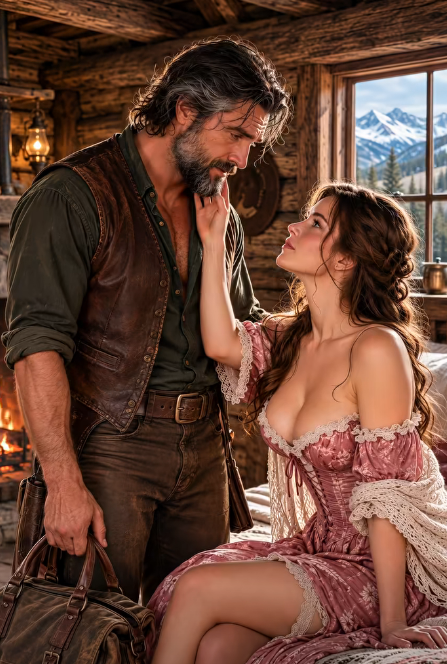
For a long while after Josephine spoke, neither of us moved.
The last snowmelt dripped from the cabin roof in a slow, steady rhythm. Somewhere beyond the open door, my buckskin gelding tore at the new grass pushing through the brown earth.
Spring had arrived while I wasn’t looking.
Maybe something else had, too.
Josephine’s hand was still resting over mine.
“You think you’re broken, Hiram,” she’d said, “but to me, you’re perfect.”
No woman had spoken to me that way in twenty years.
I looked down at our hands.
Hers were small compared with mine. Mine were scarred from rope burns, cracked by winter, marked by every fence post, horseshoe, and hard season I’d survived.
Her thumb moved gently across one of those scars.
I pulled my hand away.
Not because I wanted to.
Because I wanted to too much.
“Josephine.”
“I know what you’re going to say.”
“No, you don’t.”
“You’re going to tell me I’m confused.”
I stared toward the doorway.
“Was considering it.”
“Then don’t.”
“You almost froze to death four months ago. I carried you into this cabin. You were frightened, stranded, dependent on me for food and shelter.”
“I was never frightened of you.”
“That ain’t what I mean.”
“I know what you mean.”
She stepped away.
There was hurt in her face, but no anger.
That made it worse.
I had been prepared for anger.
Anger I understood.
“I don’t owe you love because you saved me,” she said quietly. “And you don’t owe me love because I stayed.”
“Then what are we talking about?”
“The truth.”
I almost laughed, though there wasn’t anything funny in me.
“The truth is I’m twice the age of every man you ought to be considering.”
“The truth is you’re twenty-nine years older than I am. I know arithmetic.”
“Josephine.”
“And the truth is that I’ve had four months to decide whether this is gratitude.”
She looked around the cabin.
At the little table where we’d eaten together.
At the stove she’d cursed the first week because she could never get biscuits to rise evenly.
At the peg where her buffalo coat hung beside mine.
At the wooden shelf where she’d placed three smooth stones she’d found beside the creek after the thaw.
Somehow, without my permission, she’d made the place look inhabited.
No.
Not inhabited.
Lived in.
“I know what gratitude feels like,” she continued. “I felt it when you carried me through the snow. I felt it when I woke up and found my feet wrapped in warm cloth. I felt it when you gave me the last spoonful of honey because you thought I didn’t notice the jar was almost empty.”
I glanced at her.
“You noticed?”
“I notice a great deal about you.”
“That’s unfortunate.”
A smile touched her lips.
Then it disappeared.
“What I feel now isn’t gratitude.”
My chest tightened.
I could have crossed that room in two steps.
Instead, I put my hands on my hips like a fool trying to decide whether a fence post needed mending.
“Your bag is packed,” I said.
Her expression changed.
“Yes.”
“We should leave at first light.”
“We?”
“I’ll take you to Ouray.”
“You said the trail was safe.”
“Safer. Not safe.”
“And you’ll come back?”
“That’s generally how escorting someone works.”
The words sounded colder than I meant them to.
Josephine turned toward the window.
“Of course.”
Something in the way she said it made the cabin feel empty already.
That evening we spoke very little.
I checked the girth on the old buckskin twice.
Josephine repacked her canvas bag three times.
Neither of us mentioned what had happened.
After supper, she washed the plates while I sharpened my knife at the table.
Scrape.
Turn.
Scrape.
Turn.
The little sounds filled the silence between us.
Finally she said, “You know, people can care about one another without every conversation becoming a funeral.”
I looked up.
“What?”
“You’ve looked like you’re attending your own burial since this afternoon.”
“I’m thinking.”
“I’ve noticed.”
“That’s a dangerous occupation.”
“For you, apparently.”
I almost smiled.
Then her canvas bag slipped from the bench.
It struck the floor.
A leather-bound notebook, a handkerchief, two pencils, and several folded papers spilled across the planks.
Josephine dropped the plate in the wash basin.
“Hiram—”
“I’ve got it.”
“No.”
The sharpness of her answer stopped me.
She hurried around the table.
Too late.
A folded envelope had landed beside my boot.
And written across the front, in faded ink, were two words.
**HIRAM WALKER.**
I stared at my own name.
Josephine went still.
The air seemed to leave the room.
I bent down and picked up the envelope.
It was old.
Several years old, judging by the yellowing paper.
The seal had never been broken.
I looked at Josephine.
Her face had gone pale.
“What is this?”
She swallowed.
“I can explain.”
“Seems like a mighty fine time.”
She took a slow breath.
“Please give it to me.”
“It has my name on it.”
“I know.”
“How long have you had this?”
Her eyes met mine.
“Since before I came to Colorado.”
Something cold settled inside me.
Not anger.
Not yet.
Something more difficult.
Disappointment.
“You told me you were headed to Ouray.”
“I was.”
“You told me you’d never been in these mountains.”
“I hadn’t.”
“Did you know I was here?”
“Not exactly.”
“Josephine.”
“My father believed you were.”
My hand tightened around the letter.
“Your father?”
She lowered herself onto the chair.
Suddenly she looked tired.
Not twenty-five.
Not stubborn.
Just tired.
“My father’s name was Samuel Bell.”
That name reached through twenty-seven years and struck me square in the chest.
I sat down without meaning to.
Samuel Bell.
A lanky young cattleman from Missouri who could rope a steer at full gallop and quote Shakespeare badly after half a bottle of whiskey.
A man who once rode into a flooded river after me when my horse lost its footing.
A man I’d called friend.
“I knew Sam,” I whispered.
“I know.”
I looked at her again.
Really looked.
The dark hair.
The stubborn chin.
Those gray-green eyes.
Samuel’s eyes.
“Dear God.”
Josephine folded her hands.
“He spoke about you.”
“When?”
“My whole life.”
I leaned back.
“You never said anything.”
“I tried.”
“When?”
“The second week I was here.”
“You asked whether I’d ever worked cattle in Kansas.”
“Because Father said you drove cattle with him through Kansas.”
“You could’ve just told me.”
“I was going to.”
“But?”
She stared at the floor.
“But then I realized you didn’t remember his name.”
The words hit harder than they should have.
I rubbed a hand over my face.
“I remembered him.”
“Not when I mentioned Bell.”
“There are a thousand Bells.”
“Hiram, I was afraid.”
“Of me?”
“Of changing what this was.”
The quiet honesty of it stole some of my resentment.
She continued.
“At first I was a stranger you rescued. Then I became someone who helped with supper and carried firewood and argued with you about wasting coffee grounds.”
“You do waste coffee grounds.”
“I do not.”
“You make it strong enough to shoe horses with.”
For one brief instant we were ourselves again.
Then my eyes dropped to the envelope.
“What did Sam want?”
“I don’t know.”
“You never opened it?”
“It wasn’t addressed to me.”
“How’d you get it?”
“Father gave it to me three weeks before he died.”
My gaze lifted.
“I didn’t know.”
“It was September.”
“I’m sorry.”
“So am I.”
There was no bitterness in her answer.
Only grief worn smooth from being carried.
“He told me if I ever came west, I should take that letter with me. He said if circumstances brought me near Ouray, I was to leave it with an attorney named Andrew Cole. Mr. Cole would know how to find you.”
“Why?”
“He wouldn’t say.”
“And you came in January?”
“My aunt had been living outside Ouray. She offered me a teaching position through a friend of hers. I received word in December that she’d become ill. I took the stage as far as I could, then hired a horse.”
I frowned.
“In January.”
“Yes.”
“Through the Rockies.”
“Yes.”
“Alone.”
Her mouth tightened.
“When you say it in that particular tone, it sounds less sensible.”
“It was madness.”
“I was twenty-five, not five.”
“Smart people can do foolish things.”
“I seem to remember a certain cowboy gathering firewood beneath ice-heavy pines during a March storm.”
“That was different.”
“Naturally.”
Despite myself, I looked away to hide a smile.
But the letter remained between us.
I ran my thumb over Samuel’s handwriting.
Memories came slowly.
Sam laughing beside a campfire.
Sam singing to frightened cattle during a thunderstorm.
Sam handing me a tin cup and saying, _One bad day ain’t the same thing as a bad life, Walker._
I’d forgotten that sentence.
Or tried to.
“Did Sam know about the cabin?”
“He knew you had gone into the mountains. He didn’t know exactly where.”
“So you weren’t looking for me that morning?”
Josephine hesitated.
“I was looking for the trail to Ouray.”
“That wasn’t my question.”
Her gaze softened.
“I wondered whether I might find you.”
The truth hurt less than the suspicion.
“Why?”
“Because my father trusted you.”
“You’d never met me.”
“No.”
“I could’ve become anything in twenty-seven years.”
“He said the same thing.”
That sounded exactly like Samuel.
Despite myself, I laughed.
A short, rusty sound.
Josephine smiled.
“He said, ‘For all I know, Hiram Walker is a terrible old grouch by now.'”
“Sam knew me well.”
“He also said you were the bravest man he’d ever known.”
“He drank.”
“Frequently, according to Mother.”
I looked at the envelope again.
“Why didn’t you give it to me once you knew who I was?”
Her smile vanished.
“Because you were happy.”
I frowned.
“I wasn’t happy.”
“You became happier.”
The answer silenced me.
Josephine looked toward the window.
“At first, every morning you woke as though you were disappointed the world was still there.”
I stared at her.
She continued before I could object.
“You barely spoke unless something needed fixing. You ate standing up half the time. You never sat near the fire unless the cold forced you to.”
“I’ve always been that way.”
“No. You’ve been lonely that way.”
Something inside me shifted.
I wanted to deny it.
Couldn’t.
“Then you started telling me stories,” she said. “About cattle drives. About towns that don’t exist anymore. About sleeping beneath skies so clear you could count every star God ever made.”
“You asked questions.”
“I did.”
“You ask too many.”
“I know.”
A faint smile.
“Then one morning you laughed because I burned the biscuits.”
“They could’ve killed a bear.”
“And I thought… maybe whatever Father wanted from you could wait.”
“You didn’t have the right to decide that.”
“I know.”
Her voice cracked.
The first sign that all her courage had limits.
“I’m sorry.”
I looked down.
Some apology deserved punishment.
Some deserved forgiveness.
And some simply needed to be believed.
I broke the seal.
Josephine watched silently.
Inside was one sheet of paper covered in Samuel’s slanting handwriting.
I unfolded it.
_Hiram,_
_If this reaches you, then either Providence has a peculiar sense of humor or my Josephine has ignored at least six pieces of sensible advice and gone looking for the mountains._
I closed my eyes.
That was Sam.
Even from the grave.
I continued.
_There are things a man means to say while believing he has endless time. Then time proves him a liar._
_I never thanked you properly for Kansas._
My throat tightened.
Kansas.
A storm.
A river.
A frightened herd.
Samuel caught beneath a horse.
I’d dragged him free.
I’d forgotten that, too.
Or maybe memory had buried the good years beneath the bad ones.
_You believed afterward that I saved your life. Perhaps we saved each other. Friendship often works that way._
_There is a matter concerning land outside Ouray. Cole has the papers. Your name is on them, though I suspect you’ve forgotten that as well._
I straightened.
“What?”
Josephine leaned forward.
“What is it?”
I read on.
_Long ago, you and I paid together for forty acres beside Miller Creek. You left before the deed was properly recorded. I kept your share because I always assumed you’d come back for it._
My heart thudded.
I remembered.
A valley.
Summer grass.
A foolish plan between two young cowboys who thought someday they might raise horses instead of chasing cattle across half the country.
We’d put money down.
Then my wife, Anna, had fallen ill.
Everything changed.
I’d never returned.
_The land is worth more now, but that is not why I am writing._
_Josephine believes home is a place a person finds. I have always believed it is something people build._
I stopped.
The room blurred.
I blinked until the words steadied.
_If she ever meets you, do not mistake her kindness for weakness. And do not confuse protecting someone with choosing for them._
I glanced at Josephine.
She was watching my face.
“He knew you,” I murmured.
“What?”
“Nothing.”
I kept reading.
_Most importantly, old friend, if you’ve spent all these years punishing yourself for surviving Anna, stop._
My breath caught.
Josephine saw it.
“Hiram?”
I couldn’t answer.
_She loved you. I saw that with my own eyes. A love like that does not ask the living to become ghosts._
The fire popped.
Outside, a bird called through the timber.
Twenty years.
Twenty years of carrying guilt as though grief were a debt that had to be paid every morning.
My hands began trembling.
Josephine moved toward me.
I held up one hand.
Not to stop her.
To steady myself.
There were only four final lines.
_If Josephine has brought you this, then she has probably already decided for herself whether you’re worth knowing._
_God help you._
_Trust her judgment._
_Samuel._
I lowered the letter.
For several minutes I said nothing.
Josephine finally whispered, “What did he say?”
I looked at her.
“He told me not to decide your life for you.”
Her eyes widened.
Then, unexpectedly, she laughed.
A soft, beautiful laugh that filled the cabin.
“Your father was an irritating man.”
“He would’ve considered that a compliment.”
I laughed too.
And for one dangerous moment, happiness came so easily that it frightened me more than any winter storm ever had.
Later, after Josephine had gone to bed behind the curtain we’d hung across the small sleeping alcove, I sat alone beside the dying fire.
Samuel’s letter rested in my lap.
I read the part about Anna again.
_Do not become a ghost._
I hadn’t spoken Anna’s name aloud in years.
I whispered it then.
“Anna.”
Nothing terrible happened.
The mountains didn’t collapse.
The fire didn’t go out.
Her memory didn’t vanish because I had allowed another woman into my heart.
Maybe that had been my greatest fear.
That loving Josephine would betray the woman I’d buried.
But perhaps memory wasn’t a room with only one chair.
Near midnight, I folded Samuel’s letter.
That was when I noticed something written on the back.
Not Samuel’s handwriting.
Josephine’s.
Only three words.
A date beneath them.
**Ask Cole why.**
May 3, 1876.
Tomorrow’s date.
I looked toward the sleeping alcove.
Josephine had known there was something waiting in Ouray.
Something she hadn’t told me.
And for the first time since reading Samuel’s letter, I wondered whether the greatest secret she carried had anything to do with love at all.
**–END OF PART 2–CLICK “NEXT” AT THE BOTTOM OF THE PAGE TO CONTINUE READING**
✓ Lynn R. Adams
For a long while after Josephine spoke, neither of us moved. The last snowmelt dripped from the cabin roof in a slow, steady rhythm. Somewhere beyond the open door, my buckskin gelding tore at the ne…