PART 2: What the Velvet Box Held 053
Emily looked inside.
A bank draft lay beneath a folded sheet of cream-colored paper, its amount written in a row of figures so long she had to read it twice.
Ten million dollars.
For a moment, the room seemed to tilt around her.
She didn’t reach for it.
“Is this supposed to be a joke?” she asked.
“No,” Vincent replied.
The answer came quietly, without the easy confidence he used when a room full of people expected him to command it.
Emily lifted her eyes to his.
“Then why are you showing me?”
“Because Vanessa made a promise in front of witnesses, and I wanted you to know it wasn’t an empty one.”
He nodded toward the letter.
“That came from her family’s attorney.”
Emily took the paper from the box, careful not to touch the draft.
The letter was brief, formal, and signed by a lawyer whose name she recognized from the newspapers.
It confirmed that the Whitmore family had established a trust for the full amount of the wager.
The money was available, the letter said, once Emily Parker publicly confirmed that she accepted the award.
Her fingers tightened around the page.
“Publicly confirmed,” she repeated.
“That’s the condition.”
“So I’m supposed to stand in front of people again and let them watch me decide whether I’m worth ten million dollars?”
“No.”
“Then what are you asking me to do?”
“Nothing.” Vincent glanced at the box, then back at her. “I brought it because I didn’t want you to think I’d let Vanessa’s promise disappear the moment the guests went home.”
Emily studied him, searching for some sign that the money came with expectations he had not named.
She had learned, long before she entered the Moretti house, that generosity could arrive carrying a debt no one had bothered to explain.
“Is this your money?” she asked.
“No.”
“Did you arrange the trust?”
“No.”
“Do you get anything if I accept it?”
“Not a cent.”
She looked again at the bank draft.
Its official seals and signatures made it feel more real than the numbers on the page, but not more welcome.
“I don’t want it.”
Vincent’s expression shifted, not with anger, but with something like concern.
“You don’t have to decide tonight.”
“I have decided.”
“Emily—”
“I won’t take money tied to that ballroom. Vanessa offered it while everyone laughed, and I performed because I wanted them to remember I was a person, not because I wanted to be bought.”
“You earned it.”
“That isn’t the same as wanting it.”
The words came out sharper than she meant them to.
She set the letter on the table beside the box and stepped back.
Vincent did not follow her.
That small restraint surprised her more than a grand apology would have.
“I’m not here to buy your affection,” he said.
“I know what you said.”
“But you don’t believe me.”
“I believe you may mean it right now.”
His gaze held hers.
“And later?”
“Later is when people often remember what they expected in return.”
For a moment, neither spoke.
Outside the tall windows, the city gleamed with the restless light of a thousand lives going on without them.
At last, Vincent closed the velvet box.
“I won’t ask you again tonight.”
Emily folded her arms, trying to keep the tremor out of her hands.
“Why did you come yourself?”
“I could have sent the attorney.”
“That would have been easier.”
“Yes.”
The plainness of his answer unsettled her.
He looked down at the box, his thumb resting against its edge.
“Vanessa’s stunt was wrong,” he said. “Ending our engagement was the obvious thing to do. But that doesn’t undo what happened to you.”
“No, it doesn’t.”
“I wanted you to hear from me that I’m sorry.”
“You didn’t make the offer.”
“I was there.”
“You told her to stop.”
“Too late.”
Emily had no ready answer for that.
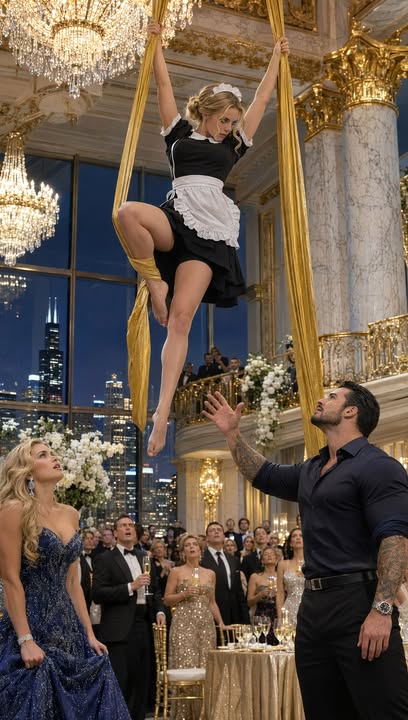
She remembered the ballroom: the polished floor, the watching faces, the silence that had swallowed the room after she let go.
She remembered Vincent standing beneath her, looking up as if he could hold her steady through the air.
But memory was not trust.
“Thank you for telling me about the money,” she said. “Now please take it with you.”
Vincent lifted the box.
At the door, he paused.
“Would you let me help you find a safe place to train?”
Her shoulders stiffened.
“I’m not looking for a sponsor.”
“I didn’t say you were.”
“I don’t need a man with a mansion to decide what’s safe for me.”
“I know.”
“Do you?”
He accepted the question without flinching.
“I know enough to understand that you get to decide.”
She searched his face, finding no easy charm in it now, only a patience that seemed unfamiliar in someone accustomed to being obeyed.
“What kind of place?” she asked.
“A proper aerial studio, if that’s what you want. With inspected equipment and an instructor who understands your limits.”
“I’m not sure I have limits.”
“Everyone does.”
A memory passed across his face, too fleeting for her to interpret.
Emily looked away first.
“I’ll think about it.”
“That’s all I’m asking.”
He left without trying to turn the moment into a promise.
When the door clicked shut, Emily stood very still.
The velvet box remained on the table.
She could hear the soft, steady rhythm of the clock on the mantel, each tick marking a second in which she did not have to answer anyone.
At length, she opened the box again.
The ten-million-dollar draft seemed almost absurd in the small, quiet room.
Her fingers hovered over it, then stopped.
She thought of the hospital bills stacked on her old kitchen table, of the months she had spent learning to walk without leaning on the wall, of the calls from collectors that had once made her heart race.
She thought of the years she had spent telling herself that those days were behind her.
They were behind her, but not gone.
A knock sounded at the door.
Emily shut the box.
A housekeeper stood in the hallway with a folded linen sheet in her arms.
“Mr. Moretti asked me to make sure you had everything you needed,” she said. “He’s gone now.”
Emily glanced down the corridor.
“Did he tell you what happened?”
“Only that you’d had a difficult evening.”
“I suppose I have.”
The housekeeper gave her a sympathetic look, then moved on.
Emily shut the door and rested her forehead against it.
She had learned to distrust gestures made in the wake of spectacle.
Flowers, invitations, apologies, promises: all of them could be another kind of audience.
Yet Vincent had offered something practical and then left the choice with her.
That, at least, was different.
The following days passed with a strange quietness.
The Moretti household returned to its routines, though the servants spoke of the engagement celebration in lowered voices whenever Emily entered a room.
Vanessa’s name appeared in the society pages beside phrases like “postponed wedding” and “private disagreement.”
No one asked Emily to explain what had happened.
Vincent did not send flowers.
He did not appear outside the servants’ entrance.
He did not summon her to his office.
The absence of all those things gave her more room to think than she had expected.
On the fourth morning, a plain envelope appeared in the staff room.
It contained the name and address of a community arts center in Lower Manhattan, along with the contact information of a director who ran movement classes for children.
A note was folded inside.
“I asked whether they had a suitable space and was told they might.
“If you want the introduction, you can contact them directly.
“If you don’t, no one will follow up.
“—Vincent”
Emily read the note twice.
No money had been offered.
No meeting had been arranged without her.
He had not even asked for an answer.
She slipped the address into her pocket.
That afternoon, after finishing her shift, she called the number from the staff room telephone.
The woman who answered spoke briskly, with the warm impatience of someone juggling a dozen tasks.
“Yes, Vincent Moretti’s office called,” she said. “He asked if we had a movement room that might be suitable for a former aerial performer.”
“He told you I was a former performer?”
“He said you had experience with aerial work and wanted to ask about the space yourself.”
Emily leaned her shoulder against the wall.
“That’s all?”
“That’s all.”
The simplicity of it loosened something in her chest.
The woman introduced herself as Marisol, director of the East River Community Arts Center.
She explained that their small gymnasium had high ceilings, but their aerial rig was old and awaiting inspection.
“We don’t use it until it’s cleared,” Marisol said. “We’re careful about that. But we have a dance room, and we could use someone to teach basic movement to the children.”
“I don’t know if I’m ready to teach.”
“You don’t have to decide over the phone.”
Emily heard herself asking, “Could I come see the place?”
“Of course.”
The center smelled of floor polish, tempera paint, and something sweet baking in a kitchen down the hall.
Children’s drawings covered the walls.
A row of bright paper stars hung from the ceiling, turning slowly whenever a door opened.
Marisol led Emily through the building, showing her a small dance room with scuffed wooden floors and tall windows.
There were no silks hanging overhead, no stage lights, no crowd.
The empty room felt less like a challenge than an invitation.
“We have a beginner’s class tomorrow,” Marisol said. “The kids could use someone who knows how to move with confidence.”
“I haven’t taught children before.”
“Then you’ll learn alongside them.”
Emily looked at the floor, imagining a group of small feet waiting for her to tell them where to stand.
The idea frightened her in a way the ballroom had not.
In the ballroom, she had known what her body could do.
Here, she would have to trust that a different part of her might still be useful.
“I’ll come tomorrow,” she said.
Marisol smiled.
“Good.”
At the first class, Emily began with simple stretches and balance exercises.
The children watched her closely, their faces serious with the importance of being trusted to try.
One little boy kept tipping sideways whenever he raised his arms.
Emily crouched beside him.
“Your body’s not doing it wrong,” she told him. “It’s just finding out where the middle is.”
He tried again, his tongue caught between his teeth.
This time, he stayed upright.
His grin brightened the whole room.
Something inside Emily softened.
She spent the next hour teaching the children how to move through space without rushing, how to notice their breath, how to stand tall even when their knees felt uncertain.
When class ended, one girl asked if Emily could come back next week.
“I think I can,” Emily said.
On the way home, she caught herself smiling.
She had not performed.
She had not flown.
Still, for the first time in years, she had felt that some part of her old life might have survived.
Vincent’s introduction had opened the door, but he did not appear at the center.
He did not ask Marisol how Emily was doing.
He did not send someone to watch.
That, too, mattered.
A week later, he found her in the conservatory at the estate, where she had been arranging fresh flowers before the afternoon guests arrived.
He stood at the entrance rather than crossing the room.
“May I come in?” he asked.
Emily looked up from the white roses.
“You’re asking permission now?”
“I thought it might be a useful habit.”
“It is.”
He came no closer than the end of the table.
“How is the arts center?”
“Busy.”
“Good busy?”
“Mostly.”
“And the children?”
“They’re teaching me as much as I’m teaching them.”
A faint smile touched his mouth.
“Marisol said they liked you.”
Emily’s hand paused over the flowers.
“You spoke to her?”
“Only to thank her for meeting you. I didn’t ask about your class.”
She watched him for a moment.
The distinction mattered.
“Then she told you on her own?”
“She mentioned it when I called to ask whether the space had been inspected.”
“That sounds like something you would do.”
“What does that mean?”
“It means you think checking the equipment is more useful than asking how I feel.”
“Is it not?”
“Sometimes it is.”
He seemed to consider the answer.
“I’m trying not to assume I know what would help.”
“Trying is not the same as knowing.”
“No,” he said. “It isn’t.”
Emily set the roses into a crystal vase.
The conservatory held the warmth of a greenhouse, and the leaves of the lemon trees shone in the afternoon light.
She had once thought the Moretti estate was beautiful in a way that could only belong to people who had never needed to wonder what beauty cost.
Now she knew the rooms could be beautiful and still feel lonely.
“Why are you still here?” she asked.
Vincent glanced toward the windows.
“I’m not sure I understand the question.”
“You ended your engagement. You brought me the money. You offered an introduction. You could have done those things and gone back to your life.”
“I could have.”
“But you didn’t.”
“No.”
“Why?”
He took a breath before answering.
“Because I wanted to know whether you were all right.”
“And if I’m not?”
“Then I would listen.”
“What if I don’t want you to?”
“Then I would leave.”
Her eyes stayed on his.
It was a simple answer, but she could not tell whether it was easy for him to give.
“Most people say they want to listen,” she said. “Then they start explaining what I should do.”
“I may do that by mistake.”
“You might.”
“I’ll try to notice.”
“I don’t want to be grateful to you for everything.”
“You don’t owe me gratitude.”
“Not even for the arts center?”
“Not even for that.”
“Why help, then?”
“Because you asked for a chance to decide whether you wanted it.”
Emily searched for a hint of pride in his voice, but found none.
She could have mistaken him for sincere.
That did not mean she was ready to trust him.
“I’m still not accepting the money,” she said.
“I understand.”
“Do you?”
“I don’t have to agree with your reasons to respect your decision.”
She looked down at the flowers.
“I don’t want that wager deciding what my life becomes.”
“It shouldn’t.”
“Ten million dollars would change everything.”
“Yes.”
“I could pay every bill I still owe. I could stop choosing work based on what I can afford to lose.”
His expression grew still.
“You still have medical debt?”
The question came before she could stop it.
A silence opened between them.
Emily turned back to the roses, adjusting one stem that did not need adjusting.
“It’s not your concern.”
“You’re right.”
She wished he had pushed a little.
She wished he had not.
For several seconds, the only sound was the quiet tick of water running through the fountain outside.
Then Vincent said, “You don’t have to tell me.”
The gentleness in his voice made the words harder to keep hidden.
“I was injured,” Emily said.
He did not move.
“Before I came to work here, I performed with a traveling circus.”
“I know you said you had experience.”
“I didn’t tell you the rest.”
“No.”
Emily kept her gaze on the flowers.
“It was called the Marlowe American Circus. I joined when I was nineteen, after years of training in neighborhood studios and church basements. I wasn’t famous. I wasn’t even close. But I was good enough to travel.”
The memory returned in fragments: the smell of canvas warmed by sunlight, the thrum of music beneath the tent, the familiar pressure of silk against her palms.
She had loved the moment before every performance, when the crowd quieted and the entire world seemed to hold its breath.
“I had a number with two other aerialists,” she continued. “We worked on silks and trapeze. Nothing reckless. We checked the rigging, we followed the routine, and we trusted the people responsible for the equipment.”
Vincent’s face had gone unreadable.
“What happened?”
“I fell.”
The words seemed too small to contain the years that had followed them.
She set the flower she was holding back into the vase.
“One of the lines shifted during a rehearsal. I landed badly. I remember the floor coming up, and then I remember waking in a hospital.”
“I’m sorry.”
“I had surgery on my shoulder and my back. There was nerve damage. The doctors said I might never perform aerial work again.”
Vincent’s hands tightened once at his sides, then relaxed.
“Did you ever try?”
“I did, after the surgery. Much later. I could do the warm-ups. I could climb a little. But I couldn’t trust my body to catch me, and my body couldn’t always do what I asked.”
She swallowed.
“Some days my arm shook if I held it overhead for too long. Other days I could do more. The uncertainty was worse than the pain.”
“How long were you in the hospital?”
“Long enough to lose my place with the troupe. Long enough for the bills to arrive after the people who had promised to help stopped calling.”
“I’m sorry,” he said again.
“I’m not telling you so you’ll feel sorry for me.”
“I know.”
“I’m telling you because I need you to understand that finding a studio doesn’t mean I’m going back to the air.”
“I understand.”
“Do you?”
“I don’t know what it feels like to have the thing you love taken from you,” he said. “So I won’t pretend I do.”
For the first time, Emily turned fully toward him.
His honesty carried no demand for her to comfort him.
It left the story where it belonged: with her.
“I worked in a diner after I left the hospital,” she said. “Then a hotel. Then I found this job. I’ve been paying down the medical debt a little at a time.”
“You’ve been handling it alone?”
“I’ve been working.”
“That isn’t quite an answer.”
“It’s the only one I have.”
He nodded.
“What do you want to do now?”
Emily looked through the conservatory glass, toward the long lawn beyond it.
“I want the children at the center to have a place where they can move without being told they’re clumsy or careless. Maybe I could teach movement properly someday. Not just one class when someone needs an extra pair of hands.”
“That sounds worth doing.”
“It may not be possible.”
“Would you want help finding out?”
She considered the question.
“Only an introduction. The kind you already made. No money, no promises, and no one speaking for me.”
“Agreed.”
“And if I say no to something, it stays no.”
“Yes.”
“And this does not mean I trust you.”
“I know.”
Emily let out a breath she had not realized she was holding.
“I think you may be learning.”
“I hope so.”
She returned to the flowers, and Vincent stayed where he was.
For a few minutes, they spoke about the children at the center and the old dance room’s polished floor.
Nothing important was promised.
Nothing was settled.
Yet when he finally left, Emily did not feel that she had been cornered into a new obligation.
That evening, she went back to her room and placed the attorney’s letter in a drawer.
She did not throw it away.
She did not accept the money.
For now, it could remain what it was: a question she had not agreed to answer.
Three days later, a woman named Clara appeared at the staff entrance.
Emily knew her face before she understood why.
Clara’s hair was shorter than she remembered, and fine lines had gathered at the corners of her eyes, but the way she stood—with one shoulder turned as if making room for an invisible swing—was unmistakable.
They had traveled together for nearly two years.
“Emily?” Clara said.
Emily’s hand tightened around the doorframe.
“What are you doing here?”
“I heard you were working at the Moretti estate.”
“From whom?”
“Someone who saw a photograph from the engagement party.”
Clara stepped inside only after Emily moved aside.
“I’m sorry,” she said. “I didn’t mean to surprise you.”
“You did.”
“I know.”
For a moment, neither knew what to say.
They had shared a cramped dressing room, warm-ups, late-night coffee, and the kind of jokes that only made sense when one was traveling from town to town beneath a patched canvas roof.
They had also shared the months after Emily’s fall, when every visit brought sympathy, promises, or an awkward silence.
Clara had stayed the longest.
Then the troupe moved on, and Emily stopped answering letters.
“I thought you’d left the country,” Emily said.
“I thought you didn’t want to hear from anyone from the circus.”
“I didn’t.”
“I understand.”
The patience in Clara’s voice made Emily feel both relieved and ashamed.
“Why are you here now?”
Clara’s expression changed.
“I saw the name in the caption under that photograph. Emily Parker.”
“That’s my name.”
“It wasn’t the name on your posters.”
Emily looked toward the hall.
“Can we talk somewhere private?”
They went to an unused sitting room near the kitchen.
Clara remained standing, as if she were ready to leave if Emily asked.
“Do you remember the week before your accident?” she asked.
Emily’s stomach tightened.
“I remember the rehearsal.”
“Do you remember the rigging inspector?”
“I remember someone saying the cable had been checked.”
“He had?”
“That’s what they told us.”
Clara looked down at her hands.
“I found the old inspection log.”
“What does that mean?”
“It means the rigging wasn’t properly maintained.”
Emily’s mouth went dry.
Clara’s words did not come with drama or certainty.
They came with a carefulness that made them harder to dismiss.
“The line had been flagged three weeks earlier,” Clara said. “I found a note in the crew records. It said it needed replacement before the next tour.”
Emily felt the room narrow around her.
“Why are you telling me this now?”
“Because I thought the company had taken care of it. Because I was young, and I didn’t understand what the record meant until much later. And because after the accident, people kept saying it was bad luck.”
“Was it?”
Clara met her eyes.
“I don’t think so.”
Silence settled between them.
Emily heard the soft clatter of dishes from the kitchen, a world away.
For years, she had tried to make peace with the idea that a single terrible moment had changed everything.
Bad luck was cruel, but at least it did not ask her to wonder whether anyone could have prevented it.
“What happened to the log?” she asked.
“I kept a copy.”
“Why?”
“Because I was afraid I’d forget what I’d seen. And because I thought someday someone might need it.”
Emily’s hands had gone cold.
She thought of the surgery, the debt, the doctor telling her that the air might never belong to her again.
She thought of the letter in the drawer, and the promise of money she did not want.
“What does any of this have to do with the Whitmore trust?” she asked.
Clara’s brow furrowed.
“I don’t know. Why would it?”
“I’m not sure.”
Emily told her about the velvet box, the bank draft, and the attorney’s letter.
She did not mention Vincent’s mother, because she knew nothing about her.
She did not mention the possibility that the money might be connected to the circus.
But when she finished, Clara’s face had gone pale.
“Could I see the letter?” Clara asked.
“Not tonight.”
“Of course.”
Clara’s gaze had settled on Emily’s apron pocket, where the folded page made a small, visible edge beneath the fabric.
“I didn’t come to tell you what to do,” she said. “I came because I recognized your old stage name in the photograph.”
“I haven’t used it in years.”
“Maybe that’s why I recognized it.”
Emily leaned back in her chair.
“What was on the inspection log?”
“I don’t remember every detail. Only that the equipment was supposed to be replaced, and it wasn’t.”
“Could you bring me the copy?”
“Yes.”
“Not yet.”
Clara nodded.
The choice seemed to matter to her.
“I can wait.”
After Clara left, Emily remained in the sitting room long after the house had grown quiet.
The truth she had carried for years had always been simple, if not gentle.
She had fallen.
Now someone was telling her the fall might have begun before she ever reached for the silk.
In her room, she took the attorney’s letter from the drawer and unfolded it once more.
The bank draft remained untouched.
At the bottom of the page, beneath the lawyer’s signature, she noticed a line she had missed before.
It read: “This trust was established following the accident involving members of the Marlowe American Circus.”
Emily stared at the sentence until the words blurred.
Someone had known about the accident.
Someone had placed ten million dollars beside her name and tied it to the promise Vanessa had made in the ballroom.
She had thought the money was a prize.
Now she wasn’t sure it had ever belonged to Vanessa at all.
**–END OF PART 2–CLICK “NEXT” AT THE BOTTOM OF THE PAGE TO CONTINUE READING**
* * *
[NEXT: PART 3](https://storyly.idolsgift.com/blog/part-3-what-the-velvet-box-held-053)
✓ Lynn R. Adams
Emily looked inside. A bank draft lay beneath a folded sheet of cream-colored paper, its amount written in a row of figures so long she had to read it twice. Ten million dollars. For a moment, the …