PART 2: The Words Emma Left Behind 034
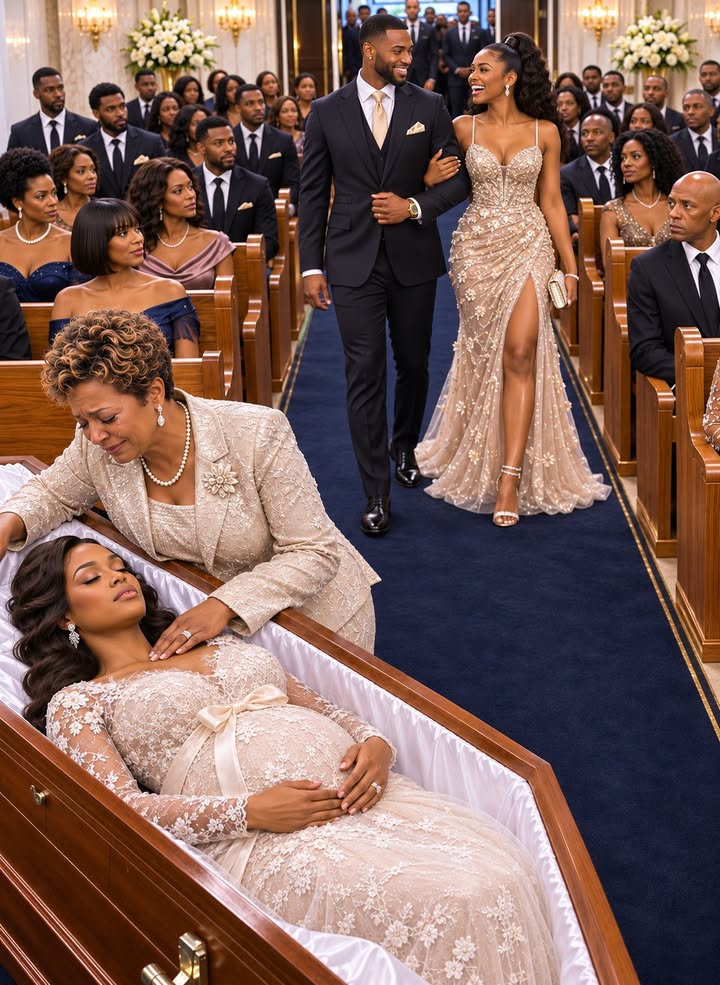
“Evan had been unfaithful during my pregnancy,” Mr. Halden read.
The words seemed to cross the church slowly, as if each one had to find its way through the stunned silence.
I held the pew in front of me, my fingers tightening around the polished wood.
Evan stared at the open pages, his face pale beneath the warm light from the stained-glass windows.
Celeste’s hand slipped from his arm.
Mr. Halden continued, his voice measured and gentle.
“I learned of his relationship with another woman, and I learned that he had been asking me to change my will while I was carrying our child.”
A murmur passed through the congregation, then faded almost at once.
I looked at Emma’s coffin.
The lilies around it were still, their white petals bright against the dark wood, and for a moment I could almost hear my daughter’s voice as I had heard it in my kitchen, trying to sound cheerful when she was anything but.
Mr. Halden read on.
“I have kept copies of messages and notes that record those conversations, not because I want anyone punished, but because I want the truth to remain clear if someone later claims I did not know my own mind.”
Evan took a step forward, but this time he did not interrupt.
His eyes had moved from the papers to the coffin, and I could not tell whether the expression on his face was grief, fear, or some uneasy mixture of both.
Mr. Halden’s tone softened as he reached the next paragraph.
“My estate is to pass to my mother, Margaret Ellis, because I trust her to put the child first.”
A sound escaped me, too small to be called a sob.
I had expected nothing.
I had not wanted Emma’s house or savings, and I had certainly never wanted them in place of her life.
The attorney paused before continuing.
“If my baby survives me, the funds I have set aside for him are to be held in trust for his care and future. No one person should have unchecked control over that money. I ask that those managing it remember that it belongs to a child who deserves love and stability, not to the adults who may argue over it.”
I closed my eyes.
Emma had thought about her baby even while she was making arrangements for a world she would not be there to see.
She had thought about him, and about me, and about the possibility that grief might turn the people around him against one another.
Mr. Halden lowered the page, then unfolded another sheet.
“There is a final statement,” he said.
Evan’s gaze snapped back to him.
“Emma asked that this be read at her service,” Mr. Halden continued, “because she wanted her family to understand the reasons for her decisions.”
He read in my daughter’s voice, though the words were spoken by someone else.
“Mom, if you are hearing this, I am sorry I could not tell you everything while I was still here.”
The church blurred around me.
I pressed my hand to my mouth and tried to breathe.
“I know you will be hurt,” Mr. Halden read, “and I know you may think you should have seen how much I was carrying. Please don’t blame yourself for the things I chose to keep quiet. I did not want you to spend your days worrying about me, and I did not want every conversation between us to become about what was wrong.”
My sister began to cry beside me.
I had remembered Emma laughing over tea, asking whether the blue blanket needed another row of stitches, and saying the baby would probably be born with a better sense of color than either of us.
I had remembered her changing the subject when I asked if Evan was coming home for dinner.
I had remembered her saying she was tired.
I had not understood how much she had hidden inside those simple words.
Mr. Halden continued.
“I want you to know I never chose you because I wanted to punish Evan. I chose you because I know the way you love, and because I believe you will help my child grow up knowing that his mother was more than the last painful months of her life.”
My knees weakened, and my sister’s arm tightened around me.
“Tell him about the garden, Mom,” the letter continued. “Tell him how you taught me to plant beans in a crooked line, and how we spent the whole summer pretending the tiny green shoots could hear us cheering. Tell him I was happy before I was frightened. Tell him I loved him from the beginning.”
I could no longer hold back the tears.
They came quietly, one after another, and fell onto my hands.
Mr. Halden’s voice broke just slightly as he read the last lines.
“And please remember that grief will make some days feel like they have no tomorrow. It will pass through us slowly, but it will not take all the love with it. I love you, Mom. I always did.”
The paper lowered.
No one moved.
The silence after Emma’s words did not feel empty.
It felt full of everything she had not had time to say, and everything I wished I had asked.
I bowed my head over the pew and wept.
For a few breaths, I was no longer standing in a church beside a coffin.
I was in my kitchen with Emma at sixteen, stealing warm biscuits from a tray while the rain tapped against the windows.
I was in the nursery with her, matching tiny socks and listening to her talk about names.
I was beside her at the garden fence, watching her kneel in the earth with one hand resting on her stomach.
Then the room returned around me, and my daughter was gone.
Mr. Halden waited before speaking again.
“Emma asked that the remainder of the service continue without discussion of the estate,” he said. “The documents will be handled privately, through the appropriate channels.”
I was grateful to him for that.
The church was not a courtroom, and Emma’s final wishes were not an invitation for anyone to argue over her coffin.
Evan remained still for several seconds.
Then he looked at me.
“Margaret,” he said, his voice lowered, “I’m sorry you had to hear that here.”
The apology landed strangely.
It had the shape of concern, but not the weight.
I could not answer him.
Celeste stood a little behind him now, her face turned toward Emma’s coffin.
For the first time since she had entered the church, she looked neither pleased nor confident.
Her lips were parted, and her eyes were fixed on the lilies.
The service resumed.
The minister spoke about life, love, and the hope that what we give to one another does not vanish when we are gone.
I heard some of the words.
Most drifted past me, leaving only the rhythm of the minister’s voice and the small sounds of people breathing through their grief.
When it was time to leave, I went to Emma’s coffin and rested my palm against the wood.
“I’ll tell him,” I whispered.
My voice was almost lost beneath the shuffle of people rising from their seats.
“I promise, sweetheart.”
The procession moved slowly toward the church doors.
Evan kept his distance from me, and Celeste did not approach.
Outside, the autumn air was cold and carried the damp scent of fallen leaves.
A few relatives gathered near the entrance, speaking softly, unsure whether to offer condolences or leave me alone.
My sister stayed beside me while Mr. Halden spoke to the minister about the arrangements.
I watched the people moving around the churchyard and felt as though I had been left behind inside the moment Emma’s words ended.
Then Mr. Halden came toward me with a slim envelope in his hand.
“This is separate from the declaration,” he said quietly.
I recognized Emma’s handwriting before I saw my name.
It was written across the front in blue ink, the same looping letters she used on birthday cards and grocery lists.
“For Mom,” I read.
Mr. Halden glanced toward the others, then back to me.
“Emma gave this to me shortly before she died,” he said. “She asked me to deliver it to you after the service, in private.”
I looked at the envelope but did not take it at once.
“Why didn’t she give it to me herself?”
The question came out sharper than I intended.
Mr. Halden did not take offense.
“She said she wanted you to hear her final wishes without this letter influencing what you might feel or decide,” he said. “I believe she wanted you to understand that the will was not written in anger.”
I swallowed.
“She knew I would never have asked for any of this.”
“Yes,” he said. “She knew.”
My thumb traced the edge of the envelope.
“How long before she died did she write it?”
“Not long,” he replied, carefully. “But I cannot tell you more than she asked me to share until you have read it.”
That answer left a quiet ache behind.
I slid the envelope into my coat pocket.
My sister touched my shoulder, and I leaned into her for a moment.
Across the courtyard, Evan had stopped near the gate with Celeste.
He seemed to be speaking to her, but she was not looking at him.
Once, she glanced in my direction.
Our eyes met, and something shifted in her expression.
It was not defiance.
It was not quite shame.
It looked like a question she did not know how to ask.
Then she turned away and followed Evan out of the churchyard.
The burial passed like a dream in which I could hear the words but could not reach the people speaking them.
The coffin descended beneath the gray sky.
When the earth was placed over it, I kept my eyes on the flowers and tried to picture Emma’s hands, warm and alive, arranging them in the nursery.
Afterward, there were embraces and quiet promises to call.
I thanked people because it was the thing a person did when she could not think of anything else.
By the time I reached home, the afternoon had thinned into evening.
My house seemed too large without my sister’s voice in the hall.
I hung my coat over the back of a chair and stood for a long while in the kitchen, staring at the blue mug Emma had used whenever she came over.
She had left it beside the sink during her last visit.
I had washed it, but somehow never put it away.
The sight of it made me understand that I had been keeping small pieces of her without knowing how much I would need them.
At last, I took the envelope from my pocket.
My hands trembled as I broke the seal.
Inside was a single folded sheet.
“Mom,” it began, “if you are reading this, you have already heard the hard parts.”
I sat down at the kitchen table.
“I wish I had been braver about telling you when I was afraid. I kept thinking I could get through each difficult week and then come to you with good news, so you would not have to worry. I can see now that this was not fair to either of us.”
I stopped reading.
The ink blurred, and I wiped my face with the heel of my hand.
Emma had always been the child who tried to make things easier for everyone.
Even as a little girl, she would save the last piece of cake for her father and tell me she preferred the icing on the edge.
She had grown into a woman who hid her own fear behind gentle excuses.
I read on.
“Please don’t let the fact that I didn’t tell you everything make you believe I didn’t trust you. I trusted you enough to know you would come running, and I was scared that if you did, I might have to admit how lonely I had become.”
The sentence seemed to open a door inside me.
Lonely.
I put the letter down and closed my eyes.
I remembered every time I had asked if she wanted me to visit, and every time she had said she was fine.
I remembered accepting the answer because I did not want to intrude.
I remembered how often I had told myself that a married woman deserved space, that she would ask if she needed help.
I had believed I was respecting her.
I had not understood she might have been waiting for me to hear the hesitation behind her words.
The letter continued.
“Evan and I were not always unhappy. I need you to remember that too. There were good years, and I was glad for them. But things changed, and I could not keep pretending they hadn’t. The baby gave me a reason to be honest about what I needed, even when I was frightened of what honesty might cost.”
I thought of Evan standing in the church with the careful suit and the expensive watch.
I thought of the way he had not cried.
Then I remembered how Emma had once defended him when I questioned his absence at a family dinner.
“He’s under pressure, Mom,” she had said, reaching for my hand. “He’s trying.”
Maybe he had been trying once.
Maybe she had loved him, even after she began to understand that love alone could not make a person stay.
The letter ended with a few lines about the nursery.
“I hope you keep the blue blankets where they are for a little while. I know it will be painful to look at them, but they are part of a happy thing we made together. If there is any way for the baby to be here, I want him to grow up in a home where people can remember me without whispering.”
I read the sentence twice.
If there is any way for the baby to be here.
Emma had written it plainly, as if she had prepared herself for possibilities she had not shared with me.
My hands went cold.
I returned to the first page, searching for some other meaning in the words.
The baby had been weeks from birth.
I had assumed he had died with her because everyone at the hospital had spoken gently and avoided giving me details while I was in shock.
No one had told me clearly.
I had not asked clearly.
The phone rang, startling me.
I stared at it before answering.
“Margaret,” Mr. Halden said, “I hope I’m not disturbing you.”
“No,” I replied. “I was reading Emma’s letter.”
“I’m glad you received it.”
“She wrote about the possibility of the baby being here.” My voice tightened. “What does that mean?”
There was a pause.
“I’m not in a position to discuss medical information tonight,” he said. “The family has not yet received a complete account, and there are privacy procedures we must respect.”
My heart began to beat harder.
“Is the baby alive?”
Another silence followed, brief but heavy.
“I understand why you’re asking,” he said. “I can only tell you that Emma’s will provides for the child if he survives her. That language was deliberate.”
I gripped the edge of the table.
“Why didn’t anyone tell me?”
“The hospital was handling the immediate medical situation, and Emma had left specific instructions about who could receive information. I’m sorry this has added to your confusion.”
I stared at the letter, at the line Emma had written about a home where people could remember her without whispering.
“I need to know what she wanted me to do.”
“You should read the letter again,” he said. “For tonight, try to rest. We can speak tomorrow about the estate and what can be shared.”
When the call ended, the kitchen seemed to grow quieter than before.
I sat beneath the yellow light, holding Emma’s letter in both hands.
For the first time since the church doors had opened, grief had to make room for something else.
Hope, perhaps.
Or fear dressed in the shape of hope.
The blue blankets were still folded in the nursery.
And somewhere beyond my reach, there was a question Emma had left behind—one that might change everything I thought I knew about the day she died.
**–END OF PART 2–CLICK “NEXT” AT THE BOTTOM OF THE PAGE TO CONTINUE READING**
* * *
[NEXT: PART 3](https://puretales.idolsgift.com/blog/part-3-the-words-emma-left-behind-034)
✓ Lynn R. Adams
“Evan had been unfaithful during my pregnancy,” Mr. Halden read. The words seemed to cross the church slowly, as if each one had to find its way through the stunned silence. I held the pew in front …