PART 2: The Words Beneath the Rose 069
Part 2 – The Words Beneath the Rose
Rose leaned closer to the pendant and began tracing the first engraved letter with her fingertip.
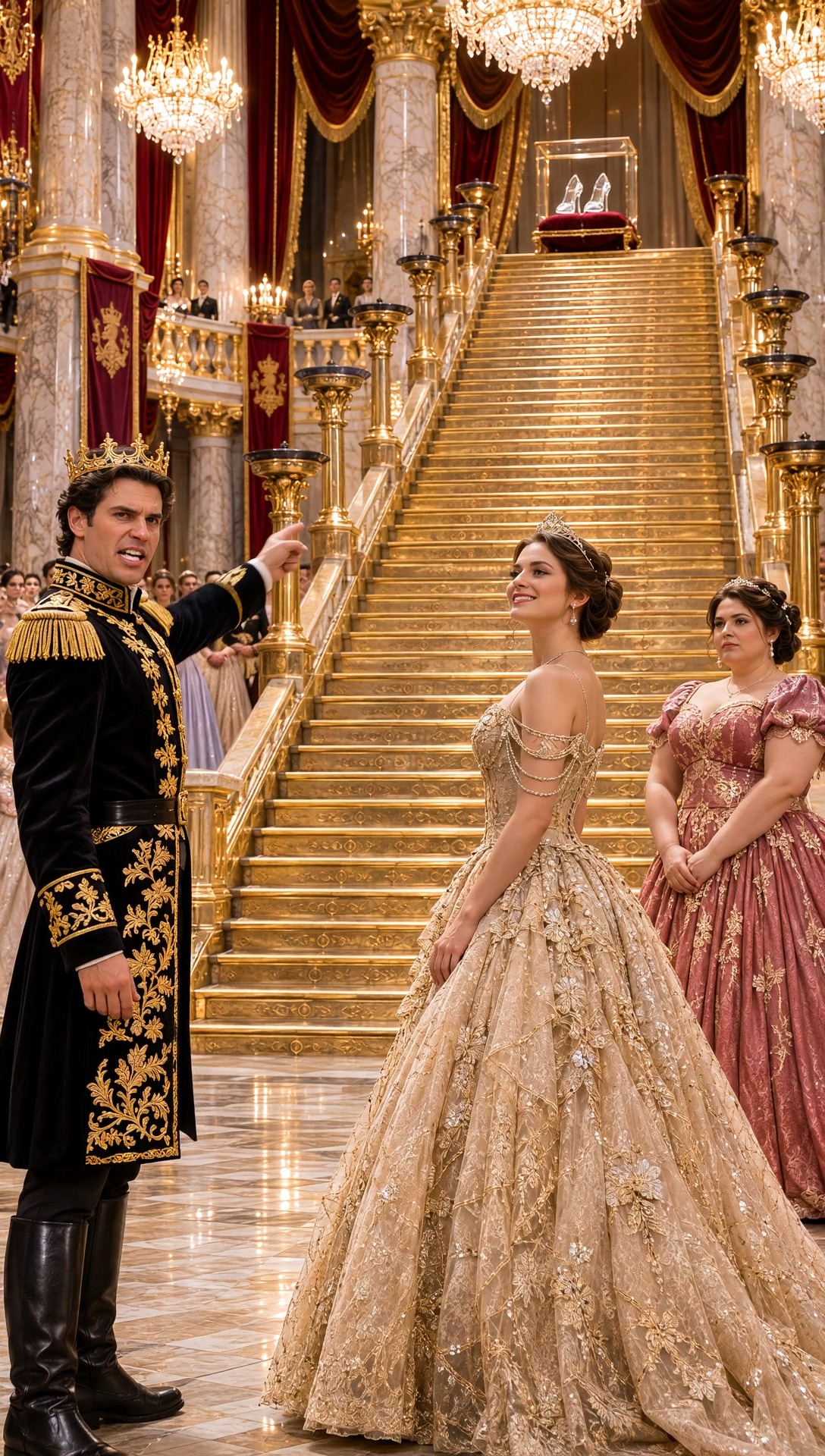
The ballroom had gone so quiet that she could hear the tiny scrape of her nail against the gold.
The inscription was faint, worn smooth by years of handling, but the words slowly emerged beneath her touch.
“For my daughter, Rose—when the sleeping bellflower blooms.”
She stopped before the final word, her finger resting on the narrow curve of the engraved letter.
The prince’s face had lost its color.
“Read it again,” he said, hardly above a whisper.
Rose did, her voice trembling now.
“For my daughter, Rose—when the sleeping bellflower blooms.”
A murmur rippled through the ballroom, but the prince lifted one hand, and the gathering fell silent once more.
He looked from the pendant to the rose engraved beneath the slipper, then at Rose’s face.
“What is your name?” he asked, though the question sounded less like a formality than a plea.
“Rose,” she answered.
“And you have never seen this pendant before?”
“Never.”
He turned the gold piece over in his palm, as if hoping another explanation might appear on its back.
“This belonged to my great-grandmother, Queen Elara,” he said. “It has been kept among the royal family’s private heirlooms for generations.”
Rose glanced at the slippers, still bright beneath the ballroom lights.
“You said they were sealed for a hundred years.”
“They were.”
His gaze moved toward the glass display case, where a narrow strip of wax still clung to the lock.
“After Queen Elara died, the slippers were placed in a case and sealed by order of the crown,” he continued. “The seal was never broken. Not until tonight.”
Rose looked down at the crystal slipper in her hands.
It fitted her foot as though it had been made for no one else.
Behind her, the noblewoman in the champagne-gold gown had gone very still.
The amusement had vanished from Lady Celestine’s expression, replaced by a look Rose could not quite read.
The prince noticed it, too, but his attention soon returned to Rose.
“Your Highness,” Lady Celestine said, finding her voice, “surely there must be some explanation for a coincidence.”
The prince held the pendant out toward her, but he did not surrender it.
“Perhaps,” he said. “But I would rather understand it before I call it one.”
Rose shifted the slippers carefully onto the cushion.
The crystal caught the light, scattering little reflections over her hands.
“I don’t know what this means,” she said. “I have never heard of Queen Elara, except in the palace histories.”
“You have lived here all your life?” the prince asked.
“Since I was a baby.”
His expression softened.
“Then perhaps we should speak somewhere quieter.”
Rose glanced around the ballroom.
Every face seemed turned toward her.
The guests were trying to be discreet, but she could feel their curiosity following her like the heat from the fire columns.
“I would rather not be the evening’s spectacle,” she said.
A hint of respect appeared in the prince’s eyes.
“Neither would I,” he replied.
He addressed the royal steward, who had been hovering at the edge of the staircase.
“Have the slippers and the pendant brought to the small council room, with their seals and records.”
Then he turned to the gathering.
“The trial is concluded for tonight,” he announced. “No decision about marriage will be made on the strength of a single evening.”
A wave of disappointed whispers passed through the ballroom.
Lady Celestine lowered her chin, her perfect posture unchanged.
Rose noticed how carefully the woman folded her hands, as though keeping her fingers from revealing what she felt.
The prince offered Rose his arm.
She hesitated.
“I’m only a palace servant,” she said quietly. “I don’t know the proper way to behave in a council room.”
“You climbed a hundred moving steps while half the court watched,” he said. “I suspect you can manage a room.”
The warmth in his voice steadied her, though it did not make the moment feel less unreal.
Rose took his arm, mindful of the slippers being carried ahead of them.
As they left the ballroom, the music started again behind them, but it sounded thinner than before.
The corridor beyond was cooler and dimmer, lined with portraits whose painted eyes seemed to follow the procession.
Rose glanced toward them.
Queen Elara’s portrait hung near the end of the gallery.
The old queen wore a green velvet gown and a narrow gold circlet, her silver hair braided over one shoulder.
Around her neck was a pendant with the same rose emblem.
Rose slowed.
The queen’s painted eyes were kind, though solemn.
“Does she look familiar to you?” the prince asked.
“No,” Rose said, then paused. “But I feel as though I should know her.”
He studied the portrait beside her.
“I was told she was a thoughtful woman,” he said. “More interested in gardens and music than court ceremonies.”
“That sounds like a lonely way to be remembered.”
“Perhaps it is.”
For a few steps, they walked in silence.
Then the prince introduced himself properly, though they had both known his name since childhood.
“Adrian,” he said. “When we’re away from the court, you may call me that.”
“Rose,” she replied. “When we’re away from the court, you may still call me Rose.”
A quiet laugh escaped him.
It surprised her that he could laugh at a moment like this, and it surprised him, too; the sound seemed to loosen something in his shoulders.
“I’m glad we have settled that,” he said.
The small council room was not one of the grand chambers Rose had dusted for state visits.
It was a modest room overlooking the palace gardens, with shelves of ledgers and old maps, a broad oak table, and a brass bell on the mantel.
The night rain tapped lightly at the windows.
The steward had placed the slippers, pendant, and a small box containing the unbroken wax seal on the table.
A royal archivist, summoned from his rooms, stood nearby with a leather-bound register tucked under one arm.
Rose hovered at the doorway.
Adrian noticed and pulled out a chair for her.
“You needn’t stand,” he said.
“Thank you.”
She sat, then folded her hands in her lap to hide the faint tremor in them.
Adrian took the chair opposite her.
The archivist set down his register and opened it to a marked page.
“Queen Elara’s slippers were entered into the royal inventory in the year of her death,” he said. “The seal was witnessed by the queen’s physician and two members of the household.”
“Was anything written about why they were locked away?” Adrian asked.
The archivist ran a finger down the page.
“Only that they were to remain untouched until the proper occasion.”
“What occasion?”
“No further explanation is recorded.”
Rose looked at the slippers.
“Then how did anyone know they were meant to be part of a trial?”
Adrian frowned.
“I don’t know.”
The archivist examined the case seal and confirmed that the wax had been intact before the evening’s ceremony.
He spoke carefully, as though each word carried the weight of a public record.
“The locking mechanism was opened by the steward under the king’s authority, and the seal was broken in full view of the court.”
Rose watched the candlelight tremble over the glass.
Whatever had happened, she knew she had not altered the slippers or the seal.
She had only tried them on.
Adrian drew the pendant toward him, then hesitated.
“May I?” he asked.
Rose nodded.
He lifted it by its fine chain, turning it so the worn inscription caught the light.
“Queen Elara wore this whenever she traveled beyond the palace,” he said. “My grandmother told me that when I was small.”
“Did your grandmother ever mention a daughter named Rose?”
“No.”
He lowered the pendant onto the table.
“Then the records may have been incomplete.”
The archivist shifted uneasily.
“Royal records are not always as complete as we might wish, Your Highness.”
“Do you know something?” Rose asked.
The question came out gently, but it made the room still.
The archivist met her eyes.
“I know that old documents are often lost, misfiled, or written in ways that later generations fail to understand,” he said. “I know nothing more than that.”
It was a cautious answer, but not a dishonest one.
Rose appreciated the distinction.
Adrian looked at her, perhaps noticing that she had not pressed him.
“You have a good way of listening,” he said.
“I’ve spent years learning what people don’t say.”
The words slipped out before she could soften them.
Adrian’s face changed, not with pity, but with attention.
“Is that how you came to live here?”
Rose glanced toward the window, where the dark garden lay beyond the rain.
“I don’t remember arriving,” she said. “I was a baby.”
The archivist closed the register, sensing that the conversation had turned private.
Adrian waited.
Rose did not often speak about her beginnings.
The late head housekeeper, Mistress Bell, had raised her with warmth and practical kindness, but had never pretended to know more than she did.
“She found me in the palace nursery,” Rose continued. “I had been left there in a basket, with no letter and no name.”
“Except Rose?” Adrian asked.
“Mistress Bell gave me that name.”
Rose touched the edge of the table, feeling its smooth grain beneath her thumb.
“She said a small rose-shaped birthmark showed beneath my left shoulder, so she chose a name that suited me.”
The prince’s attention sharpened.
“Do you still have it?”
“Yes.”
Rose drew a breath.
“It’s only a birthmark, Your Highness. There may be many people in the kingdom with one.”
“Of course,” Adrian said at once. “I didn’t mean to make you feel examined.”
The apology came so quickly and so plainly that Rose looked up at him.
He seemed to mean it.
“I didn’t,” she said. “I’m just trying to understand why a queen would leave a pendant for a daughter named Rose.”
Adrian leaned back slightly.
“So am I.”
She had expected him to speak as a prince, to begin arranging people and answers around her.
Instead, he seemed just as uncertain as she was.
That uncertainty made him feel less distant.
“Mistress Bell never knew who left me?” he asked.
“She said she was told only that I had been found before dawn, when the nursery was being prepared for the day.”
“Was there anything with you?”
Rose shook her head.
“Only a blanket, and the birthmark.”
“No family token?”
“Nothing.”
The archivist glanced down at the pendant.
“Your Highness, the inscription may refer to a different Rose,” he said. “The name is not uncommon.”
“That’s true,” Rose replied.
She surprised herself by saying it.
The hope rising in her had begun to frighten her, and she did not want to mistake a beautiful possibility for proof.
Adrian gave her a grateful look.
“We need evidence,” he said. “And time to examine the records.”
The archivist nodded.
“I can begin with Queen Elara’s household ledgers and the inventories from the year the slippers were sealed.”
“Could there be a private archive?” Rose asked.
“There is a royal archive in the eastern wing,” he said. “Some documents remain uncatalogued.”
“Then we’ll look there tomorrow,” Adrian said.
The word we seemed to settle between them.
Rose looked at him.
“You want me to help?”
“I do,” he said. “You have a right to know why your name is on that pendant, if there is a connection.”
“But I’m not a historian.”
“Neither am I.”
His answer drew a smile from her.
“I thought princes were taught everything.”
“We’re taught to look confident while asking someone else.”
Rose laughed softly, and Adrian smiled in return.
For the first time since the staircase, the room felt less like a place where a mystery was being inspected and more like a place where two people had found something worth understanding together.
The archivist began gathering his papers.
“I’ll bring the relevant registers to the archive at first bell,” he said. “Until then, I recommend we keep this evening’s details within the palace.”
Adrian nodded.
Rose understood why.
A court hungry for stories could turn a question into a claim before the truth had time to breathe.
As the archivist left, Lady Celestine appeared in the open doorway.
She had removed her gloves, and her fingers were folded around them.
“Your Highness,” she said. “I hope I am not interrupting.”
Adrian stood.
“Not at all.”
Celestine’s gaze moved to Rose.
“May I speak with you for a moment?”
Rose did not know what to expect.
The woman had laughed at her before the trial, and she had watched the slippers fit Rose with an expression that was difficult to forget.
Adrian seemed ready to remain, but Rose gave him a small nod.
“It’s all right.”
He stepped toward the window, granting them a little privacy without leaving the room.
Celestine came closer to the table.
“I owe you an apology,” she said.
Rose blinked.
“For what?”
“For the way I spoke to you in the ballroom.” Celestine paused, her gaze lowering to the gloves in her hands. “I assumed the slippers could not possibly fit you, and I spoke as though that made your attempt foolish.”
“You were surprised.”
“That is not an excuse.”
Rose studied her face.
Celestine’s beauty was polished and deliberate, but beneath it Rose could see the strain she had noticed in the ballroom.
“I accept your apology,” Rose said.
Celestine let out a breath she might have been holding.
“I did not expect you to be the one who reached the summit,” she said. “When I saw the rose on the slipper, I thought—”
She stopped.
“What did you think?” Rose asked.
For a moment, Celestine seemed to consider saying more.
Then she tightened her grip on the gloves.
“Nothing useful,” she said. “Only that my family has kept old stories for too long, and that some of them have made our name heavier than it ought to be.”
Adrian turned from the window.
“Your family knows something about Queen Elara?”
“Not enough to offer an answer tonight,” Celestine replied. “But I may be able to help you find the right records.”
Her gaze settled on Rose again.
“If you’ll allow it.”
Rose felt the wariness in herself, but also the sincerity in Celestine’s careful voice.
“Why would you help me?”
“Because I was wrong about you,” Celestine said. “And because an old silence should not be mistaken for the truth simply because it has lasted a long time.”
The answer seemed to cost her something.
Rose nodded.
“Then I would be glad of your help.”
Celestine’s shoulders eased, though her expression remained troubled.
She looked once more at the pendant.
“Do you know what a sleeping bellflower is?” Rose asked.
“Not yet,” Celestine said. “But I can find out.”
After Celestine left, Adrian returned to his chair.
“You were kinder to her than she expected,” he said.
“I don’t know what she expected.”
“Neither do I.”
Rose glanced toward the door through which Celestine had gone.
“I think she is frightened of something,” she said. “That doesn’t mean I know what.”
Adrian considered this.
“You don’t rush to judge people.”
“I’ve been judged often enough to know it rarely tells the whole story.”
The prince looked at her for a long moment.
“I’m glad you said yes to helping.”
“So am I,” Rose replied, though the words carried a tremor of uncertainty. “I’m also afraid I’ll find out I’m only a coincidence.”
“Then we’ll find out together.”
He said it simply, without promising that the answer would be comforting.
Rose felt the difference.
The next morning, a pale ribbon of sunlight stretched across the palace’s eastern corridor.
The archive occupied a long, cool wing above the old chapel, where shelves rose nearly to the ceiling and the air smelled of paper, dust, and cedar.
Rose arrived before Adrian.
She had dressed in a plain blue gown and pinned her hair back in the way she wore it for work.
The slippers were not there.
The pendant had been placed in a small velvet-lined box, guarded by the archivist’s clerk.
Rose paused at the threshold.
She had cleaned the archive many times, but she had never been invited to search its records.
Adrian came in moments later, carrying two cups of tea.
“I thought we might need these,” he said.
“You remembered I take mine with honey.”
“You mentioned it when the kitchen staff brought refreshments last night.”
Rose accepted the cup.
“That was attentive of you.”
“I’m trying to be more attentive than theatrical.”
“That may be wise for a prince.”
He smiled, then drew a chair beside the long table.
The archivist had prepared bundles of records from the years surrounding Queen Elara’s death.
Rose and Adrian began with inventories, household accounts, and lists of guests who had visited the palace.
At first, the pages gave them little.
There were descriptions of carpets, silver dishes, gardens, and winter stores.
There were records of repairs to a music room and a bill for the queen’s favorite roses.
But no daughter named Rose.
No sleeping bellflower.
As the morning passed, Rose’s shoulders tightened.
She tried to hide her disappointment by reading faster.
Adrian noticed.
“Take a breath,” he said quietly. “We have more time than the papers suggest.”
“I don’t want to waste it.”
“You aren’t wasting anything.”
She looked at him over the ledger.
“You sound certain.”
“I’m certain that if we rush, we’ll miss what matters.”
Rose let the page fall open beneath her hand.
“That is probably why you’re a prince.”
“I thought we had agreed princes were mostly good at looking confident.”
“Perhaps you are learning to do both.”
Their shared smile eased the strain between them.
Near midday, the archivist brought a narrow bundle tied with faded green cord.
“Queen Elara’s personal correspondence,” he said. “Most of it concerns household matters, but there are a few letters from her private secretary.”
He placed the bundle before them.
Rose loosened the cord carefully.
The top letter was written in a hand that slanted sharply across the page.
The next was a list of appointments.
Beneath those was a small folded note with no date and no official seal.
Rose opened it.
The paper was blank.
She turned it over.
Nothing.
“It may have faded,” Adrian said.
Rose held the paper near the window.
The light passed through, revealing a faint impression pressed into the fold.
Letters, not written in ink, but in the pressure of a pen.
She traced the marks gently.
“Can we make them out?” Adrian asked.
“I think so.”
Rose angled the page until the faint lines emerged.
Only a few words were clear.
She read them slowly.
“Bellflower… beneath the blue glass…”
Adrian leaned closer.
The archivist drew a breath.
“Is there more?”
“Not that I can see.”
Rose turned the paper again, searching for another impression.
Beneath the first line, a second set of letters showed through.
“Ask the keeper of the winter garden.”
Adrian looked toward the archivist.
“Who was that?”
The older man went pale with recognition.
“There was once a keeper of the winter garden named Oren,” he said. “He served Queen Elara until the year she died.”
“Is he still alive?” Rose asked.
“No,” the archivist said. “But his records may be.”
He crossed to a shelf and pulled down a thin catalogue.
His finger moved across the entries, then stopped.
“The winter garden’s ledgers were transferred to the eastern archive after the palace was renovated,” he said. “They were never added to the general collection.”
Adrian stood.
“Then we should find them.”
The archivist looked toward the corridor.
“I can send a clerk.”
“No,” Rose said, rising before she could reconsider. “If we all go, we may find them faster.”
Adrian offered her a questioning look.
Rose felt the old instinct to step back, to leave matters of the palace to people who belonged in its records.
But she had been invited.
And the words on the paper had been written for someone to discover.
“I’d like to come,” she said.
“Then we’ll go together,” Adrian replied.
The eastern archive lay behind a narrow door near the old greenhouse, a room most palace staff used only when searching for long-forgotten furnishings.
Inside, shelves stood beneath a sloping ceiling.
The air held the cool, earthy scent of clay pots and dried leaves.
They found the winter garden ledgers in a wooden chest marked with a faded crest.
The archivist opened it.
Several books had warped from dampness, and their pages stuck together at the edges.
Rose reached for the oldest ledger.
A pressed flower slipped from between its pages and landed on the table.
It was a dried bellflower, pale blue and delicate as tissue.
Beneath it lay a small card.
The ink had nearly vanished, but the name on the front remained legible.
Elara.
Rose’s throat tightened.
Adrian turned the card over.
There were only two lines, written in the same sharp hand as the note they had found.
“The sleeping bellflower will bloom when the right child comes home.”
No one spoke.
The archivist leaned over the card, his eyes narrowing.
The words seemed to change the room around them.
Rose pressed her fingers to the edge of the table.
A child.
The word felt more intimate than daughter, more real than an old royal story.
Adrian looked at her, and she saw that he understood the difference.
“This doesn’t prove anything about you,” he said gently.
“I know.”
“But it means Queen Elara was writing about a child.”
Rose nodded, though her mouth had gone dry.
The archivist lifted the card by its edges.
“There may be another book,” he said. “The winter garden keeper recorded every plant that was brought to the palace.”
They searched the chest until the light began to fade.
The old ledgers held rows of careful notes, each plant named and dated.
In one, beneath the heading for the winter garden’s blue glass house, Rose found a brief entry in the margin.
“Bellflower bulbs received by the queen’s request; to remain sleeping until the appointed season.”
The words had been written decades before the slippers were sealed.
Adrian studied the page.
“Why would a queen leave a flower waiting for an appointed season?”
“Perhaps she was speaking of something other than the plant,” Rose said.
The archivist nodded.
“Old families often use flowers as symbols. But without context, we can only guess.”
Rose looked at the faded entry.
The phrase from the pendant had seemed like an odd flourish.
Now it sounded like a promise.
She folded her hands together, trying to keep her thoughts from racing ahead.
“What if the child never came home?” she asked.
Adrian’s expression was steady.
“Then we owe it to her to learn why.”
Rose looked down at the ink, then at the dried blue flower.
For the first time, she allowed herself to imagine that the pendant might have been meant for someone like her.
Not a servant with an ordinary name.
Not a girl who had grown up among corridors and kitchens.
A daughter remembered by a queen.
She was afraid to give that thought too much space.
Then the archivist turned the ledger over to examine its binding.
A loose sheet had been tucked beneath the back cover, hidden between the boards.
It was not part of the garden record.
The paper was newer than the ledger, and the writing was hurried.
Adrian eased it free.
At the top, someone had written a family name in dark, unmistakable ink.
Celestine.
And beneath it, in a single unfinished line, were the words:
“The child was carried from the palace by a woman of House Celestine, who swore that she…”
**–END OF PART 2–CLICK “NEXT” AT THE BOTTOM OF THE PAGE TO CONTINUE READING**
* * *
[NEXT: PART 3](https://storyly.idolsgift.com/blog/part-3-the-words-beneath-the-rose-069)
✓ Lynn R. Adams
Part 2 – The Words Beneath the Rose Rose leaned closer to the pendant and began tracing the first engraved letter with her fingertip. The ballroom had gone so quiet that she could hear the tiny scra…