PART 2: The Word That Changed Everything 027
Part 2 – The Word That Changed Everything
“My son tried to say something.”
Rosalind’s words seemed to thin the air between us.
I looked from her face to the page in her hand, where a series of numbers had been written beside a time stamp.
“What did he say?” I whispered.
She swallowed, then answered as if the word still hurt to speak.
“Sunshine.”
For a moment, I couldn’t move.
The only sounds in the office were the quiet hum of the radiator and the faint ticking of the clock on Rosalind’s desk.
“Are you sure?” I asked.
“No.” Her fingers tightened around the paper. “That is the honest answer. His mouth moved, and the monitor registered a change. The nurse thought she heard a word, but it was so faint she couldn’t be certain.”
“Could it have been something else?”
“It could have.”
Rosalind looked down at the chart, then back at me.
“But it was the clearest sound he has made in forty-nine nights.”
I pressed one hand to my chest, where my heart seemed to be trying to escape.
“Was it after Poppy sang?”
“Several minutes after she left.”
Her voice cracked on the last word.
She turned the chart toward me and pointed to a small notation beside the time.
“Nurse Alder recorded the change. She saved the monitor readings, too. His pulse increased while Poppy was singing, then settled. A few minutes later, it rose again, and that was when his mouth moved.”
I studied the page, though the numbers meant little to me.
“That doesn’t prove he heard her.”
“No,” Rosalind said. “It doesn’t.”
She spoke carefully, as though refusing to let herself reach for hope too quickly.
“It doesn’t prove the song caused anything. It doesn’t tell us whether he understood it, or even whether he was aware of the room. The doctors will say the same.”
Her hand trembled as she set the chart down.
“But something happened.”
I thought of Poppy’s small fingers wrapped around Matthew’s hand.
I thought of her solemn voice telling him it was all right to be scared.
“She didn’t know who he was,” I said. “She didn’t understand what the machines were for.”
“That may be why she wasn’t afraid of him.”
The words came so quietly that I almost missed them.
I looked at Rosalind, whose face seemed suddenly older than it had a moment before.
“Why did you call me in here?” I asked. “If the doctors don’t know what it means, what do you want from me?”
For several seconds, she didn’t answer.
Then she rose from behind her desk and crossed to the tall windows.
Beyond the glass, the estate’s gardens lay under a pale winter sky, the bare branches holding still in the cold.
“I want to ask you something, and I want you to understand that I am not ordering you.”
I waited.
“Would you consider bringing Poppy back to see Matthew?”
The question startled me so badly that I took a step backward.
“Back?”
“Yes.”
“Mrs. Sterling, I can’t let her wander into that room again.”
“I agree.”
“She’s three. She doesn’t understand that there are rules she could break.”
“Then we make sure she doesn’t have to find the room herself.”
I glanced toward the office door, thinking of the security cameras, the silent men posted in the hall, and the medical wing she had forbidden me to enter.
“Why would you ask this of me?”
“Because you’re her mother,” Rosalind said. “And because whatever happened, she was gentle with him. I would like to know whether he responds again.”
“That sounds like an experiment.”
“I don’t want it to be one.”
She turned from the window.
“I don’t want your daughter tested, and I don’t want anyone telling her to perform. If you agree, she can visit only because she wants to. You’ll stay beside her. I’ll be there the entire time.”
I searched her expression for the cold certainty I had seen when she first accused me of letting Poppy enter the room.
Instead, I found fear.
Not anger.
Not the brittle impatience of a woman who expected everyone around her to obey.
Fear, plain and unguarded.
“You’re asking me to bring my little girl into a house where she isn’t welcome,” I said.
Rosalind flinched.
“I understand why you feel that way.”
“Do you? I was hired to clean, not to bring my daughter near your son.”
“You were hired because you needed work, and I have no right to make your child carry the weight of my hope.”
That answer disarmed me more than an argument would have.
She returned to her chair and lowered herself into it.
“I can’t promise Matthew will respond. I can’t promise this means anything. But if he does respond, I would like a chance to notice it.”
“And if he doesn’t?”
“Then we leave him in peace.”
The carefulness of her answer made my eyes sting.
I knew what it was to hope for a sign from someone you had lost.
My father had died when I was young enough to remember his hands but not his voice clearly.
For years, my mother had kept his old work jacket on a hook in the hall, though she never admitted she was waiting for his scent to fade.
When Poppy was born, I had promised myself I would never make her responsible for repairing an adult’s sadness.
“I won’t ask her to sing,” I said.
“Nor will I.”
“And she doesn’t stay if she gets frightened.”
“Of course.”
“If she wants to leave, we leave.”
“Immediately.”
“And you won’t tell her she has to help him.”
Rosalind closed her eyes briefly.
“I promise.”
I looked down at the chart again.
The word had been so small.
Sunshine.
Maybe it was only a sound shaped by the movement of a mouth.
Maybe it was a hopeful nurse hearing what she needed to hear.
Or maybe, for one fleeting moment, Matthew Sterling had found a way to reach back toward the little girl who had treated him like a lonely person instead of a famous one.
“I’ll ask Poppy,” I said.
Rosalind’s shoulders loosened slightly.
“Thank you.”
“Don’t thank me yet. She may say no.”
“I won’t persuade her.”
“And I’m staying beside her the whole time.”
“I will, too.”
She stood, but did not reach for me or try to close the distance between us.
“Would you like to see the readings?” she asked.
I nodded.
Rosalind turned the chart so I could see the monitor printout beneath it.
A narrow line ran across the page, mostly steady, with small peaks and dips marked in ink.
She pointed to the section where Poppy had been in the room.
“There.”
The line rose in several brief steps, then eased back down.
“And here,” she said, indicating a separate mark a few minutes later.
“The nurse recorded the mouth movement at this point.”
I couldn’t read the numbers, but I could see that the second change was real.
“Did the doctors see it?”
“They did. They said it was not enough to establish awareness. They’ve asked Nurse Alder to continue documenting everything.”
“Do you want me to tell Poppy what happened?”
“Only what feels right to you.”
I studied Rosalind’s face.
“Why do you want her there so much?”
Her gaze shifted to the window again.
For a long moment, she seemed to be looking at something far beyond the winter garden.
“I have kept his room closed to everyone except medical staff.”
I thought of the rule she had given me when I first arrived.
Never enter the second-floor medical wing.
“I assumed it was for privacy.”
“It was.”
She paused.
“And because I couldn’t bear to watch him suffer.”
The confession was almost inaudible.
I had imagined Rosalind as a woman who could walk through any room without hesitation, who made every decision before anyone could question her.
Now her hands were clasped in her lap, her eyes fixed on the paper.
“I told myself that staying away was respect,” she continued. “I told myself I was giving the doctors room to work. But the truth is that I could not sit beside him and see him lying there without being able to do anything.”
I knew that helplessness.
It was the feeling of sitting in a hospital chair at two in the morning, watching a loved one sleep beneath a blanket while machines measured things you couldn’t fix.
“Have you been to see him?” I asked.
“From the doorway. A few times.”
“Not in the room?”
She shook her head.
“I have not touched his hand since the crash.”
The admission changed something in me.
Not enough to make the mansion feel less intimidating, or to erase the way she had locked the office door.
But enough to make me see that the rule had not been built from cruelty.
It had been built around a hurt she didn’t know how to approach.
“When was the last time you spoke with him?” I asked.
“On the night of the accident.”
Rosalind’s eyes lowered to the chart.
“He called me. I was in the middle of a meeting, and I assumed it was about another business disagreement. I let it go to voicemail.”
She stopped speaking.
“Did he call back?”
“He left a message. I didn’t listen to it until the next morning.”
The room fell still.
I didn’t ask what the message said.
Her face told me it remained somewhere inside her, unopened no matter how many times she had heard it.
“I’m sorry,” I said.
She looked up, startled by the kindness.
Then she nodded once.
“I am, too.”
A soft knock interrupted us.
Rosalind opened the office door, and Nurse Gwen Alder stood in the hallway with a small tablet in her hands.
Her expression was cautious, but not unfriendly.
“Mrs. Sterling, the doctor has finished his rounds,” she said. “He asked me to pass along that Matthew’s condition remains stable.”
“Thank you, Gwen.”
Gwen’s gaze moved to me.
“And the readings have been added to his file, as requested.”
“Were you the one who heard him?” I asked.
Gwen glanced at Rosalind before answering.
“I heard a sound. I can’t say with certainty what it was.”
“But you thought it might be a word.”
“I thought it sounded like one.”
She spoke without exaggeration.
That honesty helped me trust her more than a confident answer would have.
“Can I ask you something?” I said. “When Poppy was in there, did she seem frightened?”
“No. She was calm.”
“Was he?”
Gwen’s expression softened.
“I don’t know what he felt. The monitor showed a small change in his heart rate, but those changes can happen for many reasons.”
“I understand.”
“I’m glad you do,” Gwen said. “It’s important that no one places expectations on the child or on Matthew.”
Rosalind nodded.
“That’s exactly what we discussed.”
Gwen studied her for a moment, perhaps checking whether she meant it.
Then she gave a small, approving nod.
“If you decide on a visit, I’ll be present, and I’ll keep it brief.”
“Thank you,” Rosalind said.
I had not expected to find an ally in the nurse, but her steady manner made the medical wing seem slightly less like a forbidden world.
“Poppy is downstairs,” I told them. “I need to ask her first.”
“Of course,” Rosalind said.
She unlocked the office door completely and stepped aside.
The corridor beyond was silent.
My legs still felt weak when I walked away from her office.
Poppy was waiting in the small staff sitting room, curled in a chair with her gray rabbit pressed beneath her chin.
She had coloring pencils spread across the table, but the page in front of her was mostly empty.
When she saw me, her eyes brightened.
“Mama, I drew Bunny’s ear.”
She held up the rabbit, showing me the patch where one ear had been restitched in pale thread.
“You did a beautiful job,” I said, sitting beside her.
She leaned against my shoulder.
“Did the sleepy man wake up?”
I looked at the picture on the table.
“No, sweetheart. He’s still sleeping.”
“Does he know I went?”
“I don’t know.”
Poppy turned the rabbit in her hands, smoothing its worn fabric.
“Was he lonely?”
The question came so simply that I had to take a breath before answering.
“I think he might have been.”
“Can I say good night again?”
I had been prepared to explain the risks.
I had been prepared to tell her the house had rules and that the room belonged to the doctors now.
But she had asked gently, without excitement or pride.
Only kindness.
“Would you like to?” I asked.
She nodded.
“Yes. But I can go if he doesn’t want me.”
I kissed her forehead.
“That’s a very kind thing to say.”
When I led her back to the office, Rosalind was standing beside the door with Gwen.
She had removed her formal jacket and draped it over one arm, as though she had been waiting without wanting to look as if she were waiting.
“Poppy,” she said, lowering herself to the child’s height. “Would you like to visit Matthew for a few minutes?”
Poppy held Bunny close.
“Is he the sleepy man?”
“Yes.”
“Can my mama come?”
“Your mama will stay beside you the entire time.”
“And you?”
“I’ll be there, too.”
Poppy considered this, then nodded.
“Okay.”
Rosalind’s face changed.
It was not a smile, exactly.
It was the look of someone being handed a fragile thing and realizing how carefully she must hold it.
The walk to the medical wing seemed longer than it had the first time.
We passed two security men, both of whom stepped aside without speaking.
Poppy held my hand with one hand and her rabbit with the other.
Rosalind walked ahead of us, but she slowed every few steps to make sure we were still close.
At the heavy door, she stopped.
For a moment, she rested her fingers on the handle without turning it.
“I haven’t gone in since the accident,” she said.
Gwen’s voice was gentle.
“You can enter when you’re ready.”
Rosalind took a careful breath.
Then she opened the door.
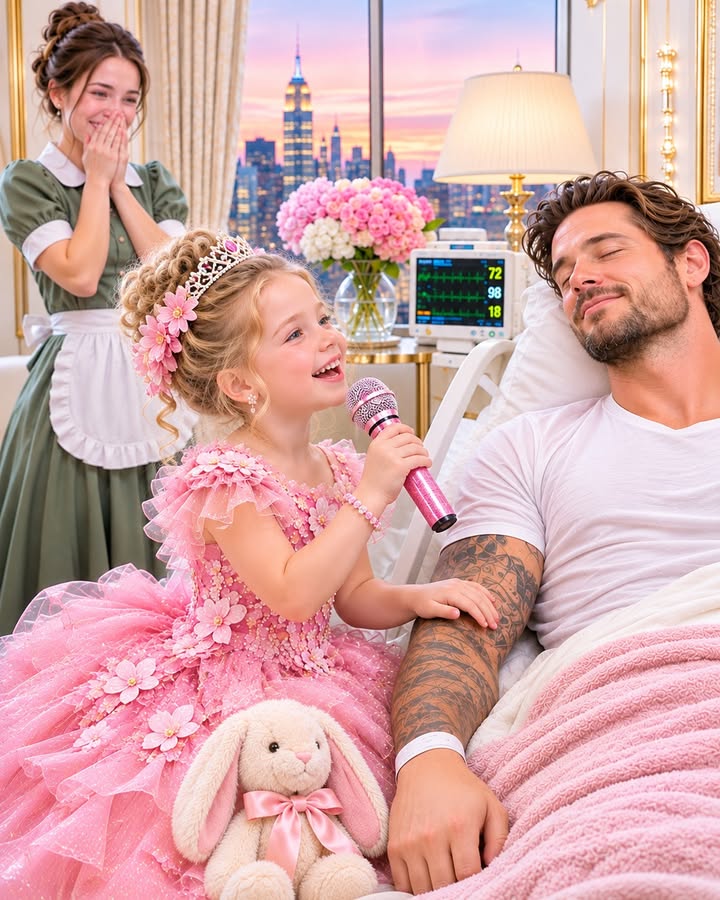
The room was warm, dimly lit, and filled with the quiet rhythm of machines.
Matthew lay beneath the white sheets, his face pale against the pillow.
He looked younger than the portraits in the main hall, where he appeared stern and untouchable in dark suits.
Without those portraits, without the sharp angles of wealth and authority, he looked only tired.
Poppy stopped at the threshold.
“That’s him,” I whispered.
She nodded but did not rush forward.
Rosalind entered first and moved to the side of the bed.
Her hand hovered above Matthew’s blanket, then lowered to the rail instead.
I guided Poppy to the chair beside him.
She climbed up only after I helped her, then set Bunny on her knees.
“Hello, mister,” she said softly.
The monitor continued its steady rhythm.
Poppy glanced at me.
“Can I sing?”
“If you want to,” I said. “You don’t have to.”
“I want to.”
She began with a low, tentative hum.
The first notes of *You Are My Sunshine* floated through the room, barely louder than a whisper.
I felt Rosalind’s attention sharpen beside me.
Gwen watched the monitor, not Poppy, as if determined not to turn the child into a performance.
Poppy sang the song slowly, stumbling once over a word, then starting the line again.
Her voice was small, but there was nothing uncertain in the way she offered it.
When she finished, she pressed Bunny against her chest.
“I have this rabbit because my daddy died,” she told Matthew.
My breath caught.
Poppy did not look at me.
She stared at his still face, her expression solemn.
“Mama says we miss him because we loved him. Bunny helps when I miss him a lot.”
I felt my eyes burn.
Rosalind’s hand tightened around the bed rail.
Poppy lifted one finger and gently touched Matthew’s knuckle.
“I don’t know if you miss your mama,” she said. “But she’s here.”
Rosalind closed her eyes.
A thin line on the monitor shifted upward.
Gwen leaned toward the screen but said nothing.
Poppy kept her fingertip on Matthew’s hand, light as a feather.
Then she looked up at Rosalind.
“Are you his mama?”
“Yes,” Rosalind answered, her voice unsteady.
“Then you can tell him you’re here.”
Rosalind drew in a breath that trembled all the way through her.
She leaned closer to the bed.
“Matthew,” she whispered. “It’s Mother.”
For the first time since we had entered the room, she touched him.
Her fingers rested against his hand, careful and still.
“I’m here.”
The monitor gave one brief rise, then settled.
No one spoke.
I watched Rosalind’s face, wondering what that tiny change meant to her.
The moment did not prove anything.
It did not wake Matthew or erase the long nights between the crash and now.
But it gave his mother a reason to stay beside his bed.
After a minute, Poppy began to slide from the chair.
“I’m done,” she said.
I lifted her down.
“That’s all right.”
She tucked Bunny under her arm and turned toward the door.
Rosalind remained by the bed, her hand still resting against Matthew’s.
As we reached the threshold, she finally looked up.
“Thank you,” she said.
Poppy waved at Matthew.
“Good night, mister.”
Then we left the room with Gwen, and Rosalind stayed behind.
That evening, after Poppy was asleep, I sat in the small room the estate had given us and thought about the quiet change in the monitor.
I reminded myself that numbers could rise for countless reasons.
I reminded myself that a song was not medicine, and a little girl was not responsible for a grown man’s recovery.
Still, I could not stop thinking about the way Rosalind had touched her son’s hand only after Poppy invited her to.
A soft knock sounded at the door.
Rosalind stood in the hallway, holding a thin sheet of paper.
“I’m sorry to come so late,” she said. “I wanted you to see the new reading before you decided what to make of today.”
I invited her in.
She placed the page on the table beside my chair.
“It happened after you left the room,” she said. “Gwen was still there. I was, too.”
I looked at the recorded line.
It showed another small shift in Matthew’s pulse, followed by a brief, uneven pattern.
“What does it mean?” I asked.
“The doctor says it may mean nothing.”
Rosalind paused.
“But Gwen noticed his lips move again.”
I looked up.
“Did he say something?”
“No.”
Her eyes stayed on mine.
“Not clearly.”
The room seemed to grow quiet around us.
“What did you hear?”
Rosalind’s fingers rested on the edge of the paper.
“I heard him try to form another word.”
“Which word?”
She looked toward the sleeping child in the next room, then back at me.
“I think he was trying to say ‘Mother.’”
**–END OF PART 2–CLICK “NEXT” AT THE BOTTOM OF THE PAGE TO CONTINUE READING**
* * *
[NEXT: PART 3](https://puretales.idolsgift.com/blog/part-3-the-word-that-changed-everything-027)
✓ Lynn R. Adams
Part 2 – The Word That Changed Everything “My son tried to say something.” Rosalind’s words seemed to thin the air between us. I looked from her face to the page in her hand, where a series of numb…