Part 2: The Winter Daughters-039
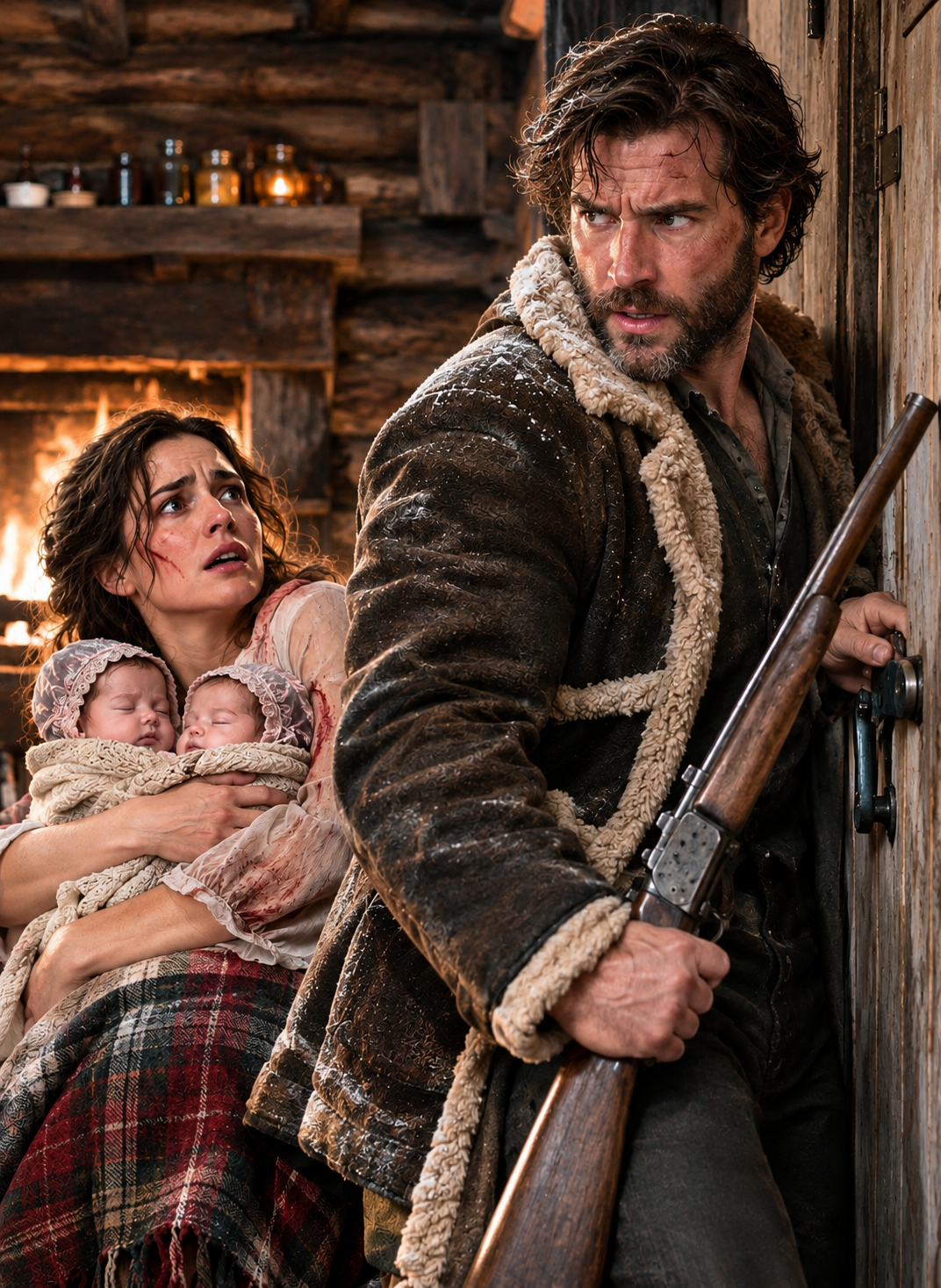
“Please… don’t open that door.”
Mara’s whisper barely rose above the crackle of the fire, yet every word seemed to sharpen the silence inside my cabin.
I kept one hand around the rifle and stared at the wooden door.
The footsteps outside had stopped.
No pacing.
No muttered conversation.
Whoever stood on the other side was waiting.
Behind me, one of the newborn girls gave a small, sleepy sound from the wooden crate beside the hearth. Mara turned toward it immediately. Even half-conscious with fever, her first thought was still for her daughters.
I moved between her and the door.
“How many?” I asked quietly.
“I don’t know.”
“You heard horses?”
She shook her head.
Another long silence passed.
Then came three knocks.
Not pounding.
Not the blows of someone trying to break inside.
Three deliberate knocks.
“Elias Vance?”
My grip tightened.
The man outside knew my name.
Mara’s fingers twisted into the blanket.
“Don’t answer.”
The voice came again.
“Vance, I know you’re in there. I can see smoke from the chimney.”
I recognized the voice then.
Thomas Graves.
County sheriff.
I had spoken to Graves perhaps five times in six years, and four of those conversations had involved taxes, missing livestock, or somebody asking whether I’d seen a traveler who had wandered into the mountains.
Graves wasn’t a friend.
But he wasn’t a fool, either.
I stepped closer to the door without lowering the rifle.
“What do you want?”
Mara stared at me in alarm.
Outside, Graves released a breath that turned faintly audible through the gaps in the timber.
“Good. You’re alive.”
“Wasn’t planning otherwise.”
“Open the door.”
“No.”
A pause.
“That’s unusual, even for you.”
“Get used to disappointment.”
Under different circumstances, Graves might have laughed.
He didn’t.
Instead, he said, “I’m alone.”
Mara shook her head frantically.
I looked toward the window. Frost coated the lower glass, but through a narrow clear patch I could see part of the clearing.
One horse.
One rider’s trail.
At least as far as the snow revealed.
“Why are you here?” I asked.
“I’m looking for a woman.”
Mara closed her eyes.
“And two newborn children,” Graves added.
Her face drained of what little color remained.
I raised the rifle.
“Keep talking.”
“I’ve spent two days asking questions from Blackwood Pass to Miller’s Creek. A woman disappeared from the Hart property four nights ago. Everyone up there has a different story.”
Mara opened her eyes again.
Hart.
That single name seemed to carry an entire history with it.
Graves continued.
“One man says she died during childbirth. Another says she ran away before the babies came. A third claims there never were any babies.”
His boots shifted outside.
“Those stories can’t all be true.”
I glanced at Mara.
She stared at the door as though it might suddenly disappear and reveal the people she feared most.
“What do you know?” I asked her quietly.
She swallowed.
“The sheriff used to come to the house.”
Graves apparently heard.
“I did,” he called. “Because Gideon Hart owns half the timber rights on the eastern slope and employs enough men to fill a church. That doesn’t mean I belong to him.”
Mara’s expression remained wary.
I couldn’t blame her.
A person who had nearly died in the snow didn’t owe strangers the benefit of the doubt.
“Leave,” I told Graves.
“Vance—”
“Leave.”
Another pause.
Then his voice became quieter.
“All right.”
I heard him step backward.
“But you need to know something.”
I waited.
“So does she.”
Mara slowly pushed herself upright.
Pain crossed her face, but she said nothing.
Graves spoke through the door.
“Caleb Hart is alive.”
Mara stopped breathing.
For one terrible second, I thought the fever had taken her again.
Then the blanket slipped from her fingers.
“No.”
The word emerged like broken glass.
Outside, Graves continued.
“He arrived in town yesterday.”
“No,” Mara whispered again.
“He has been searching for his wife.”
Her gaze found mine.
I had seen fear on men’s faces before. I had seen grief. I had seen disbelief.
What passed through Mara’s eyes was all three.
“My husband is dead,” she said.
The sheriff heard her.
“Who told you that?”
Mara did not answer.
Her breathing came fast.
“I buried him in my heart months ago.”
Graves’s voice softened.
“I don’t know what you’ve been told, Mrs. Hart. But Caleb Hart walked into my office yesterday morning.”
She covered her mouth.
I lowered the rifle a fraction.
“When did he supposedly die?” I asked her.
“September.”
It was January.
“How?”
“An accident near Silver Gorge. His horse fell. They said…” She pressed trembling fingers to her temple. “They said there was nothing to bring home.”
Outside, Graves said, “There was an accident. Caleb was injured badly enough to spend weeks recovering in a hospital south of the state line.”
Mara stared into nothing.
“That’s impossible.”
“I saw him myself.”
“Then why didn’t he come home?”
“He says he tried.”
That silenced her.
Graves stepped toward his horse.
“I’ll leave something on the porch. You can decide whether to believe me.”
I heard paper rustle.
“Vance?”
“What?”
“If she is there, don’t take her to town yet.”
My attention sharpened.
“Why?”
“Because somebody filed death notices for Mrs. Mara Hart and two unnamed infants yesterday.”
The room seemed suddenly smaller.
Mara’s hand went instinctively toward the crate.
The twins slept on.
Graves’s final words came through the door.
“Someone wants the county to believe they’re already dead.”
Then his boots crunched away.
A few moments later came the saddle creaking, the horse turning, and finally the slow fading rhythm of hoofbeats through snow.
I waited until I could hear nothing.
Only then did I open the door.
Cold air swept inside.
The clearing was empty.
On the porch lay a folded sheet of paper held beneath a smooth black stone.
I brought it inside and locked the door.
Mara watched every movement.
“Read it.”
It was not a letter.
It was a notice copied from the county registrar.
**Mara Hart, deceased.**
Below her name were two entries.
**Female infant, deceased.**
**Female infant, deceased.**
No names.
No physician’s signature.
Only the initials of a witness.
O.R.
Mara stared at them.
Her entire expression changed.
Not fear this time.
Recognition.
“Who is O.R.?” I asked.
She whispered the answer.
“Owen Rusk.”
The name meant nothing to me.
“Our estate manager.”
“One of the men who hurt you?”
She looked at the sleeping children before answering.
“I never saw who ordered it.”
That surprised me.
“You said they punished you because the babies were girls.”
“They told me Gideon ordered it.”
“Gideon Hart?”
“My husband’s father.”
She drew the blanket tighter around herself.
“For months, Gideon talked about Caleb giving him a grandson. The family name. The land. The company. He spoke as though my child existed for only one reason.”
“Then you delivered daughters.”
Her eyes lowered.
“Nora first.”
She looked toward the crate.
“And June three minutes later.”
It was the first time I’d heard the babies’ names.
Nora and June.
Not heirs.
Not entries in a ledger.
Not unnamed infants on a death notice.
Two tiny human beings asleep beside my hearth.
Mara continued.
“Gideon wasn’t in the room when they were born. Owen was. So was Mrs. Bell, the midwife.”
“What happened?”
“Owen looked at the babies and walked out.”
Her mouth tightened.
“He came back before sunset. Said Gideon had given instructions.”
I didn’t ask for the details.
The injuries had already told enough of that story.
“Did you hear Gideon say any of it?”
“No.”
“Did you see him afterward?”
“No.”
Her eyes lifted sharply.
“You think I imagined it?”
“No.”
I sat across from her.
“I think somebody left you and two newborn children in a snowstorm, and now that same somebody has paperwork saying you’re dead. I don’t intend to believe anything that person says without proof.”
For several seconds, she simply looked at me.
Then she whispered, “Neither should I.”
One of the babies stirred.
Mara tried to rise.
She made it halfway before her knees weakened.
I caught her.
“I can walk.”
“Apparently not.”
“They need feeding.”
“I’ve managed four days.”
She stared at me.
I cleared my throat.
“Poorly.”
For the first time since she woke, something almost like amusement touched her face.
It vanished quickly, but I had seen it.
“Bring June to me,” she said.
“How do you know which one is June?”
“Nora has a darker patch of hair near her left ear.”
I looked into the crate.
They looked exactly the same.
I picked up one baby.
Mara sighed.
“That’s Nora.”
I put her down.
Picked up the other.
“June?”
“Yes.”
“I knew that.”
“You absolutely did not.”
The small exchange felt strange in the shadow of everything we had learned.
Strange, but necessary.
Life had a stubborn way of continuing even when fear demanded all the room.
While Mara fed June, I examined Graves’s paper again.
Owen Rusk.
Two letters.
A signature.
A lie.
“Tell me about Caleb.”
Mara looked toward the flames.
“We married three years ago.”
“Did his father approve?”
“No.”
That answer came immediately.
“Gideon wanted Caleb to marry the daughter of a business partner. Caleb wanted…” Her voice softened. “Me.”
“What did you want?”
“Caleb.”
A faint smile appeared.
“I suppose we were inconveniently certain.”
I understood more than I wanted to.
Certainty could make a person brave.
It could also make them careless about the enemies forming around them.
“What was Rusk to the family?”
“He handled the timber accounts, land leases, wages, contracts. Gideon trusted him completely.”
“And Caleb?”
“Didn’t.”
“Why?”
Mara hesitated.
“Caleb thought money disappeared from the company books.”
That caught my attention.
“Did he prove it?”
“He left for Silver Gorge because he believed records there would prove Owen had been selling timber through another company.”
“And then his horse fell.”
Mara’s eyes slowly met mine.
Neither of us said what we were thinking.
Maybe the accident had been an accident.
Maybe not.
But the list of coincidences was growing.
A husband injured far away.
A wife told he was dead.
Newborn daughters declared dead on paper.
An estate manager’s initials beneath every lie.
“Tomorrow,” I said, “I’ll find Graves.”
Mara stiffened.
“No.”
“You need medicine. The babies need supplies. And if Caleb is really alive—”
“I can’t see him.”
“Why?”
She looked at me as though the answer should have been obvious.
“Because if I let myself believe it and it isn’t true, I don’t know whether I can survive losing him twice.”
There are moments when a person doesn’t need an argument.
They need time.
I nodded.
“Then you don’t see him.”
“Just like that?”
“Just like that.”
She studied me.
“You don’t know me.”
“No.”
“Yet you’re willing to hide us from half the county.”
“I’m hiding three injured people from whoever tried to kill them. I don’t need your life story to decide that.”
The fire settled with a low hiss.
Mara looked away.
“Why do you live here alone, Elias?”
I disliked the question immediately.
“I like quiet.”
“That’s not an answer.”
“It’s the one I have.”
She did not push.
I was grateful.
Night fell early.
By seven, wind had begun scraping loose snow against the walls. I checked every shutter, fed my horse, split another stack of wood, and placed the rifle within reach.
Mara slept in short stretches.
The twins woke often.
Around midnight, I was carrying Nora across the cabin while she expressed astonishing displeasure for someone who weighed less than a sack of flour.
“I don’t know what you want,” I whispered.
Nora screamed louder.
“That isn’t helpful.”
Behind me came a weak laugh.
I turned.
Mara was awake.
“Walk slower.”
“I am walking slowly.”
“You’re marching.”
“I don’t march.”
“You do when you’re nervous.”
“I’m not nervous.”
Nora screamed again.
Mara raised an eyebrow.
I slowed down.
The baby quieted almost immediately.
I frowned at her.
Mara smiled.
And for perhaps half a minute, the cabin felt like an ordinary home.
Then my horse whinnied outside.
Not a frightened sound.
A greeting.
I froze.
Mara’s smile disappeared.
Someone was in the clearing.
Again.
I placed Nora beside her sister and took the rifle.
This time no boots crossed the porch.
No knock came.
I waited near the window.
A shadow moved beyond the trees.
Then vanished.
I went outside only after nearly twenty minutes had passed.
The moon reflected off the snow.
No horse tracks.
Whoever had come had approached on foot through the trees.
I found no person.
Only something tied to the latch of my barn.
A small leather pouch.
Inside was a silver pocket watch.
Mara saw it from the doorway and made a sound behind me.
I turned.
She had one hand against the frame.
The watch slipped from my fingers into my palm.
On the back were engraved three letters.
C.A.H.
Caleb Andrew Hart.
Mara opened it.
Inside the lid was a tiny painted portrait of her.
She began to cry silently.
Beneath the watch lay a folded scrap of paper.
The writing was hurried.
Mara recognized it before I even handed it to her.
“His handwriting.”
She unfolded the message.
There were only twelve words.
**Mara, if you live, come to St. Anselm’s tomorrow. Come with Vance.**
Mara read it twice.
Then her eyes dropped to the final line.
I saw her face change.
“What?”
She handed me the paper.
At the bottom, beneath Caleb’s signature, someone else had added four words in a different hand.
**Do not trust Rusk.**
Then one more sentence.
**And do not trust Gideon Hart.**
**–END OF PART 2–CLICK “NEXT” AT THE BOTTOM OF THE PAGE TO CONTINUE READING**
✓ Lynn R. Adams
“Please… don’t open that door.” Mara’s whisper barely rose above the crackle of the fire, yet every word seemed to sharpen the silence inside my cabin. I kept one hand around the rifle and stared …