Part 2 – The Winter at Broken Spur-039
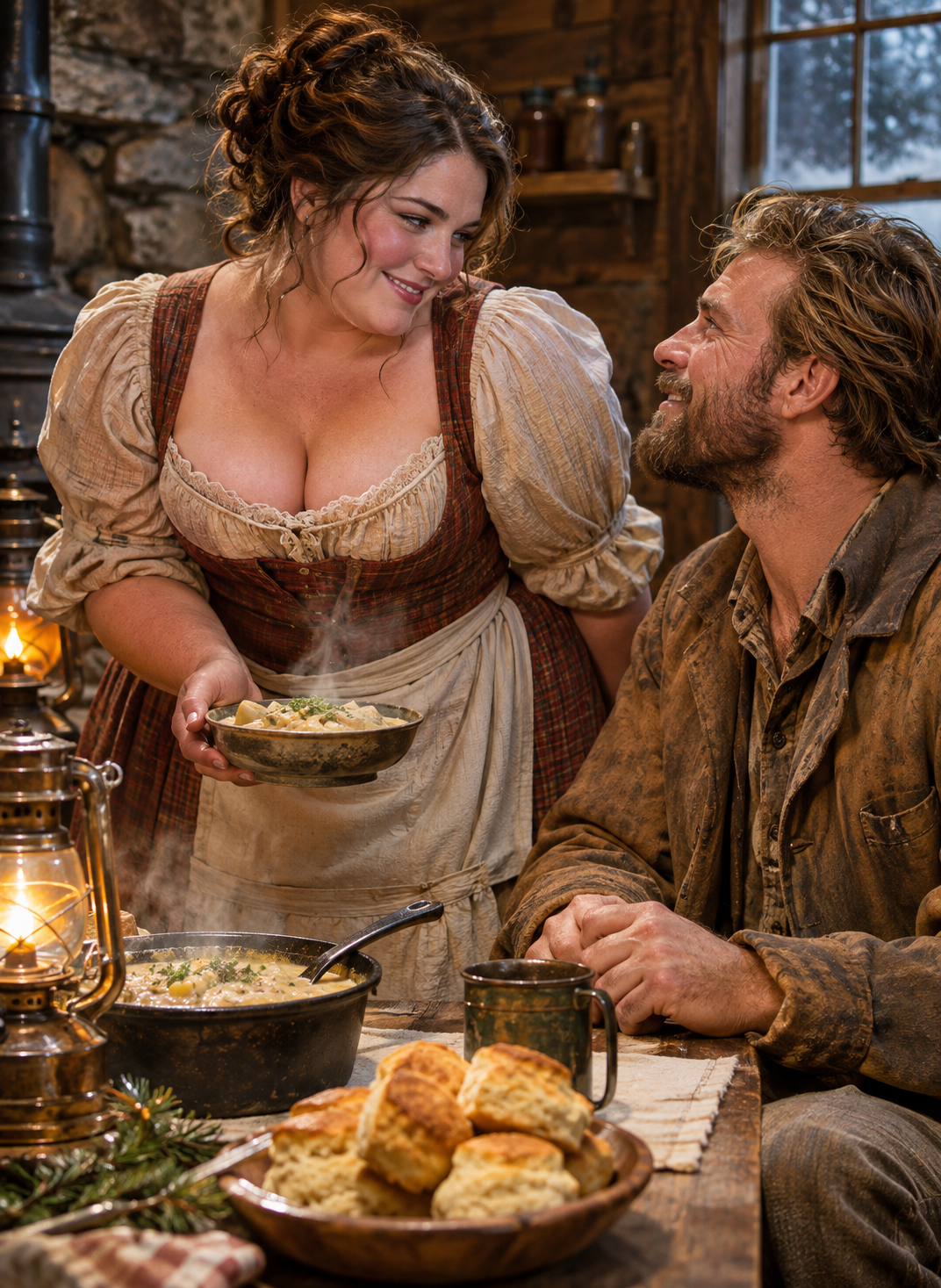
### Part 2 – The Question at the Supper Table
I looked into Beatrice’s calm hazel eyes, my heart pounding, and finally opened my mouth.
“How long can you make it last?”
She didn’t pretend not to understand.
Her gaze moved toward the pantry door.
“The food?”
“The food. The flour. Potatoes. Everything.”
The question tasted bitter coming out. A man was supposed to provide for his wife. Four days into our marriage, I was asking mine whether she could somehow turn half a pantry into an entire winter.
Beatrice pulled out the chair opposite mine.
“Sit down, Caleb.”
It was the first time she’d used my given name.
Perhaps that was why I obeyed.
I lowered myself slowly, still wearing my work shirt, my shoulders aching from a day of hammering frozen fence posts. She ladled chowder into a bowl and pushed it toward me.
“Eat first,” she said.
“I need an answer.”
“You need supper more.”
Something in her tone made arguing feel foolish.
I took one spoonful.
Then another.
The chowder was simple, yet after weeks of burnt coffee, leathery salt pork, and potatoes baked directly in the ashes, it tasted like something from another life.
Beatrice sat across from me.
She didn’t fill her own bowl immediately.
Instead, she folded her hands.
“I counted everything,” she said.
My spoon stopped.
“Everything?”
“The flour. Potatoes. pork. Coffee. Molasses. Salt. I checked the milk your cow gives. I looked in the smokehouse, though there isn’t much worth mentioning there. I also found eleven onions beneath an old sack behind the wood box.”
I almost laughed.
“Eleven onions won’t save us.”
“No.”
Her expression didn’t change.
“But knowing you have eleven onions is better than believing you have none.”
That sentence silenced me.
Beatrice continued.
“If we eat as you have been eating, the flour might last six weeks. The potatoes less. The pork perhaps one month.”
I stared at my bowl.
“And winter hasn’t truly begun.”
“No.”
The wind pressed against the cabin walls as though agreeing with her.
Outside, the Wyoming darkness had swallowed the ranch. Somewhere beyond the barn, one of the cattle called low and mournfully.
I rubbed my forehead.
“I shouldn’t have brought you here.”
Beatrice’s eyebrows lifted.
“Why?”
“You’ve seen the place.”
“Yes.”
“You’ve seen the pantry.”
“Yes.”
“You’ve seen me.”
That finally made her smile.
It wasn’t a mocking smile.
That somehow made it worse.
“I have,” she said.
“I spent fifty dollars sending for a wife when fifty dollars should probably have gone toward hay.”
The confession had lived inside me since Oak Haven.
Now it sat between us.
“I thought…” I stopped.
Beatrice waited.
I couldn’t say it.
I thought a smaller woman would eat less.
The shame of the thought burned hotter now than it had at the stage depot.
Beatrice studied my face.
Then, to my surprise, she said quietly, “You thought I would be different.”
I looked up.
She spared me the humiliation of forcing me to explain.
“Yes.”
“So did I.”
I blinked.
“You did?”
“I imagined a man who wrote letters.”
That struck harder than an accusation.
During the three months before her arrival, I had written twice.
Short letters.
Practical letters.
Weather. Cattle. The size of the cabin. The distance from town.
Nothing about myself.
Nothing resembling hope.
Beatrice finally served herself a small bowl.
“Perhaps,” she said, “we both married an idea and found a person instead.”
The stove clicked softly behind her.
I didn’t know what to say.
She tasted the chowder.
Then she leaned forward.
“Now, if you’re willing to tell me the whole truth, I may be able to help.”
“I have told you.”
“No.”
There was no anger in her voice.
Only certainty.
“You told me about the pantry. You haven’t told me about the ranch.”
My stomach tightened.
She had noticed.
Of course she had noticed.
A capable woman who could account for eleven onions would certainly notice unpaid invoices tucked beneath a flour tin.
I stood, crossed to the mantel, and took down the little black ledger I had kept hidden behind an old almanac.
I set it in front of her.
Beatrice opened it.
She read silently.
The numbers seemed uglier under the lamplight.
Money owed to the Oak Haven Mercantile.
Money owed to the feed dealer.
A note at the territorial bank secured against the ranch.
The cost of fencing wire.
The cost of salt.
The cost of surviving one bad year only to arrive at another.
Finally, she closed the book.
“How many cattle?”
“Fifty-three.”
“How many can the hay feed properly?”
I stared at her.
“Maybe thirty-five.”
“Then you don’t own fifty-three cattle.”
My jaw tightened.
“They’re mine.”
“No, Caleb. Eighteen of them belong to winter.”
I frowned.
She tapped the ledger.
“If you try to keep all of them, winter will choose which ones you lose. If you sell some now, you choose.”
It sounded merciless.
Yet it wasn’t.
It was arithmetic.
And arithmetic had no patience for pride.
“My father built this herd,” I said.
Beatrice’s expression softened.
“Did he build it so you could watch it starve?”
I pushed away from the table.
The question hurt because the answer was obvious.
For three years, I had treated every cow sold as evidence that Broken Spur was shrinking.
Perhaps I had been defending the memory of the ranch instead of protecting the ranch itself.
“I can take twelve into Oak Haven next week,” I said.
“Fifteen.”
I stared at her.
“Fifteen.”
“The weakest?”
“The ones least likely to carry their value through March.”
She sounded like a stockman.
“You said you worked in boardinghouses.”
“I did.”
“Boardinghouses don’t have cattle.”
“No. But boardinghouses have accounts. Food costs. Rent. Coal. People who eat twice what they pay for.”
For the first time that evening, I laughed.
A rough sound.
But genuine.
Beatrice smiled.
“There. That’s better.”
“What?”
“You look less like you’re waiting for your own funeral.”
I laughed again.
She joined me.
The cabin felt warmer.
Not because of the stove.
We spent the next hour going through the ledger.
Beatrice asked questions nobody had asked me in years.
Could I repair tools instead of buying new ones?
Could we barter milk for eggs with the Larsens?
Could I cut lodgepole pine on the western ridge for fence posts instead of purchasing milled ones?
Could the old garden be planted again in spring?
Could I sell the calf hides I’d stacked in the shed and forgotten?
Each answer was small.
But small answers gathered.
By the time we finished, the future no longer looked like one black wall.
It had cracks in it.
Narrow ones.
Perhaps enough for light.
The following morning, Beatrice came outside before sunrise.
I was harnessing Buck when I heard the cabin door.
She wore my spare wool coat over her dress.
The sleeves ended halfway up her forearms.
“What are you doing?” I asked.
“Learning where everything is.”
“It’s freezing.”
“I had noticed.”
“You should stay inside.”
She looked toward the eastern horizon.
A faint silver line appeared above the prairie.
“Caleb, I did not travel nine hundred miles to become acquainted only with your stove.”
There was no sensible response to that.
So I showed her the barn.
The hay loft.
The tack room.
The milk cow, Daisy, who disliked nearly everyone but allowed Beatrice to scratch behind her ears.
We walked toward the south pasture.
Beatrice moved slowly across the frozen ground, careful of her knees but unwilling to turn back.
At the rise above the creek, she stopped.
“What’s beyond those cottonwoods?”
“Lower meadow.”
“You use it?”
“Not anymore.”
“Why?”
“No water.”
She frowned.
“There was water once.”
I looked at her.
“How would you know?”
Beatrice didn’t answer immediately.
She stared toward the bare trees.
“There are willows.”
“So?”
“Willows don’t grow for memories.”
I followed her gaze.
She was right.
The lower meadow had once been the richest patch of grass on Broken Spur. My father had spoken about it sometimes. There had been a spring somewhere beneath the hill, but long before I inherited the ranch, the channel had dried.
“We lost the spring when I was a boy,” I said.
“Did anyone look for the reason?”
“My father did.”
“And?”
“He said the ground shifted.”
Beatrice said nothing.
Something in her face changed.
Not surprise.
Recognition.
“Come on,” I said. “You can’t stand out here.”
She followed me back.
But that evening, after supper, I noticed her watching the western window.
“What is it?” I asked.
She shook her head.
“Nothing.”
It was the first answer she’d given me that I didn’t believe.
For two more days, we worked.
I repaired the northern fence.
Beatrice washed blankets, patched shirts, churned what little cream Daisy produced, and transformed leftovers with a skill that made yesterday’s supper seem like something new.
She also began keeping notes in a small brown book.
On the third night, I found her at the table studying an old piece of paper.
She covered it when I entered.
“What was that?”
She hesitated.
Then she seemed to make a decision.
“Sit.”
My chest tightened.
“You always say that before telling me something I won’t like.”
“You’ve known me six days.”
“Long enough.”
That earned the faintest smile.
Then Beatrice went to her trunk.
From beneath neatly folded dresses she removed a cloth bundle.
Inside lay several letters tied with faded blue ribbon.
A photograph.
And a brass key.
She placed the photograph in my hand.
A younger woman stood beside a stone building.
Behind her were cottonwoods.
A ridge.
And a barn.
My barn.
I looked at Beatrice.
“Where did you get this?”
“The woman is my mother.”
My pulse quickened.
“Your mother was here?”
“Long before you inherited the ranch.”
I looked again.
Now I recognized the old stone springhouse in the background. I had not been near it since childhood.
“What’s her name?”
“Margaret Miller.”
The name stirred something faint.
A memory from my father’s stories.
Not enough to catch.
Beatrice picked up the brass key.
Three letters had been stamped into its bow.
B.S.R.
Broken Spur Ranch.
“You knew this place before you answered my .”
“I knew the name.”
“Why didn’t you tell me?”
“Because I wasn’t certain my mother’s stories were true. And because I didn’t want you wondering whether I had come here for something other than marriage.”
“What stories?”
Beatrice looked toward the darkened window.
“When my mother was dying, she gave me this key.”
My throat went dry.
“What does it open?”
“I don’t know.”
She placed it gently on the table.
“But she told me that if I ever came to Broken Spur, I should find the old springhouse.”
The wind moved across the roof.
I stared at the key.
Then at Beatrice.
“And after that?”
Her hazel eyes held mine.
“She said I should look beneath it.”
**–END OF PART 2–CLICK “NEXT” AT THE BOTTOM OF THE PAGE TO CONTINUE READING**
✓ Lynn R. Adams
### Part 2 – The Question at the Supper Table I looked into Beatrice’s calm hazel eyes, my heart pounding, and finally opened my mouth. “How long can you make it last?” She didn’t pretend not to un…