Part 2 – The Water Between Us-068
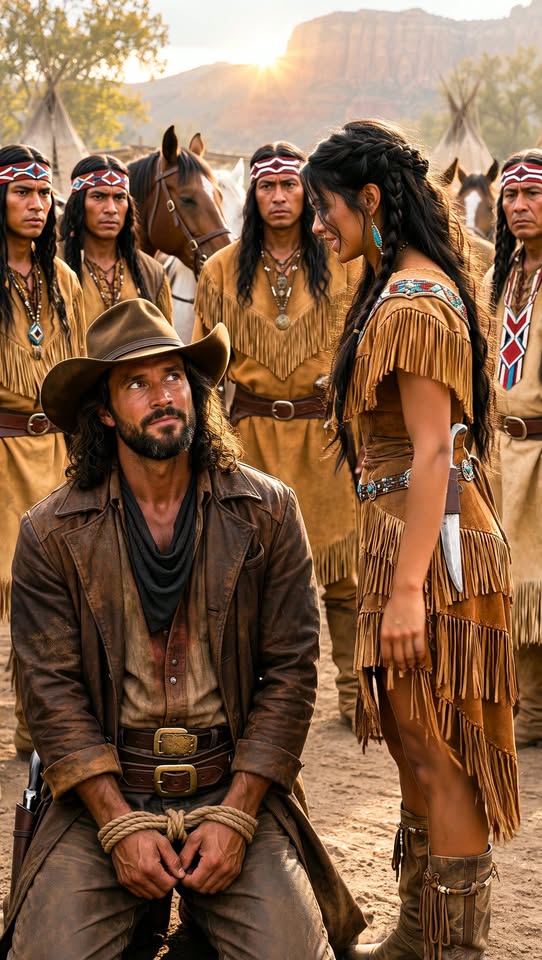
## Part 2 – Tracks in the Red Dust
**Part 2**
The rider on the distant ridge did not move.
For several long seconds, Samuel Carter could hear nothing but horses breathing, leather tack creaking, and the dry Arizona wind whispering through the mesquite branches.
The man sat against the morning sky like a black mark drawn across the horizon.
Samuel narrowed his eyes.
There was something familiar about the rider’s posture—the slightly crooked way he leaned in the saddle, one shoulder lower than the other.
Then recognition struck him.
“That’s Silas Vane.”
The tribal chief turned toward Samuel.
He was a broad-shouldered man in his late forties, his dark hair streaked faintly with gray. Samuel still did not know his name, but there was nothing uncertain about the man’s attention.
“Who?”
“Silas Vane,” Samuel repeated. “He works for the Red Basin Mining Company.”
The young Apache woman spoke quietly to her father.
The chief listened before looking again toward the ridge.
By then, Silas had turned his horse.
A moment later, he disappeared behind the rocky rise.
Samuel’s stomach tightened.
“He was here last night.”
The chief’s gaze returned to him.
“You saw him?”
“No. Not clearly.” Samuel pointed toward the western fence. “I found tracks. A broken strap. Blood on a piece of cloth.”
Several warriors exchanged glances.
The young woman immediately said something.
This time her father answered her before addressing Samuel.
“My daughter says the man who followed her rode a gray horse.”
Samuel swallowed.
Silas Vane rode a gray horse.
Everybody in Red Basin knew it.
The chief dismounted.
The movement caused the other riders to become still.
He stepped toward Samuel, stopping perhaps six feet away.
“My name is Nantan.”
Samuel nodded.
“Samuel Carter.”
“I know.”
That answer unsettled him.
Nantan saw the question in Samuel’s face.
“The man who came to us knew your name.”
Samuel’s pulse quickened.
“What man?”
“He did not give his own.”
“What did he look like?”
Nantan described him carefully: pale beard, narrow face, brown hat with a split along the brim.
Samuel knew the description too.
“Caleb Dorne.”
Nantan watched his reaction.
“You know him also?”
“He’s Silas Vane’s foreman.”
Samuel looked toward the empty ridge.
The pieces were beginning to form, although he did not yet understand the picture.
Red Basin Mining had been buying land throughout the valley for more than a year. They had offered Samuel money twice.
He had refused twice.
The land was poor by the standards of richer farms. Water was scarce, the soil stubborn, and half the buildings needed repairing.
But it had belonged to Samuel’s father.
And his father’s father before him.
More importantly, the only dependable spring for miles crossed the northern edge of the Carter property.
Samuel suddenly understood something.
He turned toward Nantan.
“Why was your daughter near my farm?”
The young woman answered before her father could translate.
Her English was careful but understandable.
“I was looking for water.”
Samuel stared at her.
“You speak English?”
“A little.”
Despite everything, a brief expression almost like amusement crossed her face.
“My father speaks more than he lets people know.”
Several warriors behind Nantan smiled faintly.
Nantan ignored them.
“My daughter’s name is Tala.”
Samuel nodded toward her bandaged arm.
“I’m glad you made it home.”
Tala’s expression became serious again.
“I almost did not.”
“What happened?”
She looked toward the hills.
“I had gone to gather medicine plants near the canyon. On my way home, I heard riders.”
“How many?”
“Two.”
Samuel felt the morning air grow colder despite the rising sun.
“They followed you?”
Tala nodded.
“I thought they wanted my horse. I rode toward the old mining road because I knew the canyons there.”
Her eyes fell to her injured arm.
“My horse stumbled among loose stones. I fell. A broken branch cut me.”
Samuel looked at Nantan.
“So nobody attacked her.”
“No,” Nantan said.
“But someone told you I did.”
“Yes.”
Samuel rubbed a hand across his face.
It was an astonishingly simple lie.
And a dangerous one.
“Why?”
Nantan looked toward Samuel’s land.
“That is what I came to learn.”
Samuel turned toward his cabin.
“There’s something you should see.”
Several warriors shifted uneasily.
Samuel stopped.
“My house isn’t a trap.”
Nantan regarded him for a moment, then nodded.
Samuel retrieved the bloodstained cloth and broken leather strap from where he had left them beneath the porch roof.
Tala recognized the fabric immediately.
“That is mine.”
Samuel handed it over.
“What about the strap?”
Tala examined it and shook her head.
Not hers.
Nantan took it.
A small symbol had been stamped into the leather.
Samuel had noticed it the night before without understanding its importance.
Now he did.
A circle pierced by a diagonal line.
The Red Basin Mining Company mark.
Nantan’s thumb moved slowly across the symbol.
Someone behind him murmured.
Samuel felt a knot tighten in his chest.
“They wanted you to believe I attacked Tala.”
Nantan said nothing.
Samuel continued.
“And they wanted me to believe…”
He stopped.
Nantan finished the thought.
“That we had come to attack you.”
Samuel looked at the warriors surrounding the cabin.
Yesterday, he would have described them only as strangers.
This morning, for one terrible minute, he had seen them as enemies.
All because someone had arranged it that way.
Tala stepped forward.
“Why?”
Samuel looked toward the north.
Beyond his fields, the land rose toward a line of cliffs broken by cottonwood trees.
The spring was there.
“My water.”
Nantan followed his gaze.
Samuel explained the offers from Red Basin Mining.
“They’ve bought nearly every small property between here and the mining road. Mine is one of the last parcels they don’t own.”
“Why do they need it?”
“I thought they wanted the grazing land.”
Nantan’s expression suggested he did not believe that.
Neither did Samuel anymore.
Tala looked at the spring.
“Water does not belong only to cattle.”
“No,” Samuel murmured.
Then another thought came to him.
“Does your community use that spring?”
Nantan’s eyes hardened—not with anger, but with guarded caution.
“My people used the northern route long before your cabin was built.”
Samuel knew enough local history to understand what Nantan meant.
Seasonal trails crossed this country. Springs could mean survival.
“My father never stopped anyone from taking water.”
“I know.”
Samuel stared at him.
“You knew my father?”
For the first time, something changed in Nantan’s expression.
Not suspicion.
Memory.
“Thomas Carter.”
Samuel’s throat tightened.
“Yes.”
Nantan looked toward the cabin.
“He once repaired a wagon wheel for my brother.”
Samuel had never heard that story.
“My father didn’t talk much about anything.”
Nantan almost smiled.
“That I remember.”
The tension around the cabin softened slightly.
But not enough.
The mystery remained.
Samuel walked to the edge of the porch and looked down.
The ground had been disturbed by dozens of horses now, but one set of wagon tracks remained visible near the western fence.
“They went toward the mining road.”
Nantan came beside him.
“We should follow.”
Samuel looked at the warriors.
Then at his abandoned shotgun.
Then at Tala.
“You want me to come?”
“You know the land.”
Samuel hesitated.
His first instinct was to stay at the cabin.
His second was stronger.
Someone had nearly turned him and Nantan against each other.
If Silas Vane and Caleb Dorne believed the plan had succeeded, they might try again.
“I’ll saddle my horse.”
They rode west shortly after sunrise.
Nantan brought only four men.
Tala insisted upon coming as well.
Her father objected quietly in Apache.
Samuel did not understand the words, but he understood the argument.
Tala won.
Samuel tried not to smile when she rode past him.
“You find that amusing?” she asked.
“No.”
“You are smiling.”
“I was thinking your father and mine probably had something in common.”
“What?”
“They both discovered that telling someone not to do something often makes them more determined to do it.”
Tala gave him a sideways glance.
“You were like that?”
“According to my father, I was born that way.”
She smiled.
It was the first time Samuel had seen her do so.
For several miles, they followed the old mining road.
The landscape widened around them—red earth, pale grasses, scattered juniper, distant cliffs glowing beneath the morning sun.
Samuel rode beside Nantan.
“Why didn’t you believe the man who accused me?”
“I did.”
Samuel glanced at him.
“At first.”
Nantan continued.
“Then Tala returned.”
“And told you what happened?”
“She was exhausted. She slept before telling us much.”
Samuel understood.
“So you rode here believing the accusation.”
“Yes.”
“What changed?”
“My daughter recognized you.”
Samuel thought about the moment outside his cabin.
His shotgun.
The riders.
His certainty that he was about to die.
“All that because of one lie.”
Nantan looked ahead.
“A lie placed between frightened men can travel faster than a horse.”
They rode another mile.
Then Tala raised her hand.
Everyone stopped.
She pointed.
Near a dry creek bed stood the remains of an abandoned supply shed.
The door hung crookedly from one hinge.
Fresh wagon tracks led behind it.
Samuel dismounted.
They approached cautiously.
No one was inside.
But something had been left behind.
Empty crates.
Several burlap sacks.
A lantern.
And a rolled survey map.
Samuel opened it across a crate.
Lines had been drawn across the valley in red pencil.
One parcel had been circled repeatedly.
His farm.
Tala leaned closer.
“What are these?”
“Survey marks.”
Samuel followed one line with his finger.
It crossed his northern field, passed directly through the spring, and continued toward Red Basin’s newest mining claim.
Nantan noticed another mark.
“What is this?”
Samuel stared.
A proposed channel.
Or perhaps a pipeline.
He felt suddenly ill.
“They don’t just want the land.”
He traced the route.
“They want the spring.”
Tala looked at him.
“For the mine?”
“Probably.”
Nantan’s face became unreadable again.
Samuel examined the notes in the corner.
Most were measurements.
One was not.
Written in pencil were six words:
**CARTER WILL SELL AFTER THE INCIDENT.**
Nobody spoke.
Samuel read the sentence twice.
Then a third time.
His anger arrived slowly.
Not hot.
Cold.
Precise.
“They planned it.”
Nantan’s voice was quiet.
“Yes.”
Tala looked at her father.
“They followed me because they knew I might cross Samuel’s land.”
Samuel shook his head.
“Maybe. Or they were waiting for anyone from your community.”
The idea disturbed all of them.
A manufactured misunderstanding.
A frightened farmer.
An injured young woman.
A community given false information.
And afterward, perhaps, a property owner suddenly eager to leave.
Samuel rolled up the map.
“We take this to Sheriff Bell.”
Nantan’s expression did not change.
“You trust him?”
Samuel hesitated.
Sheriff Amos Bell had served the county for almost nine years.
He had attended Samuel’s father’s funeral.
He had once helped Samuel recover stolen cattle.
“I think so.”
Tala studied him.
“That is not the same answer.”
“No.”
Samuel looked again at the note.
“But we need someone with legal authority.”
Nantan nodded.
“We go together.”
They were preparing to leave when one of Nantan’s men called softly from behind the shed.
He had found a small tin box half buried beneath loose boards.
The lock had already broken.
Samuel opened it.
Inside were receipts.
Company correspondence.
And several envelopes.
Most concerned mining equipment.
One was addressed to Caleb Dorne.
Samuel unfolded it.
The letter contained only a few lines.
He read them silently.
Then again.
Nantan noticed his expression.
“What does it say?”
Samuel handed him the paper.
Nantan read English slowly.
Tala moved beside him.
Samuel already knew the words by heart.
**Dorne—**
**Carter still refuses. Proceed with pressure as discussed. Bell has agreed the matter will be handled quietly.**
There was no signature.
Only the initials:
**E.V.**
Samuel felt the desert tilt beneath him.
Tala spoke first.
“Bell?”
Samuel stared toward the road leading to town.
Sheriff Amos Bell—the man Samuel had intended to trust—was apparently already part of it.
And suddenly the journey to Red Basin seemed far more dangerous than the riders who had surrounded Samuel’s cabin that morning.
Because now Samuel understood the real problem.
He and Nantan had discovered the lie.
But the people responsible for it controlled the mine.
They might control the sheriff.
And they had no idea how many others were involved.
Nantan folded the letter.
“We do not go to Bell.”
Samuel looked toward the distant settlement.
“No.”
He slowly rolled up the survey map.
“We find out who E.V. is.”
Tala’s gaze fell upon the initials.
For some reason, her expression changed.
Samuel noticed.
“You recognize them?”
Tala hesitated.
“My father may.”
Nantan looked at her sharply.
“Tala.”
She reached inside the small pouch tied at her waist.
From it, she removed a folded scrap of paper.
“I found this yesterday,” she said. “Near the place where the riders began following me.”
She opened it.
Samuel saw a company seal.
Beneath it was a handwritten message.
Only one sentence.
But the signature at the bottom was complete.
**Elias Vane.**
Samuel stared at it.
Silas Vane’s older brother.
Owner of the Red Basin Mining Company.
The wealthiest man in the valley.
And, according to the newspaper in town, the leading candidate to become the county’s next judge.
Samuel looked from Tala to Nantan.
The mystery had just acquired a name.
What none of them yet knew was that Elias Vane’s interest in the Carter farm had begun long before Samuel’s father died.
And hidden beneath the floorboards of Samuel’s cabin was the reason.
**–END OF PART 2–CLICK “NEXT” AT THE BOTTOM OF THE PAGE TO CONTINUE READING**
✓ Lynn R. Adams
## Part 2 – Tracks in the Red Dust **Part 2** The rider on the distant ridge did not move. For several long seconds, Samuel Carter could hear nothing but horses breathing, leather tack creaking, an…