PART 2: The Wall David Wanted to Save 029
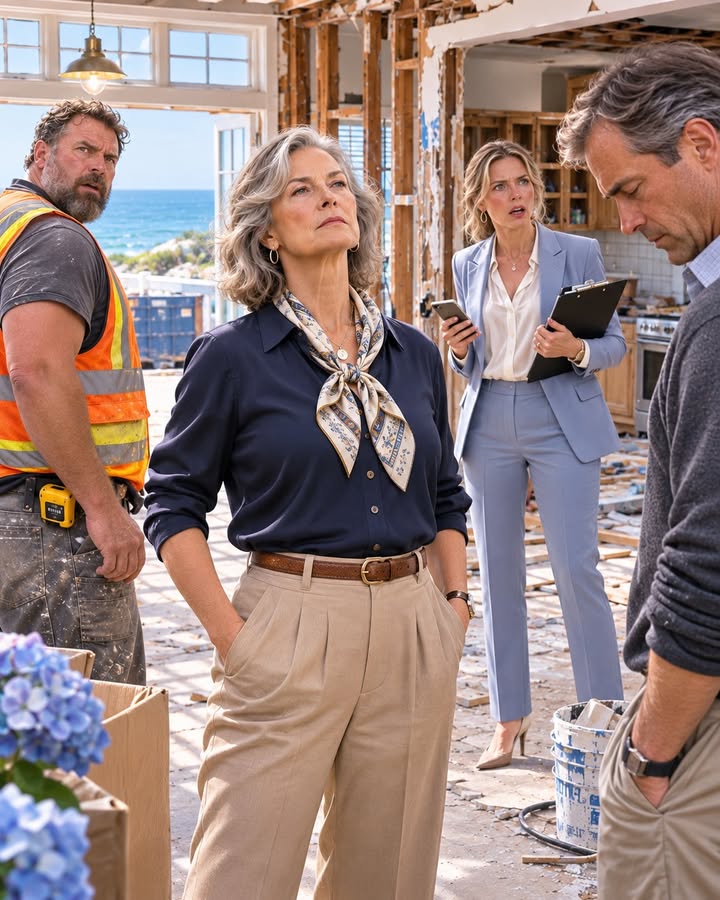
Greg slowly dropped his hand.
Then he turned to David.
“Before anyone does anything else,” he said, “I need to see the deed and the contract.”
Sarah’s expression tightened.
“The contract is in my folder,” she said. “But David told me he had permission.”
Greg looked at her, then at David.
“I’m not asking what you were told,” he said evenly. “I’m asking what the paperwork says.”
David’s shoulders drew in as if the question had landed somewhere deeper than his pride.
“I can get the deed,” I said. “It’s in my car.”
I left them in the living room and walked outside.
The sea was hidden beyond the houses and scrub pines, but I could hear it moving steadily against the shore.
The morning air smelled of salt, sawdust, and the sharp tang of fresh-cut wood.
For a moment, I stood beside my car with my hand on the door, trying to remember how to breathe without feeling that every breath was a decision.
I had thought I was coming here to rest.
Instead, I was learning how quickly a home could become unfamiliar when the people inside it stopped asking.
The deed was in the glove compartment, tucked into a folder with the property-tax papers.
When I returned, Greg had gathered the workers near the open front door and asked them to pause until he could clarify who had authority to direct the project.
His voice was calm, but there was no mistaking the finality in it.
The saws had stopped.
The hammering had stopped.
In the sudden quiet, the damage seemed louder.
I handed him the deed.
He read it carefully, then looked at Sarah’s contract.
Sarah had signed in her own name.
David’s name appeared only in a line identifying the person who had authorized access to the property.
Greg turned the papers toward me.
“Your name is on the deed,” he said. “Only yours.”
Sarah leaned over the clipboard.
“David told me he’d talked to you,” she said, her voice now quieter. “He said you’d agreed the place needed work.”
“I never agreed to this.”
“I thought—”
She stopped herself and looked toward David.
He had not moved from the doorway.
I had expected him to defend himself, or to accuse me of making a scene over money.
Instead, he stared at the papers as though they were something he had hoped not to see.
“David,” I said, “I want to know why you let this happen.”
He glanced toward Greg and the workers.
“Can we talk somewhere private?”
The request hurt, though I could not have explained why.
Maybe it was the sudden instinct to protect him from an audience, even after he had left me unprotected in my own house.
I looked at Greg.
“Please give us a few minutes.”
He nodded.
“I’ll have the crew stay outside.”
Sarah remained where she was, clutching the clipboard to her chest.
I turned to her.
“I need to speak with my son alone.”
She looked as if she might object, then seemed to reconsider.
“All right,” she said.
She walked toward the porch, but she did not go far.
David followed me to the small bedroom where I had slept the night before.
The boxes of my clothes were stacked along one wall.
My favorite quilt still lay in its garbage bag beside the dresser.
I had not unpacked anything because I had spent the night telling myself I would not let the house make me feel like a stranger.
Now I wished I had found a place where we could sit.
There was nowhere to sit without moving something that belonged to me.
David stayed by the door.
“Why?” I asked.
He rubbed the back of his neck, the old gesture he had used since he was a boy when he was trying to find a way around the truth.
“Sarah’s parents got a rent increase,” he said.
I waited.
“It was sudden. Their landlord told them the new amount would start next month, and they can’t afford it on their retirement income.”
“They’re being evicted?”
“Not exactly. They can pay the new rent for a while, but it would use almost everything they have.”
His eyes lifted to mine.
“They’re scared they’ll lose the place anyway. The landlord’s been talking about selling.”
I thought of Sarah’s confident announcement the day before, her certainty that her parents would live here.
“She said they were retiring next month.”
“They are.”
“And you told her they could move into my house.”
David’s eyes fell.
“I promised them they could stay here.”
The words seemed to change the shape of the room.
I had wondered whether he had merely allowed Sarah to run ahead of him, whether he had stood back and hoped I would eventually accept what she had already decided.
But he had made a promise.
Not to me.
To them.
“Without asking me,” I said.
“Yes.”
“Why?”
He swallowed.
“I thought you’d say no.”
“That was your reason for not asking?”
“I know how that sounds.”
“It sounds like you knew the answer belonged to me.”
He nodded once.
“I did.”
His honesty should have made the moment easier.
It did not.
I had spent years believing that David knew the house was more than a place to him.
His father had wanted it.
I had wanted it.
After my husband died, buying it had felt like carrying one part of our shared future forward.
David had helped me choose the porch chairs.
He had once spent an entire afternoon sanding the old dining table because he said Dad would have liked it better that way.
He knew what each room meant.
“I thought you’d see how much they needed it,” he said. “I thought once they were settled, you might feel differently.”
“You were going to let them move in first and ask me later?”
His face tightened.
“I wasn’t thinking clearly.”
“No,” I said. “You were thinking about what you wanted to happen.”
He looked down at the boxes.
“Maybe.”
“And Sarah thought she had permission to remodel the house.”
“She thought I had permission.”
“Did you tell her I’d given it?”
He hesitated.
“I told her we could make it work.”
“That isn’t the same thing.”
“I know.”
“Did you tell her to charge my card?”
“No.”
His answer came quickly, without hesitation.
I looked at him.
“I didn’t approve that charge,” he continued. “I told her I’d figure out the costs, but I didn’t tell her to use your card.”
“But she had the account details.”
“Yes.”
“Because you were an authorized user.”
“Yes.”
He looked miserable now, but his distress could not restore the trust that had been spent.
“Sarah said you had saved the card in the account from when we booked the plumbing inspection,” he added. “She believed I’d already cleared it with you.”
“I didn’t clear anything with anyone.”
“I know that now.”
“You should have known before you promised away my house.”
He flinched.
For a few seconds, neither of us spoke.
I could hear muffled voices outside, and a car passing along the road beyond the dunes.
The house was full of sounds I recognized, but none of them seemed to belong to the life I had expected to have here.
“Why didn’t you tell me?” I asked.
David pulled a chair from the corner, then thought better of sitting and pushed it back beneath the little desk.
“I was ashamed.”
“Of asking?”
“Of asking and of knowing I’d already made the decision in my head.”
He let out a breath.
“Sarah’s parents have always been kind to us. They helped when we were getting started. I thought I could do something for them without making it a big family crisis.”
“You thought you could give them something that was never yours to give.”
“Yes.”
His voice had gone thin.
I looked at my son and saw the little boy who used to bring me broken shells because he thought they were beautiful.
I also saw a grown man who had chosen my silence for me.
“Your father would have understood why you wanted to help them,” I said.
David’s eyes glistened.
“But he would have asked you first,” I continued.
David nodded.
“Yes.”
“I’m not angry because you care about them.”
“I know.”
“I’m angry because you decided my answer would be an obstacle to get around.”
He pressed his lips together.
“I thought I was protecting everyone from a hard conversation.”
“You protected yourself from one.”
He looked at me then, and something in his expression gave way.
“I’m sorry, Mom.”
I believed that he was sorry.
I did not yet know what his apology could change.
The distinction mattered.
When we returned to the living room, Sarah was waiting on the porch with her arms wrapped around herself.
The morning had warmed, but she looked cold.
Greg stood beside the work trucks, speaking with one of the crew members.
He held up the contract as we approached.
“I’ve checked the paperwork,” he said. “Sarah signed it. It lists David as the access contact, but there’s no authorization from the owner.”
Sarah looked at David.
“You told me you’d spoken with her.”
“I said we could make it work,” he replied. “I should have been clearer.”
“No,” I said. “You should have asked me.”
Sarah lowered the clipboard.
“I honestly thought you knew.”
“That doesn’t make the work authorized.”
“I understand.”
Her voice sounded different from the day before, when she had talked about my house as if it were a project she had inherited.
Now she was looking at the damaged doorway and the open kitchen wall, and I could see the consequences beginning to reach her.
“What happens to the materials?” she asked Greg.
“We can stop delivery on anything that hasn’t left the supplier,” he said. “For what’s already here, we’ll need to sort out the costs and see what can be returned.”
“Can the house be put back the way it was?”
Greg’s gaze went to the kitchen.
“Some of it, yes. Some of it may take time. We haven’t taken out any support beams, and the plumbing hasn’t started.”
I took that in slowly.
No plumbing yet.
No new bathroom.
No enlarged closet.
There was damage, but perhaps not as much as I had feared when I arrived.
“Did you tell the crew what to remove?” I asked David.
He looked toward the kitchen.
“I talked with Greg when Sarah first showed him the rooms.”
“What did you tell him?”
“I asked him to be careful with the original features.”
Sarah stared at him.
“You told me we were taking out the cabinet.”
“I asked them not to touch one wall.”
“What wall?” I said.
David looked toward the hall, then back at me.
“The one in the master bedroom.”
I could not remember anything on that wall that seemed worth preserving.
The room had been cleared so thoroughly that I had barely looked beyond the exposed plywood and blue tape.
“Why that wall?”
“I don’t know,” he said. “It’s the old one. I thought it should stay.”
Greg adjusted the contract in his hands.
“He mentioned that during the walkthrough,” he said. “Asked us to leave the section behind the built-in cabinet alone.”
A small chill passed through me, though the house was warm.
“What cabinet?”
“The narrow one in the master bedroom,” Greg said. “It’s set into the wall near the closet. Sarah wanted it removed to make room for the expanded suite.”
I looked at David.
He seemed uncomfortable in a new way, as if he had been caught preserving a detail he had not understood himself.
“Why didn’t you tell me about that?” I asked.
“I didn’t think it mattered.”
“Then why ask them to preserve it?”
He had no answer.
Sarah set her clipboard down on the porch rail.
“I thought the cabinet was just an old storage space,” she said. “I didn’t know it was important to anyone.”
“It may not be,” David said.
“But you went out of your way to protect it.”
He glanced at the floor.
“I remembered Dad asking me about it once.”
That made me look at him more closely.
“What did he ask?”
“I don’t remember exactly. He said something about how some parts of the house should stay the way they were.”
I felt the years between us shift.
My husband had been the kind of man who noticed small things.
He kept old screws in jars because they might fit something later.
He wrote dates on the backs of photographs and folded handwritten notes into books he meant to read again.
The thought of him asking David to protect a cabinet seemed possible.
But the house had been full of small repairs over the years, and there were stories I could not retrieve just by wanting them.
“Did you ever look inside it?” I asked.
David shook his head.
“No.”
Sarah rubbed at the edge of the clipboard.
“I’m sorry, Hannah.”
I looked at her.
“I thought because David said you’d agreed, I was helping make something possible for my parents.”
“You were planning to make decisions about a house you don’t own.”
“Yes.”
“You signed a contract and used access to my credit account.”
“I know.”
Her voice trembled, but she did not turn the apology into an excuse.
“I thought David had arranged the permission. I should have asked you myself, no matter what he told me.”
It was the first thing she had said that felt entirely her own.
I did not know whether I was ready to forgive her.
I knew only that I believed her embarrassment was real.
Greg cleared his throat softly.
“I need to be practical here,” he said. “The work is on hold, but there may be legitimate costs for labor and materials already used. I’ll put together an itemized account before anyone discusses payment.”
“I won’t be paying for work I didn’t authorize,” I said.
“I understand. I’m not asking you to.”
He looked toward David and Sarah.
“You two signed the agreement. We’ll need to talk about what’s owed and what can be canceled.”
Sarah nodded.
“We’ll handle it.”
David looked at her, then at me.
“I’ll handle my part.”
I watched him carefully.
“Your part?”
“The part I caused,” he said. “The promise, the access, all of it. I won’t ask you to cover the bill.”
For a brief moment, the answer sounded almost like the son I knew.
Then I remembered that trust was not rebuilt by saying the right thing while everyone was watching.
It was rebuilt in the decisions made afterward, when no one was there to applaud.
I went back inside and stood at the entrance to the master bedroom.
The room looked larger without the furniture and smaller without the carpet.
The built-in cabinet was still there, a narrow wooden face set flush into the wall.
Its paint had yellowed slightly, and the brass knob was dulled from years of use.
I had never given it much thought.
It had held extra towels once, and then a tin of old sewing supplies, and later nothing I could remember.
Now it seemed to be the one thing in the house that had escaped the demolition.
I placed my palm against its door.
The wood was cool beneath my hand.
Behind me, David stood in the hallway.
“I’m sorry I didn’t tell you,” he said.
I did not turn around.
“I heard you.”
“I know that doesn’t fix anything.”
“No.”
“I’ll do what I can to make this right.”
“You don’t yet know what that means.”
He was quiet for a moment.
“No,” he said. “I don’t.”
That answer was better than a promise.
I opened the cabinet.
Inside, there was nothing but a faint smell of old cedar and dust.
The shelves were bare.
At the back, a narrow seam ran along the right side, almost hidden by the shadow where the cabinet met the wall.
I ran my finger over it.
The wood shifted slightly.
“Mom?” David asked.
I stepped back.
“Nothing,” I said, though I was no longer sure.
Outside, Greg called for his workers to begin packing up the tools they could take with them.
Sarah started making calls to the supplier, her voice low and careful.
David stayed in the hallway, looking toward the bedroom as if he wanted to ask me something else and could not decide whether he had earned the right.
I closed the cabinet door without pushing on the seam again.
For the first time since arriving, I wondered whether the house had been holding on to something of its own.
And I wondered why David had been so determined to keep that one old wall untouched.
**–END OF PART 2–CLICK “NEXT” AT THE BOTTOM OF THE PAGE TO CONTINUE READING**
* * *
[NEXT: PART 3](https://puretales.idolsgift.com/blog/part-3-the-wall-david-wanted-to-save-029)
✓ Lynn R. Adams
Greg slowly dropped his hand. Then he turned to David. “Before anyone does anything else,” he said, “I need to see the deed and the contract.” Sarah’s expression tightened. “The contract is in my …