PART 2: The Voice That Wouldn’t Hang Up5 025
Part 2 – The Voice That Wouldn’t Hang Up
“Where is Emily, and why do I hear her crying?”
My husband’s smile disappeared, but my father’s voice did not waver.
For a moment, no one moved.
Then my father said my name again, more softly this time.
“Emily, sweetheart, are you there?”
I tried to answer, but the pain in my abdomen tightened until all I could manage was a breathless sob.
“I’m here,” I whispered.
“Are you hurt?”
My eyes found Carter’s.
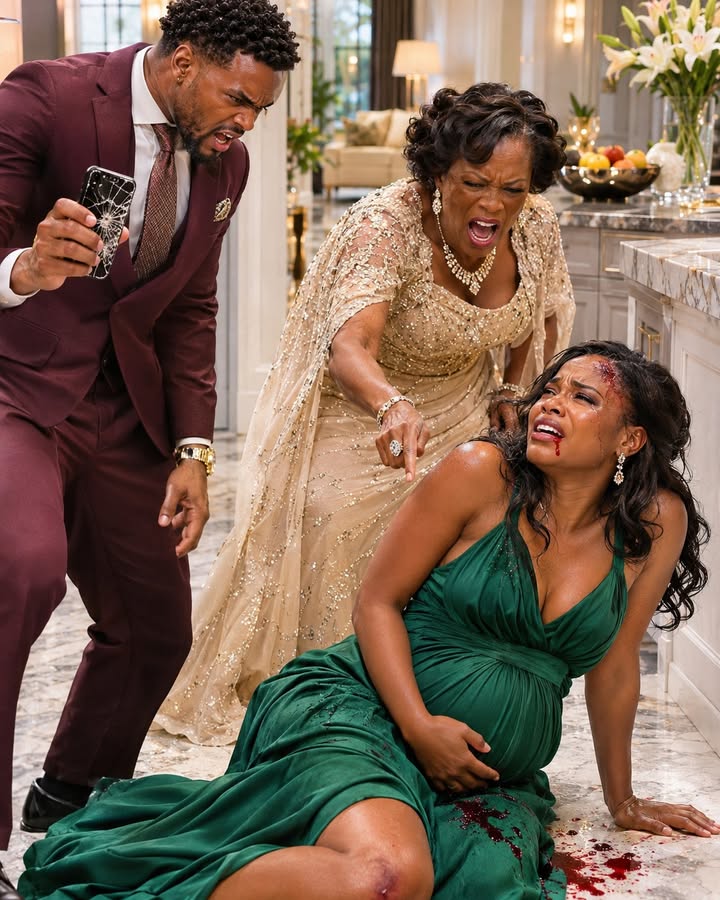
He stood over me with the broken phone in his hand, the last of his amusement draining away.
“Yes,” I said. “I’m bleeding.”
The word seemed to change the room.
My father did not shout.
He did not ask Carter who he was or make a threat.
He simply said, “Emily, I need you to stay as still as you can. Help is coming.”
Carter glanced toward the front hall, then back at me, as if he were trying to calculate how much of the evening could still be put right.
“Don’t make this worse,” he muttered.
My father heard him.
“Who is that?” he asked.
No one answered.
I pressed one hand against my stomach and the other against the floor, trying to keep my breathing even.
“My husband,” I said.
The silence on the line grew heavier.
Then my father spoke with a calm I had never heard from him before.
“Carter Whitmore, this is General William Carter, Emily’s father. She is injured and pregnant. Do not move her. Do not touch her. An ambulance is on its way.”
Carter’s jaw tightened.
“You don’t know what happened.”
“I know what I heard,” Dad replied. “And I know what she said.”
Eleanor rose from the sofa, her composure suddenly less certain.
“She fell,” she called toward the phone. “This is a family matter.”
“Then you can explain that to the people arriving,” my father said.
He stayed on the line as he contacted emergency services from another phone, giving them the estate’s address and the details I could barely hear him repeating.
When he asked how far along I was, I managed to say, “Seven months.”
His voice softened again.
“Is the baby moving?”
I closed my eyes and waited, listening through the pain and the rush of fear.
A faint flutter brushed beneath my palm.
“Yes,” I whispered. “I think so.”
“Good,” he said, though I could hear how carefully he was holding himself together. “Keep talking to me, Emily.”
So I did.
I told him the kitchen was cold beneath my cheek.
I told him I could see a sliver of the chandelier reflected in the polished floor.
I told him I was scared.
“I know,” he said. “You don’t have to be brave for me right now.”
That was when I began to cry in earnest.
Carter took a step toward the phone, but his mother caught his sleeve.
“Let her speak,” Eleanor hissed.
He pulled away from her.
“She’s turning this into something it isn’t.”
My father heard that, too.
“Carter, the best thing you can do now is give the paramedics room and tell them exactly what happened.”
Carter looked down at me.
For a fraction of a second, I thought I saw uncertainty in his face, perhaps even regret.
Then he set the broken phone on the counter and walked toward the dining room.
He did not leave the house.
He did not come back to my side.
My father remained with me, telling me that the ambulance had been dispatched and that he was making another call to ensure the responders could reach the estate without delay.
His words steadied the room around me.
I had not heard him sound this certain in years.
“Dad,” I whispered, “I’m sorry.”
“For what?”
“For not telling you sooner.”
“You can apologize later,” he said gently. “Right now, just breathe.”
The siren reached us before I could answer.
It rose in the distance, then drew closer until its sound filled the quiet house.
The paramedics came through the front door with their equipment, moving quickly but speaking in measured voices.
One knelt beside me and introduced herself as Nora.
She asked my name, how far along I was, whether I had lost consciousness, and where it hurt.
I answered as best I could while she checked my pulse and blood pressure.
Another paramedic assessed my abdomen, then exchanged a look with Nora that made my heart seize.
“Can you tell me if you felt the baby move recently?” she asked.
“Yes,” I said. “A few minutes ago.”
“Good. We’re going to take you to the hospital now.”
Carter appeared in the doorway as they prepared the stretcher.
“I’m coming with her.”
Nora glanced toward the other paramedic, then back at him.
“Are you the person she says injured her?”
“I didn’t touch her,” he said.
“She says your mother pushed her,” Nora replied. “And that you broke her phone.”
Carter’s face hardened.
“She’s upset. She’s confused.”
“I’m not confused,” I said, though my voice was weak.
My father was still on the line.
“Emily’s wishes come first,” he said. “Ask her what she needs.”
Nora leaned closer to me.
“Would you like your husband to ride with you?”
For two years, I had thought of Carter as the person I was supposed to turn toward when life frightened me.
But as I looked at him, I felt no comfort.
Only the old habit of hoping he might become someone different.
“No,” I whispered. “Please.”
Carter’s expression tightened.
Nora nodded once.
“Then he won’t.”
They lifted me carefully onto the stretcher.
The pain sharpened when they moved me, and I held my breath until it eased.
As they carried me past the kitchen, I saw the broken pieces of my phone scattered near the wall.
The sight felt strangely important.
Evidence of a moment Carter had believed no one else would ever see.
At the front entrance, I heard him behind us.
“She’s my wife,” he said.
Nora kept walking.
“And she asked not to have you with her.”
Outside, cold night air touched my face.
The ambulance doors closed, and the siren began again as we pulled away.
My father stayed on the line until the signal faded, his voice reaching me through the paramedic’s phone.
“I’m coming to you,” he said. “You hear me? I’m coming.”
I wanted to say that I had spent two years pretending not to need him.
Instead, I said, “Okay.”
At the hospital, the emergency department was bright and busy, full of quick footsteps, clipped questions, and the steady hum of machines.
They wheeled me into a room where an obstetric team was already waiting.
A nurse named Leah introduced herself as she placed a monitor against my belly.
The first few seconds passed without the sound I needed.
My hands began to shake.
Then a rapid, steady heartbeat filled the room.
I let out a breath that felt as if I had been holding it since the kitchen.
“There he is,” Leah said. “We can hear him.”
I cried again, this time with relief woven into the fear.
A doctor examined me and explained that they needed to monitor both me and the baby closely.
The bleeding worried them, but they were not ready to draw conclusions.
They gave me medication, started an IV, and asked the same questions more than once so they could build a clear account of what had happened.
I told them about Eleanor’s hands at my back.
I told them about hitting the counter.
I told them Carter had taken my phone and smashed it.
Each time I said it, the story sounded more real, and less like a nightmare I might somehow wake from.
A nurse asked whether there was anyone I wanted contacted beyond my father.
“My sister,” I said. “Sarah.”
Leah found her number in the contacts saved with the hospital’s patient information and called.
My sister arrived less than an hour later, still wearing the dark coat she had pulled on over her clothes.
She looked at my bruised face, then at the monitors beside my bed.
For a moment, she could not speak.
Then she reached for my hand.
“I’m here,” she said.
“I’m sorry,” I whispered.
Sarah’s eyes filled.
“Don’t apologize for calling me.”
She stood beside the bed and held my fingers while the medical team explained that the next hours were important.
The baby’s heartbeat remained steady, but the doctors wanted to watch for changes and keep me under observation.
Every time the monitor shifted, my whole body tensed.
Sarah noticed and leaned closer.
“Listen to it,” she murmured. “That sound is telling us he’s still fighting.”
“He shouldn’t have to,” I said.
“No,” she replied. “He shouldn’t.”
There was anger in her voice, but she kept it quiet, careful not to make the room smaller with it.
When Dad finally arrived, he came in without uniform, without staff, and without any visible sign of the public life I had spent years trying to keep away from my marriage.
He wore a plain dark jacket and looked older than I remembered.
His eyes moved over my face, my hands, the monitor, and then returned to me.
He stopped at the side of my bed.
“May I?” he asked.
I nodded.
He took my hand as gently as if it were made of glass.
For a long time, none of us said anything.
I had imagined this moment many times during the years I was away from home.
I had imagined him angry, disappointed, demanding an explanation for the distance I had chosen.
Instead, he bowed his head over my hand and whispered, “I’m here.”
That was enough to undo me.
“I didn’t want you to think I couldn’t manage my own life,” I said.
“I never thought that.”
“I wanted Carter to love me without knowing who you were.”
Dad looked up.
“I understand why you wanted that.”
“You do?”
“I may not have understood every choice you made, but I understand wanting to know whether someone sees you, rather than what they can gain from you.”
Sarah’s eyes shifted toward him, and I saw an old hurt cross her face before she looked back at me.
Dad seemed to notice it.
He did not push us to talk about it.
Instead, he asked the doctor for the same update Sarah had already received and listened without interrupting.
A military lawyer he trusted called while Dad was in the hallway.
I heard only one side of the conversation, his voice low and controlled as he asked the lawyer to be available if we needed guidance.
He made clear that the hospital staff and local authorities should handle the case through the proper channels.
Then he called a former aide, not to draw a crowd around me but to help him manage the calls and arrangements he could not make from a hospital corridor.
When he came back, he placed his phone face down on the table.
“This is your life and your decision,” he told me. “I can offer help. I won’t take control.”
I searched his face for the certainty I had leaned on as a child.
“I don’t know what I need.”
“That’s all right,” he said. “You don’t have to know tonight.”
The next hours passed in fragments.
A nurse checked my vital signs.
A doctor adjusted the monitor.
Sarah brought me water and brushed a strand of hair away from my forehead.
Dad stayed near the window, answering only the calls that could not wait.
Every so often, I asked if the baby was all right, and every time, someone gave me the most honest answer they could: his heartbeat was steady for now, but they needed to keep watching.
Near midnight, a hospital social worker came to speak with me.
She explained what the staff would document, what support was available, and how the hospital could help keep me safe while the incident was reviewed.
I gave permission for the doctors to record my injuries and for the hospital to photograph the bruising that had begun to darken on my face and back.
I felt exposed, but I also knew that if I said nothing, the people who had hurt me might decide the truth for me.
A nurse came in soon after and asked whether I recognized the names of two people waiting downstairs.
“Carter and Eleanor,” she said. “They’re asking to speak with you.”
My stomach tightened.
The doctor glanced at me.
“You don’t have to see them.”
“I don’t want them in here,” I said.
“All right,” the nurse replied. “We’ll make sure your request is followed.”
Dad did not offer to confront them.
Sarah did not ask whether I was sure.
They simply stayed.
Later, a hospital security officer arrived with an update.
The police had been called to the estate, and Carter and Eleanor had been taken in for questioning after the initial accounts and the hospital report were reviewed.
The officer was careful not to promise what would happen next.
He said a technician had recovered pieces of my phone from the kitchen floor, and investigators were documenting what could be preserved.
“Will they believe me?” I asked.
“They’re gathering evidence,” he said. “Your medical records, photographs, statements, and anything else they can verify.”
I looked at the monitor beside me.
The heartbeat continued, steady and insistent.
For years, I had mistaken silence for peace.
Now the truth was being written down by strangers, one fact at a time.
After the officer left, Dad sat beside me.
“I should have asked more questions,” he said.
“What do you mean?”
“Before the wedding. Before I let you go so far from us without making sure you had people around you who knew you well.”
“I wanted space.”
“I know.”
“And I told you not to look into Carter.”
“I remember.”
“I thought you didn’t trust me to make my own choices.”
“That was never what I wanted you to feel.”
He glanced at Sarah, who had gone quiet in the chair near the wall.
“Your sister asked me to look more closely,” he said. “She was worried about things she couldn’t quite name.”
Sarah lowered her eyes.
I turned toward her.
“You were worried about Carter?”
“I was worried that I knew so little about him,” she said. “Every time I raised it, you told me you wanted to build a life that wasn’t managed by our family. I thought I was respecting that.”
“You were.”
“I wish I’d found a way to respect your independence and still make sure you had a door open.”
I had no answer.
There was love in her voice, but also regret, and I could not make either of those things disappear by saying she should not feel it.
Dad rested his hand on the bedrail.
“There is something else,” he said. “I don’t want to overwhelm you, and you can tell me to stop.”
“What is it?”
“Before you married Carter, I received an anonymous warning about his company.”
The room seemed to grow still around us.
“An anonymous warning?” I repeated.
“It said I should look more closely at some of his business relationships.”
“Why didn’t you tell me?”
“I asked a few questions quietly. I didn’t find anything clear enough to justify interfering, and you were very firm that Carter had earned your trust.”
I remembered those conversations.
Dad had asked whether I felt comfortable with how quickly Carter wanted us to settle into his home.
He had asked if I knew his closest business partners.
I had called it overprotective.
I had told him that Carter was kind when we were alone, that he listened to me, that he made me feel chosen.
I had believed every word.
“You stopped looking because of me,” I said.
“I stopped because I didn’t have proof, and because I didn’t want fear to decide your life for you.”
“But you were worried.”
“I was.”
The admission did not feel like blame.
That made it harder to hear.
I looked down at my hands.
“I thought if I kept my family away, I could know for sure that Carter loved me for myself.”
Dad’s expression softened.
“You wanted something real.”
“I did.”
“And what happened tonight wasn’t caused by your choice to keep our lives separate,” he said. “Whatever you hid, whatever I failed to ask, none of it made anyone put their hands on you.”
I wanted to believe him.
I wanted to believe that my secrecy had not helped create the distance Carter used to keep me alone.
But a question had begun to rise, quiet and unwelcome.
If the warning had been about his business, why had someone sent it?
Sarah squeezed my hand.
“We don’t have to solve all of it tonight,” she said.
The nurse returned to check the monitor.
The baby’s heartbeat was still steady, and the doctors planned to keep observing us through the night.
I closed my eyes, exhausted but unable to sleep.
When I opened them again, Dad was still there.
His phone lit up on the table.
He glanced at the screen, then at the hospital officer who had entered quietly behind him.
The officer held a clear evidence bag containing what remained of my phone.
“We found the device’s case and the SIM card,” he said. “The screen is badly damaged, but the data team may be able to recover some records.”
Dad looked toward me.
“They also found something else in the phone’s emergency-call history,” the officer continued. “There was a call to your number from an unknown source about three weeks before the wedding.”
My breath caught.
“I don’t remember that.”
The officer checked his notes.
“It lasted less than a minute, and no message was left. But the number appears in an old company record connected to Carter Whitmore’s business.”
My father’s face changed.
It was not anger.
It was recognition, as though a piece of the anonymous warning had just found its way back to him.
And for the first time that night, I wondered whether the stranger who had tried to reach my phone knew something about Carter before I ever became his wife.
**–END OF PART 2–CLICK “NEXT” AT THE BOTTOM OF THE PAGE TO CONTINUE READING**
* * *
[NEXT: PART 3](https://puretales.idolsgift.com/blog/part-3-the-voice-that-wouldn-t-hang-up5-025)
✓ Lynn R. Adams
Part 2 – The Voice That Wouldn’t Hang Up “Where is Emily, and why do I hear her crying?” My husband’s smile disappeared, but my father’s voice did not waver. For a moment, no one moved. Then my fa…