PART 2: The Voice in the Crystal 052
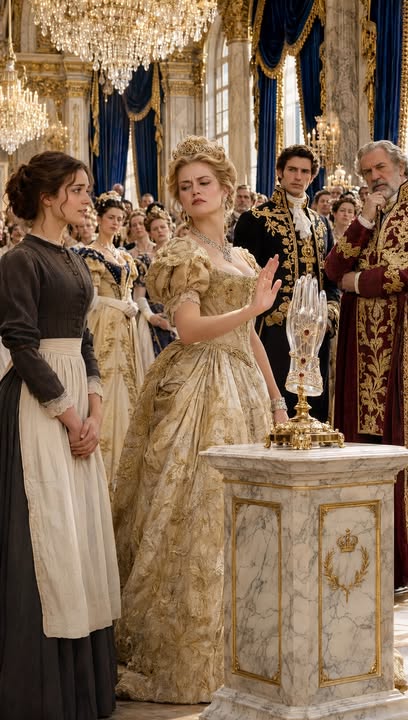
The sound came again, soft as a breath beneath winter ice.
“The promise must be freely kept.”
No one moved.
The words seemed to drift through the ballroom from everywhere at once, though their source was unmistakably the crystal glove.
Emily’s fingers remained inside it, surrounded by a golden radiance that warmed her skin without burning her.
She stared at the light, her lips parted, while the gathered nobles watched her as if she had become a stranger before their eyes.
Then the glow began to fade.
The diamonds set along the glove’s cuff dimmed one by one, and the warmth receded until only the candles brightened the ballroom.
Emily drew her hand free.
She turned it over, expecting to find a mark or a trace of pain, but her skin was unhurt.
Only the faintest golden shimmer remained on her fingertips before vanishing.
Prince Alexander stepped down from the dais.
“Are you all right?” he asked.
Emily looked at him, then at her hand.
“I believe so, Your Highness.”
King Edward’s face had gone very still.
“Enough,” he said, his voice cutting through the murmurs. “The gathering is over.”
The courtiers glanced at one another, uncertain whether they had heard him correctly.
“Your Majesty,” Lady Victoria began, “surely we should discuss what the glove—”
“We will discuss nothing here,” the king replied.
His gaze settled on the pedestal, where the crystal glove now appeared no different from an ordinary ornament.
“Have it sealed in the west vault,” he ordered. “No one is to approach it without my permission.”
The royal guards obeyed at once.
As they lifted the pedestal, Emily caught a last glimpse of the golden vines etched into the crystal.
For a moment, she thought one of them had curled into the shape of a tiny flower.
Then the guards carried it away, and the ballroom was left with nothing but whispers.
The nobles’ attention shifted to Emily.
Some looked at her with wonder; others with unease.
Lady Victoria’s expression had lost its easy amusement, though she quickly smoothed it into a practiced smile.
“Most unusual,” she said. “Perhaps the light was only a trick of the candles.”
Emily did not answer.
She had heard the voice.
And she knew it had not been a trick.
The king dismissed the guests before anyone could ask another question.
The musicians lowered their instruments, and the ballroom emptied in a slow, unsettled stream of silk, jewels, and murmured speculation.
Emily slipped through a side passage before anyone could stop her.
She wanted the familiar hush of the servants’ corridors, where no one expected her to explain what had happened.
But the voice followed her in memory, clear as a note from a distant song.
The promise must be freely kept.
She reached the narrow stair leading down to the kitchens and rested one hand against the cold stone wall.
For years, she had kept her mother’s old lullaby tucked away in the quietest corner of her heart.
It had been a small, lilting melody, gentle enough to soothe a child through a storm.
Emily could still remember the warmth of her mother’s voice, though the sound itself had grown faint with time.
There had been one line, sung more softly than the rest, that Emily had never understood.
A promise freely kept.
She closed her eyes.
The rhythm of the words from the glove seemed to fit the melody exactly.
“Emily.”
She turned.
Prince Alexander stood at the end of the corridor, alone.
He had removed his formal coat, though the silver embroidery at the collar still caught the light of the wall sconces.
His expression was unlike the composed one he had worn in the ballroom.
“I’m sorry,” he said.
Emily glanced back toward the empty passage, as if expecting someone else to appear.
“For what, Your Highness?”
“For allowing the room to make you feel that you had to apologize for asking to be treated fairly.”
His voice was quiet, but there was no hesitation in it.
“You spoke for me,” Emily said. “That was more than anyone else did.”
“I should have spoken sooner.”
She lowered her eyes.
“It is difficult to know when to speak in a room full of people who have already decided what you are worth.”
Alexander’s face tightened with regret.
“I know that does not make it right.”
“No,” Emily said gently. “But it matters that you understand.”
For a moment, neither spoke.
From somewhere below, the kitchens sent up the distant clatter of pans and the low hum of servants returning to their work.
It sounded ordinary, almost comforting.
Alexander glanced toward the ballroom.
“May I ask you something about the voice?”
Emily felt the blood leave her cheeks.
“You heard it too?”
“I heard every word.”
His eyes searched hers, not with suspicion, but with a careful curiosity that made it easier to answer.
“Have you heard it before?”
Emily drew a slow breath.
“I think I have.”
She wondered whether she should stop there.
The voice in the glove had seemed meant for everyone, yet somehow it had reached into a memory she had never shared with anyone at court.
“My mother used to sing a lullaby,” she continued. “There was a line in it that sounded like those words.”
“Do you remember the whole song?”
“Only pieces.”
She tried to hum the melody, but the notes caught in her throat.
“It was a tune she sang when I was little. I don’t remember where she learned it, and she never explained the words.”
“What was your mother’s name?”
“Anne.”
Alexander nodded, committing the name to memory.
“Is she still—”
“No,” Emily said. “She died when I was young.”
His expression softened.
“I’m sorry.”
“Thank you.”
Emily had learned that people often offered sympathy because they did not know what else to say.
Alexander did not look away or rush to fill the silence.
That small kindness loosened something in her chest.
He seemed less like a prince standing above her and more like a young man uncertain how to mend a hurt he had only just recognized.
“Do you think the glove was speaking to you?” he asked.
“I don’t know.”
Emily looked down at her hands, still rough from the day’s work.
“I only know that when it spoke, I remembered my mother.”
Alexander’s gaze followed hers.
“Then perhaps that memory is the first clue we have.”
The word clue made Emily stiffen.
She had not come to the palace hoping to become a puzzle.
“I don’t want to be treated like a mystery to solve,” she said.
“You shouldn’t be.”
He took a step back, giving her room.
“I’m not asking you to prove anything. I only thought you might want to understand what happened.”
Emily studied him.
In the ballroom, he had challenged his father for her sake, though he had done so before all the court and could have made an enemy of every noble family present.
Now he was offering to listen, not command.
“I would like to understand,” she admitted. “But I don’t know where to begin.”
“Neither do I,” Alexander said. “That may be a better beginning than pretending we already know.”
A faint smile touched Emily’s face before she could stop it.
The prince returned it, and something warm passed between them, fragile but real.
Then footsteps sounded at the far end of the corridor.
Alexander glanced toward them.
“I should go before anyone sees us here and invents a reason.”
Emily’s brief smile faded.
“They will invent one whether they see us or not.”
“Then let them be wrong.”
He hesitated, as though he had more to say, then bowed his head and walked away.
Emily watched him disappear around the corner.
She told herself that the feeling she carried was gratitude, nothing more.
Yet gratitude had never made her heart beat quite so quickly before.
The next morning, the palace moved as if it had awakened from a strange dream.
The servants spoke of nothing else, though always in low voices.
Some believed the glove had recognized Emily as the prince’s destined bride.
Others claimed the sound had been a warning.
A few insisted that the king had ordered the crystal sealed away because he feared what it might reveal.
Emily avoided the busiest corridors and kept to her duties.
She scrubbed the copper pots, folded linen, and carried trays, but her mind returned again and again to the voice.
At midday, she entered her small room beneath the eastern staircase.
It was hardly larger than a storage closet, but it had a narrow bed, a wooden chair, and a small window that looked out over the palace garden.
Emily closed the door and leaned against it.
Only there, away from the servants’ curious glances, did she allow herself to think about the secret she had carried since childhood.
Her mother’s pendant lay beneath the linen at the bottom of her workbox.
Emily took it out carefully.
It was a small, worn oval of brass, darkened by years of handling.
A golden vine had been engraved across its face, the lines so fine that they were almost lost beneath the scratches.
When Emily was a girl, her mother had placed it in her palm and told her to keep it safe.
“Someday, you may learn why it matters,” Anne had said.
Emily had asked what it meant.
Her mother had only kissed her forehead and replied, “Some things are safest when they are carried quietly.”
The pendant had never opened.
It had no clasp, no hollow edge, and no visible mark besides the vine.
Emily had worn it beneath her dress ever since, though she had never known whether it was a family keepsake or simply something Anne had treasured.
She had never shown it to anyone at court.
Not even when the royal family’s golden vine first appeared on the palace banners had she connected it to the pendant.
It seemed impossible that a kitchen maid’s old trinket could have anything to do with a royal relic.
Yet now the same curling pattern had glimmered across the glove.
Emily turned the pendant over in her palm.
A faint warmth lingered in the brass.
She held it nearer to the window, and sunlight brushed the engraved vine.
For an instant, a single line shone gold.
Emily’s breath caught.
Then the light disappeared, leaving only the old metal in her hand.
There came a knock at the door.
She quickly hid the pendant beneath her blouse.
“Emily?” called the housekeeper. “The king has sent for you.”
Emily’s stomach tightened.
“Did he say why?”
“No, dear. Only that you are to come to the small council room.”
The housekeeper’s tone was kind, but the words made Emily’s hands feel cold.
She followed the messenger through corridors that seemed longer than usual.
At the council room, the king stood beside a tall window, speaking with two guards.
The crystal glove was nowhere in sight.
Prince Alexander waited near the fireplace, his posture rigid, his face composed.
He met Emily’s eyes for a moment, and she saw a question there.
King Edward dismissed the guards.
“Miss Emily,” he said, turning toward her. “You caused a remarkable disturbance yesterday.”
“I never meant to, Your Majesty.”
“I did not say you had.”
His tone was controlled, but not unkind.
Still, Emily could feel the distance he placed between them.
“Do you have any explanation for what occurred?”
“No, Your Majesty.”
“Had you ever touched the glove before?”
“No.”
“Had you heard of the legend?”
“Only what everyone had heard.”
The king watched her carefully.
“Did you recognize the voice?”
Emily glanced at Alexander.
He offered no sign of what she should say.
She could tell the king about the lullaby.
But she could not explain why the words had sounded familiar without revealing the pendant, and she was not ready to place her mother’s keepsake in the hands of a king who had ordered the glove locked away.
“I heard the words,” she said. “I did not recognize the voice.”
The answer was true, though it left something important unspoken.
King Edward gave a brief nod.
“You will not discuss the incident with the other servants or the guests.”
Emily kept her hands folded.
“May I ask why?”
The king paused.
“Because rumors can harm innocent people.”
“Rumors are already spreading,” Prince Alexander said.
His father turned toward him.
“And your words will not stop them.”
“They might stop me from adding to them.”
The king’s jaw tightened, but he did not raise his voice.
“Alexander, this is a matter for the crown.”
“It is also a matter that affects her.”
“Then we will ensure she is not troubled further.”
Emily felt a familiar unease settle over her.
The king’s promise sounded less like comfort than a decision made without asking what she wanted.
“I’m grateful for your concern, Your Majesty,” she said. “But I can answer questions about myself.”
A silence followed.
King Edward regarded her, perhaps surprised that she had spoken.
“I see,” he said at last. “You may return to your duties.”
Emily curtsied and left the room.
She was halfway down the corridor when Alexander caught up with her.
“I’m sorry about that,” he said.
“You have apologized often since yesterday.”
“I may need to keep doing so.”
She stopped beside a narrow window overlooking the inner courtyard.
“Your father is afraid,” she said.
Alexander looked toward the council room.
“I’ve never seen him react to an object that way.”
“Perhaps he knows more about the glove than he is willing to tell.”
“I’ve wondered the same.”
Emily turned the thought over in her mind.
“Do you think he ordered it sealed because he believes I am dangerous?”
“No,” Alexander said. “I think he ordered it sealed because he does not understand what it said.”
“And that frightens him.”
“It frightens me too,” he admitted.
His honesty surprised her.
“You’re the prince,” she said. “Aren’t you supposed to be certain?”
“I was raised to appear certain.”
“And are you?”
“Not about the things that matter.”
The answer settled between them with quiet weight.
Emily had spent years believing that powerful people lived by different rules, protected from uncertainty by wealth and rank.
Alexander’s confession did not erase the distance between their lives, but it made that distance feel less absolute.
Before she could respond, a pair of ladies entered the corridor, their voices trailing ahead of them.
Alexander stepped back.
“We should speak again,” he said. “When it is safe.”
Emily nodded.
He continued down the passage without looking back.
That evening, after the palace had quieted, Emily sat on the edge of her bed with the pendant in her hands.
She hummed the lullaby her mother used to sing.
The melody began faintly, then grew steadier as memory carried her forward.
When she reached the line she remembered, her voice faltered.
A promise freely kept.
She turned the pendant over once more.
The golden vine seemed more intricate in the dim light than it had that morning.
One of its curling leaves ended in a tiny hooked point.
Emily traced it with her thumb, and the old metal gave a soft click.
She froze.
The back of the pendant had shifted by the width of a hair.
Emily pressed the edge again.
This time, a narrow seam opened along the side.
Something had been hidden inside.
Her hands trembled as she eased the pendant apart.
A thin sliver of folded paper lay within, yellowed and brittle with age.
Emily unfolded it with the utmost care.
There were no words on the paper, only a small drawing in faded ink: a crystal glove on a pedestal, and beside it, the same golden vine engraved on her pendant.
At the bottom, in a hand she recognized from the few letters her mother had left behind, Anne had written a single sentence.
“Find the place where the vine is broken.”
Emily stared at the words until the room seemed to tilt around her.
Her mother had known about the glove.
And somewhere in the palace, that broken vine was waiting to be found.
**–END OF PART 2–CLICK “NEXT” AT THE BOTTOM OF THE PAGE TO CONTINUE READING**
* * *
[NEXT: PART 3](https://storyly.idolsgift.com/blog/part-3-the-voice-in-the-crystal-052)
✓ Lynn R. Adams
The sound came again, soft as a breath beneath winter ice. “The promise must be freely kept.” No one moved. The words seemed to drift through the ballroom from everywhere at once, though their sour…