PART 2: The Voice Behind the Vault Door 041
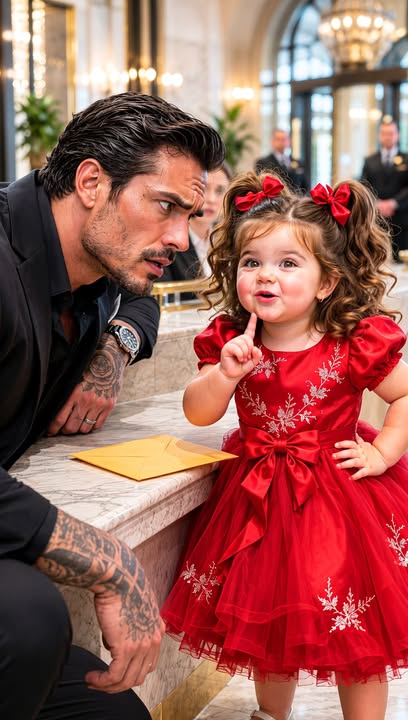
Vincent stopped breathing.
For one suspended moment, the vault held nothing but silence, the small girl’s hand curled around his sleeve, and the voice that had just called him son.
Then he turned toward the door.
“Who are you?” he asked.
The answer came after a pause, roughened by age but unmistakable.
“You know who I am.”
Vincent’s jaw tightened.
He had heard that voice in his childhood, in rooms where men spoke softly and expected everyone else to listen.
He had heard it again in nightmares, always accompanied by the memory of a gunshot and a closed coffin.
“Arturo,” he said.
The name seemed to change the air.
Isabella pressed herself against Vincent’s side.
“Is he the man from Mommy’s room?” she whispered.
Vincent lowered himself to her height, though he kept his eyes on the vault door.
“I don’t know, sweetheart.”
“But you said his name.”
“I did.”
“Is he a bad man?”
The question struck deeper than any accusation.
Vincent looked at her frightened face, at the soft curls escaping her bows, and forced his voice to gentleness.
“He’s someone I need to understand.”
From beyond the door, Arturo gave a weary sigh.
“That’s fair.”
Vincent rose, shifting Isabella behind him again.
“You’ve got one chance to explain why you’re here.”
“I arranged the meeting.”
The bank manager stood several feet away, pale beneath the fluorescent lights.
“You arranged this?” Vincent demanded.
The manager swallowed.
“I received instructions months ago. A sealed letter, with a release date and a name. I was told to open the box only if you or your daughter came in.”
“And you didn’t think to mention that before you shut us in?”
“I didn’t shut you in,” the manager said, his voice shaking. “The vault door locks automatically during a security cycle. It should have reopened by now.”
He glanced at the control panel beside the entrance and pressed a button.
Nothing happened.
A guard tried the manual release.
The panel flashed once, then went dark.
The manager’s face drained of color.
“That shouldn’t happen.”
“Then fix it,” Vincent said.
“I’m trying.”
Isabella tugged at the back of Vincent’s coat.
“Daddy, I want out.”
“I know, baby.”
He turned fully toward her and crouched, placing both hands lightly on her shoulders.
“We’re going to get out. Stay right beside me, all right?”
She nodded, then looked past him toward the door.
“Is the big man coming in?”
“No,” Vincent said.
He could not promise that the man would never come near them.
He could only promise what he could control in that moment.
“No one is coming near you unless I say so.”
The manager had begun speaking into a phone, but there was no signal in the underground vault.
One of the guards moved toward a narrow service panel set into the wall.
Vincent recognized the old brass latch and remembered it from the bank’s original blueprints.
“There’s a service corridor behind that.”
The manager turned quickly.
“That passage was sealed years ago.”
“Then it’s a good thing the bank didn’t forget where it is.”
Vincent stepped toward the panel, keeping Isabella in sight.
The guard tried the latch, but it resisted.
“Let me.”
The guard moved aside.
Vincent braced one hand against the wall and turned the latch with the other.
It gave way with a metallic groan.
Behind the panel lay a narrow passage lined with old brick and pipes.
The manager stared at it.
“I thought that was permanently closed.”
“People often mistake disuse for absence,” Vincent said.
He looked toward the vault door.
“Arturo, if you’re really there, you can explain yourself when we’re out.”
“I’ll be here.”
“Don’t count on it.”
“I’ve spent fifteen years being counted out,” Arturo replied. “I can wait.”
There was no anger in the answer.
That unsettled Vincent more than anger would have.
He lifted Isabella into his arms and entered the service corridor, with the manager and one guard following close behind.
The air smelled of dust, damp stone, and old metal.
Isabella tucked her face against Vincent’s shoulder.
“Daddy, your heart’s going fast.”
“It’s all right.”
“Does it hurt?”
He paused before answering.
“Not the way you mean.”
She placed her small palm over his chest, as if she could steady him by touch alone.
Vincent closed his eyes for half a second.
The last time he had held her this way, she had been an infant asleep against Elena’s shoulder.
He had only seen photographs since then.
He had told himself distance was protection.
He had told himself a great many things.
Behind them, the bank manager shone a flashlight down the corridor.
The passage ended at a steel door that opened into a records room on the floor above.
Once they emerged, the manager hurried to call the authorities and the bank’s security team.
Vincent remained beside Isabella in the quiet records room, one arm around her, his gaze fixed on the closed door through which they had escaped.
“What happens now?” the manager asked.
“Now you tell me everything you know about that box.”
“I already told you what the records showed.”
“Tell me what the letter said.”
The manager hesitated, then pulled a folded paper from his jacket.
“It was addressed to me. I was instructed to confirm your identity and allow you to open the deposit box. It said nothing about the vault malfunction.”
Vincent took the paper and read it.
The handwriting was careful and formal, but he recognized neither the author nor the phrasing.
“Who delivered it?”
“I don’t know. It arrived by courier.”
“Convenient.”
“I have the envelope and the security footage. You can have both.”
Vincent looked down at Isabella, who had begun tracing the seam of his lapel.
“Did the box contain anything besides the wooden case and photographs?”
The manager nodded.
“There was a letter addressed to your daughter.”
“Where is it?”
“Still in the vault. The box had a false bottom, and the documents were underneath it.”
Vincent’s expression sharpened.
“You knew about the false bottom?”
“No. We found it when your daughter pointed it out.”
Isabella lifted her head.
“I found the secret part.”
“You did,” Vincent said.
She smiled, pleased with herself.
The manager promised to arrange a proper escort back to the vault once the security system had been checked.
Vincent did not like waiting.
He liked even less the thought of Arturo remaining alone behind the sealed door, with no one knowing whether he had truly been there.
But the bank’s staff had already called for the fire department, and a technician was on the way.
The safest choice was patience.
It was a choice Vincent had never been good at making.
While they waited, Isabella asked for water, then wanted to know whether banks had kitchens.
She wanted to know whether the wooden box belonged to her, whether the old man had eaten dinner, and whether her mother could hear her from wherever she was.
Vincent answered what he could.
When he could not answer, he did not pretend.
“I don’t know, sweetheart.”
Isabella studied him with the solemn concentration of a child trying to make sense of a world that kept changing its rules.
“You’ll find out?”
“I’ll try.”
“Promise?”
Vincent lowered his forehead to hers.
“I promise I’ll tell you the truth.”
Her arms went around his neck.
That small embrace, offered without fear or calculation, nearly undid him.
For years he had imagined that if he ever saw his daughter again, he would explain everything.
He had pictured speeches, apologies, and some impossible way to make the lost time disappear.
Instead, she had asked for water and wanted to know whether a man in a sealed vault had eaten dinner.
The fire department arrived with a bank technician.
They checked the control panel, confirmed that the automatic lock had failed, and used a manual override to open the vault.
The door rolled aside with a heavy mechanical sigh.
The room beyond was empty.
Vincent stepped through first.
He scanned the corners, the floor, and the narrow gap around the vault’s rear wall.
There was no second door, no hidden passage, and no sign that anyone had recently stood there.
“Where is he?” Isabella asked.
The manager looked uncertain.
“He could have used another exit.”
“Not without tripping an alarm,” a guard said.
Vincent’s gaze settled on the bank’s old emergency release, a red metal handle beneath a glass cover.
Someone had opened it.
The mechanism had returned to place, but a fine layer of dust had been disturbed around its edges.
Arturo had not been a voice from nowhere.
He had been in the vault.
Vincent examined the release, then the narrow service passage.
“He knows the building.”
The bank manager looked troubled.
“Mr. Moretti, are we in danger?”
Vincent did not answer at once.
He looked down at Isabella, who had taken his hand and was staring at the open wooden box.
“Not while I’m here,” he said.
He knew how inadequate the words were.
Still, she squeezed his fingers as though they were enough.
Back inside the vault, the manager retrieved the letter and documents from the false compartment.
Vincent took the wooden box from the table and placed it on the floor, where Isabella could sit beside it.
The letter was sealed with a plain cream sticker.
Her name was written across the front in elegant handwriting.
Isabella Moretti.
Vincent held it for several seconds before opening it.
The handwriting made his throat close.
He knew the shape of the E, the long tail of the M, the slight slant of every line.
He had watched Elena write shopping lists and birthday cards and notes left on the kitchen counter.
He had once believed he would recognize her handwriting anywhere.
He had been right.
“Daddy?” Isabella whispered.
He unfolded the letter.
The words were brief.
“My darling Isabella, if you are reading this, the day has come when the truth can begin to find you.
“I left your birthday envelope with someone I believed could protect you.
“Your father may not understand why I chose that person, but he should know I did it because I loved you both.
“Do not let anyone tell you that love makes a person weak.
“Love is the reason I kept hoping we would find our way back to one another.
“Mommy.”
Vincent read it twice.
Then a third time.
The room seemed to tilt around him.
Elena’s handwriting.
Elena’s words.
A reference to a birthday envelope, entrusted to someone she believed could protect Isabella.
“Is that from Mommy?” Isabella asked.
Vincent struggled to answer.
“Yes.”
Her eyes grew bright.
“What does she say?”
He tried to keep his voice steady.
“She says she loves you. She says she wanted you to know the truth when you were ready.”
“Does she say where she is?”
The letter did not.
He read it again, searching for an address, a date, a name hidden in the margins.
There was nothing.
Only the unmistakable tenderness in the words.
And the unbearable possibility that Elena had written them after the night Vincent thought she had died.
“Daddy, why are you sad?”
He folded the letter carefully, as if a careless movement might erase it.
“Because I miss her.”
“Me too.”
Vincent took her hand.
“You remember her?”
“Some.”
“What do you remember?”
Isabella leaned against the wooden box.
“She had soft hands. And she sang when she brushed my hair.”
Vincent shut his eyes.
“Anything else?”
“She made pancakes in the shape of bears. But they always looked funny.”
A breath escaped him that was nearly a laugh.
“That sounds like her.”
“Sometimes she cried when she thought I was sleeping.”
Vincent looked at her.
“Did she tell you why?”
“No. She would kiss my forehead and say she was happy I was there.”
The letter trembled in his hand.
He had spent years believing Elena was gone, and here was their daughter offering him memories he had never known existed.
The box held one more small item beneath the documents: a yellowed photograph of a woman standing outside a modest house.
Vincent recognized the face immediately.
Sofia.
Elena’s twin sister had been dead for ten years.
In the photograph, Sofia stood beside a younger Isabella, whose birthday envelope was tucked beneath one arm.
On the back, a date had been written in dark ink.
“Is this Mommy?” Isabella asked.
“No,” Vincent said softly. “That’s her sister.”
“Her other Mommy?”
“No. Her aunt.”
“Did she love me?”
The question came so naturally that it hurt.
“Yes,” Vincent said. “Very much.”
Isabella traced the photograph’s edge.
“Mommy had a sister with her eyes.”
“She did.”
The image of Sofia had always belonged to a different part of Vincent’s life, one he had tried to bury beneath work and absence.
But now the photograph was connected to Elena’s letter, to the birthday envelope, and to a safe-deposit box registered on the night he disappeared.
Nothing in the vault was accidental.
He turned the photo over again.
The date was the same night the bank’s records said the box had been opened.
“Who gave Mommy this picture?” he asked.
Isabella went quiet.
Then she pointed at the woman standing in the background of the photograph, mostly hidden by the doorway.
“I saw her.”
Vincent leaned closer.
The woman’s face was blurred, but her posture and the dark line of her hair suggested someone watching from inside the house.
“When?” he asked.
“Not long ago.”
“Where?”
“At home.”
Vincent’s hand tightened around the picture.
“Did she come inside?”
“She talked to me.”
“What did she say?”
“She said I had Mommy’s eyes.”
The manager glanced toward the bank guards, uneasy at the conversation.
Vincent barely noticed.
“What did she look like, Isabella?”
The toddler frowned as she searched for the memory.
“Nice lady.”
“What else?”
“Like Mommy.”
Vincent’s pulse beat hard in his throat.
“Like Mommy how?”
“She had Mommy’s eyes. And her hair was dark. She was nice to me.”
“Did she tell you her name?”
Isabella shook her head.
“She said I was a big girl.”
“Was anyone else there?”
“Daddy wasn’t.”
The answer fell gently, but Vincent felt the weight of it all the same.
He had not been there.
He had missed birthdays, scraped knees, bedtime questions, and every small moment that made a life.
He looked down at his daughter and tried to imagine how many times she had asked where he was.
“Did she say when she’d come back?”
“She said soon.”
Vincent stared at the photograph.
The woman in the background looked enough like Elena to pass for her at a distance.
But Isabella had noticed the eyes, the manner, the resemblance.
“Could it have been Sofia?” he murmured.
Isabella shook her head.
“No. Auntie Sofia is in the picture.”
The child’s certainty stopped him.
“Do you remember Auntie Sofia?”
“Mommy showed me her picture.”
“And the nice lady?”
“She was like Mommy, but not the same.”
Vincent heard the distinction and felt the ground shift beneath him.
The woman in the photograph was not Elena.
She was Sofia.
But the visitor Isabella remembered was someone else.
Someone who looked like Elena.
The vault door stood open behind them, and beyond it the old service corridor led into the bank’s shadowed back rooms.
Vincent folded the letter and slipped it inside his coat.
He placed the photographs and documents in the wooden box, then lifted Isabella into his arms.
“Are we going to find Mommy?” she asked.
He looked at the little girl who had walked into a bank carrying a secret, at the handwriting that should not have existed, and at the empty doorway through which Arturo had vanished.
“Yes,” he said, though the certainty in his voice was new and fragile. “We’re going to find out what happened.”
As he carried her from the vault, the manager called after him.
“Mr. Moretti, what should we do about the box?”
“Keep the records. Secure the footage. Don’t tell anyone what was inside.”
The manager nodded.
Vincent kept walking.
Isabella rested her cheek against his shoulder.
“Daddy?”
“Yes?”
“Do you think the nice lady was Mommy?”
Vincent looked down at the letter in his hand.
He had come to the bank expecting money, perhaps a trap, perhaps a threat.
Instead, Elena’s own words had given him the first reason in years to doubt her funeral.
“I don’t know,” he told his daughter. “But I think she wanted us to keep looking.”
And somewhere beyond the bank’s doors, the woman with Elena’s eyes was waiting.
**–END OF PART 2–CLICK “NEXT” AT THE BOTTOM OF THE PAGE TO CONTINUE READING**
* * *
[NEXT: PART 3](https://echoesofstories.idolsgift.com/blog/part-3-the-voice-behind-the-vault-door-041)
✓ Lynn R. Adams
Vincent stopped breathing. For one suspended moment, the vault held nothing but silence, the small girl’s hand curled around his sleeve, and the voice that had just called him son. Then he turned to…