PART 2: “The Veiled Bride Said Nothing—Until She Whispered, ‘Your Brother Isn’t Dead’” 066
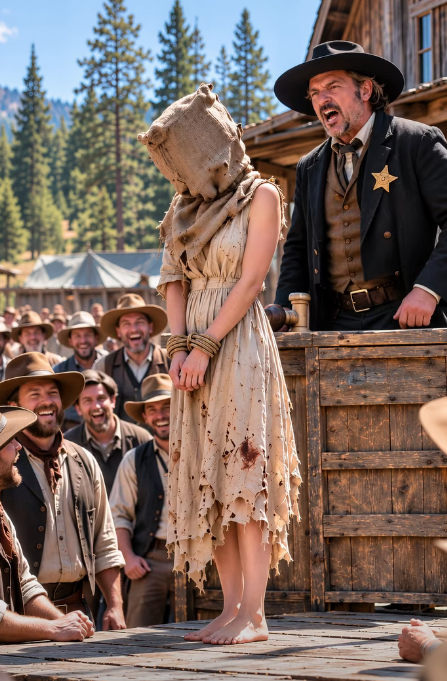
The deputy’s revolver looked enormous in the sudden silence.
Caleb Whitlock did not move toward his axe.
He did not shout.
Instead, he stepped sideways until his body stood directly between Josephine and the weapon.
Around the platform, the crowd seemed to remember all at once that this was no longer an afternoon spectacle. Men who had been laughing a moment earlier lowered their eyes. A mother pulled her young son closer. Somewhere beyond the buildings, a mule brayed into the stillness.
Deputy Silas Bell swallowed.
“Move aside, Whitlock.”
Caleb’s voice remained low.
“No.”
Silas tightened his grip. “You don’t understand what she is.”
“She’s a woman standing with ropes around her wrists.”
“That isn’t what I meant.”
“I know.”
Josephine’s fingers were still wrapped around Caleb’s sleeve.
He could feel them trembling.
But the words she had whispered continued echoing louder than anything else.
Your brother never died in there.
Six words.
Six impossible words.
Caleb’s older brother Nathan had vanished three winters earlier. Caleb had spent weeks searching after the thaw. He had found tracks leading toward the northern ridge, then nothing.
Until the blizzard.
Until the cave.
Until the silver watch.
Nathan’s watch.
Caleb had found it beneath fallen stone near the rear passage.
After that, there had been no reason to hope.
Or so he had believed.
Silas’s gaze shifted toward Josephine.
“Tell him you’re mistaken.”
Josephine remained behind Caleb.
“No.”
Her answer was barely audible.
Silas’s face changed.
Not anger.
Fear.
That frightened Caleb more than anger would have.
A woman near the front stepped forward. Mrs. Clara Finch, the settlement’s postmistress, was nearly sixty and possessed the particular courage of a person who had spent half her life listening to men make foolish declarations across a postal counter.
“Silas,” she said calmly, “there are twenty witnesses here.”
The deputy’s eyes flicked toward her.
“You stay out of this, Clara.”
“I intend to. The moment you lower that pistol.”
A murmur moved through the gathering.
Silas looked around.
Whatever authority the crooked badge had given him seemed suddenly much smaller.
Slowly, he lowered the revolver.
Caleb watched until the weapon returned to its holster.
Then he turned toward Josephine.
Her wrists were still bound.
Caleb pulled his knife.
She flinched.
He immediately stopped.
“I’m cutting the rope.”
After a moment, she nodded.
The blade passed carefully beneath the coarse fibers.
The rope fell.
Red marks circled her wrists, but Caleb did not stare.
He folded the knife and put it away.
The auctioneer cleared his throat nervously. “Well. Marriage is legal. Papers are signed. Business concluded.”
Caleb turned.
“No.”
The man blinked.
“No?”
“You called it business.”
Caleb placed one hand on the wooden table.
“It isn’t.”
The auctioneer looked toward the crowd as though hoping someone would laugh.
Nobody did.
Caleb took the marriage certificate, folded it once, and slipped it into his coat.
Then he looked at Josephine.
“You’re coming away from here.”
Silas spoke again.
“Whitlock.”
Caleb paused.
The deputy’s earlier confidence had disappeared.
“If she starts asking about the mountain,” Silas said, “you’d be wiser not to listen.”
Caleb regarded him for a long moment.
“That sounds like the advice of a man hoping I don’t.”
Then he led Josephine away.
Ridge Hollow lay four miles uphill.
They walked most of the distance.
Caleb owned a horse, but Josephine seemed reluctant to climb into the saddle, and he did not ask why. Instead, he carried the reins while the mare followed quietly behind them.
For nearly an hour, neither spoke.
Rain had fallen the night before. Moisture clung to the ferns along the road, and mist hung between the enormous pines.
Caleb kept hearing those six words.
Finally he stopped.
Josephine stopped several paces behind him.
“Is Nathan alive?”
Her covered head lowered.
“He was.”
Caleb’s chest tightened.
“That isn’t the same answer.”
“No.”
“When?”
“Three years ago.”
“The cave?”
“Yes.”
Caleb turned fully toward her.
“I found his watch.”
“I know.”
His expression hardened.
“How?”
“Because I put it there.”
The forest seemed to become unnaturally quiet.
Josephine took a step backward.
Caleb saw it.
He forced himself to unclench his hands.
“Why?”
“To make them believe Nathan was dead.”
“Who?”
“Men who were following him.”
“Silas Bell?”
She hesitated.
“Silas was there.”
Caleb stared at her.
“And you?”
“I was trying to help your brother.”
Caleb laughed once, but there was no humor in it.
“For three years I buried him in my mind.”
Josephine’s shoulders sank.
“I know.”
“You knew I thought he was dead.”
“Yes.”
“And you said nothing.”
“I didn’t know your name.”
Caleb looked away.
That stopped him.
Josephine continued.
“In the cave, you were freezing. Barely conscious. Nathan recognized you before you recognized him, but he made me promise not to tell you.”
“Why?”
“Because men were searching for him.”
“That doesn’t explain why he abandoned me.”
“No,” she whispered. “It doesn’t.”
Caleb looked back.
“Then explain.”
“I can’t.”
His jaw tightened.
“Can’t?”
“Not yet.”
For the first time, there was something stronger than fear in her voice.
Resolve.
“Nathan trusted me with one thing,” she said. “I kept that promise for three years. I will not break another merely because you’re angry with me.”
Caleb stared at the sack covering her face.
An hour earlier, he might have mistaken her trembling for helplessness.
He understood better now.
Josephine Rourke was frightened.
But frightened was not the same as weak.
Caleb picked up the mare’s reins.
“Cabin’s another mile.”
They continued walking.
Caleb’s home was small but sturdy, built against a slope above a creek.
Inside stood a rough table, two chairs, a stone hearth, a narrow bed behind a hanging blanket, and shelves containing flour, coffee, nails, books, and tools in no sensible order.
Josephine remained by the door.
Caleb set down his axe.
“You can have the bed.”
She said nothing.
“I’ll sleep near the hearth.”
Still nothing.
Caleb glanced toward the sack.
“You can take that off.”
Josephine’s hands lifted instinctively toward it.
Then stopped.
“Do I have to?”
Caleb frowned.
“No.”
Her shoulders relaxed.
“No,” he repeated. “You don’t have to do anything because somebody paid two dollars.”
A long silence followed.
Then Josephine whispered, “Thank you.”
Caleb pointed toward a wash basin.
“There’s water. Clean cloth in the chest. Food’s mostly beans unless you’ve got strong feelings about dried apples.”
To his surprise, a tiny laugh escaped beneath the sack.
It was the first warm sound he had heard from her.
Caleb turned toward the hearth so she would not see how deeply it affected him.
He lit a fire.
Behind him, fabric rustled.
Then Josephine said, “Caleb.”
He turned.
The sack was gone.
For a moment, nothing about the mysteries mattered.
She was perhaps thirty. Her brown hair had been cut unevenly near her shoulders, as though someone had done it with a small knife and little patience. Her skin was pale from weeks beneath cloth.
A thin scar curved beside her left temple.
But there was nothing monstrous about her face.
Nothing that explained the laughter at the auction.
Her eyes were gray-green.
And Caleb remembered them.
The cave.
Firelight.
A woman leaning over him while snow melted from his coat.
He had believed it a fever dream.
“You,” he breathed.
Josephine nodded.
Caleb sat slowly.
Three years disappeared.
He remembered waking beside a small fire.
A woman’s voice saying, Drink slowly.
Another voice farther back in the cave.
Nathan.
Caleb had convinced himself afterward that he had imagined it.
“You were there.”
“Yes.”
“What happened that night?”
Josephine sat across from him.
“Your brother was carrying documents.”
“What documents?”
“Land surveys.”
Caleb frowned.
“My brother cut timber.”
“He did when you knew him.”
Caleb said nothing.
Josephine continued.
“Before that winter, Nathan began working for a timber purchasing company. He could read contracts. Numbers. Survey descriptions. He discovered something unusual.”
“What?”
“Land around Ridge Hollow was being sold twice.”
Caleb leaned forward.
Josephine explained slowly.
Official government survey lines did not match private maps being used by timber companies. Homesteaders thought they owned particular parcels, while companies held papers claiming the same forests.
Nathan had discovered altered boundaries.
Someone had been moving survey markers.
“Who?” Caleb asked.
“My father was trying to discover that.”
“Your father?”
“Cormac Rourke. Territorial surveyor.”
The name stirred a memory.
Caleb had seen it printed on old land notices.
“Your father disappeared.”
Josephine nodded.
“Two months before the cave.”
Caleb stared at her.
“So Nathan was helping him?”
“After my father disappeared, Nathan helped me.”
She looked toward the fire.
“We believed the original surveys were hidden somewhere in those mountains.”
“The cave.”
“Yes.”
“And Silas?”
Josephine’s expression became guarded.
“He knew people were searching for the records.”
Caleb leaned back.
He felt as though the floor beneath his life had shifted.
His brother had not simply vanished.
Nathan had been involved in something Caleb had never understood.
“Where is he now?”
“I don’t know.”
Caleb’s disappointment was immediate.
Josephine reached inside the torn seam of her dress.
“I know where he was six months after the cave.”
She removed a folded piece of paper.
Old.
Creased repeatedly.
She slid it across the table.
Caleb did not touch it.
“What is that?”
“A letter.”
“From Nathan?”
“Yes.”
Caleb’s fingers slowly closed around the paper.
He recognized the handwriting immediately.
The letters leaned left.
Nathan had always written as though the words were walking into a strong wind.
Caleb unfolded it.
The date was August 17, 1866.
Six months after the cave.
His brother had been alive.
Caleb read the first lines.
Josephine,
If you ever reach Ridge Hollow, find Caleb.
Tell him I am sorry.
Caleb stopped.
His vision blurred.
He swallowed and continued.
Do not tell him everything until you know who is listening. The mistake was not made in the cave. It began years earlier, in our own house.
Caleb’s heart began pounding.
He looked up.
“What does that mean?”
Josephine’s eyes filled with a sorrow he did not understand.
“I was hoping you might know.”
Caleb read the final line.
And suddenly his breath caught.
Nathan had written:
Ask Caleb where Father kept the blue ledger.
Caleb stared at the words.
The fire cracked behind him.
Josephine waited.
At last Caleb whispered, “There was no blue ledger.”
“You’re certain?”
“Yes.”
Then he remembered something.
A winter evening.
He had been nine years old.
His father had caught Nathan searching beneath the floorboards.
Their father had shouted only once in Caleb’s entire childhood.
That night.
Get away from there.
Caleb slowly looked toward the far corner of the cabin.
His cabin.
Built from timber salvaged from his father’s house.
And beneath the floor near the hearth sat three wide planks Caleb had never replaced because his father himself had fitted them.
Josephine followed his gaze.
“What is it?”
Caleb stood.
He crossed the room.
Kneeling, he ran his fingers along the oldest floorboard.
There.
A narrow iron nail.
Different from all the others.
Caleb pried it free.
The plank lifted.
Beneath it was darkness.
He reached inside.
His hand touched cloth.
Caleb pulled out a small package wrapped in oilskin.
Josephine rose.
Neither spoke.
Caleb removed the wrapping.
Inside lay a thin book.
Its cover had once been blue.
And on the first page, in Caleb’s father’s handwriting, were four words.
I helped them do it.
**–END OF PART 2–CLICK “NEXT” AT THE BOTTOM OF THE PAGE TO CONTINUE READING**
✓ Lynn R. Adams
The deputy’s revolver looked enormous in the sudden silence. Caleb Whitlock did not move toward his axe. He did not shout. Instead, he stepped sideways until his body stood directly between Josephi…