PART 2: The Truth on the Screen10 026
Part 2 – The Truth on the Screen
“I know you’re watching this because Mrs. Wilson gave you the drive,” I said, my voice unsteady but clear.
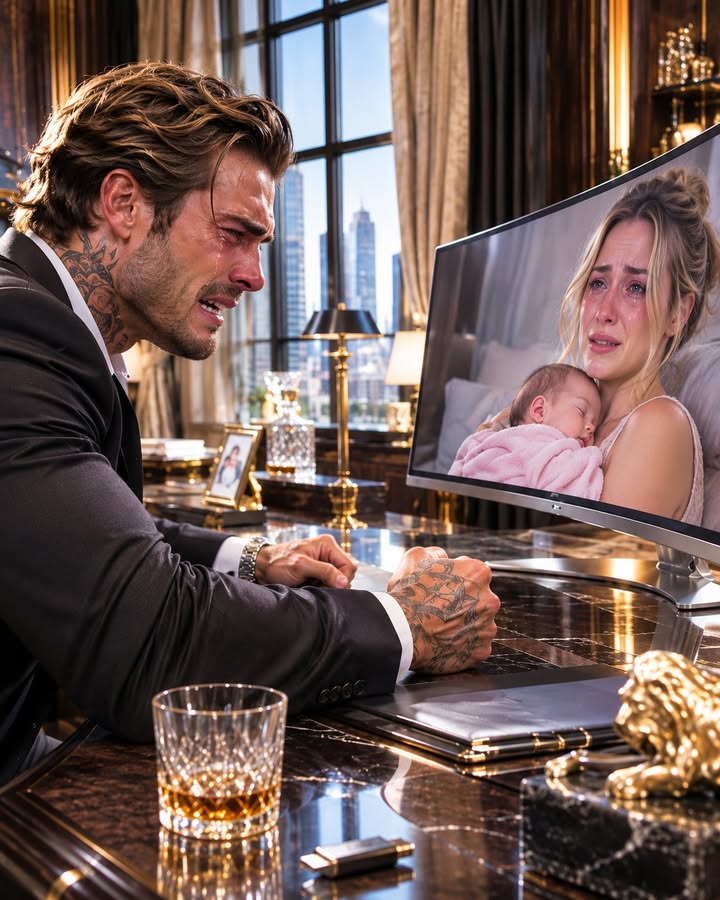
Vincent sat alone in his study, the door locked, the champagne roses forgotten on the desk beside him.
On the screen, I looked tired enough to disappear into the pale cushions behind me.
Our daughter slept against my chest, one tiny cheek pressed beneath my chin, her breath soft and even.
Vincent leaned toward the laptop as if moving closer could close the distance between us.
“I don’t know what Mrs. Wilson has told you,” I continued, “but I need you to listen to me before you decide what this means.”
He stared at my face.
For the first time in years, there was no one in the room to distract him, no call demanding his attention, no business waiting for an answer.
Only my voice, and the child he had never held.
“I’m not sending this to punish you,” I said.
The words seemed to land harder than any accusation.
“I know you may think I left because I wanted you to suffer, or because I wanted you to chase me.”
Vincent’s fingers curled against the edge of the desk.
“I didn’t.”
I paused to adjust the blanket around our daughter.
She stirred, made a small sound, and settled again.
Vincent watched her with a concentration that frightened me more than his anger ever had.
“I left because I couldn’t keep waiting for you to become someone I could trust with our family.”
The study’s silence seemed to tighten around him.
He looked away for the first time, toward the closed door, as if the mansion itself might offer an answer.
“It began before Paris,” I said.
“You know that.”
He gave a faint, involuntary shake of his head.
Perhaps he had forgotten the nights I waited for him.
Perhaps he had never understood that waiting could become its own kind of grief.
“You told me the trip was business,” I continued.
“You said there were meetings you couldn’t postpone and that you would be back as soon as you could.”
Vincent’s jaw tightened.
The video did not show what he remembered: the suitcase by the front door, the careful way he avoided my eyes, the phone vibrating in his hand while I stood in the nursery with our newborn daughter.
But he remembered.
He had told me Paris was necessary.
He had not told me Sophia had asked him to come.
“I found out the truth two days after you left,” I said.
The room on the screen was bright with afternoon light, but Vincent’s study seemed to darken.
“Sophia called the house.”
He went very still.
“She asked whether you had arrived safely.”
The video captured my eyes lowering to our daughter.
“I was holding the baby, and I heard her say your name as if she had every right to know where you were.”
Vincent’s hand slowly released the desk.
“She didn’t know I was listening,” I said.
“Or perhaps she did and didn’t care.”
I took a breath, steadying myself.
“She said she had asked you to come to Paris.”
Vincent closed his eyes.
For a moment, the only sound was the quiet murmur of the video and the faint tick of the clock on his wall.
“I asked you before you left if it was business,” I continued.
“You looked me in the face and said yes.”
He opened his eyes again, but he did not look at the screen.
The memory must have been there: my standing barefoot in the kitchen, still moving carefully because my body had not recovered, our daughter sleeping in the next room.
“I chose not to tell you that I knew,” I said.
“Not because I was trying to trap you in a lie.”
My gaze settled on the camera.
“I was waiting to see whether you would come home and tell me the truth yourself.”
Vincent’s shoulders lowered, and something in his expression seemed to give way.
He had come home with roses expecting forgiveness before he had even asked what I was feeling.
He had expected me to receive his apology like a familiar ritual.
“I wanted to believe that becoming a father would change what mattered to you,” I said.
“I thought that when you held her, something would settle into place.”
My daughter’s fingers opened against my blouse, then closed again.
“I thought you would look at her and understand that there was no meeting, no old promise, and no person from your past who could matter more than the life we had made together.”
Vincent’s eyes shone, though no tears fell.
“I’m not saying you don’t love her,” I told him.
“I don’t know what you feel for her, because you never came close enough to show me.”
He flinched.
“That isn’t the same as saying you can never love her.”
The distinction was small, but I had chosen it carefully.
I did not want my anger to decide our daughter’s future.
“I can’t tell you what she will need from you someday,” I said.
“But I know what she needs now.”
I looked down at the baby in my arms.
“She needs a home where the people responsible for her are present.”
Vincent leaned back in his chair, one hand covering his mouth.
The screen held my image steady, while the man before it seemed to lose the last of his certainty.
“I’m leaving because I want our daughter to grow up knowing that love is more than promises,” I said.
“It is showing up.”
The words were not loud.
They did not need to be.
“I don’t expect you to agree with every choice I’ve made, and I don’t know what will happen between us after this.”
I swallowed.
“But you can’t use your money, your name, or the people who work for you to make me come back.”
Vincent’s eyes lifted to mine.
“You can’t send men to find us and call it protection.”
The room went utterly still.
His phone sat on the desk beside the flowers, screen dark.
When he had first realized we were gone, he had ordered everyone he could reach to search for us.
Now my recorded voice made him hear the fear inside that command.
“If you want to speak to me,” I said, “you will have to do it in a way that leaves me free to say no.”
My voice softened.
“I don’t know if you can do that.”
The video continued.
Vincent leaned forward again, almost reaching for the screen, then stopped himself.
“I need to tell you something else.”
The change in my face was subtle, but he saw it.
The tiredness remained, yet something more guarded passed behind my eyes.
He sat upright.
For thirteen days, he had searched the empty rooms for signs of what I had taken and what I had left behind.
He had seen the cleared closets, the bare nursery, the signed papers.
He had not understood there was another absence, one I had carried without him.
“Before you left for Paris,” I said, “I took our daughter to see a pediatric cardiologist.”
Vincent’s hand dropped from his mouth.
The doctor’s office had smelled faintly of soap and warmed plastic.
I remembered the exam room’s white walls, the careful questions, the monitor showing a shadowed image of a heart too small to imagine and too important to ignore.
I remembered the doctor’s calm voice as she explained that our daughter had a congenital heart condition.
The words had sounded distant at first.
Then she had explained what they meant: regular monitoring, careful attention to her breathing and feeding, and the possibility that she might need surgery as she grew.
I had nodded through it, asked the questions I could manage, and memorized the signs she told me not to overlook.
Then I had gone home and sat beside the crib alone.
Vincent had been in Paris.
“The doctor said she needs close follow-up,” I told him in the video.
“She may need surgery someday.”
His face drained of color.
He rose from the chair so abruptly it struck the desk behind him.
For a moment, he seemed unable to breathe.
“Claire,” he whispered, though the screen could not hear him.
I held our sleeping baby closer.
“I didn’t tell you before you went because I already knew you had decided what was important.”
His mouth opened, but nothing came out.
“I knew you would say the trip was necessary,” I continued.
“You would promise to come back soon, and you might even mean it when you said it.”
My eyes were bright now, but I kept my voice steady.
“Then something else would come up.”
Vincent lowered himself back into his chair.
The roses had begun to shed small droplets of water onto the desk.
“I wasn’t afraid you wouldn’t care,” I said.
“I was afraid you would care in the moment, make a promise, and then leave me to carry the consequences when another call came.”
The confession changed the room.
Until then, Vincent had been grieving the fact that he had missed our daughter’s first days.
Now he was understanding that he had missed something far more serious: the chance to be trusted with her uncertainty.
“I kept the diagnosis from you because I couldn’t trust you to put your family first,” I said.
The sentence came out quietly, but it left no room for misunderstanding.
Vincent looked down at his hands.
They were the hands of a man used to being obeyed, the hands that had signed contracts, ended arguments, and held a glass of champagne while he walked through the front door.
They had never held his daughter.
“I know you may think I should have told you,” I said.
“Maybe I should have.”
A faint tremor entered my voice.
“But I was frightened, exhausted, and trying to decide what would keep her safe.”
My daughter slept against me, unaware of the life we were trying to shape around her.
“I didn’t want your money,” I said.
“I didn’t want your doctors chosen because someone owed you a favor.”
“I wanted to understand what was happening before the people around you turned her health into another reason you could control where we went and who we saw.”
Vincent stared at me as if each word were a door closing, one after another.
“I’m not telling you this so you’ll rush in and fix everything,” I continued.
“She has a doctor. She has appointments. I’m following the plan we were given.”
I paused, then added, “What she doesn’t have is a father she knows.”
His expression crumpled.
That was not a punishment.
It was simply the truth.
“I don’t know what you’ll do with that truth,” I said.
“I hope you’ll think about it before you decide what you are owed.”
I looked toward the window beside me.
The sunlight stretched across the room where I was staying, warming the blanket on the sofa and the little bag of baby clothes near the wall.
For the first time since I had walked away from the mansion, the room looked less like a temporary refuge and more like a place where we might begin.
“You are her father,” I said.
“That matters.”
Vincent looked up quickly.
“But it doesn’t make you entitled to take her from me or to step into our lives as if nothing happened.”
His hands tightened together.
“If you want to be part of her life, you will have to show me that you can be steady.”
I let the silence sit between us.
“Not once.”
“Not because you’re frightened of losing her.”
“Every day, in the ways that matter.”
The video’s small red timer continued to count.
“I still love the man I thought you could be,” I said, and for the first time my voice nearly broke.
“But I cannot raise our daughter on the hope that you will become him.”
Vincent’s lips parted.
He did not interrupt.
“I’ve signed the divorce papers,” I said.
“I’m not asking you to sign them because I want revenge.”
“I’m asking you to understand that I have made a choice for our daughter and for myself.”
The camera caught me looking down at the baby.
“I hope you don’t make me regret leaving.”
Then the screen went black.
Vincent did not move.
The laptop reflected his face in the dark glass: pale, stunned, and unfamiliar even to himself.
He watched the empty screen for several seconds, then pressed play again.
This time, when my recorded voice mentioned Paris, he did not look away.
When I described the diagnosis, he reached for the desk but found only the wet stems of the roses.
One flower slipped from the arrangement and fell against the signed papers.
He lifted the pages.
My signature ran across the final line in a hand he knew, though it seemed smaller than he remembered.
He had thought the papers were a message about what I wanted from him.
The video made him understand they were also a boundary.
His phone began to ring.
He glanced at the screen and saw a name from his office.
For years, he would have answered immediately.
Instead, he let it ring until the call stopped.
Then he opened his contacts and found the number for the family physician who had overseen my pregnancy.
He did not call the doctor.
The first question that came to him was whether the diagnosis could be treated, and the second was how to find the best specialist.
But Claire had asked him not to rush in and fix everything.
She had told him to listen.
So he sat back down and watched the video again.
When it ended, he called Mrs. Wilson.
She answered on the second ring.
“Mr. Moretti?”
“Where are they?”
He heard her inhale, careful and quiet.
“I promised Claire I would not tell you where she was.”
“I’m not asking for the address.”
His voice sounded rough.
“Is she safe?”
“Yes.”
“And the baby?”
“She’s being cared for.”
“Does she have a doctor?”
“Yes, sir.”
He closed his eyes.
“Did you know about the heart condition?”
There was a pause.
“No.”
“Did Claire tell you anything else?”
“Only that she had made the choice she needed to make.”
He looked at the divorce papers on the desk.
“I told everyone to search for them.”
“I know.”
“I won’t do that again.”
Mrs. Wilson’s reply came gently.
“You should tell Claire that yourself, when she is ready to hear from you.”
He nearly asked her to help him contact Claire.
Then he remembered the video.
“Thank you for protecting them,” he said.
Mrs. Wilson was silent for a moment.
“I was protecting my friend, sir.”
The words stung, but he accepted them.
After the call ended, Vincent returned to the desk and placed the USB carefully beside the divorce papers.
He had no right to demand an address.
He had no right to show up at a clinic and expect the door to open.
He had no right to make Claire’s fear come true simply because he was frightened himself.
For the first time in his life, doing nothing felt harder than giving an order.
Across the city, I sat beside my daughter’s crib after the video had gone dark on the small camera I had used to record it.
My hands were cold, though the room was warm.
I had said everything I had planned to say, and still there were words I had left out.
I had not told Vincent why I had recognized the cardiologist’s name when the doctor first mentioned it.
I had not told him that years before our marriage, his mother had taken my hands in hers and quietly arranged for me to see a doctor after a frightening night connected to Vincent’s world.
She had given me a letter then, one I had kept in a box through every move and every uncertain year.
I had never told Vincent what it said.
The memory of that letter rested in the back of my mind as I watched our daughter sleep.
There would be time to decide whether he deserved to know.
For now, I wanted only to give her a peaceful night.
At the mansion, Vincent sat in the study until the late afternoon light faded from the windows.
The house around him was full of reminders he had never noticed before: the small pair of slippers near the stairs, the framed photograph of Claire from their wedding, the unopened package of baby blankets that had arrived while he was away.
He picked up the package and found the card he had written.
For our little girl.
He had intended to give it to her when he came home.
He had imagined that there would be time.
The phone rang again.
This time, the caller was not from his office.
The name on the screen belonged to Sophia.
He watched it ring twice before answering.
“Vincent,” she said, relief quickly giving way to concern.
“I’ve been trying to reach you.”
He looked at the roses, then at the dark laptop.
“Why did you ask me to come to Paris?”
The pause on the other end was small, but it was there.
“I told you, there was something important I needed to discuss.”
“That isn’t what I asked.”
He heard a quiet breath.
“Claire knows, doesn’t she?”
“She knows you asked me to come.”
Sophia did not answer right away.
And in that silence, Vincent understood that the first truth he had heard from Claire was not the only one waiting for him.
**–END OF PART 2–CLICK “NEXT” AT THE BOTTOM OF THE PAGE TO CONTINUE READING**
* * *
[NEXT: PART 3](https://puretales.idolsgift.com/blog/part-3-the-truth-on-the-screen10-026)
✓ Lynn R. Adams
Part 2 – The Truth on the Screen “I know you’re watching this because Mrs. Wilson gave you the drive,” I said, my voice unsteady but clear. Vincent sat alone in his study, the door locked, the champ…