PART 2: The Truth He Couldn’t Outrun 056
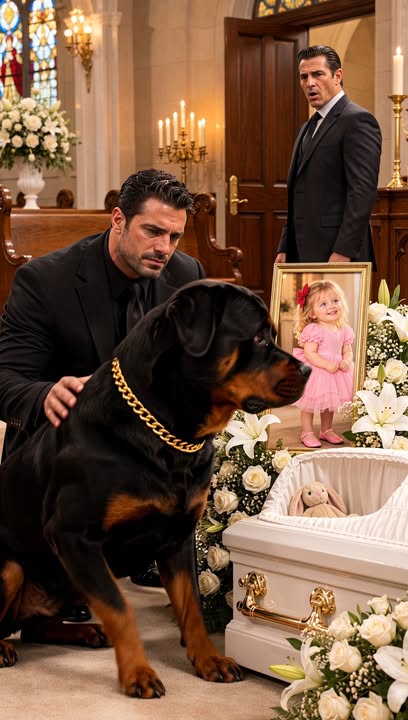
“What was an accident, Marco?”
For a moment, he didn’t answer.
The chapel held its breath around us, and Bruno stood between Marco and the coffin, his growl softened now to a low, uneasy rumble.
Marco looked at the floor as if the words might be written there.
“I was driving,” he said.
Tony came back from the hallway and stopped just inside the doorway.
No one moved.
Marco swallowed, then looked at me.
“That night, I was driving the car that hit Elena.”
The sentence seemed too small to contain what it meant.
Behind me, someone drew in a sharp breath.
Luis Vasquez sat in the front row, his hands still folded together, his gaze fixed on the coffin. I wondered whether he had heard. I wondered whether I should make sure he did.
Marco’s face had gone pale beneath the chapel lights.
“She came out of nowhere,” he said quickly. “I saw her too late. I tried to turn, but there was nowhere to go.”
“Stop,” I said.
He closed his mouth.
“Don’t tell me what you think I want to hear. Tell me what happened.”
Marco rubbed his palms against his trousers. His hands were shaking.
“I was coming back from the bakery. I’d finished the collection and was heading home. I was tired, and I’d had a drink earlier.” He glanced toward the coffin and looked away again. “Then she stepped into the road.”
“You stopped?”
His silence answered before he did.
“No.”
A quiet sob came from somewhere behind us.
I turned and saw an older woman with a tissue pressed to her lips. She had been seated near the back, close enough to hear everything.
Marco looked as though he wanted to disappear inside his dark suit.
“I panicked,” he said. “I kept thinking if I stopped, the police would find out who I was, and then they’d come after my family. My past, the people I work for—everything would come down on my wife and my boy.”
“And Elena?” I asked.
His eyes lifted to mine, wet and frightened.
“I know,” he whispered. “I know what I did.”
“No,” I said, more quietly than I meant to. “You know what you’re saying now.”
He flinched.
“I didn’t mean to hurt her.”
“I believe you didn’t set out to hit a child.”
His shoulders sagged, as though he had been waiting for that small distinction.
“But you did hit her,” I continued. “And you left her there.”
Marco’s mouth trembled.
“I told myself she’d run into the road. I told myself someone else would find her. I told myself a lot of things.”
Bruno shifted his weight, nails clicking against the chapel floor.
Marco glanced at him and then at me.
“Your dog knew.”
“No,” I said. “Bruno growling at you isn’t proof of anything.”
The dog’s ears tilted at the sound of his name, but he stayed where he was.
“Your confession is proof enough that you left a child and her family without answers.”
Marco nodded once.
The words had landed. They were not a punishment, and they were not forgiveness.
They were simply true.
Tony stepped nearer, his expression drawn tight.
“Boss, we should take this somewhere private.”
“Not yet.”
My eyes had shifted to Luis.
He had heard us. I could tell by the way his hands had locked together, his knuckles pale against his dark jacket.
For three days, he had sat with the weight of a death he couldn’t explain. Now the man who had struck his daughter stood in the same room, breathing the same air.
Luis rose slowly.
He was a small man, narrow in the shoulders, with deep lines at the corners of his mouth. I had known him for almost two years through his restaurant, though most of our conversations had concerned money and dates and promises.
He looked at Marco.
“Why?” he asked.
Marco opened his mouth, but no answer came.
Luis turned his face toward me instead.
“Did you know?”
“No.”
The answer sounded plain and inadequate, but it was the only one I had.
Luis studied me, searching for something I couldn’t name. Then he looked back at the coffin.
“My daughter walked home from school every day,” he said. “She knew how to cross that street.”
His voice did not rise.
That made it harder to hear.
“She was careful. She always looked both ways. She used to remind me when I was in a hurry.”
Marco lowered his head.
“I’m sorry,” he said.
Luis didn’t respond.
I wanted to say something for him, but the words that came to mind were all about money, arrangements, and what I could do to make a problem smaller.
There was no way to make this smaller.
Luis sat down again, as if standing had taken the last of his strength.
I looked at Tony.
“Get Marco’s car keys. He isn’t driving anywhere.”
Marco didn’t resist when Tony held out his hand.
“And call the lawyer,” I added. “We’re going to find out exactly what surrendering means, and we’re going to do it properly.”
One of my men shifted near the door.
“Boss, if this gets to the police, they’ll start asking questions about the collections, the old cases—”
“They’ll ask what they ask.”
A few faces turned toward me.
I understood their fear. Marco had been part of the organization longer than some of them had been adults. His confession might open doors we had spent years keeping shut.
But the possibility of consequences did not change the fact that a family had been left to bury a child without knowing who had struck her.
“Don’t make this about us,” I said.
No one answered.
The funeral director appeared at the side entrance and gently asked whether we needed more time.
I glanced at Luis.
He gave the smallest shake of his head.
The service continued, though nothing about it felt the same afterward.
The priest spoke of Elena’s bright drawings, her love of horses, and the way she had once collected fallen leaves in a paper bag because she thought each one looked like a different kind of bird.
Luis listened without looking at Marco.
I sat in the back with my hands clasped, and Bruno lay at my feet. He did not growl again.
When the service was over, families gathered around Luis, offering embraces and condolences. He accepted them with a tired patience, thanking each person as if he were trying to remember how a grieving father was supposed to behave.
Marco remained near the doorway under Tony’s watch.
I kept my distance from him.
There would be time to hear the rest, but not while Luis was surrounded by people who had come to mourn his daughter.
When the last guests began to leave, I found Luis near the coat rack, looking down at a small envelope someone had pressed into his hands.
“Luis,” I said.
He tucked the envelope into his jacket.
“I’m sorry.”
He looked at me with a weary sort of courtesy.
“I know.”
“I’m not asking you to make this easier for me.”
“Good.”
His reply was not harsh. It was only honest.
I nodded.
“The forty-two thousand dollars,” I said. “I’m suspending the debt. There won’t be any more collection visits. I can also cover the funeral expenses, if you’ll let me.”
Luis’s eyes narrowed slightly.
He had good reason to be wary. In his experience, my offers came with dates, amounts, and expectations.
“This is not a loan,” I said. “There’s no condition attached.”
“I know what you’re telling me.”
“I mean it.”
He looked past me toward the chapel, where Elena’s white coffin rested beneath a spray of flowers.
“My daughter is gone,” he said. “Money can’t change that.”
“No.”
“And if I take your money, what am I supposed to call it?”
“Help, if that’s what it is.”
“And if I don’t?”
“Then you don’t.”
For a moment, neither of us spoke.
Luis turned the envelope over in his hands.
“I spent two years trying to pay that debt,” he said at last. “I kept thinking if I made enough, I could get clear of it.”
“I know.”
“Do you?”
The question was quiet, but it found its mark.
I had known the numbers. I had seen his payments arrive late, then smaller, then stop altogether. I had known his restaurant had lost customers when the roadworks began and that he had sold his delivery van to keep the rent paid.
I had not asked what the debt was costing him beyond the figures in my account book.
Luis breathed in slowly.
“I was going to bring you another payment next week,” he said. “Not much, but something.”
“You don’t owe it now.”
His eyes remained on mine.
“Why?”
I could have told him that I didn’t want to take money from a grieving man. I could have dressed my answer up as decency.
Instead, I looked toward Elena’s coffin.
“Because I can’t stand here and pretend it’s still just business.”
Luis’s expression did not soften, but something in it shifted.
“Then don’t pretend,” he said.
He left without accepting the offer.
I watched him go, his coat hanging loose on his frame, the envelope still in his hand.
Behind me, Marco stood beside Tony, silent and alone.
My men were waiting for instructions. They knew I would have to decide what happened next, though no one said it aloud.
I looked at the white coffin again, then at Bruno.
The dog’s head rested on his paws, his eyes open and watchful.
“Take Marco to the house,” I told Tony. “No visitors, no calls without my say. He stays there until the lawyer comes.”
Marco nodded.
“I’ll go to the police,” he said.
“You will,” I replied. “But you’ll do it with counsel, and you’ll tell the truth.”
“I will.”
The promise sounded thinner than it should have.
Perhaps he knew that too.
As the chapel emptied, I remained near the back until the funeral director began gathering the flowers. I had never been good at standing still when there was something to fix.
This time, there was nothing.
Outside, cold air swept across the parking lot. Tony opened the car door for Bruno, but the dog stopped beside me and looked back toward the chapel.
“Come on,” I murmured.
Bruno took one step, then paused again.
I glanced through the open doorway.
Luis was still inside, alone now, standing beside the little white coffin. His shoulders were rounded, his head bowed, and he held one hand against the polished wood.
Bruno whined softly.
I put a hand on his collar.
“Let him have his moment.”
The dog looked up at me, then turned away at last.
On the drive back, Marco sat between two men in the rear seat. He did not speak. I watched the city slide past the window and thought of the story he had told himself: that Elena had darted into the road, that stopping would destroy his family, that somebody else would find her.
Fear had turned a few seconds into three days of silence.
It had also turned an old friend into a stranger.
At the house, I asked Tony to stay with Marco while I made two calls. The first was to the lawyer. The second was to a man who knew the families on Elena’s block and might be able to find out what Luis needed without making him feel cornered.
I told him not to offer money.
“Just ask if there’s anything practical we can do,” I said. “And if he says no, accept it.”
When I finished, I found Marco sitting at the kitchen table with a glass of water untouched before him.
“You’ve got a son,” I said.
His gaze rose.
“Fifteen.”
“Does he know?”
“No.”
“Does your wife?”
“She knows I was in trouble. She doesn’t know the details.”
I took the chair across from him.
“You understand this won’t stay private.”
“I do.”
“Your family may hear things you don’t want them to hear.”
“I know.”
“And the police will decide what to do with you. Not me.”
Marco nodded.
His hands were folded on the table now, just as they had been in the chapel.
“I thought I could protect them by keeping quiet,” he said.
“Were you protecting them when you lied to your wife?”
He looked down.
“No.”
“Were you protecting them when you left a child in the road?”
His jaw tightened.
“No.”
I let the silence settle between us.
The house was quiet except for the faint hum of the refrigerator. Outside, one of the men opened and shut a car door.
Marco touched the rim of his glass but didn’t lift it.
“I saw her shoes,” he said.
I waited.
“Purple sneakers. I remember one of them was turned sideways in the road.” He shut his eyes. “I can still see it.”
The image settled into me with a weight I could not shake.
“What did you do after you drove away?”
“I went home. I didn’t tell my wife where I’d been. I washed the car, but there wasn’t much to wash. I thought about calling someone. Then I convinced myself I couldn’t.”
“You could have called an ambulance.”
“I know.”
“You could have gone to the police.”
“I know.”
He said it without defending himself, but knowing what he should have done had not made him do it.
I stood.
“Try to sleep.”
“I don’t deserve to.”
“That isn’t the question.”
He looked at me.
“Then what is?”
“What you do now.”
I left him with Tony and walked down the hall to my study.
For years, I had kept records of the money I loaned, the money I collected, and the people who owed me favors. I had never thought of those pages as anything but accounts.
That night, for the first time, I wondered what else they might say.
Among the recent entries, I found Luis’s name and the remaining balance beside it. Below that, in my own handwriting, was a note from months earlier: “School supplies, Elena—paid quietly.”
I stared at the words.
I remembered the day only faintly: Luis had mentioned that Elena’s art class was short on paper and paints, and I had asked someone to take care of it without using my name. It had seemed like a small thing, a way to ease a burden without turning it into a debt.
I had forgotten it almost immediately.
Then Tony called from the hallway.
“Boss, Luis is on the phone.”
I picked up.
For several seconds, neither of us spoke.
Then Luis said, “There’s something I didn’t tell you about that night.”
My hand tightened around the receiver.
“What is it?”
“I don’t know if it matters,” he said. “But when they returned Elena’s things, her sketchbook was there.”
I waited.
“One page was missing.”
My eyes drifted to the account book, to Elena’s name written in my hand.
“Did you tell the police?”
“I thought it had fallen out somewhere. I didn’t want to make trouble over a piece of paper.”
His voice wavered, then steadied.
“But now I’m wondering who took it.”
**–END OF PART 2–CLICK “NEXT” AT THE BOTTOM OF THE PAGE TO CONTINUE READING**
* * *
[NEXT: PART 3](https://storyly.idolsgift.com/blog/part-3-the-truth-he-couldn-t-outrun-056)
✓ Lynn R. Adams
“What was an accident, Marco?” For a moment, he didn’t answer. The chapel held its breath around us, and Bruno stood between Marco and the coffin, his growl softened now to a low, uneasy rumble. Ma…