PART 2: The Thread Beneath the Hem 069
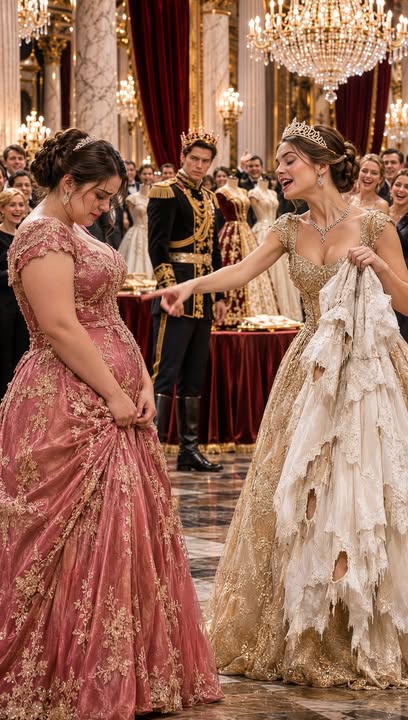
Part 2 – The Thread Beneath the Hem
The magnifying glass caught the chandelier light as Mara eased it beneath the gown’s torn sleeve.
She held the fabric steady with one hand and guided the lens with the other, careful not to pull at the fragile threads.
The ballroom, so full of whispers moments before, grew quiet enough for the faint rustle of silk to sound like a footstep.
Prince Adrian stood close beside her, his gaze fixed on the sleeve.
Lady Celestine remained a few paces away, her champagne-gold skirts gleaming beneath the chandeliers.
The seamstress had never been the center of a room like this.
She could feel the attention pressing against her from every side, but she kept her eyes on the stitches.
“May I have a little more light?” she asked.
Adrian turned to a footman, who brought a small lamp from the restoration table.
Mara angled it toward the seam, and a narrow line of blue thread appeared between the old ivory stitches.
Her breath caught.
“That thread,” Adrian said quietly. “What does it mean?”
Mara did not answer at once.
She adjusted the lens until the tiny blue strand came into focus, then traced its path with the tip of a clean wooden pick.
“It was used to mark a repair,” she said. “Not an ordinary repair, though.”
Lady Celestine gave a small, disbelieving laugh.
“A blue thread hidden in a sleeve is proof of nothing.”
“It may be nothing,” Mara replied, still looking through the glass. “But it has been placed between two layers of stitching. Someone opened this seam and closed it again.”
Adrian’s expression changed.
“Could it have been done by accident?”
“No, Your Highness. Not this way.”
She lowered the magnifying glass, aware that everyone was waiting for her to explain.
“In the palace sewing rooms, we sometimes used a colored thread as a guide when a seam had to be opened and restored exactly as it had been. The thread stayed hidden inside the work, where it could be found later by the person who knew to look.”
“Who knew to look?” Adrian asked.
“The seamstress who made the repair, or whoever asked her to.”
For an instant, Mara saw something flicker behind his composure: not anger, but a grief that had learned to keep its voice low.
“Your mother’s gown was thought to have been stolen,” he said.
The words were not directed at anyone in particular.
Mara felt the old dress settle more heavily against her shoulders.
“I didn’t know it belonged to the queen,” she said. “I’m sorry.”
Adrian’s eyes moved to the embroidered symbol near her sleeve.
“Neither did I know it was here.”
A murmur passed through the gathered guests.
Celestine glanced from the blue thread to the prince.
“Your Highness, surely we should let the palace tailor examine it before drawing conclusions.”
“I agree,” Adrian said. “We’ll have him examine it.”
His calmness seemed to unsettle her more than a sharp reply would have.
Mara turned her attention back to the gown.
The embroidered mark was small, no larger than a coin, and nearly hidden in the folds of the sleeve.
It showed a crescent moon cupped by a sprig of rosemary.
Mara had seen it before in an old wardrobe inventory, though she had not known who it belonged to.
Now Adrian looked at it as though it were a face he had not expected to see again.
“It was my mother’s personal mark,” he said.
No one laughed now.
The young seamstress swallowed.
“Your mother wore this gown?”
“She was married in it,” Adrian replied. “It disappeared from the royal archive when I was a child.”
He had spoken with the measured courtesy of a prince, but his hands had closed at his sides.
Mara wondered how many times he had heard the story of the missing dress.
She wondered whether he had been told it was stolen by someone who worked in the palace.
“Do you know where it came from?” he asked.
Mara felt the room turn toward her once more.
“I found it in the restoration rooms,” she said. “It was among a group of garments sent down from storage.”
“When?”
“Several weeks ago.”
“And you didn’t report it?”
The question was quiet, yet it reached her more sharply than an accusation shouted across the ballroom.
Mara looked down at the white silk gathered in her hands.
“I thought it had been marked for repair.”
“Did you?”
“I saw the old seams and the damaged lining. There was no royal seal on the storage tag, only a number. I thought someone had put it aside because it needed mending.”
“Then why didn’t you ask?”
Mara’s cheeks warmed.
“Because I was afraid.”
The honesty escaped before she could soften it.
Adrian’s gaze remained on her.
“Afraid of what?”
“Of being blamed for touching it. I’m the newest assistant in the restoration rooms. If something valuable goes missing, the person with the least power is often the first one questioned.”
It was not the whole truth, but it was the part she could make herself say before the ballroom.
The rest—the way she had recognized the symbol and decided to wait, the fear that she had already done something wrong simply by finding it—sat heavy behind her teeth.
Adrian studied her for a moment.
“Did you take the gown from the restoration rooms?”
“No.”
“Did you know it was your mother’s?”
“No, Your Highness.”
“Did you alter it?”
“No.”
The answers came plainly.
She could not tell whether he believed her.
“Then I should not have asked you as if I had already decided,” he said.
A quiet surprise moved through the room.
Mara looked up.
Adrian’s face remained composed, but the apology in his words was unmistakable.
“Thank you,” she said, unsure what else a person could say to a prince who had just admitted he might be wrong.
Celestine shifted her weight.
“Your Highness, the challenge is still unfinished. We have three gowns on the table, and one of them has been altered. This discovery may be related, but it may also be a distraction.”
Her voice was smooth, as if she were trying to return the evening to a more familiar shape.
Adrian turned toward the display.
“The challenge is to identify the gown that was altered,” he said. “We’ll continue, but no one will be judged on guesswork.”
His eyes returned to Mara.
“Can you examine the three gowns?”
She hesitated.
“Not without removing the old gown first.”
“I’ll help,” he said.
The offer startled her.
A prince lifting the torn, yellowed hem of his mother’s wedding dress would have seemed impossible an hour earlier.
He reached for the fabric carefully, but Mara shook her head.
“Please, Your Highness. The weight is uneven. If you lift from that side, the sleeve may tear.”
She expected him to bristle at being corrected.
Instead, he stepped back at once.
“Then tell me where to stand.”
Mara showed him how to support the skirt without pulling against the bodice.
Together they moved toward the restoration table.
The sight of them carrying the dress—one in royal evening clothes, the other in a borrowed rose-pink gown—drew every eye in the ballroom.
Mara could hear the whispers returning, though the words were too soft to make out.
She had spent years learning to work while others looked through her.
She had never imagined how different it felt to be watched because someone had finally noticed what she knew.
They laid the old gown across a padded stand.
Mara removed her hands slowly, checking each fold for strain.
The dress’s faded silk seemed almost luminous beneath the golden lights, its worn places telling a history that no official record had managed to preserve.
Adrian stood beside it, not touching the fabric.
“My mother used to say a dress remembered how it had been treated,” he said.
Mara glanced at him.
“Did she?”
“She said silk could keep a crease long after the person who made it had forgotten why it was there.”
A faint smile touched his mouth, but it faded quickly.
“I was too young to understand what she meant.”
Mara felt the familiar ache of remembering someone through small things.
“My grandmother taught me to listen to the fabric,” she said. “She said every garment has a different kind of silence.”
Adrian looked at her hands, roughened slightly from years of careful work.
“Your grandmother was a seamstress?”
“She was the first person who taught me. She worked in the palace before I was born.”
“Do you remember her?”
“Not as much as I wish I did,” Mara answered. “I remember the smell of lavender sachets in her sewing basket, and how she hummed when she was concentrating. She could take a sleeve apart and put it back together so neatly that you wondered whether it had ever been sewn.”
Adrian’s expression softened.
“Perhaps she knew this gown.”
Mara looked at the hidden blue thread beneath the sleeve.
“Perhaps.”
She moved to the first display gown and began examining its lining.
The contestants stood back while she worked, some still wearing expressions of polite curiosity, others watching with impatience.
Celestine’s chin remained lifted, but her eyes followed Mara’s every movement.
Mara checked the bodice seams, then the underarms, then the inside of each cuff.
The first gown showed no sign of a concealed opening.
The second carried the pale, even stitching of a careful restoration.
The third had several old repairs, but each was recorded by the visible markers attached to its restoration tag.
“None of these has the same kind of hidden repair,” Mara said.
“So the old gown is the altered one,” Celestine replied. “It was not even part of the challenge display.”
“That doesn’t prove that,” Mara said.
Celestine’s eyebrows rose.
“Are you suggesting another dress was altered as well?”
“I’m saying I haven’t examined enough to know.”
Adrian gave Mara a thoughtful look.
“Then we won’t call it a conclusion.”
Celestine’s lips pressed together, but she said nothing.
A door opened at the far end of the ballroom.
The palace tailor entered with a leather case in one hand and a silver measuring gauge in the other.
He had been summoned from the neighboring workroom, where he had been overseeing preparations for the next day’s court ceremony.
His name was Master Vale, and his gray hair was tied neatly at the nape of his neck.
“Your Highness,” he said with a bow. “I came as quickly as I could.”
“Please examine this seam,” Adrian said.
Master Vale approached the dress.
He paused when he saw the embroidered crescent and rosemary.
For just a moment, his face seemed to lose its color.
“Do you recognize it?” Adrian asked.
“I recognize the mark, Your Highness.”
“Then you knew the gown was here?”
“No.” Master Vale’s gaze shifted to the torn sleeve. “I had no knowledge that it had been moved from the archive.”
“Could the blue thread have been used in a restoration?”
The tailor leaned closer.
He did not touch the fabric at first.
“May I?”
Mara nodded, then passed him the magnifying glass.
Master Vale examined the hidden seam with long, patient attention.
“The thread is old,” he said. “And it was used to identify a work line, not to hold the seam together.”
“Who used it?” Adrian asked.
“The palace sewing rooms once had a practice of using blue silk to mark certain repairs. It was not used by every worker. The supply was kept in a locked cabinet.”
Celestine glanced at Mara.
The young woman felt the accusation even before it came.
“You have access to that room,” Celestine said.
“I do,” Mara replied.
“Then she could have placed it there.”
Master Vale looked up from the gown.
“So could any person with access to the old supply.”
“But the seamstress herself admits she found the dress weeks ago.”
Mara’s fingers curled against her palm.
She could already imagine the questions that would follow.
When did you find it?
Who did you tell?
Why did you wait?
What did you hope to gain?
A moment ago, Adrian’s apology had made the ballroom feel less like a court and more like a place where the truth might be allowed to breathe.
Now the old fear was gathering again.
Adrian noticed her expression.
“Lady Celestine,” he said, “the tailor has confirmed only that this is an old palace technique. He has not said who used it.”
Celestine’s shoulders stiffened.
“I was only asking.”
“And I’m only asking that we distinguish what we know from what we suspect.”
The restraint in his voice carried further than a raised one would have.
Celestine looked away.
Master Vale returned the magnifying glass to Mara.
“This repair was made with a particular hand,” he said. “The knot is an old one, used mainly by senior seamstresses. It was taught before the current staff took their places.”
“Can you identify the person who tied it?” Adrian asked.
“Not from the seam alone.”
Mara examined the tiny blue line again.
The knot was so small that it seemed less like a knot than a fleck of color caught between the layers.
Still, Master Vale was right.
It had been made by someone who knew how to keep a hidden join secure without adding strain to the outer fabric.
“Someone opened the sleeve,” Mara said, “and then resewed it with care.”
“Why?” Adrian asked.
“I don’t know.”
She heard a slight tremor in her own voice and tried again.
“There may have been a tear. Or a worn lining. Or something inside the sleeve that needed to be removed.”
Adrian’s gaze sharpened.
“Something inside it?”
“It is only a possibility.”
The prince looked toward the gown.
For the first time, the mystery seemed to reach beyond a missing dress and into the room around them.
“May I ask you something?” he said.
Mara met his eyes.
“Yes, Your Highness.”
“Did you see this mark when you first found the gown?”
She considered the question carefully.
“I saw the embroidery, but I didn’t recognize it. It was partly covered by the fold of the sleeve.”
“And the seam?”
“I didn’t notice the blue thread until I had the magnifying glass.”
He gave a small nod.
“I believe you.”
The words were almost too quiet for anyone else to hear.
Mara felt her shoulders loosen by a fraction.
She had not realized how much she had been bracing herself until then.
The other contestants began to drift back toward the display, encouraged by the tailor’s arrival and the promise that the evening might continue.
Adrian asked that the three gowns remain untouched until the records could be reviewed by the archive keeper.
The challenge, he explained, would resume the next day.
Some guests seemed disappointed.
Others appeared relieved to have the chance to discuss what had happened in smaller groups.
Celestine stood apart from them, her hands clasped before her.
She looked less certain now, though not less proud.
Her gaze settled on Mara’s rose-pink gown, then on the old white silk.
“I should not have made a spectacle of you,” she said.
The words came stiffly, like a new dress she had not yet learned to wear comfortably.
Mara searched her face for mockery and found none.
“You don’t have to apologize for the gown,” Mara said. “It’s old, not shameful.”
“I know that.”
Celestine’s voice softened, but only for a moment.
“I thought the challenge would be settled quickly. I didn’t expect—”
She stopped.
Mara did not ask what she had expected.
Perhaps Celestine had expected to win easily.
Perhaps she had expected the prince to admire confidence and good breeding, as the court had taught her to do.
Or perhaps she had wanted the room to laugh because laughter was safer than uncertainty.
“I hope you’ll let Master Vale inspect the other gowns,” Mara said. “If the thread appears there, it may tell us more.”
Celestine looked at her with a guarded expression.
“Why would it appear there?”
“I don’t know. But the old dress was kept with the restoration garments, and the others have their own histories. We shouldn’t decide what they mean before we look.”
Master Vale folded his leather case closed.
“She is right,” he said. “A single clue can point in several directions.”
Adrian watched Mara as though he were listening not only to her words but to the care with which she had chosen them.
“Then we’ll look again tomorrow,” he said.
The formal gathering ended shortly afterward.
Mara was escorted to a small dressing room where she could change out of the old gown.
She felt a pang when the white silk was taken from her shoulders, though she was grateful not to be responsible for its weight any longer.
The dress had seemed like a burden when Celestine thrust it at her.
Now it felt like a story she had been trusted to hold, however briefly.
Mara folded her rose-pink gown over one arm and stepped into the quiet corridor.
The ballroom’s noise had faded behind her, but her thoughts were still full of whispers.
She had found a royal gown that should not have been there.
She had seen a hidden line of blue thread that someone had wanted concealed.
And she had admitted that she had kept quiet when she first found the dress.
Her fear had not protected her.
It had only left her alone with a secret she did not understand.
“Mara.”
Adrian’s voice came from behind her.
She turned.
He had removed his ceremonial sash, and without the gathered court around him he looked less like the prince in the portraits and more like a tired young man trying to make sense of an old loss.
“I wanted to speak with you before you left,” he said.
“Of course, Your Highness.”
He glanced toward the corridor’s tall windows, where the evening sky had turned the color of ink.
“My mother’s gown was the last thing I saw her wear before she left for a long journey,” he said. “I remember the rosemary embroidery because I asked her what it meant.”
Mara waited.
“She told me it was a reminder that memory mattered, but so did choosing what to do with it.”
He let out a quiet breath.
“I have spent years believing the dress was taken by someone who wanted to profit from it.”
“Do you still believe that?”
“I don’t know what I believe.”
His honesty surprised her again.
Mara looked down at the folded rose-pink fabric in her arms.
“Perhaps someone was trying to protect it.”
“Perhaps.”
The prince’s gaze rested on her face.
“I don’t want my mother’s memory used to accuse someone without evidence. I also don’t want the truth hidden because it is inconvenient.”
“Neither do I.”
For a moment, neither of them spoke.
The corridor was dim and peaceful, far from the chandeliers and the watchful faces of the ballroom.
“What will happen to the gown tonight?” Mara asked.
“It will be taken to the archive room, under the tailor’s supervision.”
“Then may I see it again tomorrow?”
“Yes.”
The answer came without hesitation.
“I would like you to examine it with Master Vale present. Your skill is clear, and you noticed what the rest of us missed.”
Mara felt warmth rise in her cheeks.
“I was only doing my work.”
“Perhaps,” Adrian said, “but doing it well is not a small thing.”
She had heard compliments before, usually offered as a prelude to asking her to finish someone else’s mending.
This one felt different because he was not asking her for anything.
“Thank you,” she said.
He nodded and turned to go.
Then he paused.
“Mara, if you remember anything else about finding the gown, tell me, even if it seems insignificant.”
“I will.”
She watched him walk away, his footsteps fading down the corridor.
For the first time since entering the ballroom, she wondered what it would be like to speak to him without a crowd between them.
The next morning, the royal archive smelled of cedar chests, paper, and the faint sweetness of old cloth.
Mara arrived before the other contestants, carrying the magnifying glass in a padded case.
Master Vale had already laid the queen’s gown across a broad worktable.
In daylight, the fabric seemed less golden and more fragile.
Adrian stood at the far end of the room with a closed ledger before him.
“Good morning,” he said.
“Good morning, Your Highness.”
“Master Vale has not opened any seams,” Adrian said. “We’ll begin with the sleeve you examined last night.”
Mara put on a pair of clean cotton gloves and leaned over the worktable.
She had spent most of the night thinking about the hidden stitch.
Now that the gown lay still beneath her hands, a new detail caught her attention.
The blue thread was not simply inside the sleeve.
Its path continued beneath the lining, vanishing where the sleeve met the bodice.
“It goes farther than I thought,” she said.
Master Vale came to stand beside her.
“Can you follow it?”
“I think so.”
She moved the magnifying glass slowly along the seam, careful not to disturb the fabric.
The blue line appeared, disappeared, then surfaced again near the underarm.
There was a tiny knot where it crossed itself.
Mara went still.
“What is it?” Adrian asked.
“This knot is familiar.”
Master Vale bent closer.
“Familiar from where?”
“I’m not certain yet.”
She kept looking, trying to separate memory from guesswork.
The knot had been taught in the palace rooms, but not as a general repair method.
Her grandmother had shown it to her when she was a child, threading colored silk through a scrap of linen and telling her that some stitches were meant to be found only by the right person.
“Did your grandmother use it?” Adrian asked.
Mara nodded.
“She called it a listening knot. It could hold a thread in place without pulling the fabric. She said it was useful when someone needed to mark a seam for a later repair.”
“Could she have made this one?”
“I don’t know.”
Mara’s voice had become very quiet.
She examined the knot once more, then looked at the embroidered crescent and rosemary.
The old dress had been hidden among damaged garments.
Its personal mark had been folded out of sight.
Someone had opened the sleeve, closed it again, and left a thread that the ordinary eye would miss.
“Your grandmother was the palace’s first seamstress,” Adrian said.
Mara stared at him.
“I never said that.”
“Master Vale mentioned it last night. He remembered her work.”
Master Vale inclined his head.
“Your grandmother served in the palace for many years.”
Mara felt the room tilt slightly, not from fear this time, but from the sudden closeness of the past.
“Did she work on the queen’s wedding dress?”
“I cannot say,” Master Vale replied. “The records from that period are incomplete.”
Adrian opened the ledger.
“Then we should see what they do say.”
He turned several pages, careful not to disturb the brittle paper.
Mara looked again at the tiny blue knot.
A memory surfaced with startling clarity: her grandmother’s hands guiding hers, the small blue spool kept apart from the others, the instruction to never use it unless she was certain the person waiting on the other side of the seam would know what it meant.
Mara had been too young to ask why.
She had assumed it was only one of her grandmother’s old habits.
“Your Highness,” she whispered.
Adrian looked up.
Mara lifted the magnifying glass toward him, showing him the blue knot.
“I think this thread may have been left as a message.”
Before he could answer, Master Vale turned a page in the ledger.
His face changed.
“What is it?” Adrian asked.
The tailor looked from the open record to the gown on the table.
“This entry says Queen Elara requested that her wedding dress be preserved,” he said. “It was not recorded as stolen.”
Adrian’s eyes held on the words.
“Who was it entrusted to?”
Master Vale’s finger stopped beside the line.
The name beneath it had been smudged, but one word remained clear enough to read.
Mara leaned closer.
It was her grandmother’s name.
**–END OF PART 2–CLICK “NEXT” AT THE BOTTOM OF THE PAGE TO CONTINUE READING**
* * *
[NEXT: PART 3](https://storyly.idolsgift.com/blog/part-3-the-thread-beneath-the-hem-069)
✓ Lynn R. Adams
Part 2 – The Thread Beneath the Hem The magnifying glass caught the chandelier light as Mara eased it beneath the gown’s torn sleeve. She held the fabric steady with one hand and guided the lens wit…