PART 2: The Stitch Beneath Her Apron 057
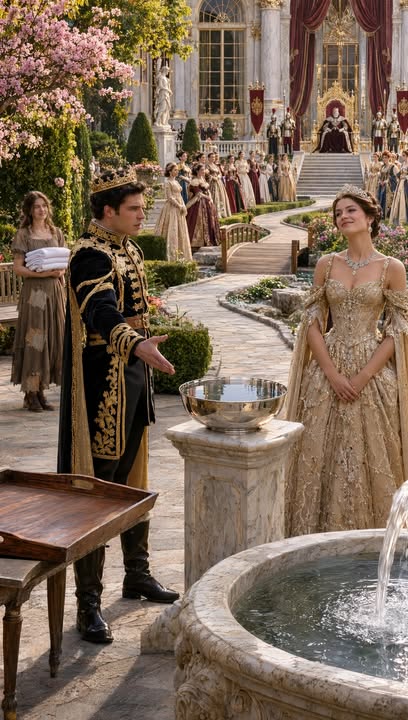
The maid raised the silver bowl from the fountain stand, holding it steady on the broad tray as if she had carried it that way a hundred times before.
The water trembled, its bright surface quivering close to the rim, but not a single drop escaped.
A murmur passed through the royal garden.
She adjusted her hands beneath the tray and turned toward the stone pathway, her gaze fixed not on the watching nobles but on the first narrow turn ahead.
The prince watched her with an expression that had changed from curiosity to keen attention.
“Two minutes,” the royal judge called.
The maid took her first steps.
Her pace was neither hurried nor grand.
She moved with the measured rhythm of someone accustomed to balancing wet laundry baskets through crowded corridors, where a careless turn could send a day’s work across the floor.
At the first narrow bend, she lowered her shoulders slightly and shifted the tray a fraction to the left.
The water stirred, then settled.
The crowd, which had laughed only moments before, fell quiet.
She crossed the second turn without looking down.
At the wooden bridge, she paused.
The plank beneath her leading foot gave a faint, uneven creak.
She did not step forward.
Instead, she lifted her eyes toward the prince.
“That board is loose,” she said.
The gold-gowned noblewoman, still standing near the fountain, folded her arms.
“It held me well enough,” she replied, though her voice had lost its earlier certainty.
“It moved when you crossed,” the maid said gently.
“I felt it.”
The prince glanced toward the bridge, then back at the full bowl.
“You may proceed if you wish.”
The maid considered the bridge.
Her fingers tightened beneath the tray, not from fear of the watching crowd but from the strain of keeping the heavy bowl level.
“I would rather not risk the water,” she answered. “Or the tray.”
For a moment, no one spoke.
Then the king leaned forward on his throne.
“An observant answer,” he said.
The maid gave a small nod and waited.
The prince studied her face, perhaps expecting her to press ahead and prove herself at any cost.
Instead, she remained still.
“Would you like the bridge inspected?” he asked.
“Yes, Your Highness,” she replied. “If the course is meant to test our steadiness, it should be steady enough for everyone.”
A new ripple passed through the audience, but this time it was not laughter.
The prince looked from the bridge to the waiting contestants.
“Stop the clock.”
The judge lowered his hand, and two attendants hurried to examine the plank.
The maid kept holding the tray while they worked.
Only when one attendant offered to take it did she allow him to support the far side, careful not to shift the bowl.
The first attendant pressed his foot against the loose plank.
It dipped visibly.
The prince’s expression tightened.
“Who inspected the course before the challenge?” he asked.
“I did, Your Highness,” the judge answered. “The bridge was secure this morning.”
“Then it has changed since morning.”
The prince looked toward the maid.
“You noticed it from the fountain?”
“I noticed the way it moved under the first contestant,” she said. “I was carrying towels near the path.”
The gold-gowned woman lowered her gaze toward the bridge.
“I thought I had simply lost my balance,” she murmured.
“You didn’t,” the maid replied. “The board moved.”
The noblewoman looked up, startled by the kindness in the answer.
The attendants secured the plank with a wedge and tested it twice.
When the judge declared the bridge safe, the maid set her feet once more at the beginning of the course.
“Would you like to continue?” the prince asked.
“If the rules still allow it.”
“They do.”
She adjusted her grip on the tray.
The judge restarted the clock.
This time, the maid approached the bridge slowly, feeling the boards beneath her worn leather shoes before trusting her weight to them.
The bowl remained level.
The crowd watched her cross the short span, then make the final turn and climb the five stone steps.
At the top, she stopped before the golden throne.
The water shone in the bowl, still brimming to its silver edge.
Not one drop had spilled.
For an instant, no one seemed to understand that the challenge was over.
Then the judge raised his hand.
“She has completed the course.”
The garden burst into applause.
The maid’s arms trembled with the effort of holding the tray, but she did not set it down until the prince stepped forward and took the bowl from her himself.
“You were right to stop at the bridge,” he said quietly.
“I wasn’t certain anyone would believe me.”
“I’m glad you spoke.”
She looked at the bowl in his hands, then at the rows of noblewomen who had come to compete.
“Your Highness, I don’t think you should name me the winner yet.”
The prince’s brows lifted.
“You completed the challenge.”
“So did none of the others,” she said, “but the bridge was loose when they crossed it.”
The gold-gowned noblewoman stood very still beside the path.
The maid continued, her voice careful but clear.
“If the course wasn’t fair for them, then my result should be considered fairly too.”
A hush settled over the audience.
The prince did not answer at once.
He seemed to be studying her not as an unexpected contestant, but as someone whose judgment mattered.
“You could have accepted the easy victory,” he said.
“I could have,” she replied. “But it wouldn’t feel like a true one.”
The king’s eyes remained fixed on her.
Something in his expression had changed.
The applause faded, leaving behind the rustle of leaves and the soft trickle of water from the fountain.
The prince turned toward the judge.
“The course will be inspected before we decide the result,” he announced. “And every contestant who wishes to try again will be given the same opportunity.”
Several noblewomen exchanged glances.
Some looked relieved.
Others seemed uncertain whether they wanted another attempt.
The gold-gowned woman stepped forward.
“I would like to try again,” she said. “If the bridge is properly repaired.”
The prince inclined his head.
“You will have that chance.”
She looked toward the maid.
“I owe you an apology,” she said, with effort but without evasion. “What I said about the laundry room was unkind.”
The maid’s expression softened.
“You were nervous.”
“That is no excuse.”
“No,” the maid agreed. “But it can be a reason to do better next time.”
For a moment, the noblewoman seemed unsure what to say.
Then she gave a short, rueful smile.
“I’ve spent so long preparing to be chosen that I forgot how to listen.”
The maid glanced down at the tray.
“Listening helps with heavy things.”
The noblewoman let out a quiet laugh, and some of the tension between them loosened.
The prince returned the silver bowl to an attendant.
“Your name?” he asked.
“Lena, Your Highness.”
“Lena,” he repeated, as if committing it to memory. “You will remain here while we inspect the course and review the challenge.”
She hesitated.
“I should return these towels.”
“They can wait a little,” said the prince.
A nearby attendant took the folded bundle from the bench and assured her he would deliver it.
Lena glanced toward the palace’s tall windows, beyond which the servants’ corridors ran like hidden passages through the grand rooms.
She was accustomed to being noticed only when something needed carrying, cleaning, or mending.
The attention of the garden pressed on her shoulders more heavily than the silver bowl had.
“May I stand somewhere out of the way?” she asked.
The prince gestured toward a shaded bench beneath an old cedar.
“Of course.”
She crossed the garden without a tray in her hands and felt strangely unbalanced.
When she reached the bench, she rested her palms on her knees.
The king had not yet taken his eyes from her.
At first, Lena thought he was still considering her answer about the challenge.
Then his gaze dropped to the apron tied over her faded dress.
It was brown linen, patched at one corner and repaired in several places with uneven but careful stitches.
The king’s face had gone pale.
He leaned toward the chamberlain beside his throne and murmured something.
The chamberlain followed his gaze to Lena’s apron.
“What is it?” the prince asked.
“Nothing,” the king replied too quickly.
But the word had the strained quality of a door being shut against a question.
Lena heard the exchange and looked down at her apron.
She knew every patch and loose thread in it.
There was one repair tucked inside the waistband, hidden from view unless the apron was turned inside out.
Her mother had sewn it there years ago, when the cloth had begun to fray.
Lena had never thought it important.
The king rose from his throne.
The garden quieted again as he walked toward her, leaning lightly on the carved handle of his cane.
He stopped a respectful distance away.
“May I ask where you got that apron?” he said.
Lena looked from him to the prince.
“It was my mother’s before it was mine.”
“Your mother served in this palace?”
“She worked in the laundry,” Lena answered. “Long ago.”
The king’s fingers tightened around the cane.
“What was her name?”
“Maris.”
The king looked as though he had been struck by a memory rather than a blow.
“Maris,” he repeated.
Lena rose from the bench.
“Is something wrong, Your Majesty?”
“May I see the inside of the waistband?”
She drew the apron’s edge between her fingers but did not turn it over immediately.
“Why?”
The king paused.
It was the first time Lena had seen him struggle to answer a simple question.
“There is a repair in the stitching,” he said. “A pattern I recognize.”
Lena felt the warmth leave her hands.
She turned the waistband carefully, revealing a small row of dark stitches arranged in a tiny stepped pattern, almost like three narrow leaves joined at their tips.
The king stared at it.
For a moment, the court seemed to disappear from his face.
“I remember that work,” he said softly. “The late queen’s personal attendants used the same pattern when they mended garments for her household.”
Lena shook her head.
“My mother never told me she served the queen.”
“Did she speak of the palace?”
“Not much.” Lena’s thumb brushed the old repair. “She said she had worked here, but she left before I was old enough to understand why.”
The king’s voice grew quieter.
“Did she tell you why she left?”
“She said only that it was safer for us to live elsewhere.”
The prince glanced sharply at his father.
“Safer from what?”
The king did not answer him.
Lena felt the garden closing in around her, though the air remained bright and warm.
“My mother died when I was young,” she said. “I remember her hands more clearly than her face. She always smelled of soap and lavender.”
The king’s expression softened, but it did not ease her unease.
“Did she give you anything else?” he asked.
Lena’s eyes narrowed.
“Why are you asking?”
“I don’t wish to alarm you.”
“You already have.”
The words came out more sharply than she intended.
She lowered her gaze, then forced herself to continue.
“My mother was a laundress. She mended this apron. That is all I know.”
The king nodded, taking her answer as a rebuke he had earned.
“I understand.”
But he did not look as if he understood at all.
The prince stepped between them, not to block his father but to ease the strange pressure gathering around Lena.
“She has had a long day,” he said. “Perhaps the questions can wait until she has rested.”
The king looked at his son.
“Yes,” he said after a moment. “Perhaps they should.”
Lena turned the waistband back into place.
The tiny stitched pattern disappeared against the brown cloth.
Yet the king’s face remained fixed in her thoughts, pale and unguarded, as if the repair had opened a door he had believed long sealed.
An attendant brought her a cup of water.
She accepted it, though the small tremor in her fingers made the surface ripple.
The prince noticed.
“You needn’t be afraid,” he said.
“I’m not sure what I’m afraid of.”
“That is fair.”
He stood beside the bench rather than sitting, leaving her room to choose whether to speak.
Lena looked at him.
“Did you know the challenge would end like this?”
“I hoped it would reveal something about the contestants,” he said. “I didn’t expect you to be among them.”
“Why did you make the challenge?”
He studied the course in the center of the garden.
“Because people keep telling me what a queen should look like,” he said. “How she should dress, where she should come from, how easily she should smile at the right people.”
“And you wanted to know something else?”
“I wanted to see how someone responds when a task becomes difficult. Whether she notices what is wrong around her, and whether she thinks only of winning.”
Lena looked at the silver bowl now resting on a table.
“Then perhaps your challenge asked the wrong question.”
“How so?”
“It asked whether someone could carry water without spilling it,” she said. “But a queen might need to ask why the path was unsafe, or who had to cross it after the contest was finished.”
The prince’s mouth curved, not into amusement but recognition.
“I think you’re right.”
He glanced toward the course, where the attendants were examining the bridge.
“Would you help us review it?”
Lena looked at him with surprise.
“You want me to judge the challenge?”
“Not judge the contestants,” he said. “Help us inspect the course. You noticed what others missed.”
The request felt more unsettling than praise.
She had spent years learning how to move through the palace without being in anyone’s way.
Now the prince was asking her to step closer.
“If I help,” she said, “I won’t pretend the rules were fair just to make the result convenient.”
“I wouldn’t ask you to.”
The gold-gowned noblewoman approached, her hands clasped before her.
“I can help too,” she said. “I know what the bridge felt like underfoot, and I would rather not be remembered as the woman who blamed a bad step when the step really was bad.”
Lena glanced at her.
“What should I call you?”
“Lady Celeste.”
“Then we should look at the bridge together, Lady Celeste.”
The noblewoman nodded.
For the next several minutes, the three of them walked the course with the attendants.
Lena pointed out where the stone path narrowed abruptly near the third turn and where the final steps grew slick in the shade.
Celeste described how the bridge had dipped beneath her right foot.
The prince listened, asked questions, and wrote down their observations himself rather than leaving them to a servant.
When they reached the beginning of the path, Lena noticed a pale scuff on the ground beside the fountain.
“What is this?” she asked.
One of the attendants bent to examine it.
“Perhaps a mark left by the tray.”
“Maybe,” Lena said.
She looked from the scuff to the bowl’s stand, then toward the bridge.
Somewhere, a small detail remained out of place.
The king watched them from the edge of the garden, his face troubled by thoughts he had not shared.
When the inspection was finished, he asked the chamberlain to escort him back inside.
Before he went, he looked once more at the brown apron.
“Lena,” he said, “I would like to speak with you privately tomorrow, if you are willing.”
Her throat tightened.
“About my mother?”
“About the history of this household.”
“That sounds like the same thing.”
The king accepted the point with a faint, tired nod.
“Yes,” he said. “It may be.”
Lena did not know what to tell him.
The king turned away before she had to answer.
That evening, after the garden had emptied and the palace’s corridors had grown quiet, Lena returned to the servants’ quarters with the repaired apron folded over her arm.
She ran her finger across the tiny pattern inside its waistband.
Her mother had made that stitch when Lena was little, sitting beside a narrow window in a rented room far from the palace.
Lena remembered the needle flashing in the lamplight.
She remembered her mother humming softly, then stopping whenever footsteps passed outside.
She had believed those silences belonged to grief.
Now she wondered whether they had belonged to fear.
Across the palace, the king stood alone in the old records room, where dust lay along the shelves and the scent of dried ink lingered in the air.
He had asked the keeper of archives to bring out the household registers from the year before the queen died.
The pages were brittle, their edges browned by time.
The king read each name slowly until he found it.
Maris, laundress and trusted attendant to the queen’s private household.
He read the line twice.
Below it, a notation recorded that Maris had left palace service several months before the queen’s death.
The reason column was blank.
The king turned the page.
A narrow strip of stitching remained along the binding where another page should have been.
He touched the empty place with one careful finger.
“What was written here?” the archivist asked.
The king stared at the gap.
“I don’t know.”
But he remembered that the queen had once asked him to keep a household matter from the court until the danger had passed.
And he remembered how quickly, after her death, the old records had been gathered and sealed.
In the garden, Lena had carried a full bowl without spilling a drop.
In the archive, the king had found a name he thought time had erased—and a missing page that suggested someone had wanted the reason for her mother’s departure to remain unknown.
**–END OF PART 2–CLICK “NEXT” AT THE BOTTOM OF THE PAGE TO CONTINUE READING**
* * *
[NEXT: PART 3](https://storyly.idolsgift.com/blog/part-3-the-stitch-beneath-her-apron-057)
✓ Lynn R. Adams
The maid raised the silver bowl from the fountain stand, holding it steady on the broad tray as if she had carried it that way a hundred times before. The water trembled, its bright surface quivering…