PART 2: The Step That Changed Nothing—and Everything 058
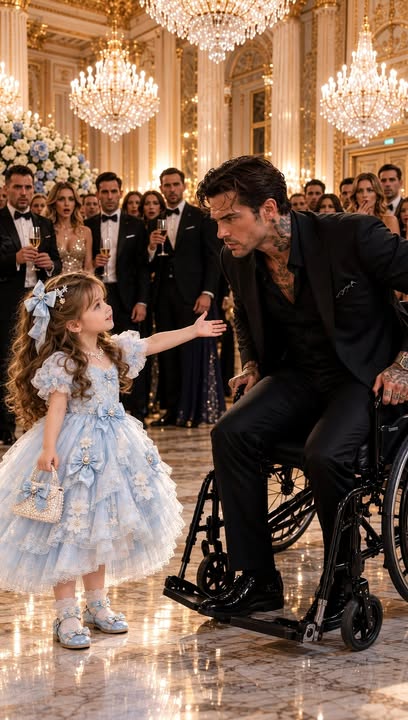
Part 2 – The Step That Changed Nothing—and Everything
My knees trembled violently, and the ballroom seemed to tilt around me.
For one suspended second, I was upright, held between the wheelchair and the hope I had spent years trying not to feel.
Then my legs buckled.
A hand caught my elbow, another steadied my shoulder, and the wheelchair was pulled close behind me before I could fall.
“Easy,” someone said.
“Don’t try to hold yourself up.”
I did not know whose voice it was.
The room had filled with movement, but all I could hear was the thud of my heart and the ragged pull of my own breath.
Lily stood a few feet away, her little hands clasped beneath her chin.
Her eyes were wide, but she did not look triumphant.
She looked frightened for me.
“I’m all right,” I managed, though I wasn’t sure it was true.
The guests lowered me carefully into the chair.
My arms shook from the effort, and my legs lay still beneath the dark fabric of my trousers.
The faint movement I had felt was gone.
Someone placed a hand on my shoulder.
Someone else asked if they should call an ambulance.
“No ambulance,” I said, too quickly.
My voice sounded like it belonged to a stranger.
“Call my doctor.”
The orchestra had stopped playing.
Across the ballroom, a champagne glass lay in pieces on the floor, catching the chandelier light in tiny, bright shards.
No one seemed to know what to do with their hands or their faces.
A moment earlier, they had watched me rise.
Now they were watching me return to the chair.
I looked down at my legs, searching for some sign that I had imagined the tremor.
There was nothing.
Lily took one cautious step toward me.
“I’m sorry,” she whispered.
The apology hurt more than the fall.
“Why are you sorry?”
“Because you got scared.”
I stared at her small, serious face.
“I was already scared.”
She lowered her eyes.
“You were standing.”
“For a moment.”
“That still happened.”
The words were simple, but they unsettled me.
I had spent years learning not to trust moments.
Moments were too brief to build a life on, and hope had a way of making the distance between them feel cruel.
I looked away from Lily and addressed the gathering.
“I appreciate everyone’s concern, but I need a little room.”
A few guests stepped back.
The rest followed their lead, creating a wide circle around my chair.
I felt less exposed, though not less watched.
Then a woman in a silver dress leaned toward the man beside her and murmured, “It was a miracle.”
I turned toward them.
“Please don’t call it that.”
The woman flushed and fell silent.
I did not know what it was.
A reflex, a spasm, an act of will, a trick of nerves—there were explanations I had not yet heard, and I was not ready to trade them for a story people could toast to.
Lily’s voice came softly from beside me.
“He did stand up.”
“I did.”
“And that’s good.”
I met her eyes.
“It may be good.”
She seemed to accept that answer, although something in her expression suggested she understood more than a child should have to understand.
My head of security, Thomas, had reached us by then.
He crouched beside Lily, careful not to startle her.
“Are you here with someone, sweetheart?”
Lily nodded toward the entrance.
“I came with Maria.”
“Maria who?” I asked.
The name had already stirred a memory.
Maria Alvarez had been in my household for nearly two decades, longer than most of the people in the ballroom had known me.
She was the housekeeper who had stayed after the accident, when my life had become a schedule of nurses, specialists, and locked doors.
She was the one who remembered how I liked my coffee and who quietly moved the flowers when their scent became too much.
I had never asked her to stay.
I had never thanked her properly for not leaving.
“She’s in the kitchen,” Lily said.
“Maria is here?”
Lily nodded.
“She brought me.”
Thomas looked toward the corridor.
“I’ll find her.”
“No,” I said, then paused.
“Tell her she can come if she wants to.”
Thomas gave a small nod and disappeared into the crowd.
The guests began to drift away, not because they had lost interest, but because no one wanted to look as though they were staring.
The orchestra remained silent.
My birthday party had become something else, and I could not decide whether I wanted it to return to what it had been.
A doctor’s bag appeared beside the wheelchair before the doctor did.
Dr. Samuel Reeves had come from the small private clinic he maintained on the Upper East Side.
He had treated me for years and had been invited to the party in the hope that I might finally stop asking him whether there was anything new to try.
He took in the crowd, the wheelchair, and my face without commenting.
“William,” he said, kneeling in front of me, “tell me what you felt.”
I made myself answer carefully.
“I leaned forward and pushed on the armrests.”
“And then?”
“My knees trembled.”
“Did you feel pain?”
“No.”
“Dizziness?”
“No.”
“Did you feel your legs move, or did you see them move?”
“I felt the tremor, and I saw my knees.”
He nodded and began checking my pulse and blood pressure.
Around us, the ballroom had grown quiet again, though the guests pretended to study the flowers and the empty dance floor.
Dr. Reeves kept his voice low.
“Can you feel my hand here?”
“Yes.”
He touched my shin, then my ankle, asking me to describe each sensation.
I answered, and he made notes on a small pad.
“Try moving your left foot,” he said.
I concentrated until my forehead tightened.
Nothing happened.
“Right foot?”
Nothing.
He sat back on his heels.
“I can’t tell you what caused the movement from this alone.”
“But it happened.”
“Yes.”
He did not soften the answer, and I appreciated him for it.
“What does it mean?”
“It means you were able to rise briefly with assistance from your arms and whatever your legs managed to contribute.”
“Is that improvement?”
“It may be a sign worth examining.”
His pause was careful, almost tender.
“But a single moment cannot explain your paralysis or reverse it.”
The words settled over me like a familiar blanket, except that tonight it felt impossibly thin.
I had spent seven years being told what my body could not do.
I had stopped asking whether that might change.
Now, after one unsteady rise, I was being asked not to turn it into a promise.
“I’m not calling it a cure,” I said.
“Good,” he replied.
“I’m not calling it anything.”
“That may be best for tonight.”
Dr. Reeves studied my legs once more and recommended that I avoid trying to stand again until he could arrange a full assessment.
He asked whether I had experienced unusual fatigue, a change in sensation, or a new medication.
I answered no.
He gave instructions to my nurse and offered to speak with me privately in the morning.
Then he stood and looked at Lily.
“You gave him quite a scare.”
“I didn’t mean to,” she said.
“I believe you.”
Dr. Reeves’s expression was gentle, but he did not turn her words into a medical explanation.
He did not praise her for curing me or blame her for what had happened.
That steadiness brought the room back into focus.
The doctor had not dismissed what I felt.
He had not dressed uncertainty up as certainty either.
For the first time that evening, I understood how much I needed both.
Maria came through the doorway a few minutes later, wiping her hands on a clean linen towel.
She had removed her apron, but a trace of flour dusted one sleeve.
Her eyes found me first.
“Mr. Harrison, are you hurt?”
“No.”
She looked at the doctor, then at the chair.
“Are you sure?”
“I’m sure I’m not hurt.”
She exhaled, and the tension in her shoulders eased.
Then she turned to Lily.
“Are you all right, mija?”
Lily nodded.
“Did I do something wrong?”
“No, sweetheart.”
Maria cupped the back of Lily’s head, smoothing one of her braids.
“You came because you wanted to help.”
“I thought he could stand.”
Maria’s eyes flickered toward me.
“I know.”
There was something in that look that I could not quite read.
I had seen Maria worried before, and tired, and quietly amused by my stubbornness.
This was different.
It was the look of someone standing at the edge of a memory.
“You knew she was going to speak to me?” I asked.
Maria did not answer at once.
“I knew she wanted to meet you.”
“That isn’t what I asked.”
She glanced down at Lily, who had begun rubbing her thumb over the hem of her frayed shirt.
“I brought her because she asked me to.”
“Why?”
Lily stepped close to Maria’s side.
“Because I wanted to see you.”
“Had you heard about me?”
“A little.”
“From whom?”
“From Maria.”
Maria’s fingers tightened around the towel.
I waited.
She had cared for me long enough to know the difference between a question asked out of politeness and one I meant to have answered.
Finally, she said, “I told Lily about the accident.”
“Why?”
“She asked why you didn’t come downstairs when she saw your photograph.”
The sentence stopped me.
“What photograph?”
Maria’s gaze moved briefly toward Lily, who looked up at me with a kind of nervous expectation.
“Not here,” Maria said.
“Why not here?”
“Because this room is full of people who have already decided what they saw.”
I glanced at the guests, many of whom were still pretending not to listen.
Maria’s point was clear.
I had spent the evening as the center of a story that did not belong to me.
I did not want the next piece of it overheard and repeated by people who had never met Lily before tonight.
“Come to my study,” I said.
Dr. Reeves started to object, but I told him I would remain seated and would not attempt to stand.
He agreed to stay nearby.
Thomas cleared a path through the ballroom, and Maria walked beside my chair while Lily followed close behind her.
The party’s music resumed somewhere behind us, uncertain at first, then swelling into a polite imitation of celebration.
I could hear the guests returning to their conversations, though I suspected none of them had forgotten what had happened.
My study was a quiet room beyond the library, lined with dark wood and filled with books I had once intended to read.
The door shut softly behind us.
Maria declined the chair I offered and remained standing.
Lily sat on the edge of the small settee, her feet not quite reaching the floor.
For a moment, none of us spoke.
Then I asked, “What photograph?”
Maria looked at the floor.
“It was taken years ago at a neighborhood clinic.”
“I’ve never been to a neighborhood clinic.”
“I know.”
“Then how did Lily see me in one?”
“She saw the photograph at my home.”
I tried to remember when Maria had last mentioned her home.
She had lived in the same modest apartment in Queens since before she came to work for me.
I had been there once, years ago, to drop off a Christmas gift when she was recovering from a fever.
I could recall a narrow kitchen, a lace curtain, and the smell of cinnamon.
I could not recall a photograph of myself.
“What was I doing in it?”
Maria’s answer came slowly.
“You were helping a frightened child.”
My hand tightened on the armrest.
“Helping how?”
“The clinic was busy that day. The child had been crying. You were sitting beside him, talking to him while one of the nurses worked.”
“That can’t be right.”
“I was told it was you.”
“By whom?”
“By the clinic staff.”
“Maria, I don’t remember going there.”
“I know.”
She looked at me, and there was no accusation in her face.
That made the words harder to hear.
Lily watched me carefully.
“Is that why you recognized me?” I asked her.
She nodded.
“I saw your face in the picture.”
“And you decided to come here because of a photograph?”
“I wanted to see if you were still sad.”
I had no answer for that.
Maria stepped nearer, keeping her voice low.
“The picture was in a frame in my living room. Lily was visiting me with her mother, and she asked about it.”
“Why did you have it?”
“I kept it because it mattered to me.”
“Why?”
Maria paused, then gave a small shake of her head.
“It’s a long story, and I don’t know all of it.”
I had spent years asking questions that came with invoices, test results, and probabilities.
This was different.
The photograph existed somewhere beyond the walls of my house.
It held a version of me I did not remember being.
And Lily had seen that version and crossed a ballroom to find the man I had become.
“How did you know I’d want to see her?” I asked Maria.
“I didn’t.”
“Then why bring her?”
“Because she asked. And because I thought it might do you good to meet someone who didn’t know what people expect you to be.”
The answer carried no grand meaning, no effort to comfort me.
It was Maria’s plain way of saying that she had seen how lonely I had become.
I looked at Lily.
“Did you know I might not stand?”
“Yes.”
“Then why tell me to?”
“Because you looked like you wanted to try.”
Her small hand rested on the edge of the settee.
I looked at it and remembered the warmth of her fingers near mine, the pressure of my palms against the armrests, the brief and startling tremor in my legs.
I could not tell whether the moment had been physical, emotional, or both.
I only knew that I had wanted it to continue.
“Did Maria tell you to say those words?”
“No.”
“Did someone else?”
“No.”
“Then why did you say them?”
Lily’s eyes moved toward the closed study door.
“Because I felt God was telling me not to be afraid.”
She said it with the same quiet certainty she had shown in the ballroom.
I did not believe that certainty proved anything.
But I could not dismiss the courage it had taken for a little girl to walk into a room full of strangers and speak to a man who had forgotten how to hope.
“You shouldn’t have to carry the responsibility for what happened to me,” I told her.
“I’m not carrying it.”
“Good.”
“You are.”
That answer caught me off guard.
I glanced at Maria.
She pressed her lips together, but a trace of a smile appeared in her eyes.
The doctor knocked and came in before I could reply.
He reminded me to rest, asked Maria to keep Lily near the family rooms, and promised to check on me again before he left.
When he was gone, Maria said she should take Lily home.
I should have let them go.
Instead, I asked, “Can you bring the photograph tomorrow?”
Maria studied my face.
“If you still want to see it.”
“I do.”
“Then I will.”
Lily stood from the settee.
“Will you try again?”
“I don’t know.”
She considered that.
“That’s all right.”
“You’re not disappointed?”
“No.”
“Why not?”
“Because you tried.”
I wanted to tell her that trying had never been the difficult part.
The difficult part was what came after trying, when the body refused and the mind remembered.
But the words stayed with me as Maria led Lily toward the door.
At the threshold, Lily turned back.
“Good night, Mr. William.”
“Good night, Lily.”
She smiled, then disappeared with Maria into the hallway.
For several minutes, I remained alone in the study, listening to the softened noise of the party beyond the door.
My legs felt as they had before: heavy, unresponsive, unchanged.
The doctor’s caution sat firmly in my thoughts.
One moment did not make a recovery.
One step did not erase seven years.
Still, I could not stop seeing myself upright, even for that brief, impossible instant.
The night had not given me an answer.
It had given me a question I had not wanted to ask.
What if the part of me that had stopped hoping was not the same as the part of me that could still try?
The next morning, Maria arrived at my room carrying a small paper envelope.
She placed it on the table beside my bed and said, “I found the picture.”
I reached for it.
Before I opened the envelope, she added, “There’s something you should know about the day it was taken.”
I looked up.
“What?”
Maria’s expression had turned thoughtful again.
“The clinic staff said that picture was taken just after the equipment arrived—the equipment that kept them from closing their doors.”
**–END OF PART 2–CLICK “NEXT” AT THE BOTTOM OF THE PAGE TO CONTINUE READING**
* * *
[NEXT: PART 3](https://storyly.idolsgift.com/blog/part-3-the-step-that-changed-nothing-and-everything-058)
✓ Lynn R. Adams
Part 2 – The Step That Changed Nothing—and Everything My knees trembled violently, and the ballroom seemed to tilt around me. For one suspended second, I was upright, held between the wheelchair and…