PART 2: The Step He Recognized 046
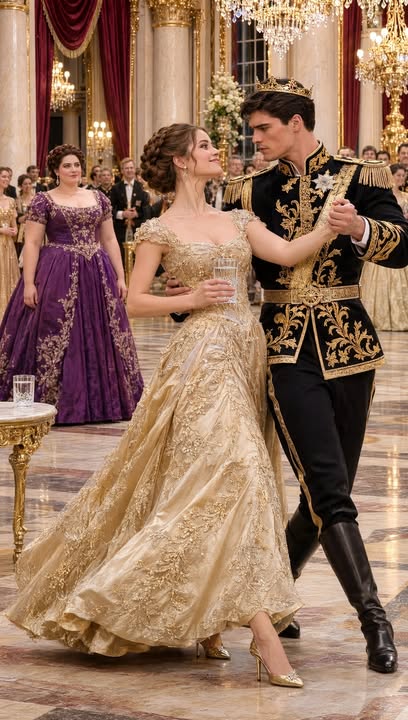
I moved before he finished leading it, turning on the ball of my foot as his weight crossed toward me.
The water tilted toward the rim, shivered once, and settled.
For a breath, the ballroom seemed to forget how to make a sound.
Then the orchestra carried us onward, and the prince’s hand at my back steadied—not because I needed it, but because he had felt the turn land exactly where he meant it to.
His eyes met mine.
“Who taught you to anticipate that?” he murmured.
“The music,” I said.
“That isn’t an answer.”
“It’s the one I have while you’re trying to make me spill.”
A faint smile touched his mouth, gone almost as soon as it appeared.
He changed the rhythm again, asking me to cross his path and turn beneath his raised arm.
The glass stayed level.
I kept my elbow relaxed and my wrist quiet, letting my body absorb the movement instead of fighting it.
The old lessons returned in pieces: the hush of a studio before morning classes, the count my instructor tapped against the floor, my mother waiting by the doorway with a thermos of tea and a patient smile.
For a moment, the palace ballroom vanished.
I was back beneath the plain wooden rafters of my old academy, moving to music that came from a scratched speaker and believing that if I practiced enough, I could make the world open.
The prince guided me through another turn.
This time, I watched his shoulder rather than his hand.
His weight shifted.
I followed.
Not a drop escaped.
At the edge of the dance floor, Lady Celeste Vale’s smile had thinned into something more thoughtful than amused.
The prince noticed her watching, but he did not look away from me.
“Still prepared?” he asked.
“More than ever.”
“You make that sound like a warning.”
“It might be.”
The orchestra’s final phrase rose around us, drawing the last measures into a sweeping waltz.
He led me through one final turn, slower now, and I let the skirt of my burnt-orange gown circle without letting the glass tilt.
The final note rang out.
I stopped with the water untouched.
For a second, no one moved.
Then someone near the back began to clap.
Another joined, and then the ballroom filled with applause—polite at first, then warm enough that I felt it in my chest.
The prince released my hand only after I had lowered the glass to the waiting tray.
“Not one drop,” he said.
“I noticed.”
A ripple of laughter passed through the crowd.
He regarded me with a new attentiveness, as if the contest had answered a question he had not been willing to ask aloud.
“You have my respect, Miss—”
“Mara,” I said. “Mara Ellis.”
“Mara,” he repeated, and the way he said it made the name feel less like an introduction than a promise to remember it.
Lady Celeste approached before he could say more.
She was as poised as ever, her gold gown catching the chandelier light, her pale hair pinned in a flawless sweep.
“An impressive performance,” she said.
“Thank you.”
“Though I imagine it helps to have danced before.”
Her gaze passed over me, not unkindly, but with the practiced ease of someone accustomed to measuring people before deciding what they were worth.
“I imagine it helps,” I replied.
The prince’s expression cooled.
“Celeste.”
“I’m only saying the result may owe as much to luck as skill.”
“Luck doesn’t usually keep a glass level through three changes of tempo,” he said.
A few people nearby fell quiet.
Celeste lifted one shoulder, conceding the point without quite yielding it.
“Then perhaps Mara will show us again next time.”
“I would,” I said, “if the next time comes.”
It was the first thing I had said all evening that I had not rehearsed in my head.
The prince’s attention returned to me.
“The next selection is in three days,” he said. “Before then, I would like to ask you to join me for a private lesson.”
The words moved through the nearby guests like a breeze through curtains.
Celeste’s face remained composed, but a small tension appeared at the corner of her mouth.
“A lesson in what?” I asked.
“Dancing.”
“I had gathered that.”
“Then you know what I’m asking.”
I glanced toward the crowd, toward the women who had been eliminated and the families who had watched them fail.
“Will it be another test?”
“No,” he said. “It will be a lesson.”
“That sounds suspiciously like the same thing with nicer manners.”
His mouth twitched.
“Then you may decide whether to come after you’ve heard what I have to say.”
I considered him.
He was handsome, certainly, but it was not his face that made me hesitate.
It was the attention in his eyes, the sense that he was trying to look beyond my gown and my performance, and that he might not know what he would find there.
“I’ll consider it,” I said.
“Fair enough.”
He bowed, formal enough for the room, and left me with the glass, the applause, and the uncomfortable knowledge that I wanted to hear more.
By the time I reached the corridor, the ballroom noise had softened behind the doors.
I found my aunt waiting beside a marble pillar, one hand pressed to her heart.
“You didn’t spill,” she said.
“I didn’t.”
“I knew you wouldn’t.”
“You were holding your breath.”
“I was holding it confidently.”
I laughed, and the sound loosened something in my shoulders.
She had helped me choose the orange gown, though she had warned me that the palace might prefer something quieter.
I had told her that the palace had enough quiet colors already.
Now she smoothed a wrinkle near my sleeve and looked toward the ballroom doors.
“Do you want to go back in?”
“I think I’ve had enough chandeliers for one night.”
“Then we’ll leave before someone asks you to explain how you did it.”
The question followed me anyway.
In the carriage, my aunt talked about the music and the applause, but my mind kept returning to the prince’s invitation.
A private lesson.
A chance to learn whether his kindness was genuine or simply another form of careful assessment.
I told myself I had no reason to be curious about him.
I told myself that twice.
The next morning, a palace footman arrived at our hotel with a cream envelope bearing the royal crest.
Inside was a note written in a neat, restrained hand.
If you are still willing, meet me in the east practice room at four.
No audience, no glass, and no selection committee.
—Adrian
The prince had signed his name without a title.
I read the note once, then again.
My aunt looked over my shoulder.
“No audience,” she said. “That sounds promising.”
“It could mean he wants to see whether I can dance without an audience.”
“Those are not mutually exclusive.”
I folded the note and slipped it into my pocket.
At four, the east practice room was empty except for the prince and a pianist seated near the tall windows.
The room smelled faintly of waxed wood and old music books.
Unlike the ballroom, it was simple: a polished floor, a row of mirrors, and a few chairs set against the wall.
Adrian wore a dark blue shirt with the sleeves rolled to his forearms.
Without the gold embroidery and formal coat, he seemed less like a portrait of a prince and more like a man who had arrived early because he was uncertain what to say.
“You came,” he said.
“I said I would consider it.”
“You did.”
“I considered it.”
“And decided?”
“I decided I wanted to know whether this was a lesson or an interview.”
He inclined his head.
“That’s a fair question.”
“What’s the answer?”
“It’s a lesson, if you want it to be.”
“And if I don’t?”
“Then we can have tea and talk about the weather.”
“I didn’t come to discuss the weather.”
“Neither did I.”
The pianist waited at the instrument with her hands folded.
Adrian glanced at her.
“Would you mind giving us a few minutes?”
She nodded and stepped into the adjoining room, leaving the door open.
He offered me his hand.
“May I?”
I placed my hand in his.
“Tell me what you noticed last night,” he said.
“Your weight shifts before your turns.”
“Most dancers notice that.”
“Your hand changes pressure before your pace changes.”
“Some do.”
“You favor your left side when you’re deciding whether to accelerate.”
His eyebrows rose.
“You noticed that?”
“I had to.”
He guided me into a simple frame, then stepped back and let me set my own stance.
“Good,” he said. “Your balance is natural.”
“It isn’t natural.”
“No?”
“It’s practiced.”
Something in his expression softened.
He began with a slow box step, giving me time to match him.
The first few measures passed without tension.
Then he altered the pattern, stepping closer before turning away.
I followed his center and adjusted, leaving the imaginary glass between us steady in my mind.
“You’re still dancing the challenge,” he said.
“I thought you wanted to teach me.”
“I do.”
“Then teach me something.”
He considered me, then changed the rhythm.
“Don’t anticipate every movement,” he said. “Sometimes I lead. Sometimes you follow.”
“And sometimes the person leading changes his mind.”
“That happens.”
“Then I’ll try to survive it.”
The smile came more easily this time.
“You speak to me as if we’re equals.”
“I speak to you as if we’re dancing.”
He was quiet for a beat.
“That may be the most sensible thing anyone has said to me all week.”
He turned me gently, then brought me back to the starting step.
When the pianist returned, she began a waltz at a measured tempo.
Adrian’s hand found my back.
I felt the familiar pressure and answered it with a shift of my own.
We moved through the first phrase, then the second.
He led a turn I recognized, a compact step that belonged to an older style of ballroom dancing, one my academy instructor had once called a courtesy turn.
I moved into it before he had fully shaped the lead.
His fingers tightened slightly at my hand.
The music continued.
He did not stop until we had completed the phrase.
Then he stepped back.
“Where did you learn that step?”
“In a dance studio.”
“That’s not what I mean.”
“It’s still the answer.”
“It’s a particular variation.”
“I know.”
“Most instructors stopped teaching it years ago.”
“My instructor didn’t.”
He looked at me closely, but not as he had in the ballroom.
There was something unsettled in his attention now, a recognition he could not place.
“Who was your instructor?”
“Mr. Bellamy.”
“Was that the academy in Westbridge?”
I blinked.
“Yes.”
He lowered his hand.
“I thought so.”
“How?”
“Your footwork.” He paused. “The turn has a particular shape. I’ve seen it before.”
“Where?”
His gaze shifted toward the mirrors, where we stood side by side beneath the pale afternoon light.
“I’m not sure.”
The answer sounded honest, but it did not sound complete.
I let the silence stretch.
He looked back at me.
“Why did you leave the academy?”
The question was gentle, but it touched a place I had learned to keep closed.
“My mother became ill.”
His expression changed.
“I’m sorry.”
“She was ill for a long time. Not all at once, not in a way that made people gather around us with casseroles and dramatic concern. It was a slow illness, the kind that rearranges every ordinary thing in a house.”
I watched my reflection instead of his.
“Appointments, medicine, meals, the stairs she could manage on good days and couldn’t manage on bad ones. My father worked long hours, and my younger brother was still in school. I became the person who kept track of everything.”
“You were young.”
“I was old enough to understand that she needed me.”
“And dancing?”
“I stopped going.”
I could hear the piano bench creak as the pianist shifted in the next room.
“I told myself I would return when things settled down,” I continued. “Then a year passed, and then another. By the time my mother died, I didn’t know how to go back without feeling that I had left too much behind.”
Adrian said nothing.
That was better than a quick reassurance.
The truth did not need to be made smaller so someone else could comfort me.
“I’m sorry you carried so much,” he said at last.
“I had help. My aunt did what she could. My brother grew up faster than he should have. We managed.”
“You gave something up.”
“I made a choice.”
“Those aren’t always different things.”
“No,” I said. “But I don’t want my life described as a tragedy because I loved my mother.”
He held my gaze.
“I wouldn’t do that.”
“I know you mean well. People hear that I left dancing and decide I must be waiting for someone to hand it back to me.”
“Are you?”
“No.” I looked down at my hands. “I still love it. That isn’t the same as waiting.”
The words settled between us, more revealing than I had intended.
Adrian’s voice grew quieter.
“What does dancing give you?”
I searched for an answer that did not sound like a performance.
“Room,” I said. “When I was caring for my mother, every hour belonged to someone else. Dancing was one place where I could hear my own thoughts.”
He nodded slowly, as if he understood the distinction.
“The challenge last night was designed to test composure under pressure,” he said. “Not appearance. Not whether a woman looked like she belonged in a portrait.”
“I wondered.”
“It was my idea. I wanted to know who could adapt when the pattern changed.”
“And did you learn what you wanted?”
“I learned that the women who failed were not failures.”
“That’s an important distinction.”
“They were placed in a situation where one mistake became a public verdict. I’m not sure the challenge was fair.”
“Then why use it?”
“Because I thought it would reveal something useful.” He looked down at his hands. “I may have confused spectacle with insight.”
It was not an apology exactly, but it was closer than I expected from a prince.
“You could have said that in the ballroom.”
“I could have.”
“Why didn’t you?”
“Because I was trying to maintain control of the room.”
“And did it work?”
“No.”
I smiled despite myself.
“Good.”
He laughed, the sound low and unguarded.
For the first time since I had met him, I saw the person beneath the title without having to search for him.
He returned to the dance frame.
“Would you like to try again?”
“Only if you promise not to turn it into a test.”
“I promise.”
“And if you break that promise?”
“You can tell me.”
“I will.”
The pianist began again, and we moved through a slower sequence.
This time, Adrian did not disguise every change as a challenge.
He let the steps breathe.
When I led one turn, he followed without correcting me, and the small trust of it surprised me more than any compliment could have.
We danced until the afternoon light slid away from the windows.
At the end, he walked me to the practice-room door.
“Thank you for telling me about your mother,” he said.
“Thank you for listening without trying to turn it into a lesson.”
“I’ll try to remember that.”
I reached for the door, but his voice stopped me.
“Mara.”
I turned.
“I meant what I said about your dancing.”
“I know.”
“You earned that skill.”
The words found a place in me I had not realized was still waiting.
“Thank you,” I said.
As I left, the old-fashioned courtesy turn kept circling in my thoughts.
I had learned it in Westbridge, from a teacher who had been old even when I was young.
Adrian said he had seen it before.
He had not said where.
And the look on his face had not been the look of a man remembering a dance.
**–END OF PART 2–CLICK “NEXT” AT THE BOTTOM OF THE PAGE TO CONTINUE READING**
* * *
[NEXT: PART 3](https://echoesofstories.idolsgift.com/blog/part-3-the-step-he-recognized-046)
✓ Lynn R. Adams
I moved before he finished leading it, turning on the ball of my foot as his weight crossed toward me. The water tilted toward the rim, shivered once, and settled. For a breath, the ballroom seemed …