PART 2: The Star That Shouldn’t Have Matched 047
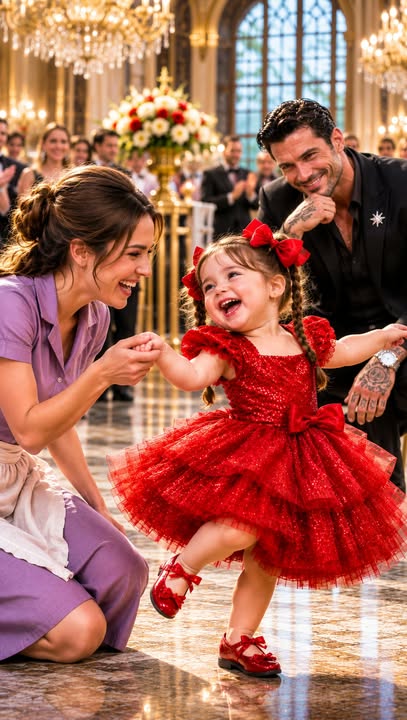
Part 2 – The Star That Shouldn’t Have Matched
For a moment, the ballroom seemed to hold its breath with me.
Then I looked at the silver starburst pinned to Luca Moretti’s lapel and remembered the small velvet box at the back of my dresser.
“Yes,” I said, barely recognizing my own voice. “Eli had one.”
The little girl’s hand tightened around my finger.
Her father did not move, but something in his face changed, a faint tension around his eyes as if he had just heard a name he had spent years trying not to remember.
“Your brother’s name was Eli?”
I nodded.
The answer seemed to settle between us, heavier than the music that had stopped.
“Where is his pin now?” he asked.
“At home.”
“May I see it?”
The question was quiet, but my grief had taught me to distrust anyone who reached too quickly for what they did not understand.
“No.”
His gaze held mine.
I expected annoyance, perhaps a command disguised as a request.
Instead, he lowered his chin once.
“All right.”
The simple answer unsettled me more than an argument would have.
Behind him, one of the guards shifted near the ballroom doors, still obeying the order he had given moments ago.
I glanced past Luca toward the exit.
“Are those doors blocked?”
He followed my eyes, then looked at the guard.
“Open them.”
“Mr. Moretti—”
“Now.”
The guard moved at once, and the nearest doors swung wide onto the hotel corridor.
No one tried to stop me.
Luca turned back to me.
“You can leave whenever you want.”
“Then why did you tell them I had to stay?”
“I didn’t.” His jaw flexed. “I said she stays here.”
He glanced down at his daughter, who had curled one hand around my finger and the other around a fold of his trousers.
For the first time, his voice carried something other than authority.
“I meant Sofia.”
The child leaned against his leg, her royal-blue skirt pooling around her shoes.
She looked up at me.
“Stay?”
My chest tightened.
I wanted to tell her I would, because her face was still flushed from crying and because her small hand felt warm around mine.
But I had already learned how promises could become anchors, and how quickly a person could mistake being needed for being safe.
“I have to go home, sweetheart,” I said gently. “But I’m glad I met you.”
Her lips pressed together.
“Again?”
“If your father asks me, and if I’m able, I’ll come back.”
She looked up at Luca, searching his face.
He seemed to understand that this was not a moment to make a promise on my behalf.
“We’ll ask,” he said.
Sofia considered that, then nodded with solemn effort.
“One, two, twee,” she whispered.
I sang the numbers back to her, just as I had before.
This time, she counted along, her voice small but steady.
When I stood, my knees ached from the marble floor.
The guests had begun to murmur again, though no one laughed now.
A woman in a silver dress stared down at her champagne glass as if it had become the most interesting thing in the room.
My supervisor hurried toward me, her face pale with worry.
“Mara, are you all right?”
“I’m fine.”
“You can’t just walk away from the service floor.”
“I know.”
She glanced at Luca, then at the open doors.
“I’ll handle it,” he said.
My supervisor looked as if she wanted to object, then thought better of it.
I could hardly blame her.
I worked for a hotel that depended on wealthy guests, and Luca Moretti was the kind of man people discussed in hushed voices even when he wasn’t in the room.
I had heard the stories, though I never knew how much was true.
People called him a crime boss, a fixer, a man who could make trouble disappear.
Yet his little daughter had said, “Dada, loud,” and he had turned off an entire ballroom without asking anyone’s permission.
That did not make him harmless.
It only made him harder to understand.
I took one last look at Sofia.
She was watching me with wet lashes and a solemn frown.
I raised my hand.
She lifted hers in response, fingers opening and closing like a tiny wave.
Then I walked out through the doors.
No guard followed.
The hotel corridor smelled of polished wood and white lilies.
I kept walking until the ballroom’s soft golden light disappeared behind me, and only then did I notice that my hands were shaking.
At the service entrance, I paused beside the staff lockers and pressed my palms against the cool metal.
My brother’s pin had been simple, almost delicate.
A small silver starburst with uneven rays, one longer than the rest and a tiny blue stone at its center.
Eli used to turn it between his fingers whenever a room became too loud.
He would hold it in his palm, tracing the points one by one while he counted under his breath.
When he was little, he wore it on his coat.
As he grew older, he kept it in the pocket of his favorite jacket, except for the night he died.
That night, he had pinned it to his collar.
The police returned it to us in a clear evidence bag, along with his wallet and one loose button.
I had kept the pin because it was the only thing they gave us that still felt like him.
The thought of Luca Moretti wearing a matching one made my stomach twist.
I finished the last hour of my shift on habit.
I polished glasses, carried trays, and answered questions from guests who wanted to know why the music had stopped.
I said the little girl had been overwhelmed.
I did not mention the pin.
By the time I reached my apartment, rain had begun tapping against the windows.
I lived in a narrow walk-up in Queens, in a place that was too quiet since Eli died.
His old sneakers still rested beneath the chair near the radiator because I could never bring myself to move them.
His favorite mug sat on the upper shelf, though nobody used it.
The velvet box was in the back of my bedroom drawer, beneath scarves I rarely wore.
I took it out and set it on the bed.
For several minutes, I only looked at it.
Then I opened the lid.
The pin lay on its faded lining, catching the light from the bedside lamp.
I did not touch it at first.
“Did you know him?” I whispered, though I had no one to ask.
The pin offered no answer.
I remembered the night we received it back.
I remembered a detective at the apartment door, his hat in his hands and his expression carefully arranged.
I remembered my mother’s fingers tightening around mine as he told us Eli had been struck by a car.
The driver had not stopped.
The investigation had gone on for weeks, then months, then quietly faded into the paperwork of an unsolved case.
Eli had been twenty-one.
He had been impatient with me about small things and gentle with everyone else’s hurt.
He always remembered which grocery clerk worked the late shift and which neighbor’s dog was afraid of thunder.
He could turn the dullest bus ride into a game if I let him choose the counting rules.
The pin was not a clue to a mystery when it belonged to him.
It was just his.
I closed the box.
For two days, I did not hear from Luca Moretti.
I told myself that was a relief.
I returned to the hotel for my next shifts, and no one mentioned the gala except my supervisor, who asked whether I was certain I wanted to keep working events.
I told her I was.
The ballroom had already been reset for another reception by the time I returned.
The staircase gleamed.
The champagne flutes stood in neat rows.
There was no trace of the child who had sat beneath the music with her hands over her ears, except for a blue ribbon caught near the base of one stair.
I picked it up and gave it to the lost-and-found desk.
That should have been the end of it.
On the third evening, a hotel manager came to the service corridor and asked whether I could spare a few minutes.
A man was waiting in the small office beside the kitchen.
I recognized him as one of Luca’s guards, though he wore no visible weapon and kept his hands folded in front of him.
“Mr. Moretti asked me to deliver a message,” he said.
My shoulders tightened.
“What kind of message?”
“He’d like to speak with you.”
“I’m working.”
“He said you should choose the time and place.”
That gave me pause.
The guard reached into his jacket and set a card on the desk.
It held only a name, a phone number, and a handwritten line.
If you prefer not to meet, I understand.
I read it twice.
“Is he at the hotel?”
“No.”
“Where does he want to meet?”
“Anywhere you’re comfortable.”
I studied the guard’s face.
He looked tired rather than threatening, and there was something almost apologetic in the way he waited for my answer.
“Tell him I’ll call,” I said.
He nodded and left the card behind.
I called the number the next morning, after sitting with it for nearly an hour.
Luca answered on the second ring.
“Ms. Hale.”
“You said I could choose the place.”
“Yes.”
“The café across from my apartment. At noon. Public place.”
“Understood.”
“And no guards inside.”
There was a pause.
“I can do that.”
“If you bring someone, I leave.”
“Understood.”
His agreement was so immediate that I wondered whether he had expected me to set conditions.
At noon, he arrived alone.
He wore a charcoal coat instead of the black suit, and without the ballroom lights and the watching guests, he looked less like a man from a story people feared and more like someone who had not slept enough.
He chose a table near the front window and did not take the seat opposite me until I did.
A waitress brought coffee.
Luca thanked her, then waited until she had walked away.
“I’m sorry about what happened at the gala,” he said.
“You mean telling your guards to block the doors?”
“Yes.”
“Was it an accident?”
“No.”
The bluntness of the answer took some of the heat from my anger.
He continued, “I saw the pin, heard your brother’s name, and reacted before I thought about what that would feel like to you.”
“You still had time to order them to stand there.”
“Yes.”
He did not try to soften it.
“I was worried you’d leave before I could ask about Eli.”
“And that made you think you could decide where I went?”
“No.” He looked down at his coffee. “It made me forget that asking was enough.”
I wrapped both hands around my cup.
The apology did not undo the fear I had felt, but it did not sound rehearsed, either.
“Why did you ask about Eli?” I said.
Luca’s eyes lifted to mine.
“Because I recognized the design of the pin.”
“From where?”
“My mother funded a small charity program years ago. It held events for children who needed quieter spaces, fewer people, or a little more time to adjust. We gave out those pins to the children who came.”
I had never heard of the program.
“Why would Eli have gone?”
“I don’t know.”
“You’re sure the pins were the same?”
“I’m sure enough to ask.”
“Your daughter recognized it.”
“Sofia notices details most people miss.” There was quiet affection in his voice. “She saw mine when she was very young and started calling it a star. She must have seen yours on Eli before, or on a photograph.”
I stared at him.
“I don’t keep pictures of the pin on my phone.”
“Then she may have seen it somewhere else.”
“Where?”
“I don’t know.”
It was the second time he had said those words, and the second time they sounded less like an answer than a door left open.
“Do you have a photograph of the program?” I asked.
“No.”
“Records?”
“Some.”
“Can I see them?”
He hesitated.
“I can look for what remains.”
“What does that mean?”
“It means the charity stopped operating years ago, and the files were never properly organized after my mother died.”
“Convenient.”
“I know how that sounds.”
“Do you?”
His expression tightened, but he did not raise his voice.
“I’m not asking you to trust me. I’m telling you what I know.”
I thought of the pin on his lapel, identical to the one locked in my dresser.
“What did your mother call the program?”
“Quiet Harbor.”
The words seemed to touch something buried in the back of my memory.
Eli had once told me he liked a place called the harbor because no one expected him to talk there.
I had thought he meant a park or library, but he never explained.
“How long ago did it run?”
“More than twenty years.”
“My brother was alive then.”
“How old was he?”
“Seven, maybe eight. I was younger.”
Luca’s gaze sharpened, but not with suspicion.
“Did he ever mention a charity event?”
“He mentioned a room where people didn’t mind if he was quiet. I didn’t know it was a program.”
“Did he say who took him?”
“No.”
“Do you remember the name of the adult who brought him?”
“I was a child myself.”
He nodded, accepting the limit without pressing.
For a moment, we sat with only the soft clatter of cups around us.
Then I asked the question that had followed me home from the ballroom.
“Why do you have a pin?”
“It was my mother’s.”
“That doesn’t explain why it matches.”
“She gave it to me when I was little.”
“Were you part of the program?”
“Not as a child. I was usually somewhere else with my father.” His hand went to his lapel, touching the pin through the fabric. “My mother told me it was a reminder.”
“Of what?”
“To make room for people who moved through the world differently.”
I thought of the ballroom, the guests who had laughed at Sofia, and the way he had stood beside her without knowing how to help until she said his voice was too loud.
“Did you understand what she meant?”
“Not then.”
“Do you now?”
“I’m trying to.”
The admission landed more gently than any polished explanation could have.
I watched him, searching for the angle, the hidden demand.
He gave me no promise that I had to help him, no offer designed to buy my silence, no warning about what he could do.
“I want to ask you something about Sofia,” he said.
I stiffened.
“Don’t use her to get me to answer questions about Eli.”
“I won’t.”
“You don’t know that.”
“You’re right.” He paused. “Then I’ll say it plainly. I want to ask you to come back because she liked you, and because I didn’t understand what was happening to her in that ballroom.”
“She was overwhelmed.”
“I know that now.”
“You knew it when she said the music was loud.”
“I knew it enough to stop the music. I didn’t know what to do before that.”
“You could have taken her somewhere quiet.”
“I tried. She wouldn’t move.”
“Because everyone was staring at her.”
His mouth pressed into a line.
“I should have noticed sooner.”
It was not a defense.
I looked out at the wet street, where a bus sighed at the curb and carried on.
“What do you want me to do?”
“Nothing she doesn’t want.” His voice was careful now. “I’d like you to spend some time with her in a quieter setting. Maybe show me what helped. But you’re not responsible for her, and you don’t owe me an answer.”
I thought about Sofia’s fingers around mine.
I thought about the way she had counted, not because she had been told to, but because the numbers had given her something steady to follow.
“I’m not a specialist,” I said.
“I know.”
“I can’t diagnose her.”
“I’m not asking you to.”
“And I won’t let anyone treat her like a problem to be managed.”
“I won’t either.”
He said it without hesitation, though I wondered whether he had earned the certainty of those words yet.
“I’ll think about it,” I said.
“That’s all I’m asking.”
“What about the records?”
“I’ll look.”
“Don’t look only for the parts that make you comfortable.”
Something flickered across his face.
“I won’t.”
I rose from the table.
He stood too, but did not reach for me or try to keep me there.
“I’ll call if I decide to come,” I said.
“I’ll respect that.”
Outside, the rain had stopped.
I made it to the corner before I heard my name.
“Mara.”
I turned.
Luca stood a few paces behind me, not close enough to block the sidewalk.
“I should have said this inside,” he said. “You don’t need to bring the pin. You don’t need to show me anything. I’m sorry I asked as if I had a right.”
I held his gaze for a moment.
“Thank you.”
He nodded, and I turned back toward home.
That night, I found myself opening the velvet box again.
This time I took the pin out.
The silver rays were cool against my fingertips, and the tiny blue stone caught the lamplight.
I remembered Eli sitting cross-legged on the living-room rug, turning it over while he counted the points.
One, two, three, he would say, then start again because he had lost track.
I had laughed at him once for doing it.
He had only smiled and told me there were always more numbers if you needed them.
The next morning, I called Luca.
“I’ll come back to see Sofia,” I said. “For one visit.”
“Thank you.”
“That does not mean I’m bringing the pin.”
“I understand.”
“And I won’t discuss Eli in front of her.”
“Agreed.”
“And if I say it’s time to leave, we leave.”
“Agreed.”
His quiet answers made it harder to hear the old fear in my own thoughts.
Two days later, I returned to the hotel.
Luca met me in a small private sitting room away from the ballroom, where the curtains were open to the gray afternoon and the only sound came from the rain easing against the windows.
Sofia sat on a rug with a wooden puzzle arranged in front of her.
She wore a yellow sweater and soft leggings, her curls tied back with two blue clips.
When she saw me, her face brightened.
“Mara!”
She stood, then stopped midway, as if remembering the rules of the room and deciding whether to run.
I crouched several feet away.
“Hello, Sofia.”
She took one small step toward me.
“One, two, twee?”
“One, two, three,” I sang.
Her smile came slowly, then all at once.
She held out a wooden puzzle piece shaped like a crescent moon.
“Help?”
I glanced at Luca.
He sat in a chair near the window, his hands resting open on his knees.
He did not answer for her.
“Do you want me to help?” I asked.
Sofia nodded.
I sat on the rug, leaving space between us.
We fitted the moon into its place, then the star, then the square.
When she became distracted by the rain, I did not call her back.
I only tapped my finger softly against the rug.
After a moment, she joined me.
Her father watched without interrupting.
For the next hour, Sofia showed me how she preferred the puzzle arranged.
She liked the pieces in a row before she placed them, and she wanted to choose which one came next.
When she finished, I asked whether she wanted to do it again or look at a book.
She considered both choices carefully, then pointed to the book.
“Book.”
I looked at Luca.
He was studying his daughter with the kind of attention that seemed almost new to him.
“She likes knowing what comes next,” I said quietly.
“So do I,” he replied.
The answer surprised a small laugh from me.
Sofia leaned against my side and turned a page.
Luca watched her for a long while before he spoke.
“My mother used to say the room should change before we asked the child to.”
“Did she teach you that?”
“She said it often.”
“Did you listen?”
“Not always.”
His honesty made the room feel softer.
When Sofia grew tired, I told her I was leaving soon.
She looked disappointed but did not cry.
I reminded her that the next time we met, we could choose a puzzle or a book.
She chose the book by pointing to it.
Then Luca walked me to the sitting-room door.
“You helped me see what I was missing,” he said.
“I didn’t do anything complicated.”
“You waited.”
“That was what she needed.”
He looked toward his daughter, now arranging puzzle pieces into a neat line.
“Maybe I needed to learn that.”
I was almost at the elevator when he spoke again.
“I found something in my mother’s files.”
I stopped.
“What?”
“A photograph from one of the old Quiet Harbor events.”
My heartbeat quickened.
“Does it show Eli?”
“I haven’t looked closely enough to be certain.”
“You haven’t looked closely enough?”
“I didn’t want to send you a name I couldn’t stand behind.”
The elevator doors opened behind me.
“Can I see it?”
“Yes.”
He reached into his coat and brought out a small envelope, but did not hand it to me yet.
“There’s something else,” he said. “The records were supposedly lost after a fire in the charity’s storage room.”
“Supposedly?”
“That’s how my family explained it.”
“Who told you?”
“My aunt. My father. Different people, same story.”
“And you believed them?”
“I didn’t have a reason not to.”
I looked at the envelope in his hand.
“Until now.”
“Until your brother’s pin.”
He held the envelope out.
I took it, though my fingers felt numb.
The photograph inside was black and white, the edges softened with age.
A small group of children sat around a low table covered in paper stars and wooden blocks.
Near the back stood a woman with dark hair pinned in a loose knot, one hand resting on the shoulder of a boy beside her.
I recognized Luca in the shape of his face, even as a child.
The woman must have been his mother.
Beside her stood a boy with solemn eyes and a familiar tilt to his head.
A silver starburst glinted on his sweater.
My breath caught.
I traced the edge of the photograph without touching the image.
“That’s Eli.”
Luca leaned closer, but kept his hands to himself.
“Are you certain?”
“I’d know him anywhere.”
The boy in the photograph looked about eight, perhaps nine.
His mouth was set in the same thoughtful line I remembered from family pictures, but his eyes were brighter here, caught in the middle of some quiet moment.
For a few seconds, the years fell away.
I could almost hear him asking whether the wooden blocks were supposed to be a tower or a bridge.
Then I noticed the woman’s hand on his shoulder.
She was not merely standing beside him.
She was looking at him with a tenderness that made my throat ache.
“Why was your mother with Eli?” I asked.
“I don’t know.”
“Why did your family say the records were lost?”
“I don’t know.”
“Why did the charity end?”
“I don’t know.”
His answers, one after another, sounded less like ignorance and more like the outline of something someone had worked hard to keep hidden.
I looked again at Luca’s lapel.
The silver star on the photograph was the same design as the one he wore.
“Your pin came from his,” I said.
He followed my gaze.
“My mother told me she had it repaired once. I never knew whose it was.”
“Repaired from what?”
“I don’t know.”
The photograph trembled in my hand.
It showed Eli alive, small and serious, sitting beside the woman who had raised the man standing before me.
It showed a connection neither of us had known existed.
And beneath the image, written in a slanted hand, were four words.
Eli returned after the closing bell.
**–END OF PART 2–CLICK “NEXT” AT THE BOTTOM OF THE PAGE TO CONTINUE READING**
* * *
[NEXT: PART 3](https://echoesofstories.idolsgift.com/blog/part-3-the-star-that-shouldn-t-have-matched-047)
✓ Lynn R. Adams
Part 2 – The Star That Shouldn’t Have Matched For a moment, the ballroom seemed to hold its breath with me. Then I looked at the silver starburst pinned to Luca Moretti’s lapel and remembered the sm…