PART 2: The Star She Kept 041
Part 2 – The Star She Kept
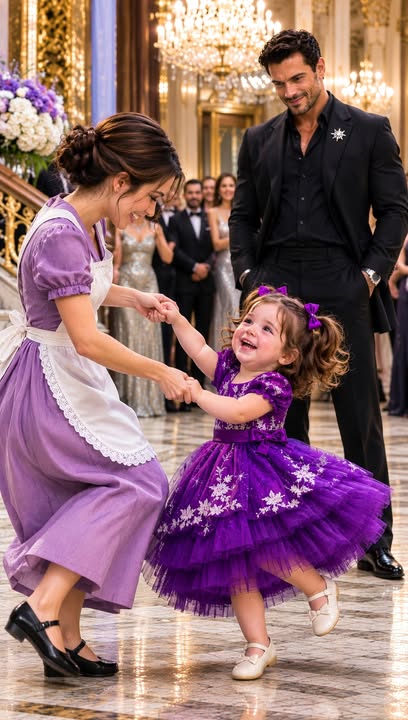
I looked from Sofia’s bright, expectant face to the silver starburst pinned to Vittorio Vale’s lapel.
For a moment, the ballroom seemed to draw tight around us, all its polished marble and glittering chandeliers narrowing to the space between his question and my answer.
“Yes,” I said at last.
My voice sounded smaller than I wanted it to.
“My brother had one.”
Vittorio’s gaze stayed on mine, guarded but intent.
“What was his name?”
“Eli.”
Sofia tugged at my finger.
“Eli,” she repeated, carefully shaping the word as if it were another number in our game.
Something shifted in Vittorio’s expression, though I couldn’t tell whether it was recognition or simply the weight of hearing a child’s name spoken aloud.
He glanced down at the pin on his jacket.
“Where did he get it?”
“I don’t know.”
The answer came too quickly, and I hated how much it sounded like an accusation.
I drew a breath and tried again.
“He wore it on his backpack. A little silver star with one point bent inward. He was proud of it.”
Vittorio’s hand rose toward the pin, but stopped before touching it.
“This is the same design,” he said. “I’ve seen it before.”
“Where?”
He looked toward Sofia.
She was studying the pin with solemn concentration, one hand still curled around mine.
“It belonged to her mother,” he said. “Elena.”
The name entered the quiet alcove softly, but it seemed to settle between us with the weight of something long kept.
Sofia touched the blue satin at her collar.
“Mama star,” she murmured.
Vittorio lowered his hand.
“Yes, sweetheart. Mama’s star.”
I searched his face for something more—a certainty, a memory, any sign that he was about to tell me he knew Eli or knew what had happened to him.
But his expression held only a careful, troubled recognition.
“You said you thought you knew what happened to my brother,” I reminded him.
“I said I thought I might know,” he answered. “I recognize the pin. I don’t know your brother.”
“You made it sound as though you did.”
“I was wrong to put it that way.”
The admission was quiet and direct.
It didn’t erase the fear that had risen in me when he ordered his guards to find out everything about me, or the fact that one of them had moved toward the doors.
Still, he had not raised his voice again.
And Sofia had both hands wrapped around my finger as if it were a promise.
“I need to leave,” I said.
Vittorio’s eyes flicked toward the ballroom, where the guests had begun speaking again in low, careful voices.
“You can leave.”
The guard nearest the entrance looked to him for confirmation.
“Open the doors,” Vittorio said.
The guard moved at once.
I stood slowly, keeping my movements easy for Sofia to follow.
Her hand tightened around mine.
“No go.”
I crouched again.
“I have to go back to work, sweetheart.”
“Again?”
“I’ll count with you again if I come back.”
She considered that, lower lip pressing out in a thoughtful little pout.
“Promise?”
“I promise I’ll try.”
Vittorio watched us without interrupting.
I knew promises made to a child could be fragile things.
I also knew I could not promise more than I meant.
Sofia lifted her free hand and tapped my knuckles once, then twice.
“One, two.”
I tapped back, gentle and steady.
Her face brightened.
“Twee!”
The ballroom’s music had not resumed, and the sudden quiet made every movement seem louder: a chair sliding, glass set down, someone’s breath catching as I passed.
My supervisor stood beside the catering station, pale with worry and fury in nearly equal measure.
I handed him the tray I had left behind.
“I’m sorry about the glass.”
He looked past me toward Vittorio.
“I’ll deal with the glass,” he said, low enough that the nearby guests could not hear. “You should go home.”
“I still have a shift.”
“You’ve already had enough of a shift.”
His tone softened at the end.
I nodded, unable to tell whether I was relieved or ashamed.
Before I reached the service corridor, Vittorio spoke behind me.
“Miss—”
“Mara,” I said, turning.
He gave a brief nod.
“Mara. I won’t stop you.”
“I’m glad.”
“But I’d like to speak with you when you’re ready.”
“That depends on what you want to ask.”
His eyes shifted to the star on his lapel.
“I want to understand why my wife’s pin was on your brother’s backpack.”
I felt the old ache stir, familiar as a bruise beneath a sleeve.
“So do I,” I said.
Then I left the ballroom.
Outside, the night air was cold enough to clear the champagne scent from my head.
I stood beneath the hotel’s stone canopy for several seconds, my fingers pressed against the small star tucked beneath my blouse on its thin chain.
I had worn it every day for three years.
Eli had been twelve when he died.
The silver pin had come from the pocket of his winter backpack, which our mother had handed me after the funeral because she couldn’t bear to sort through his things.
I had found it folded into a side compartment with a pencil worn down to almost nothing and a tiny plastic dinosaur missing its tail.
The pin had been scratched, its edges dulled, one point bent inward.
I had never known where it came from.
Eli had liked small objects with clear shapes.
He used to line them up on the kitchen table when the room felt too busy, arranging buttons and coins by size, then starting over if anyone interrupted him.
When he was overwhelmed, he pressed his palms against his ears and went quiet.
Some adults called it stubbornness.
Some said he was being dramatic.
I had thought I understood him because I loved him.
I had been wrong in ways I still couldn’t name without feeling the ground shift under me.
At home, I took the pin from around my neck and set it on the kitchen table.
The small silver points caught the light from the stove hood.
I turned it over.
The back had a narrow notch near the clasp, a flaw I had noticed years ago because it caught against the lining of Eli’s backpack.
I had never shown it to anyone.
I had never thought there was anyone who would recognize it.
My phone buzzed.
It was a message from my supervisor asking me to call him in the morning.
I set the phone down and stared at the star.
Then I pulled open the drawer where I kept Eli’s things.
A folded picture showed him sitting on the front steps of our old apartment, his hair falling across one eye and his mouth tilted into a smile he never quite managed when someone told him to look at the camera.
The backpack was beside him.
A silver glint appeared near the strap.
I had looked at that picture countless times.
I had never noticed the pin clearly until tonight.
The next morning, I called the hotel.
My supervisor told me I had not been fired, though he said I had scared him half to death when the guards moved toward the entrance.
“I thought you were about to disappear into the kind of story people only hear about afterward,” he said.
“I’m sorry.”
“Don’t apologize for helping a child.”
He paused.
“Just don’t make a habit of leaving trays on the floor.”
I laughed once, unexpectedly.
It came out shaky, but it was a laugh.
When I hung up, I didn’t know whether I wanted to see Vittorio again.
I wanted answers.
I didn’t want to be pulled into someone else’s grief and told it explained my own.
Most of all, I didn’t want Eli reduced to a clue in a story that belonged to the rich, the powerful, or the people with better records.
I had just decided to put the pin away when my phone rang.
The number was unfamiliar.
“Mara?” a man asked when I answered.
“Yes.”
“This is Vittorio Vale.”
I nearly ended the call.
Instead, I waited.
“I’m calling because Sofia asked for you this morning.”
“That’s kind of her.”
“She kept counting on her fingers and asking when you’d come back.”
I pictured her in the blue dress, though it had surely been put away by now.
“What do you need from me?”
“Nothing you haven’t already offered.”
“That sounds like a careful answer.”
“It is.”
There was a pause on the line.
Then he said, “She’s having a difficult morning. I thought you might be willing to visit for a little while. Somewhere quiet. You can leave whenever you want.”
I should have said no.
The request reached into a part of me that still remembered how it felt to watch Eli struggle while the adults around us guessed at what he needed.
But I had to be honest with myself: I wanted to know why the pin matched.
“I’ll come for one hour,” I said. “And I won’t discuss Eli unless I choose to.”
“Agreed.”
“Your guards don’t follow me around.”
“They won’t.”
“And I leave when I want.”
“You leave when you want.”
The steadiness in his voice made me more cautious, not less.
“Where?”
“My home. There’s a small garden room where Sofia plays when the house is too loud.”
“I’ll meet you there. I’m not being escorted.”
“I understand.”
The next afternoon, I arrived by taxi at a quiet townhouse on a tree-lined street.
The door was opened by an older woman in a navy cardigan, who introduced herself as Mrs. Bell, Sofia’s caregiver.
She didn’t look surprised to see me.
“He’s in the garden room,” she said. “She’s been waiting.”
The room had wide windows facing a walled garden and a soft rug scattered with wooden blocks, fabric books, and a basket of toy animals.
There were no bright ceiling lights on.
A small lamp glowed beside a low sofa.
Sofia sat cross-legged on the rug in a yellow sweater, her curls loose around her face.
When she saw me, she stood, then hesitated as if deciding whether to run.
I opened my palm.
She came to me at her own pace and placed her hand in mine.
“One,” she said.
“Two,” I answered.
She smiled.
“Twee.”
Vittorio stood near the window in shirtsleeves, without the sharp suit and the silver pin.
In the softer light, he looked less like the man who could still a ballroom and more like a tired father who had forgotten what to do with his hands.
“Thank you for coming,” he said.
“I came for Sofia.”
“I know.”
He seemed to accept that boundary without testing it.
For a while, we played with wooden blocks.
Sofia liked to stack them in a crooked tower, knock it down with the side of her hand, and begin again.
Each time, she counted with me.
When she lost track, she didn’t become frustrated.
She simply started over.
Vittorio sat on the sofa, watching her with a tenderness so carefully contained that it looked almost like fear.
“She likes counting,” I said.
“She likes having the count stay the same.”
“That can help.”
His eyes shifted to mine.
“You knew that with your brother?”
I set down a block.
“I knew he liked things in a certain order. I didn’t always understand why.”
Vittorio looked toward Sofia, who was carefully arranging three blocks in a row.
“What happened to him?”
The question was quiet.
I hadn’t promised not to answer.
I had promised I would choose.
“Eli died after a medical emergency,” I said. “There wasn’t anything anyone could do by the time we understood what was happening.”
“I’m sorry.”
“Thank you.”
The simple words left a silence behind them.
I rubbed my thumb over the edge of a wooden block.
“He was sensitive to sound and crowds. He hated scratchy clothes and sudden changes. When he got overwhelmed, he couldn’t always explain what was wrong.”
“Did you know that then?”
“Not the way I know it now.”
I kept my eyes on the blocks.
“I was older than him, but I was still a kid myself. I thought if he wanted to be alone, he was angry with me. If he covered his ears, I thought he was trying to shut me out.”
I stopped, aware that the next words were difficult to say aloud.
“Sometimes I pushed him to join us because I thought I was helping.”
Vittorio didn’t rush to fill the silence.
“I’m not telling you that to make you feel sorry for me,” I said.
“I didn’t think you were.”
“I still wonder whether I should have noticed sooner.”
Sofia looked up from her tower.
“Again?” she asked.
“Again,” I said, and helped her rebuild it.
Vittorio watched us.
After a moment, he said, “Children don’t always know how to ask for what they need.”
“No,” I replied. “And adults don’t always know how to listen.”
His gaze lowered.
“I understand that.”
There was something in the way he said it that made me think of Elena, though I didn’t ask.
We spent the rest of the hour with Sofia.
When she grew tired, Mrs. Bell brought her a small cup of water and sat beside her, speaking in a low voice.
Sofia tucked against her shoulder but kept one hand extended toward me.
“You’ll come again?” she asked.
“I can,” I said. “If your dad agrees.”
Vittorio answered before she could turn to him.
“If you want to come, you’re welcome.”
I looked at him.
“Not because you think I can solve something?”
“No.”
“Not because you think I owe you answers?”
“No.”
“Then I’ll come once more.”
A faint line appeared between his brows, as if he understood how carefully I had chosen my words.
“Once more,” he agreed.
At the front entrance, he walked me to the door himself.
A small framed photograph sat on a console table nearby.
A woman with dark hair stood in a sunlit garden, smiling into the camera.
A silver starburst rested at the neckline of her dress.
I stopped.
“That’s Elena?”
“Yes.”
“She wore the same pin.”
Vittorio followed my gaze.
“Yes.”
The photograph was old enough that its colors had softened, but the pin was clear.
My stomach tightened.
The silver points were arranged just like the one Eli had carried.
And at the center, one point bent subtly inward.
For the first time, the two stars no longer looked like similar designs.
They looked as if they belonged to the same small story.
I touched the hidden pin beneath my blouse.
“Do you know where Elena got hers?” I asked.
Vittorio’s expression changed, not with surprise but with a grief so familiar it seemed to make the room colder.
“She worked at a children’s rehabilitation center,” he said. “Years before Sofia was born.”
Then he looked at the photograph again.
“She brought home a whole collection of those stars.”
**–END OF PART 2–CLICK “NEXT” AT THE BOTTOM OF THE PAGE TO CONTINUE READING**
* * *
[NEXT: PART 3](https://echoesofstories.idolsgift.com/blog/part-3-the-star-she-kept-041)
✓ Lynn R. Adams
Part 2 – The Star She Kept I looked from Sofia’s bright, expectant face to the silver starburst pinned to Vittorio Vale’s lapel. For a moment, the ballroom seemed to draw tight around us, all its po…