PART 2: The Sound Hidden in the Vent 056
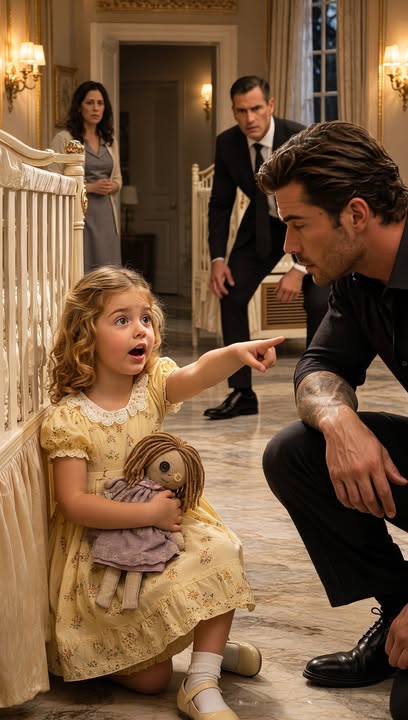
“Boss,” Marco said, his face suddenly pale. “Whatever you do, don’t touch what’s inside.”
I held up a hand to stop the others from moving closer.
“Tell me what you see.”
Marco leaned back from the grille, careful not to brush the metal edge.
“Some kind of device,” he said. “It’s wedged between the duct and the frame.”
Elena drew Sophie against her side.
The little girl clutched her doll so tightly that one of its button eyes pressed into her palm.
“Is it dangerous?” she whispered.
“I don’t know yet,” I said, keeping my voice steady. “But no one is going to touch it.”
The words were meant for Sophie as much as for everyone else.
Marco called the security team and asked them to keep the hallway clear.
Then he phoned a bomb technician he trusted, a retired specialist who had helped us with a suspicious package years earlier.
I had expected the call to take longer.
The man answered on the second ring, and Marco gave him the essential details without taking his eyes off the vent.
“Don’t move it,” the technician said through the speaker. “Don’t disconnect anything. I’m on my way.”
The babies were still in the hallway, held by the nannies.
Theo had stopped crying, but each breath came in small, uneven catches.
Miles lay against his nanny’s shoulder with his fists tucked under his chin.
Nora’s damp curls stuck to her forehead as she watched the nursery door.
I turned toward Dr. Gable.
“Can they stay out here?”
“For now, yes,” he said. “They’re calmer, and there’s no need to bring them near the room until we know what we’re dealing with.”
I looked at the open doorway.
A few minutes earlier, I had thought the room itself was safe because our cameras showed no one entering.
Now I understood how little that proof meant.
Elena kept one arm around Sophie while the other rested protectively across her daughter’s shoulders.
“I’m sorry,” she said quietly. “I should have kept her downstairs.”
I glanced at Sophie.
She had noticed something the doctors and the security team had missed.
“She helped us,” I said.
Elena looked as though she wanted to believe me but was afraid to.
Sophie peered around her mother’s side.
“Will they be all right?”
“Yes,” I said. “They’re outside the room now, and we’re going to find out what made them scared.”
She studied my face with the seriousness of someone much older.
“Promise?”
“I promise we’ll do everything we can.”
It was not the kind of promise I usually made.
I was accustomed to promises that could be enforced by money, influence, or a room full of men waiting for instructions.
This one depended on questions I couldn’t yet answer.
The technician arrived twenty-five minutes later carrying a hard case and wearing the cautious expression of someone who had learned not to trust appearances.
He introduced himself as Samuel Price, then asked everyone except Marco and me to wait beyond the nursery doors.
Dr. Gable remained in the hallway with the babies.
Elena hesitated.
“Sophie can stay with me,” she said, “but she doesn’t need to watch.”
“I agree,” I replied. “She’s done enough for tonight.”
Sophie didn’t protest, though she kept looking toward the vent.
Price asked Marco to explain exactly what he had seen.
Then he set up a small inspection camera and fed its flexible probe through the opening.
The device appeared on the screen in a gray, crowded view of dust and metal.
It was no larger than a deck of cards, tucked against the ductwork with dark tape and thin wires arranged along its side.
A red light blinked steadily.
Price leaned close to the monitor.
“Not an explosive,” he said after a moment. “I don’t see anything that suggests one.”
The breath I had been holding slipped out of me.
“But it’s powered,” he continued. “And I can see a small speaker. I want to understand how it’s attached before I remove it.”
“Could it be a listening device?” Marco asked.
“Possibly, but I can’t tell from this view. It may be a signal unit, a sound emitter, or something custom-made.”
My eyes returned to the red blink.
“Could it hurt the babies?”
Price didn’t rush to answer.
“Not in the way you’re thinking,” he said carefully. “But sound can affect people differently, especially infants. If this has been producing a loud or harsh signal, it could upset them.”
“It didn’t sound loud,” I said.
“Some frequencies aren’t easy for adults to hear.”
The room seemed to grow colder around that possibility.
Sophie had been right.
There was a sound, and my children had been reacting to it while the rest of us stood in the same room and heard nothing.
Price examined the casing through the camera and asked Marco for a set of long, nonconductive tools.
He worked slowly, stopping several times to study the wires before loosening the tape.
No one spoke while he did it.
Even the faint movement of the nannies in the hall seemed too loud.
At last, Price eased the device from the duct and lowered it onto a padded tray.
The red light kept blinking.
“Let’s see whether it’s transmitting anything,” he said.
He checked the unit with a handheld meter, then adjusted a control on his equipment.
A thin, piercing tone filled the nursery.
I heard it only as a faint pressure in my ears, but Price immediately lowered the volume and turned his device away.
“High-frequency pulse,” he said. “Repeated at intervals.”
My jaw tightened.
“Can you tell how long it’s been running?”
“Not from here. The power source is small, though. It may have been operating for days, possibly longer.”
I looked toward the open doorway, where the babies waited in the hall.
“They’ve been hearing this?”
“Likely, yes.”
The pulse had stopped, but my body still seemed to anticipate it.
I thought of Theo’s shaking fists, Miles kicking free of his blanket, Nora’s red, exhausted face.
They had not been sick.
They had been trying to tell us something with the only language they had.
Price disconnected the power source and placed it in a separate evidence container.
Then he shut down the emitter.
The red light went dark.
I waited for the room to feel different.
It did, though perhaps that was only because I now knew the silence had not been empty before.
“Can they come back in?” I asked Dr. Gable.
“Let’s give them a few minutes,” he said. “Then bring them in one at a time and watch their reactions.”
The first nanny carried Theo through the doorway.
He stiffened at the threshold, so she paused.
Price’s equipment was gone from the room, but the grille remained open.
I had Marco stand aside while I took Theo from the nanny.
My son’s small hand curled around my finger.
I stepped into the nursery.
Theo watched me, his mouth trembling, but he did not cry.
The quiet was so ordinary that it felt almost miraculous.
The nanny brought Miles next, and then Nora.
For several long seconds, they stared at the walls and the cribs.
Then Nora settled against the nanny’s shoulder.
Miles yawned.
Theo let his eyes fall shut.
The tension in my chest eased a little at a time.
I looked toward the hall.
Sophie stood beside her mother, holding the doll by its cloth body.
She had been right about the room.
“Would you like to see them?” I asked her.
Elena glanced down at her daughter, uncertain.
Sophie gave a small nod.
I led them only as far as the doorway, not wanting to make the nursery feel like a place she had to enter.
From there, she could see the babies resting in their cribs.
Her face softened.
“They’re calm now,” she said.
“They are.”
I crouched so we were eye to eye.
“You noticed something none of us did.”
Sophie looked down at her doll.
“I just listened.”
“That helped them.”
Her cheeks colored, and she tucked a curl behind her ear.
For a moment, I saw how small she was: a four-year-old in a yellow dress, standing in a hallway of polished stone while adults discussed specialists and equipment around her.
“Thank you, Sophie.”
She nodded but didn’t smile.
Then she glanced at her mother.
“Mr. Moretti?”
“Yes?”
“Please don’t blame Mama for bringing me upstairs.”
Elena’s arm tightened around her.
The request landed harder than any accusation could have.
“Why would I blame her?”
“Because she wasn’t supposed to bring me here.”
Elena’s face changed, the confidence she wore at work giving way to unease.
“Sophie,” she murmured, “we don’t need to talk about that now.”
“But you said—”
“I know what I said, sweetheart.”
Elena’s voice was gentle, but there was something strained beneath it.
I stood and looked at her.
“What was she not supposed to do?”
“Nothing that matters tonight,” Elena replied quickly. “I only meant that I should have taken her home before I came back upstairs.”
She gathered Sophie close.
The explanation was reasonable.
It also felt incomplete.
I had spent years learning to recognize the difference between a person who was hiding a danger and a person who was afraid of being misunderstood.
Elena looked like the second kind.
“All right,” I said. “We’ll talk tomorrow, when the children are settled.”
She lowered her eyes.
“Thank you.”
Price packed his equipment while Marco arranged for the device to be taken to a secure room for examination.
I asked him to document every step and keep a chain of custody.
The device had been planted in my home, and I wanted to know whether it was connected to the security system, the ventilation, or something else entirely.
Before he left, Price examined the outer casing under a small lamp.
“Someone built this carefully,” he said. “The parts aren’t all the same age, but the assembly is deliberate.”
“Can you tell who made it?”
“Not tonight. I can give you a better answer after I’ve opened it in a controlled setting.”
He placed the unit inside a clear evidence box.
Then Marco carried it out.
Sophie watched it pass, her eyes fixed on the small dark shape inside the container.
The red light was gone.
For the first time since she had entered the nursery, she seemed uncertain.
“Is it going away?” she asked.
“For now,” I told her. “We’re going to find out where it came from.”
Her gaze lifted to mine.
“Will you tell me?”
“If you want to know, I will.”
She seemed to consider this, then nodded once.
Elena took her downstairs.
I remained in the nursery with Marco until the babies were asleep.
The three of them looked peaceful, their breathing soft beneath the pale blankets.
The open vent made the room feel unfinished, as though someone had removed a piece of its skin.
I asked Marco to have the entire duct inspected before anyone closed it.
He agreed, then paused at the doorway.
“Do you think it was meant for the babies?”
“I don’t know.”
“Price said the sound could have been aimed at someone else.”
I looked at the cribs.
“Even if it was, the babies were the ones who heard it.”
Marco didn’t answer.
He knew better than to mistake anger for certainty.
For the rest of the night, I stayed near the nursery.
I sat in a chair by the door, listening to the small, steady sounds of my children breathing.
Each time one of them shifted, I woke.
Near dawn, I went to the kitchen and found Elena making coffee.
She looked tired, and the sleeves of her uniform were rolled to her elbows.
“You should have gone home,” I said.
“So should you.”
There was a quiet honesty in the reply that almost made me smile.
“How is Sophie?”
“Asleep. She was worried about the babies.”
“She helped them.”
“Yes,” Elena said. “She did.”
She put a cup on the counter but didn’t offer it to me.
I understood then that she was waiting to see what I would ask.
“What did you mean when Sophie said she wasn’t supposed to come upstairs?”
Elena’s hands stopped over the coffee pot.
“I told her to stay downstairs while I finished my work.”
“That isn’t what she meant.”
“No,” she admitted. “It isn’t.”
She stared into the coffee as if the dark surface might help her choose the right words.
“I didn’t want her to feel responsible for something that had nothing to do with her.”
“Responsible for what?”
“For noticing the sound.”
I waited.
Elena set the pot down.
“Years ago, Sophie’s father worked for the company that handled maintenance for this house.”
I had heard the name Daniel before, though only in passing.
He had died when Sophie was very young, and Elena rarely spoke about him.
“What kind of work did he do?”
“Ventilation and electrical testing. He wasn’t a full-time employee here, but he came to the house during a renovation.”
I thought of the open duct and the device Price had removed.
“Did he work on this nursery?”
“Yes.”
The answer was quiet but clear.
“What did he do?”
“He was asked to test the airflow. He also designed a simple sound test for the vent system, to make sure the ducts carried air without rattling.”
Elena’s fingers tightened around the coffee cup.
“It was harmless,” she added. “A little device he used to send a tone through the system. He told me about it afterward.”
The words seemed to rearrange the room in my mind.
The device in the vent might not have been a stranger’s invention.
It might have begun as something made by the father of the little girl who had found it.
“Did you know he had put something in the duct?”
“No,” Elena said. “Not this device. Daniel told me about the test, but he said he took his equipment with him when the job was finished.”
“Did you see it?”
“No.”
“Did he say anything about the sound bothering babies?”
She lowered her eyes.
“He said the nursery had an unusual echo. He worried that certain tones might carry farther there than they should.”
“When was this?”
“Before Sophie was born. Years ago.”
“And you never told me.”
“I didn’t think it mattered anymore.”
Her answer was so soft that I heard the fear inside it.
“Why did Sophie think you weren’t supposed to bring her upstairs?”
Elena glanced toward the doorway.
“She has always been sensitive to sounds. More than most people. She notices the refrigerator humming, the pipes knocking, a loose hinge before anyone else does.” A faint, worried smile appeared and disappeared. “Daniel used to say she listened with her whole face.”
I remembered the way Sophie had held her finger to her lips and crawled beneath the crib.
“She said the sound was coming from the vent.”
“Yes. She told me once that she could hear a thin whistle in the nursery whenever she came upstairs. I asked her not to mention it because I thought she was hearing the ventilation fan.”
“Why didn’t you tell me?”
“I was afraid you’d think I was making trouble,” she said. “Or that you’d think Daniel had left something unsafe behind.”
The confession was not dramatic.
That made it harder to dismiss.
I looked at her and saw the weight she had been carrying, not because she believed her husband had done something wrong, but because she feared that his name would be used against her.
“I wouldn’t have blamed you for something he did years ago,” I said.
Elena gave me a tired look.
“Maybe not. But I couldn’t be sure.”
I had no answer to that.
My house was run on rules, schedules, locked doors, and the expectation that people would tell me what I needed to know.
Yet Elena had kept quiet because she did not know whether honesty would protect her or cost her work.
That was not a failure of her loyalty.
It was a failure in the way I had made loyalty feel necessary.
“I’m sorry I didn’t make it easier to tell me,” I said.
Her expression shifted, though she did not seem ready to accept the apology.
“I should have spoken sooner.”
“Maybe. But we can talk about that after we know what was in the vent.”
She nodded.
I asked Marco to bring me the evidence report when it was ready.
Later that morning, he came to my office with a tablet in his hand.
“Price finished the first inspection,” he said. “The unit wasn’t transmitting. No microphone or storage component.”
“So it was only making the sound?”
“That’s what it appears to be. The pulse was produced by a small emitter, and the power supply was separate.”
“Could Daniel’s old test equipment have looked like this?”
“Possibly. Price says the basic casing could be older, but there’s a newer component inside.”
I looked up.
“How much newer?”
“He can’t be certain yet. The board and the power connector don’t match the rest of the unit.”
“Could they have been replaced during ordinary maintenance?”
“Could be. He wants to compare it with anything left from the renovation.”
I thought of Elena’s account, the sound test Daniel had designed, and Sophie’s request not to blame her mother.
“Find the maintenance records,” I said. “And speak to Elena before you question anyone else.”
Marco gave a small nod.
He left the office, and I returned to the nursery.
The triplets were awake, but none of them was crying.
Sophie stood beside Elena near the door, watching Theo move his feet beneath his blanket.
She looked up when she saw me.
“Is the tiny sound gone?”
“It is.”
“Will it come back?”
“Not while we’re watching the room.”
She seemed satisfied by that, though I knew it was not a promise strong enough to comfort a child for long.
I moved toward the crib and saw something on the corner of the evidence photograph Marco had left behind.
The device’s casing had been turned slightly under the inspection lamp.
Near one of the seams was a tiny mark, barely visible against the scratched plastic.
I leaned closer.
It looked like a star, drawn by hand with a fine point.
“Marco,” I called.
He returned from the hall.
“Did Price notice this?”
He studied the picture.
“I don’t think so.”
“Ask him to photograph it under magnification.”
Marco zoomed in.
The little star had five uneven points.
It was too small to be a factory stamp, and too irregular to be a logo.
Sophie had wandered closer.
When she saw the image, her face went very still.
“Do you know what that is?” I asked.
She stared at the star for another second, then looked toward her mother.
“I’ve seen it before,” she whispered.
Elena’s hand found her shoulder.
“Where, sweetheart?”
Sophie held her doll close.
“On Daddy’s old toolbox.”
**–END OF PART 2–CLICK “NEXT” AT THE BOTTOM OF THE PAGE TO CONTINUE READING**
* * *
[NEXT: PART 3](https://storyly.idolsgift.com/blog/part-3-the-sound-hidden-in-the-vent-056)
✓ Lynn R. Adams
“Boss,” Marco said, his face suddenly pale. “Whatever you do, don’t touch what’s inside.” I held up a hand to stop the others from moving closer. “Tell me what you see.” Marco leaned back from the …