PART 2: The Song Owen Remembered 061
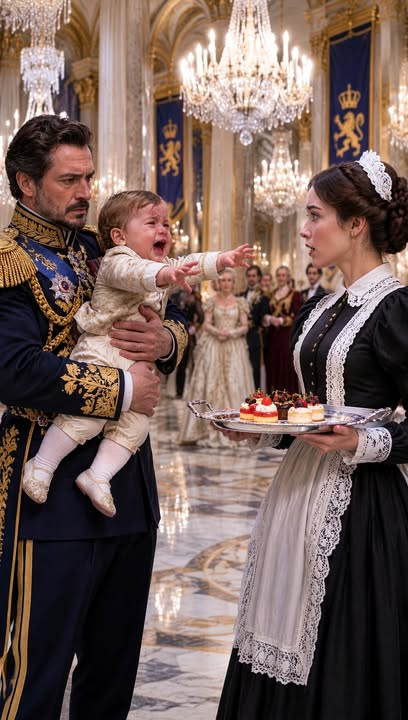
Because his son had never reached for a stranger like this before, Gideon kept watching Mallerie long after the rest of the ballroom resumed its cautious murmur.
Owen had gone quiet against her shoulder, one small hand curled in the fabric of her uniform.
Mallerie could feel every breath he took, soft and warm against her collarbone, and each one seemed to loosen a knot inside her that had been pulled tight for ten months.
“Would you come with me?” Gideon asked.
His voice was lower now, stripped of the sharpness it had carried moments earlier.
Mallerie glanced toward the tray abandoned on a nearby table.
“I should get back to work.”
“I’ll speak with the hotel manager.”
“That isn’t what I meant.”
She looked down at Owen, who had begun rubbing his cheek against her shoulder.
“I mean, I don’t know you.”
“Neither do I know you,” Gideon said. “But I know my son has been crying for nearly an hour, and he’s stopped.”
There was no command in his tone, only a weariness that made him seem older than his years.
Mallerie looked toward the security chief, who stood several paces away, watching them with careful restraint.
Then she looked at the ballroom: its gleaming chandeliers, its guests in black tie and silk, its curious faces trying not to stare.
“I don’t want to make a scene,” she murmured.
“You aren’t making one.”
Gideon turned to his security chief.
“Clear the small library beside the west corridor.”
The chief nodded and moved away without asking questions.
Gideon gestured toward a discreet doorway, but Mallerie did not move immediately.
“I’m not giving him back if he starts crying,” she said.
A faint crease appeared between Gideon’s brows.
“Then don’t.”
The answer seemed to surprise her more than a demand would have.
She followed him through the doorway, Owen still nestled in her arms.
The library was quiet and warm, furnished with dark shelves and a pair of velvet chairs beside a tall window.
Beyond the glass, the city shimmered with late-evening lights, blurred by a thin veil of rain.
Gideon shut the door, leaving the noise of the ballroom behind.
For several seconds, neither of them spoke.
Mallerie sat in one of the chairs, careful not to disturb Owen.
Gideon remained standing, his hands clasped loosely in front of him, as though he were trying to remember how to begin a conversation that mattered.
“How long have you worked at the hotel?” he asked at last.
“Six weeks.”
“And before that?”
“Different places.”
“Restaurants?”
“Mostly.”
His gaze moved to the baby, then returned to her face.
“You seem comfortable with children.”
Mallerie’s thumb brushed the edge of Owen’s sleeve.
“I used to think I would be.”
A silence gathered between them.
Gideon heard the difference in her answer and did not press right away.
Owen’s breathing had grown slow and even, but his fingers still held tightly to the fabric at Mallerie’s shoulder.
“His name is Owen,” Gideon said.
“I know.”
“Have you met him before?”
“No.”
“Have you seen him at the hotel?”
“I saw you come in with him earlier. That’s all.”
“Then what did you mean when you said he might not think you’re a stranger?”
Mallerie looked down at Owen.
The baby’s lashes rested against his cheeks, damp with the tears he had shed.
“I don’t know,” she said. “It just came out.”
Gideon studied her as if he were weighing every word.
“Are you frightened of him?”
“No.”
“Of me?”
“Not exactly.”
“What does ‘not exactly’ mean?”
“It means I’m trying to understand why this hurts.”
The words emerged quietly, but they changed the room.
Gideon’s expression softened by a degree.
“What hurts?”
“Being near him.”
She drew a careful breath.
“Not because he’s doing anything wrong. He’s lovely.”
Owen’s hand opened and closed against her shoulder.
“It’s just that holding him feels familiar in a way it shouldn’t.”
Gideon lowered himself into the chair opposite her.
For the first time since she had seen him, he looked less like a powerful man and more like a father who had been carrying a worry by himself.
“How old are you, Mallerie?”
“Twenty-four.”
“And you said you’re from—”
“I didn’t say where I’m from.”
“You’re right.”
He glanced toward the window, accepting the correction without argument.
“I’m sorry. I’m accustomed to asking questions and expecting answers.”
“I noticed.”
A brief, almost rueful smile touched his mouth.
“Then let me ask one I’m willing to answer myself.”
He paused.
“Do you have a child?”
Mallerie felt her fingers go still against Owen’s back.
The rain ticked against the window.
“No,” she said.
The answer was technically true, and it tasted like an old lie.
Gideon waited.
She had been prepared for people to ask if she was married, whether she planned to have children, or why she looked sad when a newborn cried.
She had not been prepared to answer the question while holding a baby who had reached for her as if he knew her.
“I had a son,” she said.
Gideon did not move.
“What do you mean?”
“I mean I gave birth to a baby boy ten months ago.”
Her eyes remained on Owen, because she could not look at Gideon and say the next words.
“He died.”
The sentence seemed to empty the air from the room.
“I’m sorry,” Gideon said.
It was not a grand expression of sympathy, nor an attempt to make the pain smaller.
It was simply there, offered with a sincerity that made her throat tighten.
“Thank you.”
“Was he born here?”
“No.”
She lifted her gaze to his, wary of what might follow.
“I don’t want to talk about the hospital.”
“I won’t ask you to.”
“You may want to know why I reacted this way.”
“I do,” Gideon admitted. “But wanting to know doesn’t mean I’m entitled to every part of your life.”
Mallerie studied him, trying to determine whether the gentleness was natural or carefully chosen.
“Everyone says they’re sorry,” she said. “Then they want details, or they tell me I’m young and can have another.”
Gideon’s jaw tightened.
“That sounds like a cruel thing to say to someone who’s grieving.”
“It’s usually meant kindly.”
“Intent doesn’t always make it kind.”
She looked down again.
The room grew quieter, though the ballroom seemed impossibly far away.
“I held him for less than a minute,” she said. “I was exhausted and scared. People kept coming in and out. Then someone said there had been complications, and I was given medicine.”
Her thumb moved in a slow circle over Owen’s back.
“When I woke up, a doctor told me my baby hadn’t survived.”
Gideon’s hands had settled on his knees, his fingers clasped tightly together.
“They didn’t let you see him?”
“No.”
“Not even afterward?”
“No.”
“I’m sorry.”
Mallerie nodded once, unable to bear hearing it again.
“They told me everything had been handled. I was young, and I had no money, no family who could stand beside me, and no strength left to argue.”
She stopped.
Owen shifted in her arms but did not wake.
“For months, I told myself there must have been a reason. Then I started wondering if I’d imagined the sound of him crying.”
She swallowed.
“I know I didn’t. But grief has a way of making you doubt even what you remember.”
Gideon remained silent, listening without trying to mend what could not be mended.
Mallerie appreciated that more than she could say.
“Was his name Owen?” he asked.
“No.”
She hesitated.
“I never got to name him.”
Something changed in Gideon’s face, an expression of pain that was not his own but seemed to reach him anyway.
He looked down at the child asleep in her arms.
“Owen’s mother died shortly after he was born,” he said.
Mallerie’s breath caught.
“I’m sorry.”
“Thank you.”
Gideon’s gaze stayed on his son.
“Her name was Celeste. We had planned to raise him together. She was a remarkable woman, and she wanted a family more than anything.”
He paused, then continued in a voice that had become carefully controlled.
“She died before Owen was a month old.”
“I’m sorry,” Mallerie said again, and this time the words held the ache of recognizing someone else’s empty place.
“Afterward, I thought I could manage everything if I worked hard enough. I hired nurses, specialists, and people with excellent references.”
His eyes returned to Owen.
“He never settled with any of them for long.”
“Does he cry like that often?”
“Not usually that intensely. But he’s never been easy with caregivers.”
“Maybe he senses that they’re nervous.”
“Maybe.” Gideon leaned back. “I’ve considered dozens of explanations.”
“Have you tried holding him more?”
The question escaped before Mallerie could soften it.
Gideon’s expression sharpened, but he did not take offense.
“Yes.”
“Then I’m sorry. That sounded judgmental.”
“It sounded honest.”
He looked at Owen, whose face was relaxed against her.
“I do hold him. I’m not always sure I know what he needs.”
“None of us know at first.”
“You speak as though you’ve had the chance to learn.”
Mallerie looked away.
“I’ve spent a lot of time imagining what I might have done.”
“That’s not the same as being given a chance.”
“No.”
The answer was little more than a breath.
She closed her eyes for a moment and rested her cheek lightly against Owen’s hair.
It smelled faintly of soap and warm cotton.
A memory rose in her without warning: a dim hospital room, her body heavy from medication, a nurse’s hands moving beyond her line of sight.
She could not remember the baby’s face.
She remembered only the tiny sounds he had made, and a melody she had once hummed to him in the minutes before everything went dark.
The tune had come from her own childhood, a lullaby her mother used to sing during storms.
Mallerie began humming it now without thinking.
The melody was soft, little more than a thread of sound.
Owen’s fingers unclenched.
His brow, which had creased briefly in sleep, smoothed.
Across from her, Gideon went still.
Mallerie opened her eyes.
“What is it?”
“Where did you learn that song?”
She stopped humming.
“I don’t know. My mother used to sing it to me.”
“What are the words?”
“I don’t remember all of them. It didn’t have many.”
She glanced down at Owen.
“Why?”
Gideon did not answer at once.
He seemed to be listening for the melody’s last note, though the room had gone silent.
“Celeste used to sing something very much like that to him,” he said.
Mallerie’s arms tightened around the baby before she could stop them.
“Are you sure?”
“I am.”
His voice was quiet, but the certainty in it unsettled her.
“She sang it whenever he was difficult to settle. It was one of the few things that consistently calmed him.”
Mallerie stared at him.
“I’ve never met Celeste.”
“I know.”
“My mother taught it to me when I was small.”
“Then perhaps it’s a common song.”
“Perhaps.”
Neither of them seemed convinced.
Gideon stood and walked to the window.
For a time, he watched the rain glimmer against the glass.
Mallerie could see his reflection faintly beside hers: a man dressed for a room full of admirers, and a woman in a hotel uniform holding his child.
“I don’t want you to think I believe in signs,” he said.
“I don’t know what I believe in.”
“Neither do I.”
He turned back toward her.
“But I can’t ignore what happened in that ballroom.”
“Neither can I.”
Owen made a sleepy sound, and Mallerie gently shifted him higher against her chest.
Gideon watched the movement with an expression that was difficult to read.
“How long are you working tonight?”
“Until the event ends.”
“That could be hours.”
“I’m paid by the shift.”
“I can arrange for your manager to release you.”
“I don’t need you to arrange anything for me.”
He nodded, accepting the boundary.
“Then I’ll ask rather than arrange. Would you be willing to stay with him until he wakes?”
Mallerie looked down at Owen.
Her heart answered before her mind could interfere.
“I don’t know if that’s a good idea.”
“Because of what you told me?”
“Because it feels too easy to forget that he isn’t mine.”
The honesty seemed to strike them both.
Gideon said nothing for a moment.
“He isn’t yours,” he said gently. “He’s my son.”
“I know.”
“And I won’t pretend otherwise.”
“Good.”
“But he’s also a child who needs someone calm beside him.”
“You have people for that.”
“I have people with qualifications. I don’t have anyone he trusts.”
Mallerie searched his face.
“Why are you asking me?”
“Because he reached for you, and because you didn’t treat him like a problem to be solved.”
Gideon lowered his voice.
“I’m not asking you to replace anyone. Certainly not Celeste.”
Mallerie’s eyes returned to Owen.
“What are you asking?”
“Come work for us temporarily as his caregiver.”
She looked up.
The request was so unexpected that she first thought she had misunderstood.
“You want to hire me to take care of your son?”
“I want to ask whether you would consider it.”
“I’m a waitress.”
“You have experience with children?”
“Not professionally.”
“Then I’ll arrange for you to meet his pediatrician and any specialists you’d need to work with. There would be training, a proper schedule, and a written agreement. You would be free to leave if it didn’t feel right.”
Mallerie’s grip on Owen loosened.
“I don’t know anything about caring for a baby.”
“You know how to make him feel safe.”
“That’s not enough.”
“No. But it’s a start.”
He did not offer a salary or invoke his influence.
He did not tell her the decision was already made.
The absence of pressure made the invitation harder to dismiss.
“Why me?” she asked again.
Gideon glanced at Owen.
“Partly for him.”
“And the other part?”
He looked as though he had been waiting for her to ask.
“To understand what I saw tonight.”
Mallerie’s stomach tightened.
“You think there’s something between us.”
“I think something happened that neither of us can explain.”
“You think I could be connected to him somehow?”
“I don’t know.”
“Are you looking for a reason?”
“I’m looking for the truth.”
She felt the old hospital room rise around her, cold and bright, its voices blurred by medication.
“I can’t promise you a truth.”
“I’m not asking you to.”
“What if he keeps crying once I’m there?”
“Then we’ll find another way to help him.”
“What if he gets attached to me?”
“Then we’ll make decisions carefully.”
“What if I do?”
Gideon’s expression softened.
“Then we’ll make those decisions carefully, too.”
Mallerie looked at him, trying to find the catch.
There was grief in his face, and exhaustion, and something like hope that he did not seem willing to trust.
“You barely know me,” she said.
“That’s why I’m asking for a temporary arrangement, not a lifelong promise.”
“And you expect me to live in your home?”
“I can offer you a room there, if it’s more practical. Or you can commute. The choice would be yours.”
“I can’t live with a man I’ve met an hour ago.”
“Then don’t.”
His answer came without hesitation.
“You can bring someone with you to see the house. You can speak to your manager, read the contract, and take a day to decide.”
Mallerie glanced toward the door.
The ballroom was waiting beyond it, with its silver trays and polished smiles.
Her old life was waiting, too, with its rented room and carefully avoided dates.
But Owen was warm in her arms, and the sound of his breathing had softened something she had believed would stay hard forever.
“I need the work,” she said.
“I understand.”
“I’m not saying yes because you’re wealthy.”
“I would be concerned if you did.”
“And I won’t be treated like I owe you anything.”
“You won’t.”
“I won’t answer questions about my son unless I choose to.”
Gideon held her gaze.
“Understood.”
She looked down at Owen again.
“Let me finish tonight. Then I’ll read whatever agreement you offer.”
“That’s fair.”
“And I won’t promise to stay.”
“I wouldn’t expect you to.”
For the first time that evening, Mallerie felt the smallest measure of relief.
Not trust.
Not yet.
Only the sense that she might be allowed to step closer without surrendering herself.
Owen stirred against her and made a faint, unhappy sound.
Mallerie returned to humming the melody.
His face relaxed almost at once.
Gideon watched her with a look she could not name.
“Celeste sang it exactly that way,” he murmured.
Mallerie stopped.
The baby’s eyes opened a fraction, then drifted shut again.
“What did she sing?” Mallerie asked.
Gideon hesitated.
“It was the same tune. The same rhythm.”
“Did she know where it came from?”
“Not that I ever heard.”
“Was it something her family sang?”
“I don’t think so.”
He looked toward the rain-dark window, searching his memory.
“Celeste said she’d learned it from her mother. She never knew the words, either.”
Mallerie felt the room tilt, though nothing had moved.
“My mother said the same thing.”
Gideon’s eyes met hers.
For a heartbeat, the quiet library held both their griefs, and between them the sleeping child who had somehow drawn them together.
Then a gentle knock sounded at the door.
Gideon’s security chief entered only after Gideon called for him.
“Mr. Vale, the event manager says the hotel is asking where Ms. Reed has gone.”
“I’ll speak with him.”
The chief’s gaze flickered toward Owen, then Mallerie.
“Is there anything else?”
Gideon looked at Mallerie.
She shifted in her chair, preparing to return the baby.
Owen’s fingers tightened around her uniform.
Mallerie paused.
“Not yet,” Gideon said to the security chief.
The man nodded and withdrew.
Gideon approached, but did not reach for his son.
“Would you like me to take him?”
Mallerie looked at Owen’s closed eyes.
“I think he’s comfortable.”
“So do I.”
“You should probably hold him.”
“I will.”
But Gideon did not insist.
For a little while, they sat in the quiet library, each listening to the soft, steady breathing between them.
Mallerie knew she should think about the job, the contract, and the strangeness of being asked to care for a child she had met only minutes earlier.
Instead, she found herself wondering about Celeste.
About the lullaby she had learned from her mother, and whether two families could carry the same melody without ever knowing one another.
When Owen finally stirred again, his eyes opened fully.
He looked first at Mallerie, then at Gideon.
His mouth curved into a tiny, uncertain smile.
Gideon’s face changed at the sight.
It was the smile of a father who had been waiting a long time for his child to look at him without fear.
Mallerie gently passed Owen into his arms.
This time the baby did not cry.
He settled against Gideon’s chest, still holding the edge of Mallerie’s sleeve until the fabric slipped from his fingers.
Gideon looked down at him, his expression tender and almost stunned.
“He hasn’t done that in months,” he said.
“Maybe he just needed a quieter room.”
“Maybe.”
Mallerie stood, smoothing the front of her uniform.
“Your offer,” she said. “I’ll consider it.”
“I’ll have the agreement brought to you tomorrow.”
“Don’t send anyone to my home.”
“I won’t.”
“I’ll contact you.”
“All right.”
She moved toward the door, then stopped.
“Gideon?”
“Yes?”
“If Owen settles with me, that doesn’t mean I can explain why.”
“I know.”
“And if I stay, you can’t expect me to become someone I’m not.”
“I wouldn’t want you to.”
Mallerie held his gaze for a moment, then opened the door.
The noise of the ballroom rolled in, bright and distant.
Behind her, Gideon spoke once more.
“Thank you for holding him.”
Mallerie looked back at Owen, already resting quietly against his father.
“You don’t have to thank me for that.”
“I do.”
She left before he could say anything else.
At the end of the corridor, the hotel manager hurried toward her, clearly relieved to find her.
Mallerie returned to work, but all evening she felt the warmth of Owen’s small hand on her shoulder.
And as she cleared away empty glasses and untouched desserts, the lullaby kept returning to her mind.
The same tune her mother had hummed in childhood.
The same tune Celeste had sung to her son.
By the time Mallerie stepped outside after midnight, the rain had stopped, but the question had followed her into the cool night.
How could two women who had never met have given the same song to the same child?
**–END OF PART 2–CLICK “NEXT” AT THE BOTTOM OF THE PAGE TO CONTINUE READING**
* * *
[NEXT: PART 3](https://storyly.idolsgift.com/blog/part-3-the-song-owen-remembered-061)
✓ Lynn R. Adams
Because his son had never reached for a stranger like this before, Gideon kept watching Mallerie long after the rest of the ballroom resumed its cautious murmur. Owen had gone quiet against her shoul…