PART 2: The Song Beneath the Photograph 047
Part 2 – The Song Beneath the Photograph
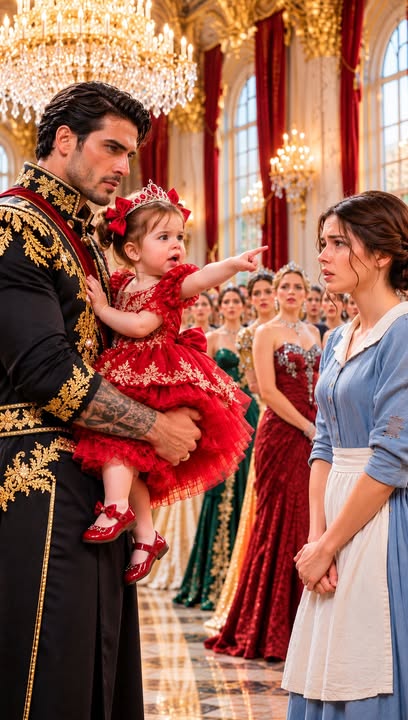
“Your Highness, there’s something you need to know about the night your wife died.”
The words hung beneath the ballroom chandeliers, fragile and dangerous.
My father’s cane rested against the marble floor behind me.
Around us, the guests had gone still, their curiosity sharpening into something almost indecent.
Lily clung to Olivia’s neck, her small face tucked against the maid’s shoulder as if she had found the one safe place in a room full of strangers.
I looked at my daughter first.
Then at Olivia.
“Not here,” I said.
My father’s jaw tightened.
“Adrian, she has just made an accusation before the entire court.”
“I made no accusation,” Olivia answered quietly.
Her voice had lost none of its steadiness, though her fingers were curled protectively around Lily’s back.
“I said there was something he needed to know.”
“Then you can tell him in front of everyone,” my father replied.
“No,” I said.
The word carried farther than I intended.
I turned toward the guards stationed near the ballroom doors.
“Secure the room, please, but no one is to touch Miss Bennett or frighten my daughter.”
The captain of the guard nodded once and moved to the doors.
No weapons were drawn, but the guests understood the meaning of the order.
Their whispers faded as the ballroom doors closed.
I held out my arms to Lily.
She tightened her grip around Olivia.
“Livvy stay.”
It was the first time she had called her anything but Mommy.
The small correction struck me harder than it should have.
“Let her stay with you,” I told Olivia.
My father’s eyes narrowed.
“Adrian, this is a family matter.”
“Then we should speak as a family,” I replied. “Without an audience.”
I took the music box and photograph from the open case on the floor, careful not to damage either.
The note in Isabella’s handwriting seemed to burn through my palm.
Don’t let your father know who she really is.
I had read the line twice already, but it did not become easier to understand.
My father had watched me grow up.
He had taught me how to read the silences of a room and how to keep my temper when every instinct urged me to act.
He had also spent years telling me that Isabella’s death was a tragedy without a mystery.
“What does the note mean?” I asked Olivia.
“I don’t know,” she said. “I’ve wondered about it for years.”
My father took a step closer.
“You expect us to believe that you have carried a message from my daughter-in-law without knowing what it says?”
“I didn’t know the note was there,” Olivia replied. “It was hidden behind the photograph.”
She looked down at the music box in my hand.
“I only knew Isabella had asked me to keep it safe.”
“You knew her?” I asked.
“Yes.”
“How?”
Olivia drew a careful breath.
“I can explain, but not with everyone listening.”
“Then we’ll use the east guest room,” I said.
My father’s cane struck the floor once.
“Not the east wing.”
I looked at him.
“Why not?”
“It is closed for repairs.”
“The room has been maintained for years.”
“It is still unsuitable.”
His answer came too quickly.
Something in me noticed, though I could not yet tell whether it was suspicion or grief looking for a new place to settle.
“The room will do,” I said.
My father’s expression hardened, but he did not stop us.
The captain opened a passage through the guests, and I led the way from the ballroom with Olivia and Lily close behind.
The palace corridors were quiet in the late afternoon, their old portraits watching us pass beneath the warm light of the wall lamps.
Lily had buried her face against Olivia’s shoulder.
Every few steps, she lifted her head to make sure Olivia was still there.
I had seen my daughter reach for comfort before, but never with such certainty.
It should have pleased me.
Instead, a knot of fear tightened beneath my ribs.
Isabella’s lullaby had been private.
The music box was real.
The photograph was real.
And the child in that photograph had been standing beside my wife years before I had ever seen her.
A guard opened the east guest room.
I had stayed there once as a boy, when a winter storm had damaged the windows in my own quarters.
It was a modest room by palace standards, with pale curtains, a small fireplace, and a view of the garden.
“Two guards outside,” I told the captain. “No one enters without my permission.”
My father had followed us as far as the corridor.
He stopped at the threshold.
“I expect this conversation to be brief,” he said.
“I expect you to give us privacy.”
His gaze shifted to Lily.
For a moment, his stern expression softened.
“Your granddaughter belongs with her family.”
“She is with her family,” I said.
The words surprised me as they left my mouth.
My father studied me, then turned away without another reply.
Once the door closed, the room seemed to exhale.
Olivia lowered herself into a chair, keeping Lily on her lap.
My daughter’s fingers were still tangled in the fabric of Olivia’s blue dress.
I set the music box and photograph on the table between us.
“Tell me how you met Isabella.”
Olivia looked at the faded photograph before answering.
“I was seven years old.”
She said it without ceremony, but her hands tightened around Lily.
“My mother had died the year before, and I was living at a charity home outside the city.”
“What was your mother’s name?”
“Clara Bennett.”
I searched my memory, but the name did not immediately rise.
Olivia seemed to notice.
“She worked as an archivist at the palace, before I was born,” she said. “She kept records, letters, old household accounts. She died when I was six.”
“I’m sorry.”
“Thank you.”
She spoke gently, without bitterness, as if the words had become familiar through years of repetition.
“The home was called St. Agnes,” she continued. “It was a small place. A lot of the children had nowhere else to go, and the staff did their best with what little they had.”
“And Isabella visited?”
“Yes.”
“How often?”
“Not every week. Sometimes once a month, sometimes less. She came quietly, without a procession or anyone announcing her arrival.”
Olivia glanced toward the door.
“She told the matron that she didn’t want the children to think she was there to be admired. She wanted to help.”
My wife had never told me.
I pictured Isabella in the polished halls of the palace, smiling at Lily’s first steps, sitting beside me at formal dinners, listening to my worries about the family’s future.
I had thought I knew the shape of her days.
Apparently I had known only the ones she shared with me.
“What did she do there?” I asked.
“She brought books, blankets, art supplies. She helped the staff find donors. Sometimes she just sat with us and listened.”
Olivia’s voice warmed as she remembered.
“She never spoke to us as if we were a problem to be solved. She remembered our names. She remembered which children were afraid of storms and which ones hated peas.”
A small sound came from Lily.
She had lifted her head, listening.
Olivia gave her a soft smile.
“That song was the first thing she taught me.”
“Why that song?”
“She said it had helped her when she was a child.”
The answer sent a cold ripple through me.
“Isabella was taught it by her mother,” I said.
“Maybe,” Olivia replied. “She never explained where it came from. She said it was for the nights when the dark felt too large.”
I looked at the music box.
“Did she give you that at St. Agnes?”
“No. She gave it to me years later.”
“How many years later?”
“The last time I saw her.”
Olivia paused.
“I was seventeen then.”
I leaned forward.
“Why did she come to you?”
“She said she had something important to ask, but she didn’t tell me what it was. She gave me the music box and asked me to keep it somewhere safe.”
“Did she say why?”
“She said the palace wasn’t safe for it.”
The room seemed to contract around those words.
“What did she mean?”
“I asked her, but she only said that I would understand if she ever asked me to bring it to you.”
Olivia looked directly at me.
“She told me not to come unless I was sure I could reach you without putting the box in the wrong hands.”
“And you decided that today was safe?”
“No,” she said. “I decided it might be my last chance.”
Lily shifted on her lap, and Olivia immediately began rubbing slow circles between her shoulders.
My daughter relaxed against her.
I watched them, caught between a tenderness I had not expected and a jealousy I did not want to name.
“How did you get a job here?” I asked.
“I applied through the palace staffing office. I’ve worked in the service wing for eight months.”
“Why didn’t you tell me who you were?”
“I tried to learn whether you would hear me before I brought the music box to you.”
“You could have spoken to me.”
“I could have,” she agreed. “But I was a maid, and you were the heir. I had no reason to believe you would take my word over your father’s—or that I would be allowed to leave with the box afterward.”
The honesty in her answer unsettled me.
“You think my father would take it from you?”
“I don’t know what he would do.”
She lowered her eyes.
“I only knew Isabella was afraid someone would.”
There was no accusation in her tone.
That made it harder to dismiss.
I turned the silver box over in my hands.
Its surface was scratched and dull, but the initials remained clear.
I.M.
“Why did you say she disappeared?” I asked.
“Because that was what I was told.”
“By whom?”
“The matron at St. Agnes. She said Isabella had gone away and couldn’t visit anymore.”
“And you believed her?”
“I was seven.” Olivia’s expression softened with an old sadness. “Children often believe the version that lets them sleep.”
I looked down at the photograph again.
Isabella’s smile was open and unguarded.
Olivia looked small beside her, her hair tied back with a ribbon, one hand gripping Isabella’s sleeve.
There was no mistaking the affection between them.
“What did Isabella call you?” I asked.
“Olivia.”
“Nothing else?”
She hesitated.
“She used to call me family.”
The room fell silent.
Lily’s head rested against Olivia’s collarbone.
My daughter’s breathing had begun to slow.
I had spent two years teaching myself not to search for Isabella in every movement Lily made.
It had never worked.
Now I was staring at a photograph that proved Isabella had built a life beyond the one I knew.
“What did she mean by family?” I asked.
Olivia looked down at the sleeping child.
“I don’t know.”
“Did she ever tell you that you were related?”
“No.”
“Did she say your mother was connected to her?”
“No.”
“Then what did she mean?”
“I can only tell you what she told me,” Olivia said. “That family wasn’t always the people who shared your name. Sometimes it was the people who stayed.”
The words were not dramatic.
They were worse for being true.
I thought of Isabella’s final months, the late evenings she had spent writing letters and making calls she never explained.
I had assumed she was tired.
I had assumed she would tell me if something mattered.
“How long did she keep visiting you?” I asked.
“Until a few weeks before she died.”
The room seemed to tilt.
“A few weeks?”
“Yes.”
“Did she ever mention me?”
“Of course.”
“What did she say?”
Olivia’s mouth curved with the faintest hint of a smile.
“She said you loved too fiercely to know what to do with the feeling.”
I looked away.
That sounded like Isabella.
“She also said you were trying to become a good father,” Olivia added. “She thought you would be.”
For a moment, the words brought my wife close enough to hurt.
I set the music box down.
“Why keep this from me?”
“She asked me to.”
“And you followed her request for years without asking questions?”
“I was young when she gave it to me, and then I was afraid. When I learned she had died, I thought the box might be the only thing she had left in the world that belonged to me.”
“Belonged to you?”
Olivia’s cheeks colored.
“I didn’t mean it like that. I meant it was something she had trusted me with.”
I studied her face.
She looked exhausted, frightened, and stubbornly calm.
Nothing about her resembled the elegant women my father had invited to win Lily’s affection.
That did not make her trustworthy.
But it made me want to listen.
“What was she like when you last saw her?” I asked.
Olivia’s gaze drifted toward the window.
“Worried.”
“About what?”
“She never said. She kept looking at the gate whenever she heard a car.”
The east gate.
A place I had not thought about in years.
The night Isabella died, I had been away from the palace on a family matter.
I remembered the call.
I remembered the cold rain against the windows of the car as I raced back.
I remembered the words spoken in the hospital corridor.
A carriage had left by the east gate.
There had been a crash on the old road.
Isabella was gone before I arrived.
“What did she say about the gate?” I asked.
“Nothing. She just seemed afraid to stay much longer.”
“Did she tell you to bring the box to me that night?”
“No.”
“Did she leave anything else?”
“Not that I know of.”
I opened the lid of the music box.
The tiny mechanism gave a faint, uneven turn, then began to play.
The melody rose into the room, each note worn but recognizable.
Lily stirred in Olivia’s arms.
Olivia lowered her voice and joined the tune, singing the line that had stopped the ballroom.
My throat tightened.
For two years, I had avoided singing it myself.
I could still hear Isabella’s voice beside the cradle, soft and warm, while rain tapped the nursery windows.
Lily settled again.
The song faded to its last note.
Olivia closed the lid.
“She sang it to me when I couldn’t sleep,” Olivia said. “I thought it belonged to all of us.”
I could not answer.
A light knock sounded at the door.
One of the guards entered only far enough to speak.
“Your Highness, the ballroom guests have been escorted to the west salon. His Majesty asks that you return when you are ready.”
“Tell him I’ll come later.”
The guard bowed and withdrew.
I stood, then stopped beside the table.
“Do you have the note?”
Olivia nodded toward the photograph.
I lifted it carefully, checking its edges for any sign of a fold or hidden pocket.
The paper backing felt thicker on one side.
I slid a finger beneath the loosened edge.
A narrow strip of paper emerged.
Olivia went still.
“That wasn’t there before,” she whispered.
I unfolded it.
The handwriting was Isabella’s, but the letters were smaller, rushed.
Ask why the east gate was unguarded.
I read it once.
Then again.
The floor seemed to vanish beneath me.
The east gate was supposed to be watched that night.
I remembered the report filed after the crash, the explanation that an emergency evacuation had caused confusion among the guards.
No one had ever told me the gate was unguarded.
I heard my father’s cane in the corridor before I heard his voice.
“Adrian,” he called through the closed door. “We need to speak.”
Olivia looked at me.
Her face had gone pale, but she did not seem surprised.
I folded the note and closed my hand around it.
For the first time since Isabella’s death, I wondered whether the story I had been told was not the whole story.
My father’s footsteps paused outside.
Then his voice came again, quieter this time.
“Do not ask questions about the east gate.”
**–END OF PART 2–CLICK “NEXT” AT THE BOTTOM OF THE PAGE TO CONTINUE READING**
* * *
[NEXT: PART 3](https://echoesofstories.idolsgift.com/blog/part-3-the-song-beneath-the-photograph-047)
✓ Lynn R. Adams
Part 2 – The Song Beneath the Photograph “Your Highness, there’s something you need to know about the night your wife died.” The words hung beneath the ballroom chandeliers, fragile and dangerous. …