PART 2: The Slipper Turned Toward Me 046
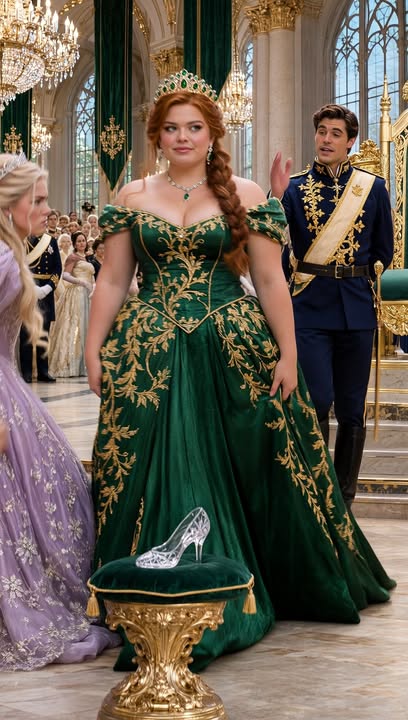
Part 2 – The Slipper Turned Toward Me
My fingers were only inches from the glass when the blue light flared beneath the golden pedestal.
A ripple of color traveled through the slipper, bright as moonlight caught beneath ice.
I froze.
The laughter in the ballroom died so quickly that the silence seemed to ring.
The slipper did not crack.
It did not tremble or shift on its velvet cushion.
Instead, it turned.
Slowly, unmistakably, the glass toe angled toward me.
A murmur rolled through the gathered guests.
Someone behind me whispered, “That can’t be possible.”
I drew back my hand, and the light dimmed.
When I reached toward the slipper again, the blue gleam returned, brighter this time, tracing the delicate curve of the glass.
The queen rose from her chair.
“Everyone, please remain where you are,” she said.
Her voice was calm, but I saw the strain in the way her fingers pressed against the arm of her seat.
Prince William stepped down from the dais.
“Amelia,” he said softly, “don’t move.”
I looked at him, unsure whether he was warning me or trying to reassure me.
“Is it dangerous?”
“I don’t know.”
He did not pretend otherwise, and somehow that honesty steadied me more than a confident answer would have.
The queen came toward us, her gaze moving from the slipper to my hand.
“We need to speak privately,” she said.
The invitation sounded more like a request than an order, but the room had already begun to watch us as if we were the center of a story none of them understood.
Lady Olivia stood near the ceremonial chair, her face pale beneath the ballroom lights.
For a moment, her eyes met mine.
The mockery had vanished from them, replaced by something unsettled and almost frightened.
“I’m sorry,” she said, so quietly I nearly missed it.
I didn’t know whether she meant the laughter, the comment about my size, or the fact that the slipper had turned toward me.
Perhaps she didn’t know either.
The queen gestured toward a pair of tall doors at the edge of the ballroom.
“Miss Brooks, would you come with me?”
Prince William moved at once.
“I’m coming too.”
His mother’s expression tightened.
“William.”
“I won’t leave her alone with a mystery that has just made the entire court forget how to breathe.”
For one beat, the queen seemed ready to refuse.
Then she looked at me, and something in her face softened.
“Very well,” she said.
We walked through the doors together.
Behind us, the ballroom erupted into subdued conversation, a hundred voices trying to give meaning to what they had just seen.
The doors closed, leaving the noise muffled and distant.
A corridor stretched ahead, lined with portraits of solemn men and women in old-fashioned clothes.
The queen led us into a small sitting room, where a fire burned low in a marble hearth.
There were no guards inside, no attendants, no audience.
Only a writing desk, several armchairs, and a tall window overlooking the palace gardens.
The queen shut the door herself.
“Please sit,” she said.
I chose the chair nearest the window, because it gave me something to look at besides the queen’s worried face.
William remained standing for a moment before settling into the chair opposite mine.
The queen took the seat between us.
“I need you to tell me exactly what happened,” she said.
“I touched the air near the slipper,” I replied. “I didn’t even touch the glass.”
“And the light appeared?”
“Yes.”
“Had you seen it before tonight?”
I hesitated.
“Just before I came closer, I thought I saw a blue glow in a crack in the pedestal.”
The queen exchanged a glance with her son.
William leaned toward me.
“Did it look like the light that appeared when your hand was near the slipper?”
“It was fainter,” I said. “But yes, I think it was the same.”
The queen looked down at her hands.
“Did you notice anything else? A sound, a sensation, anything unusual?”
“I felt cold,” I admitted. “Not frightened, exactly. More like I’d walked into a room where someone had just been.”
William’s eyes stayed on mine.
“That sounds like what Father described.”
The queen turned sharply toward him.
“Your father’s warning was not meant to be repeated without care.”
“But I think she deserves to know why you’re both looking at her as if she’s about to disappear.”
A silence settled between them.
I drew my hands together in my lap.
“What warning?”
William glanced at his mother, then back at me.
“When I was younger, my father took me into the old archive beneath the east wing,” he said. “He showed me a record of the slipper and told me that one day it might respond to someone who wasn’t part of the ceremony.”
“Respond how?”
“He said the light would return only when the lost line came near.”
The words seemed to change the air in the room.
The lost line.
I repeated them silently, trying to understand why they sounded familiar even though I was certain I had never heard them before.
“Who is the lost line?” I asked.
“We don’t know,” William said.
The queen’s mouth tightened.
“Your father never explained?”
“He said some truths become more dangerous when spoken before the right person is ready to hear them.”
“That sounds like a very royal way to avoid answering a question,” I said.
William gave a brief, rueful smile.
“It was one of his less helpful habits.”
The queen did not smile.
“Your father believed the light was a sign that something unfinished had returned to the palace,” she said. “He did not know when or how it would happen.”
“And you’ve been waiting for it?” I asked.
“No,” she said quickly.
Then she looked away, and I understood that the answer was not entirely true.
The slipper had turned toward me in front of the entire court.
Whatever the queen knew, she had not expected the moment to arrive tonight.
I glanced down at my gown.
The emerald fabric shimmered faintly in the firelight, its color deep as pine needles after rain.
“My grandmother gave me this dress,” I said.
The queen’s attention returned to me.
“Your grandmother?”
“Eleanor Brooks. She died six months ago.”
I could feel the familiar ache rising behind my ribs, but I had learned to speak of Eleanor without letting grief take over every room I entered.
“She left the gown in a wooden trunk with a note,” I continued. “It said, ‘Wear this when you are finally ready to be seen.’”
William’s expression changed.
“What did you think she meant?”
“I thought it was about confidence. About not hiding because other people might have something to say about how I looked.”
I smoothed the skirt over my knees.
“For most of my life, I thought being seen meant being judged. My grandmother wanted me to believe it could mean something else.”
The queen studied the gown.
“May I?”
I looked at her, then nodded.
She came closer and examined the sleeve without touching it at first.
Her gaze moved over the embroidered vines at the cuff, the tiny leaves stitched in darker green thread.
Then she noticed a small section of embroidery near my waist, half-hidden by a fold.
Her hand stopped.
The change in her was so slight that I might have missed it if I hadn’t been watching her closely.
Her fingers hovered above the cloth.
“What is it?” I asked.
“An old design,” she said.
“Do you recognize it?”
The queen withdrew her hand.
“I may have seen something similar in the palace records.”
William glanced at her.
“Mother?”
“Not now.”
The words were quiet, but they closed the subject as firmly as a locked door.
I felt the beginnings of suspicion.
“You brought me here because the slipper reacted to me,” I said. “You’re asking about my grandmother, and now you recognize something on her dress, but you won’t tell me what it is.”
“I’m trying to be careful,” the queen replied.
“Careful for whom?”
Her eyes met mine.
For the first time, I saw something beyond worry in them.
Fear.
“I don’t know yet,” she said.
That answer frightened me more than a denial would have.
William leaned forward.
“She shouldn’t be kept in the dark.”
“Nor should she be given a half-understood story that could hurt her,” the queen said.
“It’s already hurting her,” he answered.
I looked from one to the other.
“I’m sitting right here.”
Both of them fell silent.
The queen’s expression softened.
“You’re right,” she said. “I apologize.”
It was the first time anyone in the palace had spoken to me as if I were not merely a candidate, a curiosity, or a body to be measured against a glass slipper.
“Do you know anything about Eleanor Brooks?” I asked.
The queen paused.
“I know the name.”
My breath caught.
“From where?”
“Old household records,” she said. “A long time ago.”
“What did she do here?”
“I cannot answer that yet.”
I felt the warmth of the fire on one side of my face and the chill of uncertainty on the other.
“My grandmother never told me she had anything to do with the palace.”
“Perhaps she had her reasons,” William said.
“Or perhaps no one gave her the chance.”
The words came out more sharply than I intended.
I looked down at my hands, ashamed of how quickly anger had found a home beside grief.
William did not challenge me.
Instead, he said, “My father used to tell me that silence can protect people, but it can also leave them alone with questions they never asked to carry.”
I looked up at him.
“Did he say that about this?”
“I don’t know. I wish I did.”
His gaze was steady, but the confidence he had shown in the ballroom was gone.
For a moment, I could see the son beneath the prince, someone who had inherited a warning without receiving the explanation that made it bearable.
The queen rose and walked to the window.
Outside, the palace gardens lay in darkness, their paths silvered by the moon.
“We will have the slipper examined,” she said. “The ceremony is suspended until we understand what happened.”
“And what happens to the other candidates?” I asked.
“They will be informed that the selection has been postponed.”
“I don’t want anyone blamed because of me.”
“No one will be blamed,” the queen said.
She spoke with the authority of the crown, but the concern in her voice sounded personal.
I tried to imagine my grandmother in this palace decades ago, carrying some secret that had outlasted her.
I tried to imagine why she had kept the gown, why she had waited until the end of her life to leave it with me.
Most of all, I wondered whether her note had been a farewell or an invitation.
William stood.
“I can walk Amelia back to the reception room.”
The queen looked at him carefully.
“You should remain here while I speak with the archivist.”
“I think I’ve done enough remaining where I’m told.”
“William.”
“I’m not asking to interfere,” he said. “I’m asking not to leave her alone with a mystery that belongs to my family too.”
His mother’s expression shifted, softened by something like reluctant understanding.
“Then stay nearby,” she said. “But do not promise anything you cannot control.”
“I wouldn’t.”
He turned to me.
“Would you like to get some air?”
I almost said no.
The ballroom felt unbearable, and the corridor beyond it seemed no better.
But the window was open a fraction, letting in a thread of cool night air.
“I would,” I said.
We walked through a side door and onto a covered terrace.
The garden below was quiet, the clipped hedges and pale statues softened by darkness.
For several seconds, neither of us spoke.
Then William said, “I’m sorry.”
“For what?”
“For letting you walk into that room without knowing it might become something more than a ceremony.”
“You didn’t know.”
“No. But I could have noticed you were being treated like a spectacle before the slipper ever moved.”
His apology was plain and unadorned.
I had expected sympathy from a prince to sound polished, perhaps rehearsed.
This sounded like something he had been thinking about since the moment he stepped forward.
“I’m used to people deciding what I can do before I’ve had the chance to try,” I said.
“I imagine the palace makes that worse.”
“It makes everything louder.”
He looked toward the ballroom doors.
“They were wrong to laugh.”
“They laughed because I asked to try the slipper after someone else couldn’t.”
“They laughed because they believed a person’s worth could be measured by whether her foot fit inside a piece of glass.”
I gave a small, tired smile.
“That sounds like a royal position.”
“It’s a human position. I’m only using my title to make the point harder to ignore.”
The answer surprised me.
I looked at him more carefully.
The prince was young, but there was a seriousness beneath his easy manner, a watchfulness that suggested he had grown up listening for words people didn’t say.
“Do you think the slipper is choosing me?” I asked.
“I don’t know.”
“Everyone seems to expect you to know things.”
“I’m expected to make decisions. That’s not the same as understanding the things those decisions affect.”
The honesty between us felt fragile, as if either of us could break it by reaching too quickly for certainty.
I rested my hands on the terrace railing.
“My grandmother used to say that a secret changes shape when you pass it to someone else.”
“What shape did she think this one had?”
“I don’t know if she was speaking about this secret.”
“Do you think she knew what the gown meant?”
“I think she knew more than she told me.”
The thought carried a sharpness I hadn’t expected.
I missed Eleanor so fiercely that I could barely breathe, yet a new and uncomfortable question was taking root.
Had she trusted me enough to leave the gown?
Or had she simply run out of time to explain it?
William stood beside me, leaving enough space that I didn’t feel crowded.
“You don’t have to decide what any of this means tonight,” he said.
“Neither do you.”
“No,” he agreed. “But I suspect the palace will try to decide for us.”
“That sounds exhausting.”
“It can be.”
For the first time since entering the ballroom, I laughed.
It was a small sound, but William’s shoulders relaxed as if he had been waiting to hear it.
When we returned to the sitting room, the queen had gone.
A single attendant waited by the door and informed us that the slipper had been moved to a secure chamber for examination.
The ceremony, she said, would remain paused until the queen issued a statement.
I wondered what the guests were saying about me now.
Perhaps they had stopped laughing.
Perhaps they had merely found a different story to tell.
William asked if I wanted to return to the ballroom.
I told him I would rather go to the guest suite prepared for the candidates.
He walked with me through the corridor and waited until an attendant opened the door.
At the threshold, he said, “I’ll find out what I can about your grandmother.”
I looked at him.
“Don’t do it because you feel responsible for me.”
“I’m doing it because I want to know what my father was trying to warn me about.”
“That’s different.”
“I know.”
His gaze held mine, but he did not ask me to trust him.
That mattered more than if he had.
“I’ll speak with you tomorrow,” he said.
“Only if the queen allows it?”
“Especially if the queen allows it,” he replied, and the corner of his mouth lifted.
I smiled despite myself.
Then I went inside and closed the door.
The guest suite was elegant and quiet, with pale curtains and a vase of fresh flowers on the table.
I sat on the edge of the bed without removing my gown.
For a long time, I watched the emerald embroidery catch the light from the bedside lamp.
I thought about the blue glow.
I thought about the slipper turning toward me.
And I thought about the queen’s face when she saw the crest on my grandmother’s dress.
I wanted to believe Eleanor had left me something beautiful without asking me to carry a burden.
But the palace had already begun to make that impossible.
Just before dawn, a soft knock sounded at the door.
I opened it to find the queen standing alone in the corridor.
She looked more tired than she had in the ballroom, and in her hand she held a folded sheet of paper.
“Miss Brooks,” she said, “I believe you should see this.”
I took the paper.
It was an old household record, yellowed at the edges, with the name Eleanor Brooks written in careful ink.
Beneath it, a single line had been added in a different hand:
“Dismissed from royal service following the disappearance of the glass slipper.”
I looked up at the queen.
“What did my grandmother take?”
The queen’s eyes lowered to the green crest on my gown.
“I’m beginning to think,” she said, “that she may have been the only person who ever kept it safe.”
**–END OF PART 2–CLICK “NEXT” AT THE BOTTOM OF THE PAGE TO CONTINUE READING**
* * *
[NEXT: PART 3](https://echoesofstories.idolsgift.com/blog/part-3-the-slipper-turned-toward-me-046)
✓ Lynn R. Adams
Part 2 – The Slipper Turned Toward Me My fingers were only inches from the glass when the blue light flared beneath the golden pedestal. A ripple of color traveled through the slipper, bright as moo…