PART 2: The Sketchbook He Never Saw 035
Part 2 – The Sketchbook He Never Saw
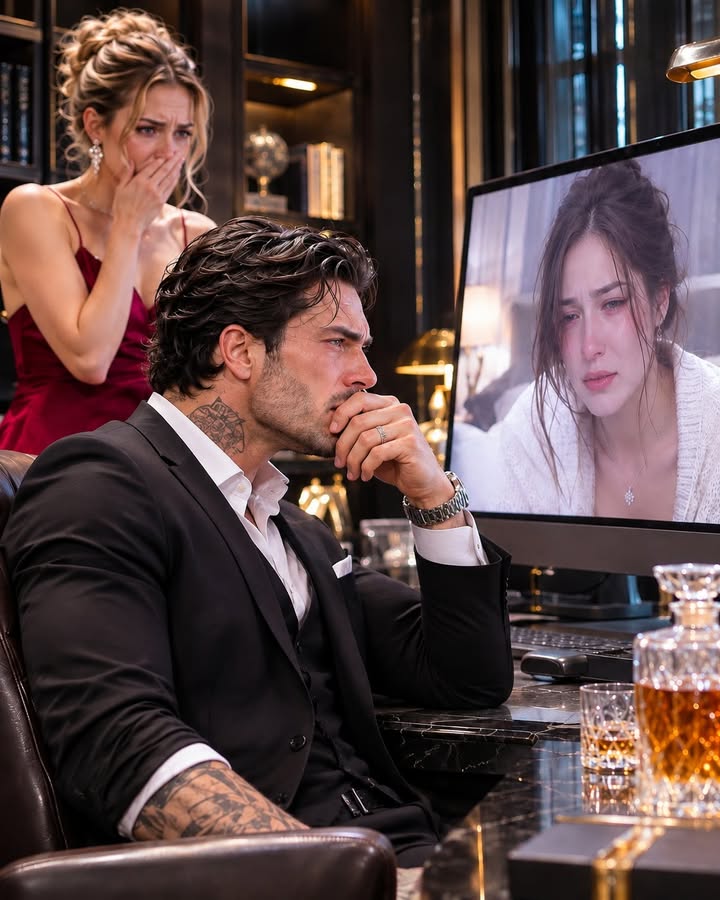
For several seconds, Alexander could not move.
My voice continued from the speakers, calm enough to make the words hurt more than if I had shouted.
“If you’re watching this, I’ve already left the house.”
He stared at the screen as though he could make me turn back by looking hard enough.
“I’m not asking you to come after me, Alexander, and I’m not asking you to fix this with money or a promise you make because you’re afraid of what people will think.”
His hand tightened around the edge of the desk.
“I need space to recover, and I need to be somewhere I can hear my own thoughts.”
The recording showed me sitting in the small room we used as a library, though the shelves behind me were mostly empty now.
I wore a simple gray sweater, and my hair was tied back without care.
There was no make-up, no jewelry, and no trace of the woman who used to spend an hour preparing for dinners she hoped he would attend.
“I’ve been depressed for three years,” I said.
“I know you’ve heard me say that, but I don’t think you ever believed me.”
Alexander’s eyes dropped.
The screen held his reflection beside my face, two versions of the same marriage occupying the room at once.
“I thought if I could explain it better, if I could find the right words, you might understand that I wasn’t trying to punish you.”
I swallowed in the recording, my gaze lowering briefly to my hands.
“When I called you at night, I wasn’t asking you to make everything disappear.”
“I was asking you to stay on the phone long enough for me to remember that I wasn’t alone.”
The faint buzz of the computer filled the pauses between my sentences.
Alexander remembered the calls.
He remembered seeing my name light up his phone during late meetings and feeling irritation rise before he answered.
He remembered telling himself that I was upset because he had missed dinner, or because he had been seen with a colleague, or because she had worn too much perfume.
He had built explanations around me until he no longer had to listen to what I was actually saying.
On the screen, I drew a slow breath.
“There were nights when I sat on the floor beside our bed because the room felt too large, and I didn’t know how to make myself feel safe in it.”
“I’d call you, and you’d tell me you were busy.”
“Sometimes you said I was pretending to be sick.”
The muscles in Alexander’s jaw shifted.
The memory came back in his own voice, sharp and impatient, spoken from a hotel lobby while he watched a group of investors leave.
Claire had been crying.
He had asked if she could call her therapist instead, then hung up before she answered.
At the time, he had considered it a reasonable solution.
Now, hearing the silence after my remembered words, he understood that a suggestion was not the same as staying.
“I stopped calling because I couldn’t bear to hear you sound tired of me,” I said.
“That didn’t mean I got better.”
For the first time since the recording began, Alexander leaned toward the screen.
His expression had changed from disbelief to something more difficult, something that looked almost like fear.
The fear was not for his marriage or his public image.
It was the dawning awareness that I had been in pain close enough for him to touch, and he had mistaken it for an inconvenience.
“I want you to know that I did try to get help,” I continued.
“I saw a doctor before the accident.”
“I went even when I was ashamed, even when I couldn’t explain why making breakfast or answering an email felt impossible.”
“I didn’t tell you because I had learned that telling you made me feel worse.”
Alexander closed his eyes.
When he opened them again, the recording had moved to the day of the hospital visit.
“I remember you asking why I hadn’t called you after the accident.”
“I remember thinking it was strange that you seemed hurt by my answer.”
My face was composed, but there was a tiredness in it that he had never allowed himself to notice.
“I didn’t call because I didn’t know what would happen if I needed you and you weren’t there.”
The room seemed to contract around him.
He could still see the hospital’s pale walls, the plastic cup of water beside my bed, the white bandage at my temple.
He remembered his own words about the meetings he had canceled.
He remembered Sophia standing behind him in his jacket, and the keys he had set on the bedside table as if they could settle the matter.
“I thought the studio would make you happy,” he whispered to the empty room.
The recording could not hear him.
I looked down at my hands.
“Thank you for the keys,” I said.
“But a gift can’t answer the question I was trying to ask.”
Alexander’s face went still.
“What question?” he murmured.
The recording gave him no answer immediately.
My eyes lifted again, meeting the camera.
“Could I count on you when I was hurting?”
The question remained between us.
Alexander drew back from the desk, one hand covering his mouth.
He had spent years believing that providing for me was a form of care no reasonable person could dispute.
The house was warm.
The bills were paid.
My clothes were chosen from the best designers.
The doctors, when I asked, had been available.
He had thought that was the same as being present.
“I know you may have your own version of what happened,” I said.
“You may remember how busy you were, or how often I seemed upset, or all the times you tried to make things nicer.”
“I’m not asking you to erase those memories.”
“I’m telling you that I can’t keep living inside the version of our marriage where my pain only mattered when it became visible to someone else.”
He stood abruptly and walked toward the window.
Outside, Chicago was a scatter of lights beneath a low ceiling of clouds.
The mansion behind him remained dark, its rooms empty in a way that made the silence feel deliberate.
He turned back when he heard my voice resume.
“I kept thinking that if I could become easier to love, you might choose me without being reminded.”
A pause followed.
Then I gave a small, rueful smile that did not reach my eyes.
“That was unfair to both of us, especially to me.”
Alexander sat down slowly.
The version of me on the screen was not accusing him.
That almost made it worse.
She was speaking with the quiet steadiness of someone who had stopped expecting to be understood and had decided to tell the truth anyway.
“There’s something else I need you to know,” I said.
He held his breath.
“I filed for divorce.”
The words were plain, with no dramatic emphasis.
Alexander stared as if the room had tilted.
The filing date appeared on the screen for a moment, followed by a shot of the sealed envelope from my attorney’s office.
He had assumed the note and the empty closet meant I was angry.
He had thought I wanted him to come after me, to plead, to promise that things would change.
But my decision had been made quietly, with counsel, before he returned from the hospital.
“I’ve also arranged a place to stay while I begin treatment,” I continued.
“It’s private, and I won’t be sharing the address.”
“I know you may want to find me, but please don’t.”
The request was gentle.
The boundary inside it was unmistakable.
“I’m not trying to punish you, and I’m not asking you to chase me.”
“I need to have a life that isn’t organized around waiting for you to come home.”
Alexander lowered his gaze.
The word treatment struck him with a force the word divorce had not.
He had known I was depressed because I had told him.
He had known there were doctors because he had seen appointment reminders on the household calendar.
But he had treated both facts as things that would resolve themselves if he gave them enough time.
“Why didn’t you tell me you were leaving?” he asked, though his own voice sounded like it belonged to someone else.
My recorded self tilted her head slightly.
“I am telling you now.”
He had no answer.
The recording continued.
“I’ve asked my lawyer to communicate with you about the divorce.”
“Please respect that.”
“If there are practical things we need to discuss, we can discuss them through her for now.”
“I can’t have a conversation with you while I’m still hoping you’ll say the one thing that would make me stay.”
The confession changed his face.
He had never considered that my hope might have been part of the harm.
He had thought hope was a gift he could count on, an endless reserve that would survive his neglect.
“I don’t know what the future will look like,” I said.
“I’m not asking you to decide anything tonight.”
“I’m asking you to let me go somewhere safe enough to begin feeling like myself again.”
The video paused briefly, and the screen went black.
Alexander sat motionless.
Then a new image appeared.
It showed the library again, only from another angle.
The camera was lower, as if I had set it on a shelf.
I was no longer seated in the chair.
Instead, I stood beside a narrow cabinet, holding a small object close to my chest.
Alexander leaned toward the screen.
The object was a sketchbook.
Its faded blue cover had a worn corner and a strip of pale tape across the spine.
He recognized it.
Or rather, he recognized the shape of a small book he had once seen in the back of the closet, half-hidden behind a stack of storage boxes.
He had assumed it belonged to one of the housekeepers.
“I used to draw when I couldn’t sleep,” I said.
“I don’t know if I was any good.”
“Sometimes I drew things I couldn’t say out loud.”
A small, private smile touched my face.
“I kept this one hidden because I thought the drawings were too sad for anyone else to see.”
Alexander looked toward the empty doorway, as if the book might still be somewhere in the room.
“I didn’t know,” he whispered.
On the screen, I opened the sketchbook.
The first pages were filled with charcoal studies of ordinary things: the curve of a teacup, a lamp on a bedside table, the orchids on the conservatory sill.
Then the drawings grew darker.
A woman sat at the end of a long table, her face turned toward an empty chair.
A window was filled with rain.
A bedroom door stood open onto a hallway that seemed to stretch too far to reach the other side.
There was one picture of a hand holding a phone, the screen bright in an otherwise black room.
Alexander’s breath caught.
“I made these during the worst months,” I said.
“I drew because sometimes it was the only thing I could finish.”
“I could hold the pencil even when I couldn’t make myself answer messages or get dressed.”
The next page showed a small figure standing beneath an enormous house.
The roof looked like a dark, unbroken line.
There was no light in any of its windows.
“I never showed you,” I continued.
“I thought you might say I was being dramatic.”
Alexander stared at the image.
He had bought the house.
He had paid for the conservatory, the art supplies, the studio he had offered in the hospital.
Yet the one place where I had tried to show him what was happening had been hidden in a book he had never thought to open.
“I thought about leaving it behind,” I said.
“But I took it with me.”
“I don’t want to keep every painful thing as proof of what happened.”
“I just don’t want to forget that I made something, even when I felt like I was disappearing.”
She closed the sketchbook carefully.
“I hope, one day, I can draw things that aren’t only about being afraid.”
For several seconds, the recording showed nothing but my hands resting on the worn cover.
Then I looked directly at the camera.
“I’m going to try to get better, Alexander.”
“I hope you do, too.”
There was no promise to return.
There was no invitation to rescue me.
There was not even an accusation he could answer.
I reached forward, and the screen went dark.
The silence afterward was so complete that Alexander could hear the faint ticking of the antique clock in the hall.
He remained at the desk until the computer screen dimmed.
Then he replayed the final section.
The sketchbook appeared again.
The empty chair.
The rain.
The phone in the dark.
He thought of all the nights I had called and all the times he had watched my name light up his screen.
He remembered the first year of our marriage, when I would leave drawings on his desk because I was shy about asking him to look at them.
He had once complimented a charcoal portrait of the lake.
He had promised to frame it.
Then a deal had closed, a dinner had run late, and the drawing had disappeared beneath a stack of contracts.
He had never asked where it went.
At some point, he had stopped noticing when I stopped leaving them.
Alexander rose and walked to the closet.
His shoes clicked across the polished floor, the sound unnaturally loud in the dark house.
The left side was bare.
A few wooden hangers remained, spaced apart like markers for what was missing.
He crouched and opened the storage cabinet built into the wall.
Inside were blankets, a box of old photographs, and a stack of household manuals.
He lifted each one aside, though he already knew the sketchbook was not there.
The closet had been cleared carefully.
Not in anger.
Not in haste.
I had taken what mattered to me and left everything that represented what he had spent years giving instead of what I had needed.
From downstairs came a faint sound.
Alexander straightened and listened.
A door had closed somewhere near the entrance.
He hurried down the stairs, but when he reached the foyer, the front doors were still locked.
The house was empty.
The orchid Sophia had carried in was on the hall table, its pale petals trembling slightly in the draft from the heating vent.
Alexander stood over it, remembering the care I had given the plant.
He had brought Sophia home with it because she had been admiring it in the office conservatory, and he had assumed I would be pleased to see someone else enjoy it.
The realization settled into him with the same quiet force as the recording.
He had not even noticed that I had spent years keeping it alive.
His phone buzzed in his pocket.
For one foolish second, he thought it might be me.
It was a message from his assistant asking whether the morning meetings should be moved.
He typed, “Cancel everything,” then deleted the words.
He had no right to turn his sudden guilt into another demand on other people.
Instead, he wrote that he would confirm the schedule in the morning and put the phone away.
He returned to the study and opened the file attached to the email from my attorney.
The subject line read: “Notice of Representation.”
The message was brief and professional.
It confirmed that I had retained counsel and that any communication regarding the divorce should go through the office.
There was no address.
There was no request for a response.
There was a single sentence asking him to respect my privacy while I began treatment.
Alexander read it twice.
Then, because he did not know what else to do, he wrote a message to me.
“Claire, I watched the recording.”
He paused.
He typed, “Please tell me where you are so I can make sure you’re safe.”
He stared at the sentence, then erased it.
I had already told him I was safe.
I had also told him not to find me.
He tried again.
“I’m sorry I didn’t understand.”
The words looked too small, too convenient, as though he were trying to close a wound with a sentence.
He erased that too.
For a moment, the cursor blinked in the empty message box.
He realized he did not know how to write to me without asking for something.
He did not know how to offer care without expecting the answer to reassure him.
So he shut the laptop.
The house remained dark around him.
He did not turn on the lights.
At the desk, the USB drive still rested beside the computer, its tiny metal edge catching a thin line of moonlight.
Alexander looked at it again and wondered whether there was more on it.
He clicked through the files.
There were only two video clips, the one he had watched and a shorter one he had not noticed at first.
It was labeled simply: “For later.”
His hand hovered over the trackpad.
The second clip opened on a close view of the desk.
For a moment, the camera showed only a blank sheet of paper and the edge of a pencil.
Then my voice came from somewhere off-screen.
“I almost forgot to tell you something.”
Alexander moved closer.
“I don’t know whether I should leave the sketchbook with the rest of my things or ask my lawyer to send it later.”
A pause followed.
The image shifted slightly, revealing one page of the book.
A drawing of the mansion’s long corridor filled the screen.
At the far end, a door stood open.
Inside the dark room beyond it, a small figure sat at a desk, holding a phone.
“I used to think you would find it,” I said quietly.
“Not because I wanted you to feel guilty.”
“I think I just wanted you to notice that I was still here.”
The recording ended before he could answer.
Alexander stayed frozen, the image of the open doorway reflected in his eyes.
Then he looked toward the empty closet once more and understood that the sketchbook was not merely something I had packed.
It was the first proof that I had been leaving him messages long before the letter, the USB, and the night he finally learned to listen.
**–END OF PART 2–CLICK “NEXT” AT THE BOTTOM OF THE PAGE TO CONTINUE READING**
* * *
[NEXT: PART 3](https://puretales.idolsgift.com/blog/part-3-the-sketchbook-he-never-saw-035)
✓ Lynn R. Adams
Part 2 – The Sketchbook He Never Saw For several seconds, Alexander could not move. My voice continued from the speakers, calm enough to make the words hurt more than if I had shouted. “If you’re w…