PART 2: The Six Words That Stopped the Palace 058
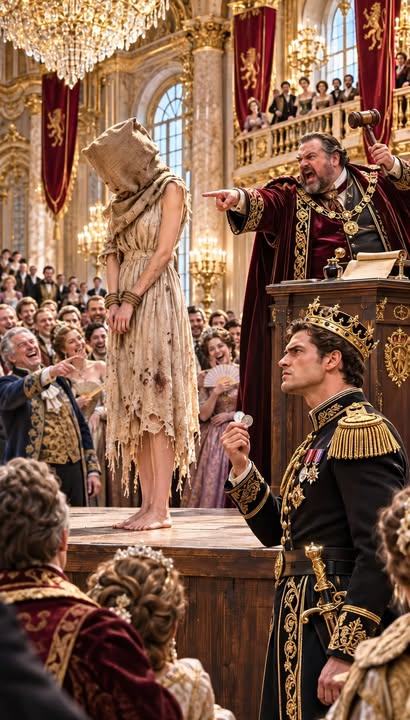
Part 2 – The Six Words That Stopped the Palace
“Seal the doors,” Caleb ordered.
His voice carried through the Grand Hall without rising, yet every guard moved at once.
The great doors swung shut, their iron bolts sliding home with a sound that silenced even the restless nobles.
Lord Garrick’s hand remained near the sword beneath his cloak.
“Your Highness, this is an auction, not a private audience,” he said. “The court has a right to witness the conclusion.”
“The auction is concluded,” Caleb replied.
He stood between Garrick and Josephine, not as a purchaser guarding his prize, but as a man trying to keep every gaze in the room from becoming another hand reaching for her.
“The marriage decree has been signed,” Garrick continued. “The bride must be presented—”
“She will not be presented to anyone.”
A murmur moved through the hall.
Caleb turned to the nearest guards.
“Escort the king’s guests to the adjoining gallery. No one leaves the palace until I speak with my father.”
It was an order, but he gave it without spectacle, and the nobles obeyed with the uneasy dignity of people who had just realized they were no longer in control of the room.
Garrick did not move.
“Your Highness, I must insist—”
“You may insist from the gallery.”
For one long moment, the two men held each other’s gaze.
Then Garrick bowed, stiff and shallow, and followed the court from the hall.
Caleb waited until the last noble had passed through the side doors.
Only then did he turn toward Josephine.
The hood still covered her face, the rough cloth hanging nearly to her waist.
Her wrists remained bound.
“I’m going to ask the guards to untie you,” he said. “You may refuse if you prefer.”
She did not answer.
Caleb glanced at the nearest guard.
“Bring a key, and leave it in my hand.”
The guard obeyed, then withdrew several paces.
Caleb held out the key, keeping his palm open and low.
“Would you like me to do it, or would you rather take the key yourself?”
Josephine’s fingers emerged from the edge of the burlap.
They shook as she reached for it, but she did not take the key.
Instead, she turned her bound wrists toward him.
Caleb released the ropes carefully, working the knot loose rather than cutting it.
The strands fell away.
Red marks circled her skin, though the binding had not drawn blood.
She rubbed one wrist with the opposite hand.
“I’m sorry,” he said.
Her covered head tilted slightly.
“For what?” she asked.
The sound of her voice struck him again, close and unmistakable.
For three years he had remembered it in fragments: the rasp of a breath, the softness beneath a frightened whisper, the cadence of a woman who had been in pain but had still tried to calm him.
“For the auction,” he said. “For allowing you to be brought into this room that way.”
“You didn’t bring me here.”
“No, but I was standing in a room where it happened.”
The answer seemed to catch her by surprise.
A door opened behind them, and the royal physician entered with a leather case in hand.
Caleb raised his palm.
“Not yet.”
The physician stopped.
“Give us a little time,” Caleb said. “Please wait outside.”
After a brief glance at Josephine, the physician withdrew and closed the door.
Caleb looked back at her.
“Those were the words you whispered to me.”
She went very still.
“Which words?”
“The six words that made me understand you knew me.”
For the first time since he had seen her on the platform, Josephine seemed to search for something in his voice.
Not comfort.
Not tenderness.
Proof.
“You remember the cave?” she asked.
“I remember a fire almost gone, snow blocking the entrance, and a woman who was trying not to pass out.”
“And you remember leaving.”
Caleb lowered his eyes.
“Yes.”
The word was barely audible.
Josephine’s covered face turned away.
Caleb did not reach for her.
He had made that mistake once already, though not with his hands.
“I need to understand what happened,” he said. “But you don’t owe me your story. You may speak freely here, leave safely if that’s what you choose, or stay under my protection until you decide what comes next.”
She gave a faint, humorless breath.
“Those sound like choices.”
“They are.”
“You’re a prince.”
“I know what I am.”
“And I’m your bride now, according to a document you signed in front of the entire court.”
“According to a document I can annul.”
“Can you?”
“I can.”
The pause that followed seemed to stretch across the empty hall.
“Then why did you sign it?” she asked.
Caleb looked toward the platform where she had stood, alone beneath the laughter.
“Because I wanted the bidding to stop.”
“You could have ordered them to stop.”
“I could have.”
“Then the two coins were unnecessary.”
“Yes.”
The admission landed between them with more weight than a polished explanation would have.
Josephine’s hands folded over her freed wrists.
“You wanted to make them look at you instead of me.”
“I wanted them to stop treating you as if you were not a person.”
“You think two coins did that?”
“No.”
She waited.
“I think I failed to do enough,” he added.
Outside, the muffled voices of the displaced nobles rose and fell beyond the side doors.
Inside, the Grand Hall seemed enormous, its chandeliers shining over a platform now empty of every ornament except a small, abandoned velvet cushion.
Josephine turned her head toward it.
“They called me a creature,” she said.
“I heard.”
“Some of them laughed.”
“I heard that too.”
“Did you feel sorry for me?”
“I felt ashamed of them.”
“That isn’t the same thing.”
“No,” he said. “It isn’t.”
She seemed to hear the difference.
When she spoke again, her voice had lost some of its guarded sharpness.
“Why were you in that cave?”
Caleb drew in a slow breath.
“An expedition was crossing the northern mountains. I was with it, along with my younger brother, Adrian. A storm came before we reached the pass.”
“Adrian was there?”
“Yes.”
The name changed the air between them.
Josephine’s shoulders tightened beneath the burlap.
Caleb noticed, but he did not ask why.
“I was separated from the main party,” he continued. “The blizzard drove me down the slope. I found the cave by following the smoke from a fire.”
He had not spoken of the cave in years.
He had spoken of the expedition, of course, but only in the spare official language his father preferred: the storm, the broken trail, the search, the losses.
He had never told anyone about the woman in the cave.
The fear in her breathing.
The brief, desperate trust between two strangers who might not live until morning.
“I was hurt,” he said. “Not badly, but badly enough that I couldn’t climb back through the snow. You were there, injured and half-conscious.”
“I remember.”
“You remember me?”
“I remember a man who kept asking if I could hear him.”
“I did?”
“You kept saying my name, though I hadn’t told you what it was.”
Caleb frowned.
“I don’t remember that.”
“Perhaps you were feverish.”
“Perhaps.”
The uncertainty unsettled him more than he expected.
In his memory, the cave had always been painfully clear: the glow of the fire, the snow hissing at the entrance, the woman’s face hidden in shadow.
But memory, he knew, could preserve a feeling while letting the details drift away.
“What happened after that?” Josephine asked.
Caleb’s jaw tightened.
“Someone came to the cave before dawn. I heard voices outside, then one of the expedition men shouted that the lower trail was still passable. I was told the camp had found a way to send help.”
“And you left.”
“I was told you had another person coming for you.”
“Who told you?”
“I don’t know.”
“You don’t know?”
“I was disoriented. The storm had kept me awake for most of the night. I believed the man was one of our party.”
“And you left me there with your brother.”
The six words settled over the hall like fresh snowfall.
Caleb’s face went still.
He had carried the outline of the cave’s ending for three years, but not those words.
Not the accusation.
Not the certainty of having failed someone he had once promised himself he would find.
“Your brother came back?” he asked.
Josephine did not answer at once.
“He came into the cave after you left.”
“Adrian?”
“Yes.”
Caleb stepped forward, then stopped himself.
“Was he hurt?”
“Badly.”
“How badly?”
“He had a cut near his temple and one arm pressed to his side. He could hardly stand.”
Caleb closed his eyes.
In the days after the storm, he had searched for Adrian until his own strength failed.
He had questioned every surviving member of the expedition.
He had ridden back along the mountain road before the snowfall cleared.
Then his father’s men had brought him home, and the official search had continued without either prince.
They had told him the last known camp was empty.
They had told him the trail was gone.
They had told him no one could have survived the storm.
“I thought he had vanished with the others,” Caleb said.
“He thought you were dead.”
“Did he tell you that?”
“He said he had seen you fall near the pass.”
Caleb opened his eyes.
“I never fell.”
“Then he was mistaken.”
“Or someone told him something false.”
Josephine made no reply.
The thought seemed to frighten both of them for different reasons.
Caleb looked at the ragged edge of her sleeve.
“How did you get out of the cave?”
“Adrian helped me.”
“Even with his injuries?”
“He had wrapped his arm in part of his cloak. He could barely keep his eyes open, but he made me walk.”
“Where did he take you?”
“Down a ravine, away from the trail. He said we shouldn’t follow the tracks we had found.”
“Why?”
“He said someone was watching the route.”
A chill spread across Caleb’s back.
“Did you see anyone?”
“No. I heard people outside the cave before you came back.”
His attention sharpened.
“What did you hear?”
“Chains.”
“Chains?”
“A metal rattle. Then men arguing.”
“What did they say?”
“I couldn’t make out all of it. One of them said the bridge was gone. Another said no one could cross before sunrise.”
Caleb looked toward the sealed doors as if the words might have followed them into the palace.
“Why didn’t you tell anyone?”
“I didn’t know who to tell.”
“You could have told the expedition leaders.”
“I had never met them.”
“You could have told the guards when you reached the capital.”
Josephine’s shoulders lifted in a guarded breath.
“Would they have listened to a woman who couldn’t give them her family name, who had been found in a mountain cave with the king’s younger son?”
“I would have listened.”
“You didn’t know I was alive.”
The plainness of it hurt more than anger would have.
Caleb lowered his gaze.
“No,” he said. “I didn’t.”
A soft knock sounded at the door.
The physician’s voice came through the wood.
“Your Highness?”
“Wait.”
Caleb looked back at Josephine.
“You said Adrian rescued you. What happened to him afterward?”
She moved one hand to the front of her dress, just below the collar.
“I don’t know what happened after he gave me this.”
Her fingers slipped beneath the fabric and drew out a thin cord.
A small brass compass rested against her palm.
Its surface was dulled and scratched, the cover bent slightly at one edge.
Caleb stared at it.
The faded crest on its lid showed a mountain crossed by a narrow silver line.
He knew that mark.
It had been stamped on every case prepared for the northern expedition.
“Where did Adrian get it?” he asked.
“He said it belonged to the expedition. He told me to keep it safe.”
“Did he say why?”
“He said it might help me prove I wasn’t lying.”
Caleb reached toward the compass, then stopped.
“May I look?”
Josephine closed her fingers around it.
For a moment, he thought she would refuse.
Then she extended her hand.
He took the compass with both care and restraint, as though it were not an object but a fragment of someone he had failed to save.
The brass felt cold in his palm.
He opened the cover.
The needle trembled, then turned north.
Under the lid, nearly hidden beneath a line of scratches, lay the same faded crest.
Caleb knew the expedition had used dozens of these.
But he remembered Adrian carrying a different compass, one with a cracked glass face and a silver chain.
“Was this the only thing he gave you?” he asked.
“Yes.”
“Did he say anything else?”
“He told me to find someone who would believe me.”
“And you came here?”
“I didn’t come here willingly.”
Caleb’s fingers tightened around the compass.
“Who brought you to the palace?”
“The men who said I had no standing in the western provinces. They said the court would decide what to do with me.”
“Garrick’s men?”
“I never saw their badges.”
The magistrate’s insistence that she be unveiled no longer seemed like an ordinary demand for an auction record.
Neither did the hand that had moved toward a hidden sword.
Caleb returned the compass to her.
Josephine tucked it beneath her dress again, keeping one hand over it.
“I’m sorry,” he said.
“You’ve already said that.”
“I’m sorry I left the cave.”
“You were sent to find help.”
“I should have taken you with me.”
“You were barely able to stand.”
“Still.”
The word carried no defense, only grief.
Josephine’s covered face angled toward him.
“Why do you think I said those six words?”
“Because you wanted me to understand that I had left you behind.”
“I wanted you to remember that it happened.”
“I do.”
“You didn’t look as if you remembered.”
“I remembered the cave. I remembered you. I didn’t remember the part that mattered most to you.”
“Or to Adrian.”
Caleb swallowed.
“Did he blame me?”
“He never said.”
“Did he tell you I was alive?”
“He said he hoped you were.”
That small mercy struck Caleb with the force of a hand against his chest.
He had spent three years wondering whether Adrian had died believing him careless, cowardly, or cruel.
Now, through the words of a woman who had survived the same night, he learned that his brother had hoped.
It was not forgiveness.
It was not even a promise.
But it was something he had not expected to receive.
The physician knocked again.
“Your Highness, the king has sent for you.”
Caleb did not answer.
Josephine’s fingers curled around the hidden compass.
“If you go, they’ll come back in here,” she said.
“Not without my permission.”
“You can’t promise what every person in this palace will do.”
“No,” Caleb said. “But I can promise what I will do.”
She was silent.
He turned toward the door.
“Keep the doors sealed. No one enters except the physician, and only if Josephine asks for him.”
The guard outside acknowledged the order.
Caleb looked back at her.
“You may remain here while I speak to my father. Or I can arrange a room with a private exit and an escort of your choosing. You decide.”
“And if I want to leave the palace entirely?”
“I’ll see you safely out.”
“You’d let me walk away?”
“Yes.”
“Even after signing the decree?”
“The decree can be undone.”
“Even after what I know?”
“Especially then.”
Her breathing softened, though the hood hid whatever answer her face might have offered.
Caleb took one step toward the door.
“Wait,” she said.
He turned.
“Do you remember anything else about that night?”
He searched the remains of his memory.
A storm.
A cave.
The thin fire.
Her hand resting near his sleeve as she tried to stay awake.
And a voice from outside, telling him help was waiting.
“I remember thinking I would come back for you,” he said.
“You never did.”
“No.”
“You never found me.”
“No.”
The truth stood between them, stark and unadorned.
Caleb could have blamed the snow, the confusion, the false directions, the search that ended too soon.
He could have spoken of the orders he had followed and the years he had spent trying to understand what happened.
But Josephine had already lived through the result of all those reasons.
“I failed you,” he said.
For the first time, she seemed to have no answer ready.
The physician appeared in the doorway, waiting for Caleb’s permission to speak.
Behind him stood a palace messenger in the king’s colors.
“His Majesty requests you at once,” the messenger said. “He has received news concerning the woman’s name.”
Caleb’s attention snapped to him.
“What news?”
The messenger glanced toward Josephine’s covered head.
“His Majesty says that no woman named Josephine Rourke appears in the official records connected to the northern expedition.”
“Then the records are incomplete.”
“Perhaps,” the messenger said carefully. “But the king also asks whether the woman possesses an expedition compass.”
Josephine’s hand flew to the cord beneath her dress.
Caleb looked from her to the messenger.
“Why would my father ask about that?”
The messenger lowered his voice.
“Because he says one of Prince Adrian’s personal effects was a matching half.”
Silence filled the sealed hall.
Josephine’s fingers closed over the compass.
Caleb felt the ground of the past shift beneath him.
“Matching half?” he repeated.
“That is what His Majesty told me.”
The messenger bowed.
“His Majesty says he wants to know where Josephine got it.”
Josephine lifted her hooded face toward Caleb.
For the first time, he heard fear in her voice that had nothing to do with the auction.
“If the king knows about the compass,” she whispered, “then someone has already told him I survived.”
**–END OF PART 2–CLICK “NEXT” AT THE BOTTOM OF THE PAGE TO CONTINUE READING**
* * *
[NEXT: PART 3](https://storyly.idolsgift.com/blog/part-3-the-six-words-that-stopped-the-palace-058)
✓ Lynn R. Adams
Part 2 – The Six Words That Stopped the Palace “Seal the doors,” Caleb ordered. His voice carried through the Grand Hall without rising, yet every guard moved at once. The great doors swung shut, t…