PART 2: The Silver Bird Beneath the Lion 069
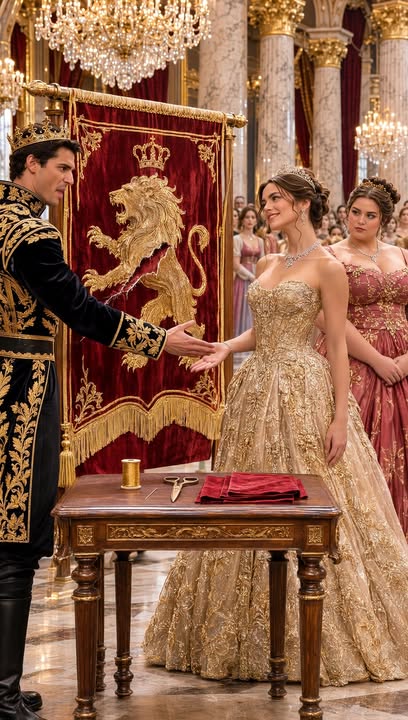
Her needle passed through the velvet patch, then through the embroidered outline of the lion’s chest.
She worked with care, not trying to pull the torn edges together but anchoring each side to the stronger cloth beneath.
The golden thread disappeared among the lion’s embroidered lines, so that the repair seemed to follow the pattern rather than fight it.
The ballroom had fallen quiet around her.
Even the contestants who had been whispering watched without a word as she made one stitch, then another, distributing the strain across the patch.
The prince stood close enough to see the small movements of her hands, but he did not interrupt.
At last, she tied off the thread and let the banner settle back into place.
For a breath, nothing happened.
Then the velvet held.
The lion’s outline was no longer broken by a widening tear, and the repaired section hung smoothly beneath the chandelier light.
A ripple of applause began somewhere near the musicians and spread through the ballroom.
The young woman lowered her hands, her fingers trembling now that the work was done.
The prince examined the repair closely.
“Does it hold?” she asked.
He pressed gently near the patch, careful not to tug.
“It does,” he said, looking from the banner to her. “And it will bear its own weight.”
The applause grew warmer.
The young woman glanced toward the first contestant, who stood a few paces away with her chin lifted and her expression carefully composed.
The prince turned to the gathered guests.
“The challenge is hers,” he announced. “The banner will hang above the throne tonight.”
Some of the noblewomen clapped with genuine admiration.
Others followed a moment later, though their smiles seemed less certain.
The first contestant’s face had regained its color, but her hands were clasped tightly before her.
She looked at the strengthened velvet, then at the woman who had repaired it.
“You made it look easy,” she said.
“It wasn’t,” the young woman replied gently. “The cloth was already tired.”
The noblewoman’s gaze flickered toward the new split she had caused.
For an instant, the practiced poise slipped, and something like embarrassment showed beneath it.
“I should have stopped pulling,” she murmured.
“You noticed the folds,” the young woman said. “You were trying to fix them.”
It was not forgiveness, exactly, but neither was it an accusation.
The noblewoman looked surprised to be met with kindness.
Before she could answer, the prince stepped closer.
“What is your name?”
“Elara, Your Highness.”
“Lady Elara?”
“Just Elara, if you please.”
A few guests traded glances at the informality, but the prince only nodded.
“Your skill deserves recognition, Elara.”
She brushed a fleck of thread from her palm.
“I’m glad the banner will hold.”
“That is not quite the same as accepting that you won.”
“I did what needed doing,” she said. “The rest is yours to decide.”
The prince studied her as though he had expected a different answer.
Then his expression softened.
“Your humility is not required by the rules of this contest.”
“Perhaps not,” Elara said, “but the banner did not care who won.”
A few people laughed, quietly and with relief.
The prince smiled, though his eyes remained thoughtful.
“Tell me how you learned to repair cloth so well.”
Elara’s smile faded at the edges.
“My mother taught me.”
“Was she a seamstress?”
“She could mend almost anything,” Elara said. “A torn sleeve, a fraying hem, a loose button. She used to say that cloth remembers where it has been strained.”
Her fingers rested lightly against the velvet patch.
“She taught me not to force a repair just because I wanted it finished quickly.”
The prince glanced at the banner again.
“That sounds like wise advice.”
“It was.”
There was a pause, small but heavy with what Elara had not said.
The prince seemed to notice.
“Is your mother still with you?”
Elara looked down at the fine golden thread caught against her fingertip.
“No,” she said. “She died several years ago.”
The prince’s voice softened.
“I’m sorry.”
“So am I.”
She did not offer more, and he did not press her.
Yet the memory had already opened inside her, as gently and as unexpectedly as a door that had not been touched in years.
Her mother’s hands came first to mind, quick and certain beneath the light of a kitchen lamp.
Mara had always kept a small sewing basket near the window, its lid worn smooth from use.
When Elara was little, she had sat on a cushion beside it, watching her mother pass thread through cloth as if she were drawing a path through a maze.
“Do I have to make the stitches invisible?” Elara had once asked, frowning over a crooked seam.
“Not always,” Mara had answered. “Sometimes a strong stitch is better than a hidden one.”
“What if people see it?”
“Then they’ll know someone cared enough to mend it.”
Elara had carried those words into the ballroom without realizing it.
The applause quieted as an attendant approached the prince, whispering that the banner must be prepared for its place above the throne before sunset.
The prince nodded, then looked back at Elara.
“Would you help the household staff mount it?”
She hesitated.
The challenge had already carried her farther into the royal court than she had expected to go.
“Only if you think I can be useful,” she said.
“I do.”
That answer seemed to surprise her more than the praise had.
The attendant and two others carefully lifted the banner from its stand.
Elara moved alongside them, watching the patched area as they carried it across the ballroom toward a set of tall doors leading to the throne room.
The crimson velvet caught the light differently where the repair lay.
It was discreet, but not invisible.
The patch made the embroidered lion’s chest slightly fuller, as though the beast had drawn a steady breath.
The prince walked beside her.
“You spoke of your mother as though she taught more than sewing.”
“She taught me to look before I decided what was broken.”
“And did she use that lesson often?”
“Whenever I was impatient,” Elara said.
“Which was often?”
“More often than I’d like to admit.”
The prince laughed, and the sound seemed to loosen some of the ceremony around them.
Behind them, Lady Celeste followed at a distance, her sparkling gown rustling softly.
Elara turned when she heard her.
“You don’t need to come,” Celeste said. “I only wanted to see whether the repair would hold while the banner was moved.”
“You’re welcome to watch,” Elara replied.
Celeste’s eyes shifted to the patch.
“I truly didn’t mean to make the tear worse.”
“I believe you.”
The words came more quickly than Elara expected.
Celeste seemed unsure what to do with them.
“I’m not asking you to pretend I did nothing,” she said.
“I’m not pretending.”
The prince looked between them but remained silent.
Celeste lowered her voice.
“My family has made this competition sound like a single opportunity, as though every moment must be won or lost. I suppose I was thinking about the clock more than the cloth.”
Elara considered her.
“Cloth is patient until it isn’t.”
“That sounds like something your mother would say.”
“It does.”
Celeste’s expression softened, though the discomfort in it remained.
“I’m sorry, Elara.”
“Thank you.”
The apology did not erase what had happened, and neither woman pretended that it did.
But Celeste did not turn away.
The group reached the throne room, where the raised seat stood beneath a carved canopy of dark oak.
The wall behind it was bare, waiting for the banner.
Two attendants climbed a short ladder to secure the hanging rings, while the prince and Elara watched from below.
“Hold the left side a little higher,” Elara called.
The attendants adjusted it.
“Now let the center settle.”
The banner unfurled above the throne.
Its crimson field brought warmth to the high-ceilinged room, and the golden lion seemed to face the gathered court with renewed strength.
The repaired chest was visible if one knew where to look, though the stitching disappeared into the gold lines.
The prince stood beside Elara, his gaze fixed on the hanging.
“People will see that patch,” he said.
“Only if they look closely.”
“Should they?”
Elara thought of her mother’s hands, and of the careful way she had hidden neither the seam nor the effort it took to make it hold.
“I don’t know,” she said. “A repair doesn’t have to be ashamed of itself.”
The prince’s eyes moved toward her.
“And if someone asks who made it?”
“Then you can tell them.”
He studied her for a moment.
“You really have no interest in taking credit?”
“I have interest in the banner staying where it belongs.”
“Those are not the same thing.”
“No,” Elara agreed. “But I can care about one without wanting the other.”
The prince looked up at the lion.
“I wish more people in this competition understood that.”
Elara turned toward him.
“Do you?”
He gave a small, rueful smile.
“I’m beginning to wonder whether the competition asks people to be partners by teaching them to compete.”
The admission seemed to surprise even him.
Behind them, Celeste had gone quiet.
“Perhaps people can learn to do both,” Elara said. “If they are allowed to stop and listen.”
The prince did not answer at once.
A steward entered the room with a roll of documents tucked beneath one arm, followed by an older man in a plain blue coat.
The newcomer carried himself with the deliberate caution of someone accustomed to handling fragile things.
“Your Highness,” the steward said, “the archive has sent Mr. Vale to verify the banner’s mounting record.”
The archivist gave a brief bow.
His attention went first to the banner, then to the repair.
When he saw Elara, he paused.
“I beg your pardon,” he said. “Did you make that stitch?”
“I did.”
He came closer, but stopped several paces away rather than reaching for the cloth.
“An unusual method,” he said. “A sensible one.”
“Thank you.”
The archivist’s gaze lingered on the lion’s chest.
“May I ask who taught you?”
“My mother.”
“What was her name?”
“Mara.”
The older man’s expression changed so slightly that Elara might have missed it if she had not been watching him.
His brows drew together.
“Mara,” he repeated. “Did she work in the palace?”
Elara felt the warmth of the room fade around her.
“My mother never told me much about the palace.”
The prince looked from the archivist to Elara.
“Do you know her?” he asked.
“I may know of her,” Mr. Vale said. “There are old work records in the archive, and the royal sewing rooms kept their own marks on finished pieces.”
Elara stared at him.
“My mother never said she worked here.”
“Some craftspeople preferred not to speak about their years at court,” the archivist said carefully. “And some records are incomplete.”
The prince’s expression became more intent.
“What kind of mark?”
“A maker’s sign, usually tucked into the lining of a larger piece. A small emblem. Sometimes a flower, sometimes an initial.”
The archivist glanced at the banner again.
“Could I examine the underside?”
Elara looked toward the prince.
He nodded.
“With care.”
The attendants lowered one edge of the banner just enough for the archivist to look along its lining.
He did not touch the new patch.
Instead, he followed the seam with his eyes, moving slowly from the lion’s shoulder toward the edge.
Then he stopped.
“There,” he said.
Elara stepped closer.
Beneath the lining, almost hidden by a fold of crimson velvet, was a tiny silver bird.
Its wings were drawn in a few delicate strokes, and its beak pointed toward the lion’s heart.
Elara forgot to breathe.
She had seen that little bird before, stamped into the wooden lid of her mother’s sewing box.
As a child, she had thought it was a decoration.
Her mother had once traced it with her thumb and said, “That belongs to someone I used to be.”
Then she had closed the box and never explained.
The archivist glanced at Elara.
“Have you seen this mark?”
She could barely make her voice work.
“It was on my mother’s sewing box.”
The prince looked at the tiny emblem, then at her.
“Your mother’s mark,” he said.
Elara reached out, stopping just short of the cloth.
She had thought her mother’s past was a room with its door shut.
Now, beneath the banner she had just repaired, the smallest of its secrets had appeared.
“Why would she leave it here?” she whispered.
The archivist’s face had grown grave.
“I don’t know,” he said. “But if this is Mara’s mark, the archive may hold the reason she left the palace—and the record of what happened before she did.”
**–END OF PART 2–CLICK “NEXT” AT THE BOTTOM OF THE PAGE TO CONTINUE READING**
* * *
[NEXT: PART 3](https://storyly.idolsgift.com/blog/part-3-the-silver-bird-beneath-the-lion-069)
✓ Lynn R. Adams
Her needle passed through the velvet patch, then through the embroidered outline of the lion’s chest. She worked with care, not trying to pull the torn edges together but anchoring each side to the s…