PART 2: The Secret in the Shape of Glass 069
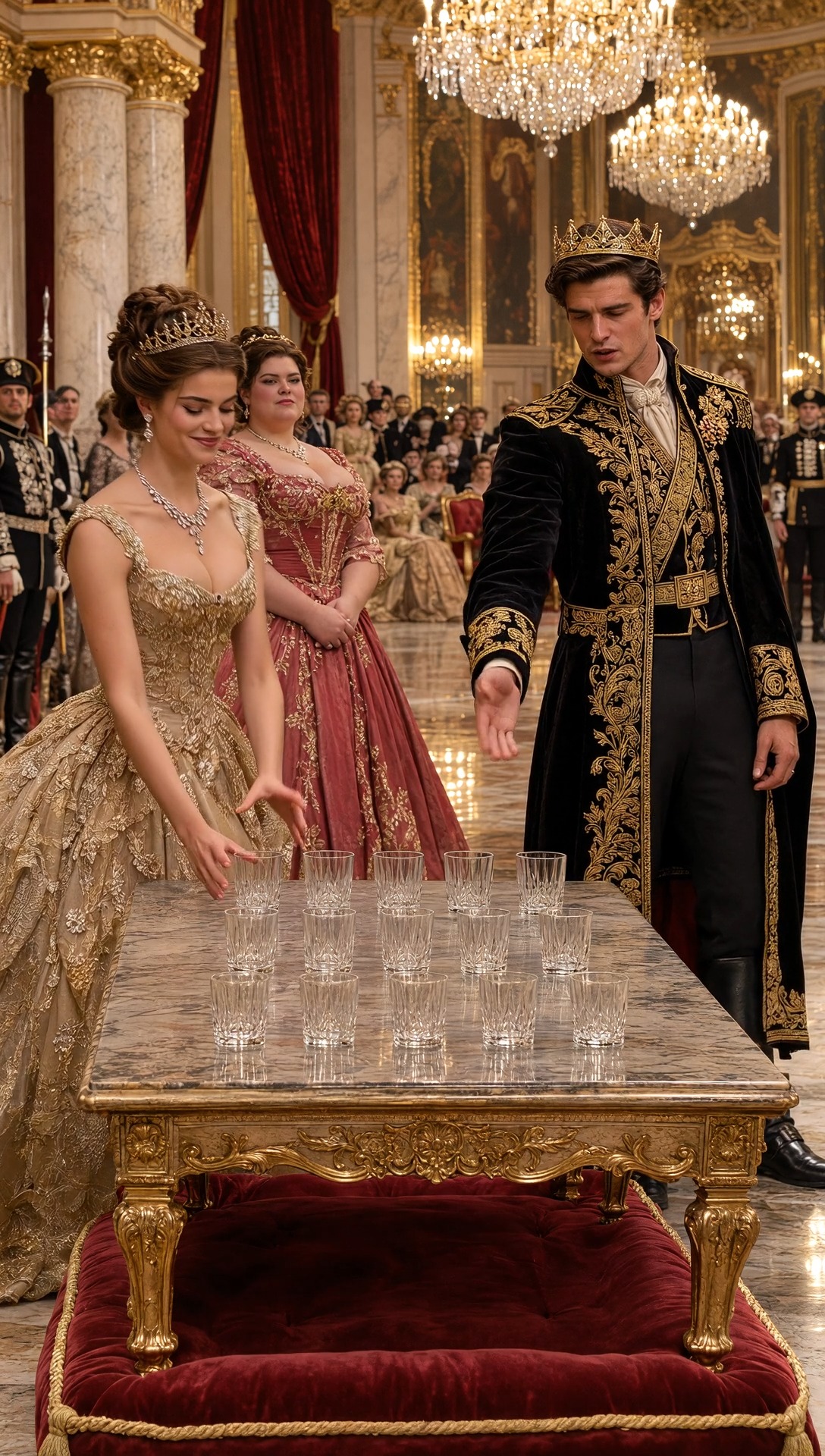
The second glass touched the marble with a soft, clear note.
Emma set it on its side beside the first, their rims facing inward, and nudged them apart until they rested evenly beneath the curve of the table’s marked boundary.
For a moment, nothing happened.
Then she lifted a third glass and laid it carefully across the two rims, creating a low bridge.
The ballroom remained so quiet that the faint hiss of the candles seemed loud.
Victoria folded her arms, though her gaze had fixed on Emma’s hands.
“You’re not building a tower,” she said.
“I am,” Emma answered, without looking up.
“That is barely higher than the table.”
“It is only the beginning.”
Emma reached for a fourth glass, turning it slowly in the candlelight before setting it on its side beside the first pair.
She studied the space between the glasses, then made a small adjustment with one fingertip.
The bridge trembled, sending a ripple through the watching crowd.
Alexander stepped nearer, but did not cross the boundary around the table.
“Would you like more time?” he asked.
“I would like everyone to give the glasses a little room,” Emma replied.
The prince lifted a hand.
The nearest courtiers withdrew, and the hush around the table grew wider.
Emma placed the fifth glass across the new supports.
The sound was delicate, almost musical.
When the glass settled, she let out a breath she had been holding.
She did not smile yet.
Instead, she leaned closer, examining how the weight traveled from the bridge to the glass rims beneath it.
Her concentration seemed to draw the room toward her.
The aristocrats who had laughed earlier now watched in silence, some with their mouths slightly open.
Emma moved the sixth glass into place, then the seventh, building another low arch beside the first.
Each glass had a purpose.
Some rested on their sides as supports, their rims turned toward one another.
Others crossed those supports, forming a broad, level surface.
The arrangement spread outward before it rose.
Victoria’s eyes narrowed.
“You’re using the rims as anchors,” she said.
Emma glanced at her, surprised by the observation.
“I’m letting them share the weight.”
“And if one shifts?”
“Then the others will feel it,” Emma replied. “That is why I’m watching all of them.”
Alexander followed the developing structure with careful attention.
“You’re building from the outside in,” he said.
“I’m building from what can hold.”
He studied her face, as though the words meant more than the tower.
Emma lowered another glass.
This time, the rim met the supports with a tiny click.
The structure quivered.
She lifted her hands at once and waited.
One heartbeat passed.
Then another.
The glasses stilled.
Only then did Emma continue.
She worked slowly, never rushing to add height for the sake of impressing anyone.
When a glass did not sit properly, she lifted it away and turned it a fraction before trying again.
The patience in her movements was not timidness.
It was confidence earned through attention.
Alexander recognized the difference.
“Where did you learn to judge a balance so precisely?” he asked.
Emma’s fingers paused over the next glass.
For a moment, the ballroom disappeared from her expression.
“I learned at home,” she said.
Her voice had softened, and she looked down at the crystal as if it might answer for her.
“My father was a glassmaker.”
A quiet murmur traveled across the room.
Victoria’s folded arms loosened.
Emma placed the glass she was holding on the table without adding it to the structure.
“He had a little workshop in our village,” she continued. “It was always warm, even in winter, and it smelled of ash, sand, and the herbs he kept by the door.”
Her mouth curved, not quite into a smile.
“He used to say that glass looked delicate because people mistook delicacy for weakness.”
Alexander listened without interrupting.
“He taught me to watch how a vessel carried its weight,” Emma said. “Where its base touched the table. How its rim could support something else, if you understood its shape.”
She glanced at the arch she had made.
“He also taught me never to waste what could serve another purpose.”
The words settled over the room more deeply than the ballroom’s polished splendor.
Emma reached for the glass again.
“My father made ordinary cups,” she said. “Bowls, bottles, little panes for cottage windows. Things people used every day.”
“And you practiced with them?” Alexander asked.
“I did.”
“Not with crystal?”
“No.” Emma’s fingers traced the smooth edge of the glass. “We didn’t own crystal.”
A faint flush rose in her cheeks, but she did not look away.
“Some of the cups were chipped, and some were so old that their bottoms were uneven. My father said those were the best ones to learn from. They made you pay attention.”
For the first time, Alexander’s formal expression eased.
He looked at the careful framework Emma had raised across the table, then at her hands.
“You’ve been paying attention for a long time,” he said.
It was not a grand compliment.
That made it feel true.
Emma lowered her eyes, and a small, unexpected warmth touched her face.
Victoria looked from one to the other, her expression guarded but no longer scornful.
“Your father must have been very skilled,” she said.
“He was,” Emma replied. “And patient.”
The word seemed to carry its own ache.
She turned back to the glasses before anyone could ask more.
The structure now covered much of the marked area, a broad, low arch supported by pairs of glasses on their sides.
It was still far from the required height, but it looked less like a precarious pile and more like a design unfolding from a careful plan.
Emma added another row of supports.
Then she laid a glass across them.
The arch widened.
The spectators leaned forward as one.
A courtier near the back whispered that it could not possibly stand.
The royal judge silenced him with a glance.
Emma did not react.
She had learned that the loudest voices were not always the ones that mattered.
She picked up the next glass and examined its rim.
A small mark, barely visible beneath the candlelight, curved along the edge.
She turned the glass once in her hand.
Then she set it into place.
Alexander saw the pause.
“Is something wrong?” he asked.
“No,” Emma said. “It’s only a mark.”
“What kind of mark?”
“I can’t tell from here.”
The prince leaned slightly, but the glass was already nestled among the others.
“Perhaps after the challenge,” he said.
Emma nodded, though her gaze lingered a moment longer than it needed to.
She continued.
The first level of the structure was now complete, spreading in a wide, stable line across the tabletop.
The second level began above it.
Emma placed two glasses on their sides near the center, their rims facing inward, then carefully laid another glass across them.
The upper arch was narrower than the base.
As she added more pieces, the design rose in measured steps, each level smaller than the one beneath.
The arrangement was not perfectly symmetrical.
It did not need to be.
Emma adjusted each support according to the small differences between the glasses.
The crystal caught the chandelier light in pale gold and rose-colored reflections, echoing the gown she wore.
Alexander watched the structure with increasing admiration.
He had expected skill to appear as speed, or confidence to arrive with a flourish.
Emma showed neither.
She offered attention, one quiet choice at a time.
“What happens if a glass is slightly different from the others?” he asked.
“Then pretending they are identical won’t help,” she replied.
A few guests smiled at the answer.
Emma glanced up and found Alexander watching her, not the tower.
For a breath, the formal distance between them seemed to lessen.
Then a glass shifted beneath her fingers.
She steadied it without pressing down.
“Don’t force it,” she whispered, more to herself than to the room.
She waited until the delicate vibration passed.
The glass settled against its neighbors.
The tension in the ballroom loosened by a fraction.
Victoria came closer to the edge of the watching circle.
“You could make it taller faster if you placed them upright,” she said.
“Perhaps,” Emma answered.
“But the narrow base would bear all the weight.”
“Yes.”
Emma reached for another glass.
“I already tried that,” Victoria said, then looked toward the fallen glasses beneath the cushion. “I thought height would persuade everyone.”
“It persuaded everyone to watch,” Emma said gently. “That isn’t the same as holding.”
Victoria’s face tightened, but the old sharpness did not return.
She followed Emma’s hands as another level took shape.
“My mistake was deciding what the tower should look like before I understood what it needed,” she said.
Emma looked up.
“That is an easy mistake to make.”
Victoria seemed to study her, searching for mockery and finding none.
“You’re not angry with me?”
“I am,” Emma said honestly. “But I don’t need to be cruel to prove it.”
Victoria’s gaze dropped to the table.
For a moment, neither woman spoke.
The words made the room feel smaller, more human, than the great chandeliers and painted ceilings had ever managed.
Emma reached for the next glass.
Her movements had begun to slow, but her hands remained steady.
The third level rose above the wide foundation.
At its center, she placed two supporting glasses on their sides, carefully balancing the rims inward.
The glass that crossed them rested almost level.
“Why not place the supports closer together?” Alexander asked.
“Because then the glass above would bear too much weight at its center,” Emma explained. “A wider span shares it.”
“And the lower arch?”
“It carries the upper level, and the table carries the lower one.”
She looked at him, catching a flicker of understanding in his expression.
“Nothing stands alone.”
Alexander’s face changed.
The words seemed to reach somewhere beyond the task.
He glanced around the ballroom, where the royal family and the gathered nobles stood beneath a ceiling painted with victories and crowns.
“Perhaps that is something a court should remember,” he said.
Victoria lowered her eyes.
Emma could not tell whether the remark was about the contest, the kingdom, or something Alexander had not meant to reveal.
She returned her attention to the crystal.
The fourth level came next.
She chose each glass with care, turning it until its rim met the supports in precisely the right place.
Her hands bore none of the clumsiness Victoria had predicted.
They were strong, and they were careful.
When the tower swayed, Emma did not grab at it.
She waited, watched, and made only the smallest adjustment.
At last, she lifted the fifteenth glass.
The final one.
The entire ballroom seemed to lean toward her.
Emma held it beneath the warm light, her eyes following its curve.
There, on the rim, the tiny maker’s mark caught the glow again.
Her breath faltered.
For an instant, she was no longer standing beside a royal table.
She was in her father’s workshop, years earlier, watching his hands turn a finished vessel in the sun.
He had shown her a small crystal fragment then, no larger than a fingernail, wrapped in a square of blue cloth.
“This mark belonged to a design I made,” he had told her. “If you ever see it on a finished piece, remember that the shape has a story.”
Emma had been too young to understand why he sounded sad.
She remembered asking whether the mark meant he had made the glass.
Her father had been quiet before answering.
“It means the idea began with me.”
“Is this one of your designs?” Alexander asked.
Emma blinked, returning to the ballroom.
“I don’t know,” she said.
She turned the glass in her fingers, but the tiny mark blurred beneath the reflection of the chandeliers.
The memory pressed at her.
Her father had kept the fragment all those years, even after the workshop closed.
She had never known why he treasured it.
“Perhaps it is nothing,” she murmured.
But she did not sound convinced.
Victoria had heard her.
“What did you see?” she asked.
“Only a maker’s mark.”
“Whose?”
“I can’t read it clearly.”
Emma looked toward the last opening in the structure.
The final glass belonged above the fourth level, where two carefully placed supports waited for it.
She lowered it slowly.
The rim touched one support.
Then the other.
She withdrew her hand.
The tower trembled.
The entire room seemed to hold its breath.
A faint movement passed through the upper levels, a delicate ripple of light and crystal.
Emma kept her hands at her sides.
One second passed.
Two.
The top glass steadied.
Three.
Four.
The wide base remained firm against the marble.
Five.
No one spoke.
Six.
Seven.
Alexander stood perfectly still.
Eight.
Victoria’s lips parted.
Nine.
Ten.
The royal judge raised his hand.
“The tower has held for ten seconds.”
The room erupted in applause.
It came first from the far side of the ballroom, hesitant and surprised.
Then the sound swelled, filling the high-ceilinged space until the chandeliers seemed to tremble with it.
Emma stared at the structure, almost unable to believe that all fifteen glasses were still standing.
Her eyes shone.
She had not built the tallest thing in the room.
She had built something that held.
Alexander approached the table, stopping at a respectful distance from the marked area.
“You did it,” he said.
Emma turned toward him, still catching her breath.
“I did.”
The pride in her voice was quiet, but it belonged entirely to her.
Alexander offered his hand, then seemed to reconsider and lowered it, leaving the choice to her.
Emma noticed.
She smiled, small but genuine, and inclined her head.
“Thank you for giving me the chance.”
“I’m beginning to think the chance was the least important part.”
The applause softened into a steady murmur.
Victoria stepped beside the table.
Her gaze moved over the arch, from its broad base to the narrow upper levels.
Then it settled on Emma.
“I was wrong about your hands,” she said.
“You were wrong about what they could do,” Emma replied.
Victoria accepted the distinction without protest.
The royal judge began to speak with the prince, while several guests crowded forward to admire the construction.
Emma did not move closer to them.
She could feel the memory of her father’s workshop following her, and the small mark on the final glass would not leave her thoughts.
Alexander noticed her expression.
“Are you certain you’re all right?”
“I’m all right,” she said. “I just want to look at that last glass again.”
The prince glanced toward the delicate tower.
“We should let the judge record the result before anyone touches it.”
“Of course.”
Victoria’s attention remained on the glass.
“After that,” she said, “may I inspect the rim?”
Emma looked at her in surprise.
“Why?”
Victoria hesitated.
“I thought I recognized something.”
The words were quiet, nearly lost beneath the ballroom’s applause.
Emma felt the warmth of triumph give way to a sharper curiosity.
She turned toward the final glass, where the tiny mark gleamed beneath the chandeliers.
And for the first time since the challenge began, Victoria’s face held no mockery at all.
**–END OF PART 2–CLICK “NEXT” AT THE BOTTOM OF THE PAGE TO CONTINUE READING**
* * *
[NEXT: PART 3](https://storyly.idolsgift.com/blog/part-3-the-secret-in-the-shape-of-glass-069)
✓ Lynn R. Adams
The second glass touched the marble with a soft, clear note. Emma set it on its side beside the first, their rims facing inward, and nudged them apart until they rested evenly beneath the curve of th…