PART 2: The Secret He Had Never Told 057
Part 2 – The Secret He Had Never Told
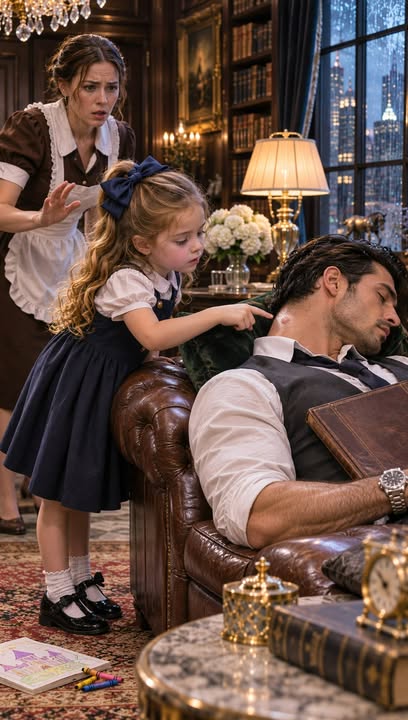
Dante’s fingers stopped just short of the small, hard bump beneath his hair.
For a moment, nobody moved.
Then he released Sophie’s wrist.
“Forgive me,” he said, his voice low and unsteady.
Sophie slipped behind my legs, clutching my skirt with both hands.
I gathered her close, though my own arms felt weak.
“Are you hurt?” I whispered.
She shook her head, staring at Dante over my shoulder.
He sat up slowly, one hand still hovering near the back of his neck.
The ledger slid from his chest and landed on the rug with a soft thud.
“I didn’t mean to frighten her,” he said.
The words seemed to surprise him as much as they surprised me.
I had heard Dante speak to guards, business partners, and visitors, but never with such uncertainty.
“She’s five,” I said, keeping my voice calm. “She doesn’t understand why everyone is afraid of that spot.”
His gaze lowered.
“Neither do I,” he answered.
Rain tapped the high windows, filling the silence that followed.
Dante looked at the narrow space between my hands and Sophie’s small shoulders.
“May I speak with her?” he asked.
I studied his face, searching for anger or impatience.
What I saw instead was a man trying very hard not to let his fear become someone else’s.
“If she wants to,” I said.
Dante leaned forward, but kept his distance.
“Sophie, can you tell me what you saw?”
Sophie peeked around me.
“The silver bug,” she said.
“Did you see anything else?”
“It had little legs.”
“How many?”
She considered the question, then frowned.
“I don’t know. Maybe lots.”
“That’s all right.”
“And it was looking at me.”
Dante’s expression tightened, but he didn’t interrupt her.
“Why do you think it was looking at you?” I asked gently.
“Because when I touched it, I felt something move.”
A faint color left Dante’s face.
I held Sophie a little closer.
“Move how?” he asked.
“Like a tiny tickle,” she said, rubbing her fingertip against her thumb. “Not like a bug crawling. Like when your arm buzzes after you sleep on it.”
Dante shut his eyes.
For an instant, the room seemed to grow smaller around us.
When he opened them again, he looked toward the door.
“Call Dr. Vale,” he said.
The guard stationed outside entered almost at once.
“Sir?”
“Ask her to come to the library, quietly.”
“Yes, sir.”
“And tell no one else.”
The guard glanced at Sophie, then at me, before nodding.
When the door closed again, Dante turned his attention to me.
“Anna, you’ll stay.”
It was not an order, though it took me a moment to hear the difference.
I looked down at Sophie.
“I should take her upstairs.”
“Please,” Dante said. “Both of you.”
His voice held no threat, only a need he seemed embarrassed to show.
I had spent three months learning how to leave a room before a powerful man noticed I was in it.
Now I stood still.
“Why?” I asked.
Dante looked at the bump beneath his hair.
“Because I don’t want to be alone with what I might find.”
The honesty in that answer unsettled me more than any command could have.
Sophie shifted against my side.
“Can I keep my crayons?” she asked.
Dante glanced at the coloring book on the carpet.
“Of course.”
I fetched it and helped her settle on the far end of the sofa, where she could see me and the door.
Dante remained in his chair, his hands clasped tightly together.
For a while, the only sound was the rain and the faint scratch of Sophie’s crayons across paper.
“You’ve had headaches for three years?” I asked.
Dante looked at me.
“Since the bombing.”
“And the memory gaps?”
His mouth tightened.
“Those began afterward, too.”
“You never told anyone?”
“I told doctors about the headaches.”
“That isn’t what I asked.”
He looked away.
“No.”
The answer came quietly, without the polished certainty he used in front of the household.
I thought of all the times I had seen him pause in the corridor, one hand pressed to his temple, waiting for the world to become clear again.
I had told myself it was exhaustion.
Or the strain of running a sprawling estate and a business that seemed to demand every hour he had.
Now I wondered how much of his silence had been mistaken for strength.
“Why not?” I asked.
Dante rubbed his thumb against the side of his forefinger.
“Because the first time I lost time, I was in the middle of a meeting.”
He spoke as if the memory were still waiting somewhere just beyond his reach.
“I remember starting an argument over a contract.”
“Then?”
“Then I was standing at the window, and everyone in the room was looking at me.”
He paused.
“They said I’d been quiet for nearly ten minutes.”
“Did you know what happened?”
“No.”
His gaze fixed on the rain-streaked glass.
“Later, I found notes in my own handwriting. They were about a decision I didn’t remember making.”
A chill crept up my arms.
“Was the decision a bad one?”
“It wasn’t disastrous,” he said. “It was simply not mine. Or it didn’t feel like mine.”
He looked down at his clasped hands.
“I couldn’t prove that, of course.”
I understood the carefulness in his voice.
When people depended on you to appear certain, admitting uncertainty could feel like handing them a weapon.
Still, I knew something about the fear of losing control.
When Sophie was three, a severe illness had kept her in the hospital for weeks.
There had been monitors beside her bed, unfamiliar doctors speaking in careful tones, and days when I had to leave the room because I could not let my daughter see me cry.
I had learned to ask questions even when my voice shook.
“You don’t have to prove you’re frightened before you’re allowed to say you’re frightened,” I told him.
Dante looked at me, and something in his guarded expression shifted.
“I was afraid they’d think I was unfit to make decisions.”
“Who is they?”
He did not answer at once.
“Everyone who depends on me,” he said at last.
I could not tell him that the people around him might already know more than he did.
But I could tell him what I had learned beside Sophie’s hospital bed.
“Keeping quiet doesn’t make fear smaller,” I said. “It only makes you carry it alone.”
His shoulders lowered a fraction.
“I’ve carried it for three years.”
The confession was so plain that I forgot for a moment who he was.
I saw only a man in a quiet room, waiting to learn whether his own body had been hiding something from him.
Sophie had stopped coloring.
“Are you scared, mister?” she asked.
Dante glanced at her drawing.
“Yes,” he said.
She seemed to consider that.
“My mommy gets scared sometimes.”
“I know,” I said softly.
“But she still helps me.”
Sophie returned to her paper, satisfied with the explanation.
Dante watched her for a moment.
Then he looked at me.
“She must have been very ill.”
“She was.”
“I’m sorry.”
“So am I,” I said. “But she’s here.”
He nodded as though the words had reached somewhere deeper than politeness.
A light knock sounded at the door.
Dr. Vale entered carrying a small medical case and wearing the composed expression of someone who had been asked to keep a promise before knowing what it would cost.
She was a compact woman in her fifties, with silver-threaded hair and clear, observant eyes.
“Dante,” she said. “What happened?”
He explained what Sophie had seen without embellishment.
The doctor listened, then asked Sophie to describe the spot again.
Sophie showed her the drawing she had started.
The little oval was imperfect, surrounded by several thin lines that stuck out like legs.
Dr. Vale examined it without smiling.
“May I look at your neck?” she asked Dante.
He nodded.
She washed her hands, put on gloves, and moved the collar of his shirt aside.
“Tell me if anything hurts,” she said.
“It doesn’t hurt now.”
“Have you noticed tingling?”
“Sometimes. Usually before the headaches.”
“And has the bump changed?”
“Not that I know of.”
The doctor examined the area under a small penlight, then pressed lightly around the edge.
Dante’s jaw tightened.
“Pain?”
“No.”
“Any numbness?”
“Not at the moment.”
Dr. Vale switched off the light.
“I can feel something firm beneath the skin, but I can’t identify it from an external examination.”
“Could it be shrapnel?” I asked.
“It could be several things,” she said carefully. “Scar tissue, a fragment, a surgical marker, or something else entirely.”
“Could it be a device?” Sophie asked.
Dr. Vale’s expression softened.
“It’s possible, but we can’t know without imaging.”
Dante sat very still.
“Can you remove it?”
“Not here, and not without knowing what it is.”
She looked him directly in the eye.
“The area is close to delicate structures in the neck. If this is embedded material, or if it’s connected to anything beneath the skin, taking it out blindly could cause serious harm.”
Dante leaned back.
“What tests do you recommend?”
“Imaging first, with a specialist who can review your old records and the details of your injuries. We need to know what we’re dealing with before we touch it.”
“Do you know anyone?”
“I know someone I trust to examine the scans. I’ll call them tonight.”
Dante nodded once.
The doctor began packing her case, then paused.
“Have you ever had imaging since the bombing?”
“Several times.”
“Do you have the reports?”
“Victor keeps the medical file.”
The name fell into the room with a quiet weight.
Dr. Vale glanced at him.
“Victor Hale?”
“Yes.”
“I’ll need the records.”
Dante’s eyes shifted toward the door.
“Ask him for them tomorrow.”
“I can,” the doctor said. “But I want to be clear that until we know what this is, no one should press on the area or attempt to remove it.”
“I understand.”
She looked again at the small drawing in Sophie’s lap.
“Could I keep a copy of that?”
Sophie held it close.
“Why?”
“To compare it with what the scans show, if you’re comfortable.”
Sophie considered this, then turned the paper around.
“You can look,” she said. “But it’s mine.”
“Then I’ll make a copy and give the original back.”
Dante glanced at the drawing, his face unreadable.
Dr. Vale promised to call with a specialist’s name and left the library.
When the door closed, Sophie began coloring the oval silver.
I watched Dante, waiting to see whether the doctor’s warning had calmed him or made the fear worse.
He had gone pale, but his hands were no longer clenched.
“Will it come out?” he asked me.
“I don’t know,” I said.
“You could have told me something reassuring.”
“I could have,” I said. “But I don’t think you need a guess.”
He studied my face, then nodded.
“No. I don’t.”
For the next few minutes, he stayed quiet while Sophie filled in the silver shape.
I wanted to take her upstairs and put distance between her and the problem she had stumbled into.
But I also remembered what Dante had said about carrying fear alone.
“Do you want me to stay until the doctor calls?” I asked.
“I do.”
He said it without hesitation.
That surprised both of us.
“Then I’ll stay,” I said.
Sophie lifted her drawing.
“I made the legs longer.”
Dante leaned forward, careful not to come too close.
“May I see?”
She crossed the carpet and held the paper out to him.
He looked at it for a long time.
“Thank you,” he said.
“You’re welcome.”
Sophie returned to the sofa and resumed coloring.
Dante kept his gaze on the page.
“Anna,” he said, “I’m sorry I grabbed her.”
“She’s all right.”
“That doesn’t excuse it.”
“No,” I said. “It doesn’t.”
He accepted the answer without defending himself.
“I should have listened before I touched her.”
“Yes.”
“I’ll remember that.”
I could hear the effort behind his promise.
It was easier to command a room than to apologize in it.
Yet he had done both, and the second seemed to cost him more.
Outside the library, footsteps passed and faded.
The estate continued its ordinary rhythm, unaware that something had shifted in the quiet room.
I folded my dust cloth and set it aside.
“When your memories disappear,” I asked, “do you know they’re missing?”
“Sometimes I only realize afterward.”
“What happens before?”
“A pressure behind my eyes. A headache. Then a sense that I’ve walked into the middle of my own day.”
He looked down at Sophie’s drawing.
“People tell me what I said or did. I nod as if I remember.”
“Why?”
“Because I don’t want them to see how much I’ve lost.”
The words settled heavily between us.
I thought of Sophie waking from a fever and asking whether I had stayed beside her.
Every time, I had answered yes, even when I had gone out into the corridor to speak to a nurse.
There were truths a person hid because they hoped to protect someone.
There were other truths they hid because they were afraid of what would happen if someone saw them clearly.
“Do you think the bump has something to do with the missing time?” I asked.
“I don’t know.”
His answer was steadier now.
“But I’m done pretending not to wonder.”
A soft chime sounded from the phone on the table.
Dr. Vale had sent a message.
She had found a specialist willing to review the case the following morning and would coordinate the scans through a private clinic.
Dante read the message twice, then placed the phone facedown.
“Tomorrow,” he said.
“Tomorrow,” I echoed.
Sophie slid from the sofa and brought her drawing to me.
“Can we go upstairs now?”
“Of course.”
I glanced at Dante.
He rose, then stopped himself from reaching for the paper.
“Thank you for telling me what you saw,” he said to her.
“You’re welcome.”
“And I’m sorry I frightened you.”
Sophie studied him seriously.
“Don’t grab people when you’re scared.”
“I won’t.”
She seemed satisfied.
I took her hand and walked with her toward the door.
Just before we left, Dante spoke again.
“Anna?”
I turned.
“Will you come back tomorrow?”
I looked at Sophie, who was already asking whether we could have toast before bed.
Then I looked at the man who had spent three years hiding his fear behind the people who protected him.
“Yes,” I said. “I’ll come back.”
Dante nodded, as if the promise mattered more than he knew how to say.
We had barely reached the corridor when his phone began to ring behind us.
I heard him answer.
“Victor.”
The name made me slow.
Dante’s voice was careful.
“I need the complete medical records from the bombing. Dr. Vale is arranging a review.”
There was a pause.
Then Dante said, “No, this isn’t about my schedule.”
Another pause followed, longer than the first.
I could not hear Victor’s response, only the faint murmur of his voice through the phone.
Dante’s face changed as he listened.
“I understand,” he said at last. “Tomorrow, then.”
He ended the call without another word.
I turned back.
“What did he say?” I asked.
Dante stared at the dark screen in his hand.
“He said he’d bring the file himself.”
“Is that unusual?”
“Yes.”
His gaze lifted to mine.
“He’s never needed to bring it before.”
Sophie tugged gently at my sleeve.
“Mommy, I think the bug was looking at me because it knows my name.”
I knelt beside her.
“Why do you think that?”
She lowered her voice.
“Because when I touched it, it made a tiny sound.”
A chill went through me.
Dante stood frozen in the library doorway.
“What kind of sound?” he asked.
Sophie thought for a moment.
“Like a little click.”
Then she looked up at him.
“And after that, the light on your desk blinked.”
**–END OF PART 2–CLICK “NEXT” AT THE BOTTOM OF THE PAGE TO CONTINUE READING**
* * *
[NEXT: PART 3](https://storyly.idolsgift.com/blog/part-3-the-secret-he-had-never-told-057)
✓ Lynn R. Adams
Part 2 – The Secret He Had Never Told Dante’s fingers stopped just short of the small, hard bump beneath his hair. For a moment, nobody moved. Then he released Sophie’s wrist. “Forgive me,” he sai…