PART 2: The Secret Beneath the Water 057
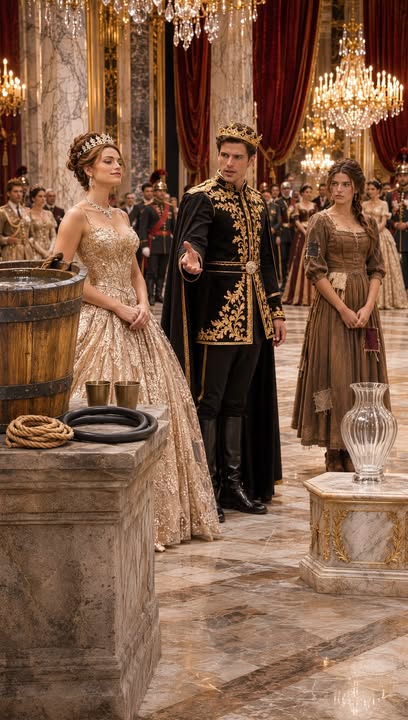
The maid lowered the first end of the hose beneath the water, holding it there until the air inside had given way to a steady stream of bubbles.
She watched carefully, her fingers resting against the rim of the bucket, while the ballroom waited in a silence so complete that even the crackle of the chandeliers seemed loud.
When the bubbles stopped, she bent the hose gently, pinching one end shut.
Then she lifted it from the bucket and carried it toward the vase, keeping the other end low.
The noblewoman’s smile had vanished, though she tried to recover it with a small, dismissive laugh.
“A length of rubber will not change the distance,” she said.
“No,” the maid replied, without looking up.
“But water can travel through it.”
She placed the open end of the hose inside the glass vase, below its rim, then released her grip on the other end.
For a moment, nothing seemed to happen.
A murmur rippled through the guests.
The noblewoman folded her arms.
The maid crouched beside the vase, her gaze fixed on the hose.
Then a clear thread of water emerged.
It ran into the empty vessel with a soft, steady sound.
The nearest guests leaned forward, their faces brightening with surprise.
The prince stepped closer.
Water continued to flow, unhurried and certain, from the raised bucket through the hose and into the vase.
Elin kept one hand near the hose, ready to adjust it if it slipped.
She did not smile at the crowd or glance toward the prince for approval.
She simply watched the water.
When the vase was filled to a third, a ripple of astonishment passed through the ballroom.
When it reached halfway, the whispers became louder.
And when the water rose to just beneath the vase’s narrow neck, the prince lifted his hand.
“That is enough.”
Elin pinched the hose closed before drawing it from the vase.
A final drop fell into the water.
The room remained still for a heartbeat, as if no one quite believed what they had seen.
Then the applause began.
It spread from the servants’ side of the room, where a few kitchen workers had been invited to watch, and soon the nobles joined them.
Some clapped with open admiration.
Others looked embarrassed by how readily they had dismissed the maid.
Lady Celeste did not clap at first.
She stood with her chin lifted, her gloved hands pressed together, and studied the hose as if it had personally contradicted her.
The prince approached the vase and examined the water level.
“You filled it without moving the bucket,” he said.
“Yes, Your Highness.”
“And you wasted almost none.”
“That was important.”
The prince looked at her, not at the patched dress or the worn shoes, but at her face.
“What is your name?”
“Elin, Your Highness.”
“Only Elin?”
“My family name is Vale.”
The prince repeated it quietly, as though he meant to remember it.
“Lady Celeste,” he said, turning toward the noblewoman, “you were quick to attempt the challenge.”
Celeste’s expression tightened, though she did not look away.
“I was.”
“And Elin noticed that effort alone would not solve it.”
“I noticed the bucket was higher than the vase,” Elin said.
The prince’s gaze returned to her.
“Why did that matter?”
Elin glanced down at the hose, still curved across the floor between the two vessels.
“Because water moves downhill when there is a path for it.”
A few guests laughed, not unkindly, at the plainness of the explanation.
Elin’s cheeks colored, but she continued.
“The hose was full of water, and one end was lower than the water in the bucket.
“So the water in the bucket kept flowing through the hose toward the lower end.”
The prince considered this.
“And if the vase had stood higher?”
“Then it might not have worked.”
“Or if the hose had been full of air?”
“It would have taken longer, and it might not have started at all.”
The prince nodded.
“An answer that admits its limits is often more useful than one that pretends to have none.”
The words seemed to settle over the room.
Celeste looked at Elin again, this time with less triumph and more curiosity.
“You have done this before,” she said.
It was not quite a question.
Elin’s hands tightened around the end of the hose.
“I have seen it done.”
“Where?”
“In my village.”
The prince stepped toward the platform.
“What village?”
“Marrow Glen, Your Highness.”
“Near the eastern hills?”
“Yes.”
“I remember the name from the court’s grain reports.”
Elin lowered her gaze.
“Those reports did not say much about the water.”
“No,” the prince said, and something in his voice suggested he knew it.
The room’s attention, which had first gathered around the trick, now gathered around the space between them.
Lady Celeste shifted the long skirt of her gown away from the damp patch on the floor.
“You said water is precious to people who know what it means to go without it,” she said.
Elin met her eyes.
“I did.”
“Were there wells in Marrow Glen?”
“There were wells.”
“Then how could you go without water?”
The question was sincere, but it carried the softness of someone who had never needed to ask it.
Elin heard that softness and hesitated.
The prince seemed to notice.
“You need not answer if you would rather not,” he said.
Elin looked at him, surprised by the care in his tone.
She had expected another test, perhaps a question about what she would do as queen or how she planned to govern people she had never met.
Instead, he had given her the choice to keep something private.
“I can answer,” she said.
Her voice was steady, but the memory was not.
“When I was a child, the drought lasted longer than anyone expected.
“The village well was shallow, and the stream that fed our fields grew thin.”
She glanced at the vase.
“People began taking turns at the well before sunrise.
“My mother would bring two pails and wait with the rest of us.”
For the first time, her composure faltered.
Not enough for the crowd to notice, perhaps, but enough for the prince.
“She taught me to measure what we carried,” Elin continued.
“Not because she liked counting, but because she wanted to know how long our water would last.”
The quiet in the ballroom changed.
It was no longer the hush of people waiting to see a clever solution.
It was the attentive silence of people who understood that the story had moved somewhere they had not expected.
“My mother was good at finding ways to make water reach farther,” Elin said.
“She would lay narrow channels between the garden plots, and she knew where the ground dipped beneath the grass.”
“Your mother designed the channels?” the prince asked.
“She helped build them.”
There was pride in Elin’s voice now, though sorrow threaded it.
“She could tell where the water was going simply by listening to it.”
Celeste’s face softened.
“Did the channels save the crops?”
“Some of them.”
“And your family?”
Elin’s mouth pressed into a thin line.
“We did what we could.”
It was not an answer, and she meant it to remain one.
The prince did not press her.
A servant hurried forward to remove the bucket and hose, but the prince raised a hand to stop him.
“Leave them for a moment,” he said.
He looked toward the gathered guests.
“This challenge was meant to reveal judgment, not merely speed.
“Elin has shown us that the simplest tools can be enough when a person understands what they are for.”
His gaze returned to her.
“You have done well.”
Elin bowed her head.
“Thank you, Your Highness.”
The compliment should have pleased her.
Instead, she felt the familiar unease of being praised by people who had only just learned to look at her.
She had not filled the vase to become admired.
She had done it because the task had a clear answer, and because the water should not be wasted.
The prince seemed to sense that, too.
“You do not look very pleased,” he said.
“I am glad the water was useful.”
“Is that all?”
“It is enough.”
A quiet laugh passed through the room, gentler than the earlier ones.
The prince smiled.
“Perhaps that is the better answer.”
Lady Celeste had remained silent.
She now stepped forward, gathering the long folds of her gown so she would not drag them through the spilled water.
“Your method was clever,” she said.
Elin looked at her cautiously.
Celeste’s proud expression had not disappeared, but it had changed.
The confidence was still there, held in place by years of being expected to enter a room and be noticed.
Beneath it, something more uncertain had appeared.
“I should have considered the tools before I began carrying the water,” Celeste added.
“Yes,” Elin said.
The honesty of the reply startled a few of the nearby guests.
Celeste’s eyebrows rose.
Then, to Elin’s surprise, the noblewoman gave a short laugh.
“You could have softened that.”
“I didn’t think you asked me to.”
For a moment, neither woman looked away.
Then Celeste’s expression eased.
“No,” she said.
“I suppose I did not.”
The prince watched them both, but he did not intervene.
Celeste looked down at the water that had splashed across the marble earlier.
“I have never carried water from a well,” she said.
The confession seemed to cost her something, though not in the way an apology might.
“I have had servants bring it to me, even in the country house.
“I thought of it as something that appeared wherever it was needed.”
Elin followed her gaze.
“That is how most people think of it until it doesn’t.”
Celeste’s fingers curled against her skirt.
“Was it difficult to carry?”
Elin’s expression softened.
“Not at first.
“After a while, the handle cuts into your hand.
“Then your shoulders ache, and you start measuring every step because you know you will have to make the same journey again.”
Celeste listened without interrupting.
“I never imagined that,” she said.
“Most people don’t,” Elin replied.
There was no accusation in her tone.
That made the words harder to dismiss.
The prince glanced between them.
“Then perhaps we have all learned something today.”
A nobleman near the front gave an uneasy chuckle.
“Your Highness, surely we are not to make a grand matter of a hose and a bucket.”
The prince’s expression remained calm.
“An ordinary thing can reveal an extraordinary habit of thought.”
The nobleman fell silent.
Elin bent to gather the hose.
A palace steward hurried to help her, but she lifted one end before he reached her.
“I can manage it.”
“Of course,” he said, sounding uncertain.
She coiled the hose carefully, avoiding the wet stones beneath it.
Celeste stepped aside to give her room.
As Elin passed, the noblewoman spoke in a lower voice.
“Your mother sounds remarkable.”
Elin stopped.
For a moment, she could not answer.
There were many things she could have said.
That her mother had been tired.
That she had kept working even when her hands cracked in winter.
That she had taught Elin to read the shape of land and the patience of water, but could not teach her how to live without her.
Instead, Elin said, “She was.”
Celeste lowered her eyes.
“I am sorry she is not here to see this.”
The gentleness of the words reached Elin before she could prepare herself against them.
“Thank you.”
The prince turned toward his attendants.
“Have the vase returned to the conservatory,” he said.
“And the bucket?”
“Leave it where it is for now.”
His gaze moved to Elin.
“I would like to speak with you after the gathering.”
The room stirred.
Elin felt the shift at once.
The servants near the walls looked at her with hope, while several nobles regarded her as if she had suddenly become a new kind of problem.
Lady Celeste noticed the change, too.
“Your Highness,” she said, “might I ask whether the challenge is finished?”
“It is finished.”
“And the question of who deserves the crown?”
The prince did not answer immediately.
“A crown is not a prize awarded for one clever afternoon,” he said.
“I wished to see how people approached a problem they could not solve by purchasing a quicker answer.”
Celeste’s cheeks grew faintly pink.
“Then perhaps the challenge was never as simple as you claimed.”
“No,” the prince said.
“Perhaps not.”
The guests began to disperse, though many moved slowly, hoping to hear more.
The prince’s attendants called for the musicians to resume.
A measured tune filled the room, but the afternoon had changed.
The nobles who passed Elin did not all speak to her, yet more than one bowed their head.
She found the attention more unsettling than the laughter had been.
Laughter had told her exactly where she stood.
Admiration, she was learning, could leave a person unsure of what would be expected next.
She carried the coiled hose toward a side table and set it down beside the cups.
The palace steward watched her.
“You should not have needed to do that,” he said.
“I did not mind.”
“Still, now that His Highness has taken an interest in you, you may not want to make yourself seem too eager to serve.”
Elin frowned.
“I am a servant.”
The steward appeared to regret speaking.
“I meant only that people will look for reasons to misunderstand you.”
“I know.”
She did know.
In a palace, a kind word could become a rumor before it reached the next doorway.
She glanced across the room.
The prince was speaking with two councilors, though his attention drifted now and then toward her.
Lady Celeste stood near a marble column, listening to an older lady but not quite hearing her.
When their eyes met, Celeste gave a small, uncertain nod.
Elin returned it.
She had been prepared to dislike the noblewoman.
It would have been easier if Celeste had remained exactly as the first laugh had made her seem.
But people were rarely as simple as their worst moment.
The musicians began a waltz.
Couples moved across the floor, their bright clothes turning beneath the chandeliers.
Elin slipped toward the open doorway leading to the servants’ corridor.
The prince’s voice stopped her before she reached it.
“Miss Vale.”
She turned.
He had come away from the councilors.
“Your Highness?”
“I would still like to speak with you.”
“Now?”
“If you have the time.”
Elin looked toward the corridor, then at the ballroom.
A maid was expected to return to her duties, not remain in the center of a gathering because a prince had found her interesting.
“I have work to finish.”
“I understand.”
He did not command her to stay.
That surprised her more than the request itself.
“Could we speak when your duties are done?” he asked.
Elin hesitated.
The prince waited without filling the silence.
“Perhaps,” she said.
“I will ask the steward where I can find you.”
The prince inclined his head.
“Then I will not keep you.”
She slipped into the corridor.
The music dimmed behind her, replaced by the familiar sounds of the palace: the clatter of serving trays, the whisper of skirts, the distant call of someone looking for fresh candles.
In the quiet passage, Elin rested one hand against the cool stone wall.
Her heart was beating harder than it had when she faced the entire ballroom.
She had expected to be laughed at.
She had not expected to be listened to.
Nor had she expected Lady Celeste to admit, in front of a room full of nobles, that she had never carried her own water.
That confession stayed with Elin as she returned to the laundry room.
She folded linens, carried a basket upstairs, and helped replace a row of tablecloths in the western dining hall.
All afternoon, the palace seemed to continue exactly as before.
Servants hurried through the corridors.
Guests praised the music.
A footman complained about a stiff collar.
But the story of the vase traveled faster than Elin could.
By sunset, a kitchen boy asked whether the hose trick would work on the fountain.
By supper, two ladies had heard that Elin had filled the vase with a single breath.
She corrected them when she could.
“It was not a breath,” she said.
“It was the height of the bucket.”
They looked disappointed by the answer.
Elin found that strange.
The truth was more interesting to her than a miracle.
When her last task was finished, she washed her hands at a narrow basin.
The water ran cold over her fingers.
She held them beneath it for a moment longer than necessary, listening to the stream strike the copper bowl.
Her mother had always said water had its own language.
As a girl, Elin had thought that was only one of her mother’s sayings.
Now she knew she had meant that water told you where it had been and where it could go, if you were patient enough to pay attention.
A knock sounded against the open door.
The palace steward stood there.
“His Highness asked whether you could meet him in the old conservatory.”
Elin dried her hands on a clean cloth.
“Is Lady Celeste there?”
The steward’s brows lifted.
“I believe she is.”
Elin wondered why.
“Then I will come.”
The old conservatory stood at the eastern edge of the palace gardens, where tall arched windows looked out over the lawn.
It had once held rare orange trees, but now only a few potted plants remained.
A stone fountain sat dry in the center.
The prince stood beside it with his uniform coat unbuttoned at the throat.
Celeste sat on a wrought-iron bench, her tiara gone and her hair slightly loosened.
The evening light softened the gold in her gown.
She looked less like the woman who had laughed at Elin and more like someone who had been thinking about the laugh ever since.
“Miss Vale,” the prince said.
“Thank you for coming.”
Elin curtsied.
“Your Highness.”
Celeste rose from the bench.
“Good evening.”
“Lady Celeste.”
The prince gestured toward the empty fountain.
“I thought this would be quieter than the ballroom.”
“It is,” Elin said.
“I have asked Lady Celeste to join us,” he continued.
“She knows the estate’s accounts better than I do.”
Celeste looked at him.
“You say that as if it were a compliment.”
“It is.”
“I have spent years reading ledgers because other people wanted me to understand what they were paying for.”
“And have you?” Elin asked.
Celeste’s mouth curved slightly.
“More often than they hoped.”
The prince’s gaze moved to the dry fountain.
“The palace gardens have been losing water for months.
“We have paid for repairs, but the channels still fail to carry enough water to the lower beds.”
Elin looked at the carved stone basin.
“Where does the water come from?”
“An upper cistern,” said the prince.
“Then it moves through channels beneath the western path and around the garden.”
“Does anyone know where it stops?”
“Not yet,” he said.
Celeste stood and brushed a small leaf from the bench.
“The accounts say the work was completed twice.”
Elin looked at her.
“Twice?”
“Two separate repair payments, six months apart.”
“Then why is the fountain dry?”
“That is what I would like to know.”
Celeste’s voice had lost its ballroom polish.
It was precise, but there was tension beneath it.
The prince turned toward Elin.
“Would you help us inspect the channels tomorrow?”
Elin glanced from him to Celeste.
She knew what it meant to be invited into a matter that belonged to the palace.
Such an invitation could open a door.
It could also make people believe she had forgotten the life she came from.
“I could look at the water’s path,” she said.
“But I cannot promise I will find the problem.”
“We are not asking for a promise,” the prince replied.
“Only your eyes and your experience.”
Celeste lifted her chin.
“And mine, apparently, are to be used on the accounts.”
“If you are willing.”
“I am.”
The ease of Celeste’s answer surprised Elin.
A faint silence followed.
Then Celeste looked toward the darkened windows.
“I thought the challenge was a contest between us,” she said.
“It was,” Elin replied.
“I know.
“But I thought being seen beside you meant I would disappear behind you.”
The admission was quiet enough that the prince could have pretended not to hear.
He did not.
“I never intended that.”
“I believe you,” Celeste said.
“But intention and consequence are not always the same.”
Elin recognized the truth in that sentence.
She had learned it long before she entered the palace.
“I do not want to take anything from you,” she said.
Celeste met her eyes.
“I know that now.”
For the first time, her smile was not an expression she had chosen for an audience.
It was small and a little uncertain, but it belonged to her.
The prince looked from one woman to the other.
“Then we begin in the garden at first light.”
Elin nodded.
Celeste turned toward the old fountain.
“Before we go, there is something I noticed in the ledger.”
She opened the small book she had brought with her and turned it toward the lamplight.
“Most of the repair charges were signed in the ordinary way.
“But this entry bears a seal from the former royal steward’s office.”
Elin leaned closer.
The wax had been pressed hard into the page, leaving a faint impression even after the original seal was removed.
A ring of reeds surrounded a small crown.
Elin went very still.
The symbol was familiar.
Not from the palace.
From a faded paper her mother had once kept hidden at the bottom of a wooden box.
Elin could almost see that old sheet in her mind, its edges soft from handling, the same circle of reeds and crown impressed at the foot of a letter.
Celeste noticed the change in her face.
“Have you seen this seal before?”
Elin stared at the page.
“I don’t know.”
But she did know the shape.
She knew the way the reeds bent around the crown.
And, suddenly, she remembered her mother’s hands folding the faded document away whenever anyone came near.
“Miss Vale?” the prince said gently.
Elin lifted her eyes from the ledger.
“My mother kept a paper with a mark like that.”
Celeste’s fingers tightened around the book.
“What did it say?”
“I was too young to understand.”
The prince stepped closer, careful not to crowd her.
“Do you still have it?”
Elin heard the dry fountain behind them, the soft whisper of the garden beyond the glass, and felt the old memory open like a door she had never meant to touch.
“I don’t know,” she said.
“I thought it was gone.”
Celeste looked down at the seal again.
“Then we should find out whether it is the same mark.”
And for the first time since entering the palace, Elin understood that the water in the royal vase might not be the only thing her mother had once tried to lead toward the crown.
**–END OF PART 2–CLICK “NEXT” AT THE BOTTOM OF THE PAGE TO CONTINUE READING**
* * *
[NEXT: PART 3](https://storyly.idolsgift.com/blog/part-3-the-secret-beneath-the-water-057)
✓ Lynn R. Adams
The maid lowered the first end of the hose beneath the water, holding it there until the air inside had given way to a steady stream of bubbles. She watched carefully, her fingers resting against the…