PART 2: The Secret Beneath the Surface 058
Part 2 – The Secret Beneath the Surface
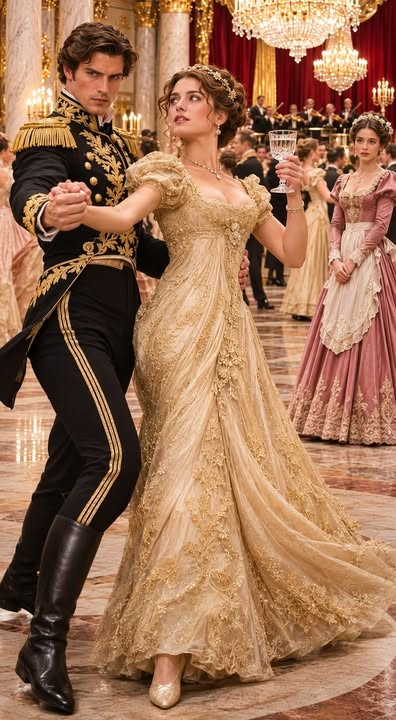
The prince’s eyes widened when he saw what I was about to do.
I turned my wrist, not toward him but slightly away, and let my arm continue the circle his sudden turn had set in motion.
The water shivered in the glass.
I kept my elbow soft and my steps small, allowing the movement to travel through my body instead of stopping abruptly at my hand.
For one breath, the ballroom seemed to hold still around us.
Then Alexander’s next step came, quick and sharp, meant to pull me off balance.
I let him lead, but I did not chase his feet.
The glass followed the path my arm had already begun, and the water rose to the rim without spilling over.
A murmur swept through the watching crowd.
Alexander’s brows lifted, and something almost like delight softened his stern expression.
He changed direction again.
This time, I felt the pull before I saw it in his shoulders.
I shifted my weight, turned my wrist, and let the glass travel in a gentle arc.
The crystal caught the candlelight.
The water trembled, settled, and stayed inside.
The orchestra carried us through the final measures, the melody swelling beneath the high painted ceiling.
When the last note sounded, I stood with the glass still in my hand, its surface level and unbroken.
Not a drop had fallen.
For a moment, nobody spoke.
Then a quiet gasp rose from somewhere near the back of the ballroom.
It was followed by another, and another, until the room seemed to exhale all at once.
Alexander released my hand.
“You did it,” he said.
His voice was quieter than I expected, as though he were speaking to me rather than announcing a result to the court.
“I did,” I answered, though my own voice came out thin with disbelief.
Lady Victoria’s smile had vanished.
Her gold-gloved hand remained lifted near her shoulder, where the stain from her spilled water had darkened the silk.
The royal adviser stepped forward, but Alexander raised one hand before he could speak.
“Emma has completed the waltz,” the prince said. “The challenge is over.”
A ripple moved through the court.
I could feel every eye upon my apron, my work dress, the plain black shoes that had carried me across the marble floor.
The admiration in some faces was genuine.
In others, it was merely curiosity, the sort one might give an unexpected turn in a play.
Lady Victoria looked at me as if she could not decide whether to be angry or impressed.
“Where did a palace maid learn to dance like that?” she asked.
“I learned to keep a tray steady,” I said.
It was the truth, but it sounded too small for the room.
Alexander studied the glass in my hand.
“And the rest?”
“There isn’t much rest to it, Your Highness.”
“That is not what I asked.”
His tone was not sharp, but it held a new attention that made me uneasy.
Before I could answer, the royal adviser leaned close to him and murmured something I could not hear.
Alexander’s gaze remained on me.
“Will you walk with me a moment?”
The invitation startled the room more than my victory had.
I glanced toward the adviser, then toward the servants’ entrance, where the head housekeeper stood waiting with the kind of expression that promised a long conversation later.
“I should return to my duties,” I said.
“You have already returned to them,” Alexander replied, nodding toward the tray I had left near the door. “You carried it in before you danced.”
A few courtiers laughed softly.
I did not.
The prince seemed to notice, because his expression changed.
“I did not mean to make light of your work,” he said.
“Then I will walk with you, Your Highness.”
He offered his arm.
I took it with my free hand, careful to keep the glass upright as we moved toward a tall window overlooking the palace gardens.
The room parted for him, though not as completely as it had when he crossed the floor with the noblewomen.
The difference was slight, but I felt it.
The court watched us go.
At the window, Alexander turned toward me.
“Tell me how you knew.”
“I watched the others.”
“I watched them too.”
“Not in the same way.”
His eyes narrowed, not in anger, but in thought.
“Explain.”
I set the glass on a narrow table beneath the window.
“In the first dances, the ladies kept their attention on your feet,” I said. “When you changed direction, they tried to stop at once and begin again. But the water had already been moving.”
“And you let it keep moving.”
“I let it finish what it had started.”
He glanced at the glass.
“How did you learn that?”
I hesitated.
A prince’s question could be an order even when he spoke gently.
But something in his face suggested he truly wanted the answer, not merely an interesting tale to repeat at dinner.
“From carrying trays,” I said. “The kitchen passages are narrow, and the floors are uneven. If you move too quickly, every glass begins to sway. You learn to notice the water before it reaches the rim.”
“How long have you worked in the palace?”
“Since I was sixteen.”
“Eight years.”
“Yes.”
“And you have never been taught to dance?”
“Not in a ballroom.”
The faintest smile touched his mouth.
“Yet you danced better than everyone I invited.”
“I didn’t dance better,” I said. “I watched better.”
He seemed to turn the words over in his mind.
For a moment, the music and the crowd faded behind us.
Then he asked, “Would you teach me?”
I thought I had misheard him.
“Teach you what, Your Highness?”
“How to notice what others overlook.”
There was no teasing in his voice.
That made the request harder to answer.
“I am not sure a prince has time to learn from a maid.”
“I have time to learn from anyone who can teach me something useful.”
“And what would the court say?”
“That I am learning.”
His answer came so simply that I almost smiled.
Then I remembered where we stood.
“The court says many things, Your Highness.”
“Yes,” he said. “I am discovering that.”
Something in the way he spoke made me wonder whether he meant more than the challenge.
Before I could ask, the adviser appeared beside us.
“Your Highness, the guests are waiting for your judgment.”
“The challenge is finished,” Alexander said.
“Of course,” the adviser replied. “But there are matters of protocol to consider.”
His eyes rested on me for only a moment, though I felt the weight of the glance.
Alexander’s expression closed again.
“Then consider them without me for a few minutes.”
The adviser bowed, but his face did not change.
“As you wish.”
He withdrew into the crowd.
I watched him go.
“He does not like me,” I said.
“He does not know you.”
“People do not always wait for that.”
Alexander turned back to me.
“Do you think I am like that?”
I was surprised by the question.
“I have only seen you in a ballroom.”
“And what do you think of me from that?”
“That you expected everyone to follow your steps.”
A flicker of recognition crossed his face.
“And you did not.”
“No.”
“Perhaps I should be grateful.”
“Perhaps you should be curious.”
His smile returned, this time with more warmth.
“I believe I am.”
A footman approached to collect the glass, and I used the moment to step back.
“I should go.”
“Emma.”
I stopped.
“Thank you for the lesson.”
“You have not learned anything yet.”
“Then I will have to ask for another.”
I did not know what to say to that, so I curtsied and returned to the service entrance.
The head housekeeper, Mrs. Bell, was waiting in the corridor.
“Do you have any idea what you have done?” she whispered as soon as the ballroom door closed behind me.
“I finished a dance.”
“You made the prince ask you to walk with him.”
“He asked about the glass.”
“Princes rarely ask about glass.”
Mrs. Bell’s disapproval was tempered by concern, and that made me feel worse.
“I did nothing improper.”
“I did not say you had.”
She lowered her voice further.
“You are a good girl, Emma. You have been careful for eight years. Do not let one remarkable evening make you careless.”
“I will not.”
“Good. Then change out of that dress and help the kitchen clear the supper trays.”
I went to the servants’ rooms, where the noise of the ballroom followed me as a muffled glow.
The other maids had already heard the story.
“Is it true?” asked Clara, who was folding napkins beside the stove. “Did you finish the waltz?”
“I did.”
“Without spilling?”
“Not a drop.”
She let out a small, delighted laugh.
“That is wonderful.”
“It was only a glass of water.”
“It was a glass of water in front of half the kingdom.”
Her smile made my own uneasiness ease.
For a little while, the servants’ quarters felt like the safest place in the palace.
Then I saw the battered music book lying on the small shelf beside my bed.
I had kept it wrapped in linen for years, tucked away from damp and careless hands.
Its brown cover was worn soft at the corners, and the spine had been mended twice with thread that no longer matched.
My mother’s name was written inside in faded ink.
Eleanor Vale.
I had taken the book with me when I came to the palace, though I had never been sure why I kept it.
My mother had once worked here too, long before I was old enough to understand the rooms she cleaned or the people she served.
She used to hum while she mended my dresses.
Sometimes, when she thought I was asleep, she would open the book and play its melodies on a small piano in the rooms where we lived.
She had died when I was nineteen.
Her music was the clearest memory I had of her voice.
Clara glanced at the book.
“You still keep that?”
“It was my mother’s.”
“I know. You never let anyone touch it.”
“Some things are better left alone.”
Clara gave me a curious look but said nothing.
I changed into my plain work dress and went back to the kitchens.
The evening’s celebration had left the palace in disarray.
Empty glasses crowded the trays, candle wax had spotted the silver stands, and the pastry tables looked as though a flock of birds had descended upon them.
I worked until after midnight, polishing and carrying, letting the steady routines quiet my thoughts.
The ballroom challenge had been a moment.
The work that followed was the life I knew.
And yet, as I wiped the edge of a serving platter, I kept remembering Alexander’s question.
Would you teach me?
The next afternoon, I was carrying a basket of folded linen past the west gallery when I saw him.
He was not in uniform now.
He wore a dark blue coat and no gloves, and he stood at the far end of the corridor with a small glass in his hand.
At first, I thought he had lost his way.
Then I noticed the water.
It was filled close to the rim.
“Your Highness,” I said, lowering my gaze.
He turned.
“Emma. I was hoping I might find you.”
I shifted the basket against my hip.
“Should I ask why?”
“To learn.”
He held up the glass as if it explained everything.
I glanced down the corridor.
A pair of footmen were polishing a console table nearby, and a chambermaid was arranging fresh flowers by the stairs.
“Here?”
“It seemed a sensible place to begin.”
“It seems a place where people will stare.”
“They already do.”
“That does not make it easier.”
He looked at the basket in my arms.
“May I help you carry that?”
“No, Your Highness.”
“Why not?”
“Because if I let you carry it, someone will say I made you do a servant’s work.”
“And if I carry a glass?”
“That may only make them wonder why you are carrying a glass.”
He gave a quiet laugh.
“I see the difficulty.”
“You see one part of it.”
He glanced toward the footmen.
“Then perhaps we should find somewhere less crowded.”
That was how I came to lead the prince through a servants’ passage.
I had never expected a royal person to walk behind me through the narrow corridors used by the staff.
The passage smelled of starch, stone dust, and the lavender soap kept in the linen room.
Alexander had to duck beneath a low beam.
He did so without complaint.
“Does everyone use these halls?” he asked.
“Everyone who works here.”
“And no one who lives here?”
“Some of the family use them when they do not want to be seen.”
“Then I am not the first.”
“No, Your Highness.”
“Alexander,” he corrected.
I did not answer.
We reached a little alcove beside the old stillroom, where a high window cast a pale stripe of light across the floor.
There was a narrow bench and enough space to move without blocking the passage.
“Put the glass in your left hand,” I said.
He obeyed.
“Now walk from the bench to the window.”
He took three careful steps.
The water trembled.
“Too stiff,” I said.
“Would you prefer I drop it?”
“I would prefer you notice it.”
He looked at the glass.
“You said the water tells you what it is doing.”
“It does.”
“And I should watch it?”
“Not only watch. Feel the movement through your hand.”
He tried again, this time allowing his arm to swing slightly with his stride.
The water rose against one side.
“Keep your wrist loose,” I said. “Not limp. Just loose enough to move.”
He adjusted his grip.
“You speak as if the glass is alive.”
“It is easier to learn when you stop treating it like an object you can command.”
His gaze lifted to mine.
For an instant, neither of us moved.
Then the sound of someone approaching sent me back a step.
A scullery maid appeared with a stack of cloths.
She paused when she saw us.
“Your Highness.”
“Good afternoon,” Alexander said.
The girl curtsied, eyes wide, and hurried past.
I turned toward the passage.
“This is not a good idea.”
“Because someone saw us?”
“Because someone will say I am looking for favor.”
“Are you?”
“No.”
“Then why should their opinion matter?”
“Because I have to live with it after you leave.”
His expression changed, as though the answer had reached him more deeply than he expected.
“You are right,” he said.
I had not expected him to agree.
“I will not make this harder for you.”
“That is kind, Your Highness.”
“It is only fair.”
I looked down at the glass.
“Try again.”
He did.
This time, he walked more naturally.
The water shifted but did not climb as high.
“Better,” I said.
His pleased smile was so quick and unguarded that it seemed to belong to someone younger.
“You make a stern teacher.”
“I learned from the best.”
“Who was that?”
I opened my mouth, then closed it.
The music book had been in my thoughts since the night before, and his question brought it close again.
“My mother,” I said.
“What did she teach you?”
“Many things.”
“Such as?”
“How to listen before speaking. How to notice when someone is tired even if they insist they are not. How to keep a tray steady.”
Alexander looked at the glass.
“She taught you all of that?”
“She worked in the palace before I did. She said you learned more by watching than by asking.”
“What was her name?”
The question was ordinary.
The answer did not feel ordinary.
“Eleanor Vale.”
His expression altered, not enough for certainty, but enough for me to notice.
“Did you know her?” I asked.
“No,” he replied. “I do not think so.”
The hesitation was slight.
I remembered it anyway.
He returned the glass to the bench.
“Would you tell me about her sometime?”
“Why?”
“Because I want to understand the person who taught you to see what I have missed.”
There was gentleness in his voice, but gentleness could still cross a line.
“My mother has been gone for five years,” I said.
“I am sorry.”
“Thank you.”
“And you keep something of hers?”
I wondered how he knew.
I must have looked toward the servants’ rooms without meaning to.
“The music book,” I said.
His attention sharpened.
“May I see it?”
“No.”
The word came out too quickly.
He did not look offended.
“All right.”
I had expected him to ask why.
Instead, he accepted my answer.
That made me want to explain, though I did not yet know what I could safely say.
“It is old,” I said. “And it is personal.”
“Then you should keep it private.”
The simplicity of his response loosened something in me.
I had thought of him as a prince first, and a man second.
Now, for a moment, he seemed like a person who could understand that some doors had to remain closed.
“Thank you,” I said.
He bowed his head.
“Until another lesson, then?”
“If there is another lesson.”
“There will be.”
It sounded less like a command than a hope.
I returned to my work.
After that, Alexander found small reasons to pass through the west gallery.
Sometimes he carried a glass.
Sometimes he asked about balance, and sometimes he asked nothing at all, only walked beside me for a few minutes while I brought linen or clean cloths between rooms.
We spoke in the quiet spaces the palace overlooked.
He told me he disliked the way the court treated every conversation as if it were a negotiation.
I told him servants did the same, only with fewer choices.
He listened when I spoke, though I never forgot that he could leave whenever he wished and I could not.
That difference followed us even when the corridors were empty.
One afternoon, he asked me what I would do if I could choose any work in the world.
“I have never had the luxury of choosing any work in the world,” I said.
“That is not an answer.”
“It is the answer I have.”
He did not press me.
Instead, he told me that as a boy he had wanted to draw maps, because maps showed where a person might go.
“And now?” I asked.
“Now I am expected to know where everyone else should go.”
I looked at him then.
He seemed weary beneath the neat coat and carefully arranged hair.
“I suppose that is lonely,” I said.
“It can be.”
I had not meant to comfort him.
But he received the words as if they were a gift.
Another evening, when the light was turning gold in the high windows, he asked about my mother again.
This time, I answered a little more.
“She liked music,” I said. “She said a melody could carry what a person could not bring herself to say.”
“Did she play?”
“A little, when she had the chance.”
“What did she play?”
“I do not remember every piece.”
“Only some?”
I hesitated, then said, “There was a waltz she used to hum.”
Alexander’s face grew still.
“A waltz?”
“An old one. She said she had helped copy the music for someone at the palace, but I was a child. I may have misunderstood.”
“What was it called?”
“I do not know. The cover was missing.”
“Would you hum it for me?”
I felt the old reluctance rise.
The memory belonged to the rooms I had shared with my mother, to the soft rasp of her voice and the touch of her hand on my hair.
It did not belong in a palace corridor with a prince listening.
“Not today,” I said.
He nodded.
“Not today.”
The next morning, I was sent to the records room to deliver a bundle of clean dust cloths.
The palace records occupied a narrow chamber behind the steward’s office, where shelves rose almost to the ceiling and the windows admitted more dust than light.
A clerk was at the far table, sorting old ledgers into piles.
I set down the cloths and turned to leave.
Then I noticed a heavy book lying open beside the inkstand.
The page was headed with the names of former palace staff.
I would not have stopped, except that I saw my mother’s name.
Eleanor Vale.
My feet carried me closer before I had decided to move.
Beside her name was a date from many years earlier, followed by a short notation written in a different hand.
The rest of the line had been cut away.
Not torn by accident.
Cut cleanly, leaving only a small fragment of ink at the edge.
I leaned closer.
The surviving words read: “left by her own—”
The rest was gone.
“Can I help you?” the clerk asked.
I straightened.
“I thought I saw someone I knew.”
“Those books are being reviewed,” he said, reaching to close the ledger.
“My mother worked here.”
The clerk paused.
“What was her name?”
“Eleanor Vale.”
His expression changed, though he quickly hid it.
“I am afraid these records are incomplete.”
“I can see that.”
He closed the book.
“Old pages are often damaged.”
“This one was cut.”
“Perhaps.”
He placed a hand over the cover as if to end the conversation.
“Do you know what happened to her?”
“I do not.”
The answer was too quick.
I looked at him.
He looked back, polite and unreadable.
“If you have questions about old staff records, you should speak to the steward.”
The steward would tell me nothing.
I knew that without asking.
The clerk lifted the ledger and carried it to a shelf beyond my reach.
I returned to the servants’ passage with my hands empty and my mind full.
That evening, I opened my mother’s music book for the first time in several months.
I had promised myself I would not let the past become a burden.
But the page with her name was still in my thoughts.
I turned through the worn sheets, past the familiar melodies, until I reached the middle.
There, in the margin of a waltz I had never learned, someone had penciled a small series of marks beside the notes.
Four short strokes, then a pause, then three.
At the bottom of the page, in my mother’s careful hand, were the words:
“Remember the water. Let it finish its turn.”
My breath caught.
The room seemed smaller around me.
A knock sounded at the door.
I closed the book.
“Emma?”
Alexander stood in the corridor.
Behind him, the palace lamps cast long reflections across the polished floor.
“May I speak with you?”
I opened the door only partway.
“What is it, Your Highness?”
“I found something in my father’s papers,” he said. “A note about a waltz demonstration at the palace.”
My fingers tightened on the edge of the door.
“What did it say?”
He looked troubled now, the warmth from our lessons replaced by a careful seriousness.
“It mentioned a missing page.”
He held out a folded sheet.
“I think it may have belonged to someone named Eleanor Vale.”
Final
**–END OF PART 2–CLICK “NEXT” AT THE BOTTOM OF THE PAGE TO CONTINUE READING**
* * *
[NEXT: PART 3](https://storyly.idolsgift.com/blog/part-3-the-secret-beneath-the-surface-058)
✓ Lynn R. Adams
Part 2 – The Secret Beneath the Surface The prince’s eyes widened when he saw what I was about to do. I turned my wrist, not toward him but slightly away, and let my arm continue the circle his sudd…