PART 2: The Secret Beneath the Silver Thread 046
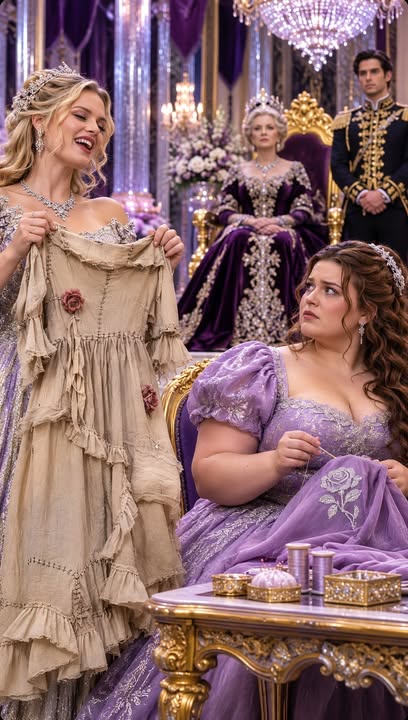
Part 2 – The Secret Beneath the Silver Thread
Because I carried that exact scar beneath my left shoulder.
For one suspended moment, no one in the ballroom moved.
Then Queen Catherine turned to the guards, her voice steady despite the tremor in it.
“Close the doors, please, and ask everyone to remain where they are.”
The guards obeyed, drawing the tall doors shut without a slam.
A hush spread through the room, broken only by the faint rustle of silk and the whisper of someone asking what was happening.
Queen Catherine faced me again, and I saw her trying to hold herself together.
“Clara, I know this must feel frightening,” she said.
“It does,” I managed.
“I promise you, no one here will harm you.”
Her gaze moved briefly across the court, where curiosity and unease had begun to mingle.
“Nor will anyone question you in front of an audience,” she added.
Isabella stood near the judges’ table, her arms wrapped around herself.
The color had drained from her cheeks, but her expression was no longer mocking.
She looked as if she had heard a door open onto a room she had spent years avoiding.
Prince William came to stand between the queen and the crowd, not blocking me from her, but making a quiet shelter around the moment.
“Mother,” he said softly, “perhaps we should speak somewhere private.”
“Yes,” Catherine replied.
She looked at me, and her voice gentled.
“Will you come with us?”
I glanced down at my unfinished gown, the silver needle still resting on its fabric.
The ballroom seemed suddenly vast, every chandelier and polished floor reflecting the faces turned toward me.
“I don’t know what you think you’ve found,” I said.
“Neither do I,” she answered.
“But I would rather ask you in private than let anyone else make a story of it.”
That honesty gave me something small to hold on to.
I nodded.
William offered his arm, though he did not presume I would take it.
I did, because my knees had begun to shake.
As we walked toward a side door, the court parted for us.
Isabella watched me pass.
For a second our eyes met, and I expected to see the old disdain there.
Instead, I saw fear.
The door led to a quiet gallery lined with portraits of former queens.
Their painted faces followed us in the dim light as a palace attendant opened another door into a small sitting room.
Queen Catherine asked everyone except William to wait outside.
The guards remained beyond the threshold, and once the door closed, the silence inside felt almost as heavy as the one we had left behind.
Catherine took a seat, but I remained standing.
“My mother told me I had a scar,” I said, before she could ask.
“She said I received it when I was a baby.”
The queen’s fingers tightened around the arm of her chair.
“May I see it?”
William looked toward me, his brow drawn with concern.
“You don’t have to,” he said.
I appreciated that he said it without looking at the queen for permission.
After a moment, I nodded.
“I can show you.”
There was a folding screen near the wall, painted with blue irises.
I stepped behind it and loosened the edge of my sleeve enough to uncover the skin beneath my left shoulder.
The scar was small, pale, and shaped like a crescent moon.
I had seen it in the mirror countless times, but never thought of it as anything more than a mark from some forgotten scrape.
When I stepped out from behind the screen, Catherine stood very still.
She did not reach for me.
She only looked, and her face changed in a way I could not name.
It was grief first, perhaps, and then wonder, followed by something that looked almost like hope.
“I saw that scar once,” she whispered.
“Where?” I asked.
“On a newborn child.”
William’s eyes moved from his mother to me.
“You mean the princess?”
Catherine looked at him, but did not answer immediately.
“Twenty-seven years ago, there was a baby in the palace,” she said at last.
“A little girl.”
I felt the room tilt around me.
Catherine continued, her voice careful.
“I was told the child died before she could be presented to the court.”
I pressed my hand against my shoulder, covering the crescent.
“My mother said I was born in a village near the coast.”
“Do you know when?”
“On the seventeenth of May, twenty-seven years ago.”
The queen closed her eyes.
When she opened them, they shone with tears.
“That was the princess’s birthday.”
I pulled my sleeve back into place.
“Then why wasn’t I raised here?”
“I don’t know,” Catherine said.
It was the first answer that made me believe she might not be hiding something from me.
She was not speaking like a queen guarding her authority.
She was speaking like a woman searching for the child she had mourned.
William moved closer to the window, as though he needed the light to steady his thoughts.
“Could the scar be a coincidence?” he asked.
“It could,” Catherine said.
“And a date can be mistaken.”
“I know,” I said.
The words came out sharper than I intended.
“I know how easily people can turn a resemblance into a story.”
Catherine bowed her head.
“You are right to be cautious.”
That surprised me more than her tears had.
I had expected the queen to take charge of my life with one sentence.
Instead, she seemed to understand that I needed the right to doubt her.
“My mother never told me I was a princess,” I said.
“She raised me as her daughter.”
Catherine looked down at her hands.
“I am grateful she did.”
The words struck me with a strange tenderness.
“Why would you be grateful?”
“Because whoever you are, you were loved.”
My throat tightened.
I thought of the narrow room above the fabric shop, the late evenings when Mother stitched by lamplight, and the way she always saved the warmest patch of blanket for me.
She had been gone three years, but I could still hear the small hum she made when she concentrated.
If she had known something this enormous, why had she never told me?
Catherine followed my gaze to the gown I had left behind in the ballroom.
“The rose,” she said.
“Your mother taught you that pattern?”
“Yes.”
“Did she ever explain why it had seven petals?”
“No.”
“She only said it was an old design in her family.”
The queen’s expression softened at the mention of the flower.
“That pattern was not simply an old design.”
She crossed to the window and looked out over the palace gardens.
For a while, she said nothing.
Then she turned back to us.
“Eleanor and I made it together when we were young.”
I stared at her.
“My mother’s name was Eleanor.”
“I know,” Catherine whispered.
She looked as though the name itself had been waiting behind her teeth for years.
“Eleanor was my closest friend.”
William lowered his gaze, understanding that his mother had stepped into a memory that belonged to her before it belonged to the crown.
“We were girls together,” Catherine continued.
“Before I became queen, before either of us understood how much the palace could ask of a person.”
A faint smile touched her face, but it did not last.
“We spent whole afternoons in a little workroom above the old kitchens, making patterns and arguing about which flowers were worth stitching.”
“Mother loved flowers,” I said.
“She loved what people overlooked,” Catherine replied.
“Wild roses, loose threads, worn-out scraps of cloth.”
I remembered Mother collecting bits of fabric from the floor and turning them into quilts.
She used to say that discarded things were often just waiting for someone to notice what they could become.
Catherine’s eyes found mine.
“When Eleanor designed that rose, she left one petal unfinished.”
“Why?”
“She said it was for the person who would complete the work.”
I glanced down at my fingertips.
“And I completed it.”
“Yes.”
The queen’s voice faltered, and she pressed her lips together until she could continue.
“I cannot ask you to believe that one flower makes you my daughter.”
“I don’t,” I said.
“I’m glad.”
She came back to her chair, but did not sit.
“Clara, may I ask what Eleanor told you about her past?”
“Not much.”
I tried to think of the few stories Mother had shared.
“She said she had worked in a grand house when she was young, and that she had once known someone who wore a crown.”
Catherine’s hand went to her throat.
“She never named you?”
“No.”
“Did she tell you why she left?”
“She said she had to leave before someone else made the choice for her.”
The queen’s face paled.
William looked toward her.
“Mother?”
Catherine gripped the back of her chair.
There was a long pause before she answered.
“I was told Eleanor had died.”
The words emerged quietly, without the firmness of an accusation.
“Not in an execution,” she added. “Not in the way the court later whispered. I was told she had fallen ill after leaving the palace.”
“Who told you?”
“A trusted official, whose name I no longer wish to place in your hands until I know more.”
She stopped herself, as if realizing how quickly a memory could become a charge.
“After a while, I was shown a record confirming it.”
“And you believed it?” William asked.
“I was young, newly queen, and grieving a child I had been told was gone.”
She looked toward him with tired honesty.
“I believed what the people around me said because I thought the alternative would destroy me.”
I felt something inside me recoil.
“My mother was alive.”
“Yes,” Catherine said.
“She lived for twenty-four years after that.”
“Then why didn’t she come back?”
“I don’t know.”
The queen did not dress up her uncertainty.
“I don’t know whether she feared for you, whether she was prevented from returning, or whether she made a promise that she kept until the end.”
The questions crowded together in my mind.
Had Mother known that I belonged to this palace?
Had she stood outside its gates and chosen not to cross them?
Had every ordinary day of my life been a kind of protection?
I wanted to reject the whole idea.
I wanted to believe that the queen’s grief had made her see a familiar pattern and a familiar scar where there might be only coincidence.
But the rose had been made by my mother and the queen together.
And the crescent on my shoulder had appeared before I could remember it.
“Why would my mother keep this from me?” I asked.
“Perhaps she thought silence was the safest gift she could give you,” Catherine said.
“Perhaps she was wrong.”
The answer was gentle, but it left no comfort behind.
William moved from the window.
“Clara, you don’t have to decide what any of this means today.”
I looked at him.
“Everyone in that room saw the queen stop the competition.”
“They saw a question,” he said.
“They do not yet know the answer.”
His calmness helped me breathe, though I could not tell whether it was his kindness or the simple need for an ally.
Catherine reached for a glass of water on the table.
Her hand trembled slightly.
“I had hoped that if I ever found Eleanor again, I would have the chance to ask why she left,” she said.
“Instead, I am asking her daughter.”
“Don’t call me that yet,” I said.
The words came out before I could soften them.
The queen accepted them with a small nod.
“You are right.”
“I am sorry.”
“You do not need to apologize.”
I looked at her face and saw no anger there.
That almost made the moment harder.
A knock sounded at the door.
A palace attendant entered just enough to bow.
“Your Majesty, the competition judges ask whether they should postpone the result.”
Catherine glanced toward the open doorway.
“Postpone it until tomorrow.”
“Of course.”
“And please tell the contestants they are free to leave when the doors are opened.”
The attendant hesitated.
“Will you be announcing the reason?”
“No,” the queen said.
“Tell them only that a private matter requires my attention.”
When the attendant had gone, I found myself thinking of my gown again.
“What about the competition?”
“Your work will be judged fairly,” Catherine said.
“I don’t want special treatment.”
“Nor should you have it.”
“Then let the judges decide.”
The queen gave the smallest smile.
“That is exactly what I intend.”
For the first time since the doors had closed, I felt something other than fear.
Not relief, exactly.
Just the knowledge that I could still ask for fairness and be heard.
Catherine took a small linen handkerchief from her sleeve and pressed it to her eyes.
“I have no right to ask anything more of you tonight,” she said.
“But I would like you to stay at the palace until morning, if you are willing.”
I stiffened.
“Why?”
“Because the court will already be guessing, and I would rather you be somewhere quiet while I begin looking for records.”
“I can go home with my friend.”
“Of course,” she said at once.
“I won’t prevent you.”
That answer eased some of the tightness in my chest.
She was not ordering me to stay.
She was asking.
William glanced toward the door.
“Your friend is waiting in the east corridor.”
“I should speak to her.”
“Certainly,” the queen said.
I hesitated, then added, “She’s not part of this.”
“I understand.”
“Her name is Mara. She entered me in the competition, and she has no idea why any of this is happening.”
“Then she should not be made to answer for it.”
I thanked the queen, though the words felt too small for the carefulness she was showing me.
William walked me back to the corridor.
As soon as we stepped outside, I saw Mara waiting beside a tall window, her hands clasped in front of her.
She had a flour smudge on one cheek from helping at the shop that morning and still wore the simple green dress she had borrowed from her older sister.
When she spotted me, she hurried forward.
“Clara, are you all right?”
“I think so.”
She searched my face.
“Is the queen angry?”
“No.”
“Isabella?”
“No.”
“Then what happened?”
I looked back at the closed sitting-room door.
“I’m not sure yet.”
Mara squeezed my hand.
“Whatever it is, you don’t have to face it alone.”
It was a promise she had made before either of us knew how much it might ask of her.
The queen stepped into the corridor.
She had composed herself, but the sadness in her eyes remained.
“Miss Mara,” she said.
Mara dipped into a nervous curtsy.
“Your Majesty.”
“Clara’s welcome to leave with you, or to stay here tonight.”
Mara looked at me rather than the queen.
“What do you want?”
“I don’t know.”
“Then we can decide one step at a time.”
I nodded.
When I turned back to Catherine, I noticed Isabella standing farther down the corridor.
Her mother, Lady Rowena, had arrived from the ballroom and was speaking to her in a low voice.
Lady Rowena was a tall woman with silver-blond hair and a face practiced at remaining serene.
She wore a pearl necklace so fine it seemed to disappear against her skin.
Whatever she said to Isabella, the young woman’s shoulders went rigid.
Then Lady Rowena saw me.
Her smile appeared, precise and polite.
“Your Majesty,” she said, approaching.
“I heard the competition has been postponed.”
“It has.”
“Is there some concern?”
“A private matter,” Catherine replied.
Lady Rowena’s gaze rested on the queen for a moment, then shifted to me.
It was not hostile.
It was assessing.
“I hope you are not being overwhelmed, Miss Whitmore.”
I could not tell whether she meant it.
“Thank you.”
Isabella stood behind her mother, staring at the floor.
For a moment, it seemed she might speak to me.
Then Lady Rowena placed a hand lightly at her elbow and guided her away.
William watched them go.
“Isabella has never liked uncertainty,” he said.
“Does anyone?”
“No,” he replied.
“But some people have been taught to treat it as a threat.”
He left the thought there, and I did not ask him what he meant.
Mara and I walked toward the front of the palace.
At the entrance hall, an attendant brought me my coat and the small satchel I had left with the other contestants.
Inside the satchel was Mother’s sewing box.
I carried it against my chest as though it might keep me steady.
The palace doors opened at last, and cold evening air rolled into the hall.
Before we stepped outside, Queen Catherine joined us.
“I will not announce anything until there is proof,” she said.
“Not to the court, not to the city, and not to you as fact.”
I searched her face.
“Even if you believe it?”
“Especially then.”
For a queen, it seemed a remarkable thing to say.
For a mother, I imagined it might be necessary.
She continued, “I would like the palace physician to examine the scar, if you agree.”
“Would that prove anything?”
“Perhaps only how old it is.”
“Not who I am.”
“No,” she said.
“Not who you are.”
The words felt fair.
I looked down at the satchel in my arms.
“I’ll think about it.”
“That is all I ask.”
Mara and I left the palace together.
Outside, the city lamps had begun to glow, each one haloed in the mist.
The carriage that had brought me to the competition was still waiting at the gate.
Its driver opened the door, and Mara climbed in first.
I lingered on the step, looking back at the palace.
Queen Catherine stood beneath the entrance arch.
She did not wave.
She only watched me with the careful stillness of someone afraid that one hurried gesture might send me farther away.
I climbed into the carriage.
On the ride home, Mara tried not to ask questions.
I was grateful for her silence, though I could feel her worry beside me.
At last, she said, “You’re thinking about your mother.”
“Yes.”
“Would you like to tell me?”
I looked out at the passing shopfronts and dim windows.
“Not yet.”
“All right.”
When we reached the fabric shop, the familiar smell of wool, starch, and old wood met us at the door.
I climbed the narrow stairs to the rooms above.
Everything was where I had left it.
A cup sat beside the window.
A folded apron hung over the back of a chair.
Mother’s old sewing basket rested on the small table where she had worked through countless evenings.
The sight of it hurt more than the queen’s words had.
Mara set water to boil, then left me alone when I asked.
I opened the sewing box.
The seven-petaled rose was still there, traced on a scrap of yellowed paper.
Beneath it lay a length of lavender ribbon, a tin of buttons, and the silver needle Mother had once used for fine work.
I found myself tracing the seven petals with my thumb.
“Why didn’t you tell me?” I whispered.
The room offered no answer.
Then I remembered something.
For years, Mother had kept a small pouch inside the lining of the sewing box.
I had found it once as a child and asked what was in it.
She had told me it was only an old mending kit and had gently taken it away.
I turned the box over and felt along the worn lining.
The seam had loosened near one corner.
My fingers caught on a tiny folded paper tucked behind the cloth.
I drew it out with care.
It was no bigger than my palm, its edges softened with age.
On the outside, someone had stitched a rose with seven petals.
There was no writing.
Only a short line of thread in gold at the center, and a second line beneath it in lavender.
I recognized Mother’s careful, slanted stitches.
But the gold thread was unfamiliar.
I turned the paper over.
A few words had been written in faded ink.
For Catherine, when it is safe—
The rest had been torn away.
I sat very still.
Mother had not simply kept the old pattern.
She had hidden a message meant for the queen.
A knock sounded downstairs, followed by Mara’s voice calling that someone from the palace had arrived.
I folded the paper and held it in my hand.
When I opened the door, an attendant stood on the landing with a message from Queen Catherine.
The queen was asking whether my family could come to the palace the next morning.
“Your family?” I repeated.
The attendant glanced at the note.
“Your relatives, if you have any nearby.”
I had none.
Mara was the closest thing I had to family.
The attendant nodded and descended the stairs.
From below, Mara called my name again.
I looked at the hidden fragment, at the unfinished words that had waited in Mother’s sewing box for years.
Then I understood what the queen’s request really meant.
She was not merely asking me to return.
She was asking me to bring everyone who had helped my mother keep the secret.
**–END OF PART 2–CLICK “NEXT” AT THE BOTTOM OF THE PAGE TO CONTINUE READING**
* * *
[NEXT: PART 3](https://echoesofstories.idolsgift.com/blog/part-3-the-secret-beneath-the-silver-thread-046)
✓ Lynn R. Adams
Part 2 – The Secret Beneath the Silver Thread Because I carried that exact scar beneath my left shoulder. For one suspended moment, no one in the ballroom moved. Then Queen Catherine turned to the …