PART 2: The Secret Beneath the Planks 069
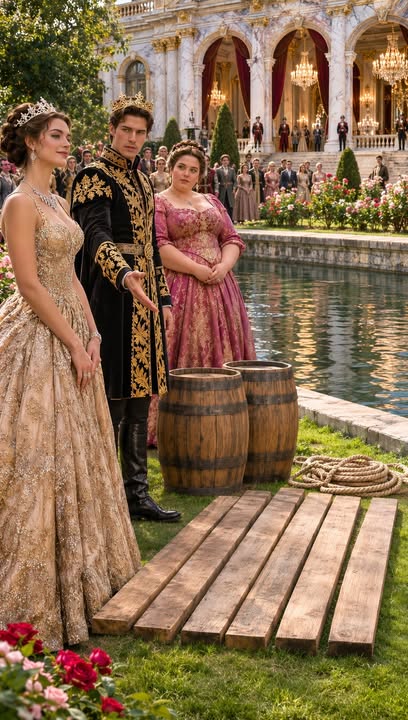
Slowly, she threaded the rope beneath the overlapping boards and began pulling it around the timber, tightening each turn with steady, practiced hands.
The rope creaked as it bit into the wood.
A few spectators leaned closer, their laughter fading into uncertain silence.
The young woman drew the final knot snug, then pressed her palm against the joined boards to test them.
They shifted slightly.
She frowned, loosened the rope, and started again, this time drawing the strands in a tighter pattern across the overlap.
The prince watched her hands rather than her face.
“What are you doing?” he asked.
“Trying to make two short planks behave like one longer one,” she replied.
“That sounds simple,” Lady Celestine said from behind him.
Her tone was smooth, but the amusement had gone from it.
“It is simple,” the young woman said, glancing up. “That doesn’t mean it can be careless.”
She finished the knot and pushed down on the joined boards with both hands.
This time, they held.
Only then did she reach for a third plank.
She set it beside the first two and tied it in place with another generous overlap, keeping the boards aligned as she worked.
The six planks became three long sections, each bound tightly at the joints.
The prince looked toward the canal.
“Those sections are still shorter than the distance across,” he said.
“By themselves, yes.”
She examined the barrels, rolled one closer to the water, and ran her fingers around its rim.
The barrel was sturdy, but its curved sides made it awkward to place precisely.
She turned it onto its side, then reached for the rope again.
The prince glanced at the thick lengths laid on the grass.
“Do you intend to lash the bridge to the barrels?”
“Not to the barrels,” she said. “The barrels would move.”
She placed one long plank section on the ground and tied a rope around its midpoint, leaving a long loop hanging from either side.
Then she repeated the same arrangement with the other two sections.
When she lifted one end, the rope loop tightened beneath the boards and held them together without slipping.
The prince’s expression changed.
“You’ve made a sling.”
“I’ve made a way to hold them steady,” she answered. “A sling would need to carry the weight. The wood should do that.”
She dragged the first section toward the canal’s edge.
The boards scraped softly over the grass.
She stopped before they reached the stone bank and studied the distance again, measuring it with her gaze.
Then she set the second section beside the first, overlapping their ends and binding them together.
The third section followed.
The full length stretched farther than the canal, though not by much.
She crouched and pressed each joint once more.
“Will the rope hold?” the prince asked.
“It should, if we keep the overlap broad and the knot tight.”
“You sound confident.”
“I sound hopeful,” she said. “Confidence is what comes after testing.”
A quiet murmur passed through the onlookers.
Lady Celestine stepped forward, her gold gown catching the late-afternoon light.
“You’re going to lay all of that across the canal?”
“If the prince will help me steady the far end.”
The prince looked at the narrow waterway, then at the joined planks.
“You want me to hold it?”
“I want you to help lower it without twisting the joints,” she said. “If you simply drop it, the weight may wrench the rope.”
For a moment, he seemed surprised not by her request, but by the care with which she had made it.
Then he removed his black gloves and handed them to an attendant.
“Tell me where you need me.”
She moved to the bank and placed the first section so that its end rested firmly on the stone.
The prince took the far end when she indicated, holding the boards level while she guided the middle across.
Together, they eased the long structure over the water.
The planks bowed faintly under their own weight.
The rope tightened around the overlapping joints.
She stopped them before the far end reached the opposite bank.
“Wait,” she said.
The prince held still.
She studied the boards, the stone ledge beneath her feet, and the small gap remaining on the other side.
“We’re short of the far bank by perhaps a handspan,” he said.
“Then we move the near end forward.”
“But that will leave less support beneath it here.”
“Only if we move it too far.”
She looked down at the first joint, checking that it still sat over the canal’s center.
Then she pointed to a flat stone that jutted slightly from the near bank.
“Set the end there, if you can.”
The prince shifted his grip and lowered the bridge by inches.
The first end settled onto the stone.
The far end touched the opposite bank with a soft wooden knock.
For a moment, nobody spoke.
The young woman placed one hand on the near section and pressed down carefully.
The bridge trembled, but the joints held.
She crouched to inspect them.
“Now we test it,” she said.
The prince nodded toward the rope.
“With what?”
“Not with a person yet.”
She tied one of the empty barrels to the loose rope and eased it onto the middle of the bridge.
The boards flexed beneath the weight.
The rope at the first joint pulled taut.
Nothing slipped.
The barrel remained steady.
The young woman leaned close, listening to the wood and watching the knots.
When the bridge held, she let out a slow breath she had not realized she was keeping.
“Good,” she murmured.
Lady Celestine’s gaze fixed on the joined planks.
“But it may still fail under someone’s weight.”
“Yes,” the young woman said. “That is why I’ll cross first.”
The prince studied her.
“You don’t need to prove anything more.”
“I know.”
“Then why?”
“Because it’s my structure, and I should be the first to trust it.”
Her voice was quiet, without triumph.
The prince’s expression softened.
He moved toward the bridge, but she raised one hand.
“Please stay where you are.”
“I can steady the far end.”
“You can, but that will change the weight on it. I need to know how it holds without help.”
He looked at the bridge, then back at her.
“Tell me when you want me there.”
She nodded.
The young woman gathered the rose-pink skirts of her gown in one hand and stepped onto the planks.
The first board gave a faint creak.
She paused, shifting her weight until the wood settled beneath her.
Then she took another step.
The canal water glimmered beneath the narrow bridge, reflecting the palace balconies in wavering lines.
A breeze stirred the fabric at her sleeves.
She kept her eyes on the far bank and moved at a steady pace, placing each foot near the center of the boards.
At the first joined section, she stopped.
The knot held.
She pressed down gently with one foot before moving forward.
The prince watched without speaking.
So did Lady Celestine.
The young woman crossed the second joint, then the third.
The boards flexed beneath her, but the overlaps remained firm.
When she reached the far bank, she stepped onto the stone and turned around.
For a heartbeat, the garden was silent.
Then a few hands began to clap.
The sound spread through the crowd, uneven at first and then warm enough to fill the space between the palace walls.
The young woman smiled, though her cheeks had flushed.
The prince crossed after her, testing each step more cautiously than she had.
When he reached the far bank, he looked down at the improvised bridge with new respect.
“You were right,” he said. “The materials were sufficient.”
“They were,” she answered. “But they needed to work together.”
His gaze rested on her face.
“So did the people using them.”
The words seemed to catch her unprepared.
She looked away, toward the canal.
For the first time since she had entered the garden, the laughter around her no longer sounded like a judgment she had to survive.
It sounded distant.
The prince walked beside her along the far bank.
“What is your name?” he asked.
“Elara.”
“Elara,” he repeated, as if taking care to remember it. “You examined the materials before you touched them. You tested the joints before trusting them. Most people would have hurried to impress the crowd.”
“Most people here were watching for me to fail.”
“Were you?”
She considered the question.
“Watching for me to fail?”
“Were you trying to impress them?”
Elara’s gaze returned to the bridge.
“I wanted to show that the challenge had an answer.”
“That isn’t quite the same thing.”
“No,” she said. “It isn’t.”
The prince seemed to hear the distinction and leave it undisturbed.
Behind them, the crowd began to shift back toward the garden path.
An attendant retrieved the remaining rope, while another carefully guided the barrel off the bridge.
Lady Celestine remained by the canal.
Her chin was lifted, and her posture was perfect, but the sparkle in her eyes had dimmed.
When Elara looked her way, Celestine gave a small, restrained nod.
It was not an apology.
It was not yet respect, either.
But it was something closer to acknowledgment than mockery.
The prince turned toward the palace.
“Would you walk with me?”
Elara hesitated.
“Where?”
“Somewhere we can talk without an audience.”
She glanced once at the people still watching them from the opposite bank.
Then she nodded.
They followed a quiet path that curved behind a row of clipped hedges and ended beside an old stone pavilion.
The palace rose behind them, its windows bright with the last of the afternoon sun.
From there, the canal was mostly hidden, though they could still hear water slipping over the stones.
The prince stood by the pavilion’s open archway.
“I asked you to demonstrate a practical solution,” he said. “You did more than that.”
“I used rope and wood.”
“You understood what the wood could bear.”
He rested one hand on the low stone railing.
“I’ve watched people in court mistake confidence for judgment. You did not.”
Elara studied him, searching his face for the faintest trace of mockery.
She found none.
“I learned not to confuse the two,” she said.
“From whom?”
The question was simple, but Elara’s answer did not come quickly.
She looked down at her hands.
There was a faint red line across one palm from pulling the rope tight.
“My father,” she said at last. “He was a carpenter.”
The prince’s expression gentled.
“He taught you to build?”
“He taught me to look at what was actually there before I decided what I wished to believe.”
A small smile touched her mouth, but it did not quite reach her eyes.
“When I was little, I thought he could fix anything. A loose table leg, a broken shutter, a gate that dragged across the ground.”
“Could he?”
“Usually. But he always tested the repair afterward.”
She traced the red mark on her palm with her thumb.
“He’d press against the joint or put weight on a beam, even if I told him it looked fine. He said a thing could appear strong and still be waiting for the moment it was asked to prove itself.”
The prince was quiet.
Elara went on, more softly.
“He taught me that listening to a structure was part of building it. The creak, the shift, the way a board settled. Those things told you what a person’s eyes might miss.”
“Those are useful lessons.”
“They were useful to him.”
The words came out more sharply than she intended.
She drew in a breath.
“He’s gone now.”
“I’m sorry.”
“Thank you.”
She looked toward the garden, where the last spectators were dispersing.
“People often heard his advice as criticism,” she continued. “He would point out a weakness before it caused trouble, and they would say he was being difficult. He never knew how to make a warning sound pleasant.”
“Warnings are not always pleasant.”
“No. But they can still be kind.”
The prince’s attention stayed with her.
“Did someone ignore one of his warnings?”
Elara’s fingers closed around the edge of her skirt.
“Not today,” she said.
It was not an answer, and he seemed to understand that.
He did not press.
Instead, he said, “The court may assume you won because you were clever.”
“I didn’t win because I was clever.”
“What would you say you won because of?”
She met his eyes.
“I paid attention.”
The prince smiled faintly.
“That may be rarer.”
Elara felt an unexpected warmth in her chest, and with it came a warning of her own.
She had spent enough of her life watching others decide what she could do before she had a chance to try.
Praise could be another kind of decision, especially when it came from a prince.
“Your Highness,” she said, “I hope you don’t think one successful bridge means I can answer every question.”
“I don’t.”
“Or that I came here only because I want a crown.”
“I don’t think that either.”
“Then why did you ask me to walk with you?”
He paused.
“Because you answered a challenge with a better question than the one I asked.”
“What question was that?”
“Whether the materials were meant to work alone.”
Elara considered him.
“And what question should you have asked?”
The prince’s smile deepened, though he looked thoughtful.
“Perhaps what each person here knows that I do not.”
It was the first time he had spoken to her as if the answer might matter beyond the contest.
Elara felt herself relaxing by a fraction.
“Then you should ask more people than the ones who already agree with you.”
“I will try.”
“That sounded like a promise.”
“It is.”
She looked down again at her hand.
The red line had faded to pink.
“Father used to say promises were like joints,” she said. “They were only as strong as the work put into them.”
The prince followed her gaze toward the bridge beyond the hedges.
“Then I should be careful what I promise.”
“You should.”
For a while, neither of them spoke.
The pavilion’s stone roof held the day’s warmth, and the garden smelled of damp earth and clipped rosemary.
Beyond the hedges, the palace bells chimed the hour.
The prince turned toward her.
“I would like to know more about your father’s work.”
Elara’s shoulders tightened.
“Why?”
“Because it shaped how you think.”
“That doesn’t mean you need to know everything he did.”
“No,” he said. “It doesn’t.”
His answer was immediate, unguarded.
That, more than his praise, made her look at him again.
“I won’t ask you to tell me what you’re not ready to share,” he said.
Elara’s eyes stayed on his.
“People say that when they expect you to share it anyway.”
“Then judge me by what I do next.”
She gave a quiet, almost surprised laugh.
“I suppose I will.”
They walked back toward the garden at an unhurried pace.
The bridge still lay across the canal, its joints secure beneath the ropes.
The prince paused beside it.
“Your design has another lesson,” he said.
“What’s that?”
“No single plank could reach the other side.”
“Not alone.”
“Yet each contributed to the whole.”
Elara looked at him carefully.
“Are you comparing a bridge to a court?”
“I might be.”
“Then I hope your court is sturdier than this one.”
“I’ll remember that.”
On the opposite bank, Lady Celestine stood with one hand resting on the stone ledge.
She had sent her attendants away and was studying the bridge as if she could read the sequence of Elara’s decisions from the rope and wood.
When she noticed them, she straightened.
“Your Highness,” she said, “the bridge held.”
“It did,” he replied.
Celestine looked at Elara.
“You chose an effective knot.”
“My father taught it to me.”
For an instant, something shifted in Celestine’s face.
It was so slight Elara might have mistaken it for a change in the light.
“What sort of knot?” Celestine asked.
“A binding knot with a doubled turn. It keeps the overlap from pulling apart when the weight shifts.”
Celestine’s gaze dropped to the rope.
“Your father was a carpenter?”
“Yes.”
“I see.”
Her response was too quick, too neat.
The prince noticed.
“Do you recognize it?” he asked.
Celestine seemed to collect herself.
“I’ve seen many knots. My family has supported repairs around the palace for years.”
“Then you know how much a sound joint matters,” Elara said.
“I do.”
For a moment, the three of them stood beside the canal while the light thinned over the water.
Celestine’s eyes lingered on the tightly bound boards.
Then she turned away.
“I should return to the palace,” she said. “My household will be looking for me.”
She began walking before either of them answered.
The prince watched her go.
“She seemed surprised by something,” Elara said.
“Perhaps by the bridge.”
“Perhaps.”
He studied the planks.
“Would you be willing to help us inspect an old footbridge in the gardens tomorrow?”
Elara turned toward him.
“Why?”
“It has been sagging slightly. The steward says the supports are sound, but I’d rather know than assume.”
“Is it open to visitors?”
“Not until it’s inspected.”
“Then I’ll look at it.”
The prince nodded.
“Lady Celestine knows the garden grounds better than anyone. I expect she’ll join us.”
Elara glanced toward the path Celestine had taken.
“Does she know my father?”
“I don’t know.”
The answer was honest, but it did not ease the feeling gathering beneath Elara’s ribs.
She looked back at the bridge she had made, at the rope drawn tight around the planks.
For the first time since she had stepped onto it, the knots seemed less like proof of what her father had taught her and more like a question he had left behind.
“Then tomorrow,” she said.
The prince offered his hand to help her across the stepping stones beside the canal.
Elara looked at his hand for a moment before accepting it.
His grip was steady, but he did not hold on longer than she needed.
As they reached the garden path, she looked back once more.
The makeshift bridge rested quietly above the water.
On the far bank, where the boards met the stone, a short tail of rope had come loose from the final knot.
Elara frowned.
She was certain she had trimmed it clean.
The prince followed her gaze.
“Did something shift?”
“I don’t know.”
She started back toward the bridge, but a palace attendant approached from the path, carrying a small sealed note.
“Your Highness,” he said. “Lady Celestine asked that this be given to you.”
The prince broke the seal.
Inside was a single line, written in an elegant hand.
The old garden bridge was inspected and repaired years ago. My family paid for the work.
Beneath it, in smaller writing, was a question.
Why does your new guest tie my father’s knot?
**–END OF PART 2–CLICK “NEXT” AT THE BOTTOM OF THE PAGE TO CONTINUE READING**
* * *
[NEXT: PART 3](https://storyly.idolsgift.com/blog/part-3-the-secret-beneath-the-planks-069)
✓ Lynn R. Adams
Slowly, she threaded the rope beneath the overlapping boards and began pulling it around the timber, tightening each turn with steady, practiced hands. The rope creaked as it bit into the wood. A fe…