PART 2: The Secret Beneath the Music 046
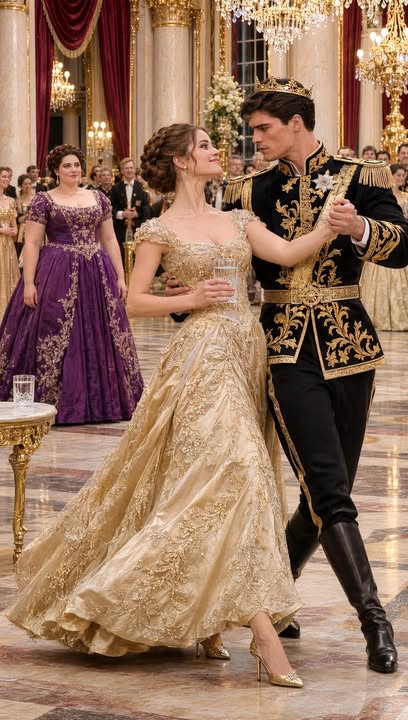
I moved before he finished leading it, shifting my weight into the turn he had only just begun.
The water tipped toward the rim.
For one suspended instant, the ballroom seemed to hold its breath with it.
Then the glass steadied in my hand, and not a drop escaped.
The prince completed the reversal a heartbeat later, his palm guiding me through the final arc.
Our feet found the next measure together.
A whisper traveled through the watching crowd, followed by another, and then the orchestra swept us onward as if nothing extraordinary had happened.
His eyes met mine.
“Interesting,” he said.
“Is that what you call it when someone keeps your glass from emptying onto the floor?”
“It’s what I call it when someone moves before I lead.”
“I didn’t move before you led.”
His brows lifted slightly.
“You did.”
“I moved before you finished.”
For the first time that evening, the prince’s composure slipped into something almost like a smile.
Around us, the ballroom brightened with gold reflections from the chandeliers, but I kept my focus on the subtle pressure of his hand against my back.
He led us into a slower sequence.
I adjusted my stride, letting my elbow soften and my wrist remain steady.
The water made a quiet circle in the glass, then settled.
“You’re not watching your hand,” he said.
“I know where my hand is.”
“Most people keep looking at the water.”
“Most people are trying to stop the water from moving.”
“And you?”
“I’m trying to understand why it moves.”
His palm changed pressure.
I felt the signal travel through his fingers and into the space between us, not a shove or a pull, but a small invitation to shift my balance.
I followed.
The next turn came quicker.
My skirt swept over the marble, and the crystal glass remained level.
The prince’s expression had grown intent, but the tension in his shoulders eased a fraction.
He was still leading with care.
That was what surprised me most.
The challenge had looked designed to catch us out, yet his touch did not feel careless or cruel.
He was measuring every change in movement, as if he wanted to know whether I would notice.
The orchestra carried us around the ballroom.
At the edge of the crowd, the woman in champagne gold watched without smiling now.
Her hands were folded at her waist, and the bright stones at her neckline caught the light whenever she turned her head.
I wondered whether she had hoped I would fail.
Then the thought seemed unfair.
Perhaps she was only waiting to see what I would do.
The prince shortened his next step.
I shortened mine.
He turned sharply to the left, and I let my shoulder follow without allowing the motion to travel into my wrist.
A soft ripple trembled across the water.
Nothing spilled.
A man near the orchestra’s raised platform leaned forward.
Somewhere behind him, a woman whispered my name.
I had not realized how tightly I was holding my breath until the prince said, “You can breathe.”
“I am breathing.”
“Not convincingly.”
“That sounds like a problem with your standards.”
“Perhaps.”
His voice carried the faintest warmth.
I let out the breath I had been holding, and the hand around the glass relaxed without loosening.
The melody began to rise.
I could feel the end approaching, though the prince made no effort to ease the pace.
He gave me another quick change of direction.
This time, I had already read the shift in his supporting hand, the minute change in pressure that came before his shoulder turned.
I adjusted my balance.
He completed the lead.
We moved together.
The final measure arrived with the strings lifting into a bright, ringing note.
He brought us to a smooth stop.
The glass was still full to its narrow line.
Not a drop had fallen.
For a beat, the ballroom remained silent.
Then applause broke over us.
It started from the far side of the room, where one of the older court advisers had been watching with his hands clasped behind his back.
Others joined him.
The sound swelled beneath the chandeliers, warm and startled, until even the orchestra’s musicians were smiling.
I lowered the glass slightly.
The prince released my hand, though his other remained at my back for a moment longer than the final step required.
“Nicely done,” he said.
“Thank you.”
“Tell me how you anticipated the reversal.”
The applause was fading, but the crowd had not moved away.
I became aware of every face turned toward us, every interested glance that might become a story by morning.
I kept my expression calm.
“Years of dance training,” I said. “You learn to read a partner’s weight shifts, not just follow the steps.”
“Where did you train?”
“At a neighborhood studio in the city, mostly. My mother taught me when I was young, and I kept going after she was gone.”
Something in his face changed at the mention of my mother.
It was slight enough that I could have mistaken it for the shift of candlelight.
“Was she a dancer?” he asked.
“She was,” I replied. “A very good one, according to the people who knew her.”
The prince looked as though he had another question.
Before he could ask it, a court attendant came forward to take the glass from me.
I handed it over carefully.
“Would you like some water?” the attendant asked.
“I think I’ve had enough water for tonight.”
That drew a small laugh from the prince.
The sound was quiet, but several people nearby noticed it.
The woman in gold was among them.
She had come closer to the edge of the dance floor, where the other contestants had gathered.
Her gaze moved from the prince to me, then to the glass in the attendant’s hand.
For a moment, our eyes met.
I expected a pointed remark.
Instead, she gave me a measured nod.
It was not quite congratulations.
It was not quite a challenge, either.
Then she turned away to speak with another contestant.
The prince glanced in her direction.
“Do you know her?” he asked.
“Not personally.”
“She seems to know you.”
“She knows what everyone else knows.”
“And what is that?”
“That I was the last woman left.”
His eyes rested on me, thoughtful.
“That isn’t what I meant.”
“Then you’ll have to ask a clearer question, Your Highness.”
The formality came out before I could soften it.
He looked down briefly, as if considering my answer, and then nodded.
“You’re right.”
That surprised me more than the applause.
I had expected a prince to be accustomed to having people meet him halfway, or more than halfway, in every conversation.
Instead, he seemed willing to accept that he had not been clear.
“I’m sorry,” he said.
I studied him, searching for the performance beneath the apology.
His expression held no easy charm, no impatience.
Only a quiet seriousness that did not quite fit the bright occasion.
“Thank you,” I said.
The court master called the contestants to gather near the center of the ballroom.
The remaining women formed a loose line, while the prince stepped aside to speak with an official.
I joined the others, aware of the lingering attention that followed me.
A contestant in a silver gown whispered, “I thought the water would fly everywhere.”
“So did I,” said another.
“Did you know he was going to reverse?”
“Not exactly.”
I did not explain that I had felt the decision in the prince’s hand before I saw it in his shoulders.
That sort of understanding was difficult to describe without sounding as though I had been reading his mind.
The woman in champagne gold stood a few places away.
Her expression was carefully composed now, but the stiffness around her mouth had not entirely disappeared.
The court master announced that the challenge had ended and that the remaining contestants would be informed of the next round in the morning.
A ripple of conversation passed through the ballroom.
The women began to drift toward the doors, their attendants appearing from the sidelines to collect shawls, gloves, and discarded wraps.
I had almost reached the entrance when I heard the prince call my name.
I turned.
He stood beside one of the tall windows, no longer surrounded by the officials who had been waiting for him.
The light from the ballroom made the gold embroidery on his jacket seem almost liquid.
“May I speak with you?” he asked.
His tone was formal enough to be overheard, but his gaze was not.
I glanced toward the departing contestants.
“If this is about my performance, the applause has already answered.”
“It isn’t.”
“Then what is it about?”
He hesitated, and that pause told me he had not rehearsed what came next.
“I wanted to ask something without an audience.”
I studied the quiet space around him.
There were still people nearby, but the officials had moved toward the main doors, and the court master was occupied by a pair of reporters.
“All right,” I said.
He gestured toward an alcove beside the window, where a tall arrangement of white roses screened us from most of the ballroom.
I followed him there, leaving enough room between us to make it clear that I had not forgotten who he was.
For a moment, neither of us spoke.
Beyond the glass, the palace gardens were dark and silvered with moonlight.
The music had ended, but I could still feel its rhythm in my legs.
“You said your mother taught you,” he said at last.
“She did, at first.”
“What did she teach you?”
“Not to fight the movement.”
He looked toward the ballroom.
“That sounds familiar.”
“It’s what every good teacher says, eventually.”
“And did you believe her?”
“I was nine. I believed the studio floor was harder than it needed to be and that my feet were always tired.”
This time, his smile was more evident.
“My mother used to say that the most important lessons were the ones you understood later.”
“Was she right?”
“Usually.”
A silence settled between us, gentler than the one in the center of the ballroom.
Then he glanced down at his right hand.
It was resting at his side, fingers curled slightly inward.
His thumb moved once against the seam of his jacket.
“Why did you set that challenge?” I asked.
His eyes lifted.
“Did you think I wanted to make everyone fail?”
“I thought you wanted to discover who could manage an unpredictable lead.”
“That’s part of it.”
“And the rest?”
He looked down at his hand again.
The movement was small, but this time I noticed a tremor in his fingers, a quick, delicate quiver that passed before I could decide whether I had really seen it.
His hand went still.
I said nothing.
The prince drew in a measured breath.
“I’ve been practicing that dance alone,” he said.
I waited for him to continue.
“Not the whole thing. Just the difficult transitions.”
“For the challenge?”
“For the last several months.”
The answer took me by surprise.
“Why alone?”
He looked toward the window, but his gaze did not seem to see the gardens.
“Because I wasn’t sure I could lead someone safely.”
The words were quiet.
They seemed to alter the space around us more than any sudden announcement could have.
“Safely?” I asked.
“Without asking a partner to compensate for me. Without making the movement unpredictable in a way they couldn’t read.”
“You were testing whether someone could read your signals.”
“I was testing whether anyone would notice them.”
“That’s not the same as trying to make us fail.”
“No,” he said. “It isn’t.”
His gaze dropped to his hand once more.
“I’ve been dealing with a tremor. It comes and goes. Some days, I can hold a glass without thinking about it. Other days, my hand won’t stay as steady as I want it to.”
I remembered the contestants who had spilled water at his sudden turns.
For the first time, the challenge looked different in my mind.
His changes had been sharp, but never careless.
The shortened steps, the quick reversals, the altered pressure of his hand.
Each one had been a signal.
Not a trap, exactly.
A question.
“And the women who went before me?” I asked.
“They weren’t supposed to prove they were inadequate.”
“But they failed.”
“Yes.”
He accepted the word without looking away.
“I knew the dance could be difficult. I didn’t know how difficult it would feel to lead someone who couldn’t sense what I was trying to communicate.”
He looked toward the open ballroom, where the last of the contestants were disappearing beyond the doors.
“I thought if someone paid attention, I might be able to manage it.”
I could hear the sincerity in his voice.
I could also hear how carefully he had chosen to reveal only what he could bear to say.
“You could have told us there was more to the challenge than a full glass,” I said.
“I could have.”
“But you didn’t.”
“No.”
“Why not?”
His fingers flexed once.
“Because the court has a way of turning a private difficulty into a public conclusion.”
“A conclusion about what?”
“Whether I’m fit to lead.”
There it was.
Not a complaint, and not a plea for sympathy.
A fear, plain and human, beneath the gold of his title.
I thought of the way he had watched my balance before the dance began.
Not my dress.
Not my shape.
My balance.
“You don’t want people to mistake a tremor for a lack of skill,” I said.
“I don’t want them to decide what I can do before I’ve had the chance to do it.”
I understood that more deeply than I wanted to.
All evening, people had looked at my body and my gown and decided what I could not do.
The prince had been watched for different reasons, but the weight of other people’s assumptions was not unfamiliar.
“I didn’t know,” I said.
“You weren’t meant to.”
“Then why tell me now?”
He held my gaze.
“Because you noticed the signals.”
That answer left me with nothing ready to say.
A faint movement passed through his right hand again.
This time, I could not mistake it.
His fingers trembled once, then settled.
He folded them lightly against his palm.
The confession had not been a performance.
I looked at his hand, then back at his face.
“You should not have had to test everyone to find that out,” I said.
“Perhaps not.”
“And you should not have to practice alone.”
His expression changed, and something guarded returned to it.
“Would you say that if you knew what the court might make of it?”
“I don’t know what the court would make of anything.”
“That may be the wisest answer I’ve heard tonight.”
“I doubt that.”
“Why?”
“Because I’m still trying to decide whether your challenge was fair.”
He nodded, accepting the uncertainty.
“It wasn’t entirely.”
The answer surprised me.
“You admit that?”
“I asked people to dance without explaining what I was afraid of.”
“And now?”
“Now I’ve explained it to one person.”
The words were careful, but they carried a trust I had not expected him to offer.
I glanced toward the ballroom.
The court master was watching from a distance, not close enough to hear us, but close enough to notice that we had not returned.
I wondered whether the prince had spent months hiding his hand from everyone.
I wondered how lonely it was to carry a fear that could be seen only when the music stopped.
“Your Highness,” I said, softer than before, “I don’t know what you expect me to do with that.”
“Nothing.”
“Nothing?”
“You don’t owe me a solution.”
His voice held no pressure.
That, more than the confession itself, made me believe him.
“I only wanted you to know that the challenge wasn’t meant to reward grace and punish mistakes.”
“Then what was it meant to do?”
He looked at his hand again.
“To tell me whether I could trust someone to move with me instead of merely obeying.”
I thought of the turn, the way I had felt his balance begin to shift before his shoulder followed.
“You can’t build trust with a test and no explanation,” I said.
“I’m beginning to understand that.”
The answer softened something in me, though I did not let it show in my face.
I still remembered the ballroom’s laughter after the first spill, the shock in the contestants’ eyes when they realized the prince would not slow down for them.
I still wondered whether the challenge had been designed to expose their mistakes, even if that had not been his only intention.
But I also remembered the care in his hand.
The signals were there.
He had simply been too afraid to tell anyone why they mattered.
“I should go,” I said.
“Of course.”
Neither of us moved at once.
Then the prince stepped back to give me room.
“Thank you for dancing with me,” he said.
“You’re welcome.”
“And for telling me I wasn’t fair.”
“I didn’t say you weren’t fair.”
“You said I shouldn’t have tested everyone without explaining what I was afraid of.”
“That is not the same thing.”
“No,” he said. “But it is close.”
I could not help smiling.
His answering expression was brief and unguarded.
Then the court master called to him from across the room, and the moment folded itself away.
I turned toward the doors.
Behind me, the prince began speaking with the court master about the morning’s schedule.
I reached the threshold before I heard the orchestra musicians starting to pack their instruments.
A violinist played a single lingering note, soft and unsteady as it faded beneath the ballroom’s high ceiling.
I paused.
The prince had told me he practiced alone.
But I found myself wondering whether he had ever had anyone to listen.
**–END OF PART 2–CLICK “NEXT” AT THE BOTTOM OF THE PAGE TO CONTINUE READING**
* * *
[NEXT: PART 3](https://echoesofstories.idolsgift.com/blog/part-3-the-secret-beneath-the-music-046)
✓ Lynn R. Adams
I moved before he finished leading it, shifting my weight into the turn he had only just begun. The water tipped toward the rim. For one suspended instant, the ballroom seemed to hold its breath wit…