PART 2: The Secret Beneath the Lock 057
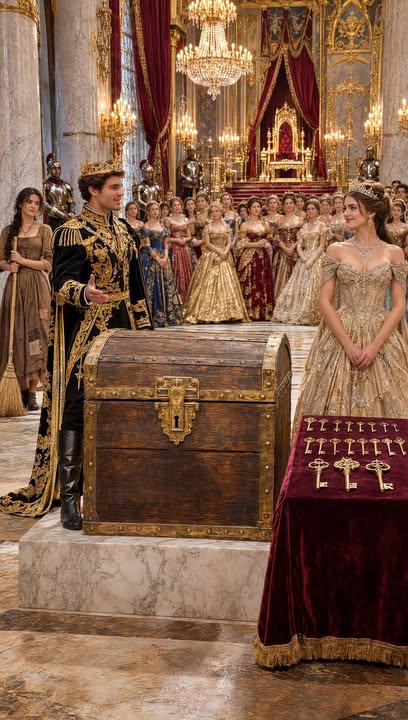
The smallest key touched the brass keyhole with a faint, delicate scrape.
The maid paused, keeping her fingers steady as the whole throne room watched.
The prince stood close enough to see the tension in her hands, but he did not urge her on.
She eased the key inward.
It slid in farther than any of the others had, yet when she tried to turn it, the lock remained still.
A murmur stirred among the gathered nobles.
The noblewoman in the champagne-gold gown tilted her chin, as if the silence itself had proved her right.
The maid did not pull the key out.
Instead, she bent nearer to the lock, studying the narrow seam around its face.
There, almost hidden beneath the brass plate, she noticed a tiny notch no wider than the tip of her smallest finger.
“Your Highness,” she said, “may I try something?”
The prince’s eyes followed hers to the lock.
“You may.”
She set her thumb against the key’s bow and turned it backward, slowly and carefully.
A faint click sounded from inside the chest.
The room fell silent again.
The maid drew a small breath, then turned the key forward.
This time, it moved.
Another click followed, deeper than the first, like a latch lifting somewhere within the oak.
The prince’s expression changed, surprise giving way to a cautious hope.
“Did it open?” someone whispered.
The maid eased her hand away from the key.
The chest’s lid remained closed, but a thin panel beneath the lock had shifted outward by less than an inch.
The royal timekeeper glanced at the prince.
“Your Highness, the contest—”
“Is over,” the prince said, his voice calm and firm. “The lock has been opened.”
The nobles stirred, and a scattered applause began, hesitant at first, then swelling across the marble hall.
The maid stepped back from the chest.
She looked as if she had expected the mechanism to move, but not for the room to suddenly turn toward her with such attention.
The noblewoman’s smile had vanished.
She looked from the small key to the narrow opening beneath the lock, her brows drawn together.
The prince raised a hand, and the applause quieted.
“Let us see what it was made to protect.”
He approached the chest, but before he could reach for the panel, the maid spoke.
“Perhaps we should be careful, Your Highness.”
Her voice was soft, yet the words carried.
“If it has been closed for years, the wood or anything inside may be fragile.”
The prince stopped and considered this.
“You are right.”
He called for the royal steward, who brought a pair of thin linen gloves and a small tool for lifting the panel without forcing it.
The guards held back the curious crowd as the prince and the maid knelt beside the chest.
From this close, the brass fittings looked less like decoration and more like the parts of a precise instrument.
The prince studied the little opening.
“Do you know what you are looking for?”
“No,” the maid answered. “Only what I am not looking for.”
“And what is that?”
“A treasure someone would display.”
A flicker of amusement crossed his face.
“What makes you say that?”
“The lock was built to be misunderstood,” she said. “If the chest were meant to impress people, it would have been opened with a grand key in front of everyone.”
The prince regarded her for a moment.
“You think it was meant to keep something private.”
“I think whoever made it wanted the right person to find it.”
The words seemed to settle between them.
Then the steward carefully eased the panel forward.
It slid out with a dry whisper, revealing a narrow inner compartment no wider than a book.
There was no glitter of gold, no jeweled crown, and no pouch of coins.
Only a faded ribbon, folded in upon itself, and a scrap of paper that had browned along its edges.
The prince leaned closer.
For a moment, he did not move.
The ribbon was a deep blue once, though time had softened it to a shade like evening dusk.
A small silver crest had been stitched near one end.
The prince’s hand hovered over it.
“I know that crest,” he murmured.
The steward looked at him.
“It is the old royal emblem,” the prince said. “The one my mother used before the design was changed.”
The maid looked down at the silver thread.
She knew that pattern.
Not from the palace, but from the wooden box her mother had kept beside her bed.
Her mother had owned a length of ribbon with the same tiny crest sewn into its edge.
The maid had seen it only a handful of times, tucked beneath folded fabric and a little packet of dried lavender.
When she had asked about it as a child, her mother had merely said, “It belongs to a time before you were born.”
Now the maid stared at the ribbon in the chest, and the old answer returned with a meaning she had never understood.
The prince picked up the paper with gloved fingers.
It was only part of a letter, torn along one side, and the ink had faded to brown.
He read the first line silently.
Then he read it again.
The room around him seemed to disappear.
The maid noticed the change in his face.
“Your Highness?”
He blinked, as though returning from a distant place.
“This is my mother’s handwriting.”
His voice was quieter now.
The prince turned the fragment toward the light, careful not to touch the brittle surface.
The letter began with a name, but the remaining words were too faint for the maid to read.
The prince’s eyes moved over the lines, and something in his expression softened.
He looked younger than he had before, no longer the prince who had announced a competition from the dais, but a son who had found a message from someone he had lost.
“What does it say?” the maid asked.
“I can make out only a few words.”
He read them aloud, slowly.
“‘Keep it where the smallest key can reach…’”
The prince paused.
Beneath that, a line of ink had blurred almost completely.
“Then, ‘…and trust the one who knows how to listen.’”
The maid felt a chill move through her, though the hall was warm.
The prince studied the scrap again.
“Those words were written by my mother.”
“How can you be certain?”
“I have seen her letters. My father kept several in his private study.” He swallowed. “She shaped the letter ‘k’ with a small loop, like this.”
He pointed to the line, then lowered his hand.
For several seconds, neither of them spoke.
The crowd was no longer murmuring.
The court had watched a maid open a lock, but the discovery before them was no longer part of the contest.
The prince carefully placed the fragment back beside the ribbon.
“Please clear the hall,” he told the steward. “Everyone except the guards on duty may leave.”
Some of the nobles exchanged disappointed looks, but the prince did not soften his request.
The contestants filed out in a rustle of silk and whispered questions.
The noblewoman in gold lingered at the edge of the platform.
Her eyes rested on the maid, then on the prince.
“I hope you will not mistake a fortunate guess for understanding,” she said.
The words were composed, but her usual certainty had thinned.
The maid met her gaze without answering.
The prince did.
“She did not guess. She observed.”
The noblewoman’s mouth tightened.
For an instant, it seemed she might say more.
Instead, she gave the prince a small, formal bow and joined the others.
When the doors closed, the throne room grew unexpectedly vast.
The chandeliers still shone above them, and the chest remained on its platform, but the audience’s presence had been replaced by a quiet that felt almost private.
The prince asked the steward to bring a shallow archival tray.
He placed the ribbon and letter fragment inside with painstaking care.
Then he turned to the maid.
“What is your name?”
“Lina, Your Highness.”
“Lina,” he repeated, as if committing it to memory. “You were right to warn me not to rush.”
She glanced at the open compartment.
“I did not know what was inside.”
“Neither did I.”
He looked at the ribbon again.
“I thought this afternoon was about choosing a wife.”
Lina’s face warmed, though she could not tell whether from embarrassment or unease.
“I thought so too.”
“And now?”
“Now I think the chest has a better sense of timing than the court.”
A surprised laugh escaped him.
It was not the practiced laugh of a prince acknowledging a clever remark.
It was a genuine, brief sound, and it changed the air between them.
Lina had expected him to ask about the key, perhaps to praise her skill before returning to the business of the competition.
Instead, he looked at her as though her thoughts mattered beyond what her hands had managed to do.
“You said your father repaired locks,” he said.
“He did.”
“Did he ever show you how a lock could be built to hide a second opening?”
“No, Your Highness. He used to say that a lock was a conversation between the person who made it and the person who hoped to open it.”
The prince lowered his gaze to the compartment.
“Then whoever made this expected someone to listen.”
Lina thought of her mother’s old wooden box.
It had been simple, made of dark wood with a brass clasp that never quite shut properly.
Her mother had kept it wrapped in a length of linen, though she had never allowed Lina to open it.
When Lina was small, she had once asked why the box mattered so much.
Her mother had turned the key in the clasp and said, “Some things are safer when they are not explained too soon.”
At the time, Lina had thought it was one of her mother’s gentle, puzzling sayings.
Now the thought returned with a force that made her fingers curl against her palm.
The ribbon in the chest had been almost exactly like the one her mother kept.
“Your Highness,” she began, then stopped.
The prince waited.
“My mother had a ribbon with the same crest.”
He did not look away from her.
“Are you certain?”
“I saw it only a few times. She kept it in a wooden box with some of her sewing things.”
“Did she tell you where it came from?”
“No. She said it belonged to a time before I was born.”
The prince glanced at the silver crest.
“My mother died when I was young,” he said. “There are many things about her I have never been able to ask.”
Lina heard something beneath the words that she recognized, though their lives had been very different.
She had lost her mother too, and there were questions she had been too young to think to ask while her mother was alive.
“I am sorry, Your Highness.”
“So am I.”
For a moment, the title seemed to stand between them like a closed door.
Then the prince said, “You need not call me Your Highness while we are alone.”
Lina looked up.
“I should call you what, then?”
He hesitated, perhaps realizing how unfamiliar it was to be asked a question without ceremony.
“Edmund,” he said. “My name is Edmund.”
The name sounded unexpectedly ordinary in the vast room.
Lina gave a small nod.
“Then you may call me Lina.”
“I already do.”
She smiled, and this time he smiled back.
They stood quietly beside the chest while the steward prepared the tray for the palace archivist.
The prince did not ask Lina to return to her duties at once.
Instead, he asked her how she had come to serve in the palace.
“My mother worked here as a seamstress,” Lina said. “After she was gone, the household kept me on as a maid. The steward said it was kinder than sending me away, but I think they also needed another pair of hands.”
“Your mother worked here?”
“For many years, I believe. She rarely spoke about the palace.”
“Do you know which rooms she worked in?”
“Mostly the royal sewing room, according to the older servants.”
The prince glanced toward the fragment.
“My mother’s clothes were mended there.”
The connection seemed small when spoken aloud, but it made Lina’s memory of the ribbon feel less like coincidence.
She wondered whether her mother had known the queen.
She wondered whether the queen had known her mother.
She wondered why no one had ever told her.
The prince looked toward the doors through which the contestants had left.
“I have spent years surrounded by people who know how to speak to a prince,” he said. “It is strange how rarely they speak to me.”
Lina considered her answer.
“Perhaps they are afraid of saying the wrong thing.”
“And you are not?”
“I am afraid of many things.”
“But you speak anyway.”
“My mother said that silence can protect a person, but it can also keep them alone.”
The prince was quiet.
“Did she say that often?”
“Only when I asked too many questions.”
He smiled faintly.
“Perhaps she knew you would ask the important ones eventually.”
Lina looked at the ribbon in the tray.
“I wish I had asked more while I had the chance.”
The prince’s expression softened.
“I know.”
There was no grand consolation in his voice, no attempt to explain away grief.
That was why Lina believed him.
The steward returned with a request from the archivist to examine the materials in a secure room.
The prince agreed, then turned to Lina.
“I would like you to be there.”
She glanced at her worn sleeves and frayed cuffs.
“I am only a maid.”
“You are the reason we found it.”
“The court may not agree.”
“The court was wrong about the keys.”
His words were gentle, but they held a quiet firmness.
Lina looked at the prince and saw that he was not offering her a favor to display his generosity.
He was asking for her because he trusted what she had noticed.
“Then I will come,” she said.
The prince placed the small key in a linen pouch and handed it to the steward.
Before he left, he looked back at the chest.
“What do you think my mother wanted someone to find?”
Lina watched the faded ribbon catch a glimmer of chandelier light.
“I don’t know.”
“But you think it matters.”
“I do.”
“Why?”
“Because she hid it where a person would have to look closely, and because my mother kept something that matched it.”
The prince considered this.
“Then perhaps the secret was never meant to belong to one of us alone.”
The thought unsettled Lina more than any of the strange words in the letter.
She had spent years believing her mother’s life before Lina was a closed room with no door.
Now, for the first time, she wondered whether the door had been there all along, waiting for the right key.
The prince reached for the tray, but the steward gently advised that the archivist should carry it.
Together, they left the throne room by a side passage, away from the servants and nobles gathering beyond the main doors.
Halfway down the quiet corridor, the prince stopped.
“I should thank you properly,” he said.
“You have already thanked me.”
“Not for opening the chest. For taking the time to see what the others missed.”
Lina lowered her eyes, unsure how to receive the words.
“My father taught me to look carefully.”
“Then I am grateful to him too.”
They continued toward the archive rooms.
At the entrance, the steward was called away by a guard with a message from the king’s private secretary.
The prince stayed with Lina beside a tall window overlooking the palace gardens.
For the first time since she had approached the table of keys, they were entirely alone.
The prince turned to her.
“Do you remember the exact pattern on your mother’s ribbon?”
“Not every stitch, but I remember the crest. It had a tiny silver crown above two crossed branches.”
He looked toward the tray.
“That is the same one.”
Lina’s throat tightened.
“Do you think she knew your mother?”
“I don’t know,” he said. “But I want to find out.”
The answer was simple, and she felt the honesty in it.
She wanted to know too.
Behind them, the archivist opened the secure room.
As the prince stepped forward, the steward returned, carrying the tray.
The maid glanced once more at the folded letter fragment.
A line had been hidden beneath the ribbon until the archivist shifted the tray.
Now, in the light from the window, the last visible words could be read.
They were written in the same careful hand as the rest:
“Ask the seamstress what she kept safe.”
Lina stopped breathing.
The prince read the words over her shoulder.
Then he turned to her, his face changed by the same question that had risen in her heart.
“Lina,” he said quietly, “what exactly did your mother keep in that wooden box?”
**–END OF PART 2–CLICK “NEXT” AT THE BOTTOM OF THE PAGE TO CONTINUE READING**
* * *
[NEXT: PART 3](https://storyly.idolsgift.com/blog/part-3-the-secret-beneath-the-lock-057)
✓ Lynn R. Adams
The smallest key touched the brass keyhole with a faint, delicate scrape. The maid paused, keeping her fingers steady as the whole throne room watched. The prince stood close enough to see the tensi…