PART 2: The Secret Beneath the Little Horse 052
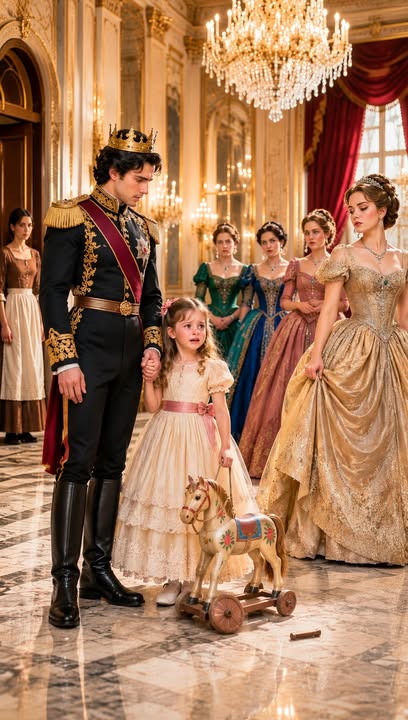
Part 2 – The Secret Beneath the Little Horse
The tiny wooden peg slid into place with a soft click.
The maid held the horse steady for a moment, as if listening for any sign that the repair might fail.
Then she eased her fingers away.
The wheel remained on its axle.
The princess leaned closer, her breath caught between hope and worry, and gave the horse a tentative turn.
It rolled smoothly across the maid’s palm.
A small sound escaped the child—not quite a laugh, but something gentler and brighter than the sobs that had filled the hall.
The maid looked up at her.
“It’s all right,” she said softly. “Your horse is still yours.”
The princess stared at the toy, then at the stranger kneeling beside her.
Her little fingers reached out and touched the wheel as though she needed to prove it was real.
“It works,” she whispered.
“It does,” the maid replied. “You might want to give it a little rest before riding it through the whole kingdom.”
For the first time that afternoon, the princess’s mouth curved into a smile.
It was small and uncertain, but it transformed her tear-streaked face.
The prince lowered his gaze, and something in his expression softened so completely that even the nobles who had been watching the contest began to look away, as though they had witnessed a private moment.
The maid offered the horse back to the girl.
The princess took it carefully, cradling it against her chest.
Then, instead of turning toward her father, she reached for the maid’s sleeve.
“Will you stay beside me?” she asked.
The question seemed to surprise her as much as it did everyone else.
The maid’s hand paused in midair.
She did not look toward the prince for permission, nor toward the silent nobles for approval.
She looked only at the child.
“If you’d like me to,” she said.
The princess nodded, holding tight to the horse with one hand and to the maid’s sleeve with the other.
The prince watched them for a long moment before he rose to his feet.
“Thank you,” he said.
The words were simple, but they carried more feeling than the formal praise the court might have expected.
The maid lowered her eyes.
“I’m glad it could be fixed, Your Highness.”
“How did you know what to do?” the prince asked.
He spoke without challenge or ceremony, with the honest curiosity of someone who had watched a small, careful act accomplish what rank and wealth could not.
The maid glanced down at the horse.
“The wheel wasn’t broken,” she said. “The little peg had only slipped out. I thought it might go back in without forcing it.”
“And if it had been broken?”
“Then I would have told you so.”
The prince gave a faint, thoughtful smile.
“That may be the wisest answer I’ve heard all day.”
A few of the nobles shifted, unsure whether to laugh or remain solemn.
The rejected noblewoman, still standing near the assembled candidates, smoothed the skirt of her champagne-gold gown.
Her earlier disdain had been replaced by a guarded expression, but she said nothing.
The prince’s attention returned to the maid.
“You must have learned this somewhere.”
For a moment, the young woman’s eyes seemed to drift beyond the bright hall, beyond the chandeliers and marble columns, toward a place none of the court could see.
“My father taught me,” she said.
She folded her hands in her lap, careful not to brush the little princess’s fingers.
“He was a carpenter in the village where I grew up. He mended furniture, made stools and cupboards, and sometimes carved toys for children who couldn’t afford anything fancy.”
The princess listened without moving.
“He used to say that a small thing deserved patience just as much as a large one,” the maid continued. “Especially if someone loved it.”
The prince’s face changed at those words.
Not dramatically, but enough that the maid noticed.
The little girl looked down at her horse.
“My mother gave him to me,” she said.
The hall seemed to grow still around her.
The prince’s hand, resting at his side, curled once and then relaxed.
“Yes, sweetheart,” he said quietly. “She did.”
The princess pressed the horse against her dress.
The maid’s expression softened with understanding.
“I’m glad I could help you keep something that matters.”
The princess looked up at her.
“Did your father make toys like this?”
“Somewhat like this,” the maid said. “He made me a little wooden bird when I was very small, but I carried it everywhere, and it lost its tail.”
The child’s attention sharpened.
“What happened to it?”
“He made me a new tail. Then I lost one of its wings.”
The maid’s eyes brightened with the memory.
“He said that if I was going to carry the bird everywhere, I ought to learn how to help mend it.”
The princess considered this with grave attention.
“Did you fix it?”
“Not at first,” the maid admitted. “My first attempt was crooked.”
A tiny smile returned to the child’s face.
“Was it still a bird?”
“It was,” the maid said. “And it was still mine.”
The princess gave the horse a gentle hug.
The prince watched the exchange, and for the first time since the challenge began, the tension in his shoulders eased.
He had seen his daughter answer questions from tutors and physicians, had seen her accept gifts from visitors, and had watched her endure the careful kindness of people who hoped to please him.
But she had rarely spoken so freely with anyone outside her familiar circle.
The words were few.
Still, they were hers.
The prince turned toward the court.
“The repair was made without replacing any part of the horse,” he said. “The wheel is secure, and the toy has not been changed.”
There was a murmur of agreement.
He continued, “The maid has fulfilled the challenge.”
The nobles looked toward him, then toward the young woman and the child.
A few faces showed polite approval.
Others revealed unease.
The prince did not seem to notice.
“More importantly,” he said, “my daughter is smiling.”
The princess’s smile faded a little at the attention.
She lowered her face and tucked the horse beneath her chin.
The maid immediately shifted so that the child was partly sheltered behind her shoulder, not hiding her, but allowing her a little privacy.
The prince saw the gesture.
So did the noblewoman in gold.
“Your Highness,” she said, her voice carefully measured, “no one can deny the maid has shown a gentle hand. But this was a marriage challenge, was it not? A broken toy is hardly the measure of a future queen.”
The prince regarded her without anger.
“No single moment could measure a person’s fitness to be queen.”
The noblewoman seemed taken aback by his answer.
“Then what was the purpose of the challenge?”
“To see who would choose to help my daughter when there was nothing to gain from looking graceful.”
A hush passed through the hall.
The maid felt every gaze turn toward her.
She had not expected to become the subject of so many eyes, and the weight of their attention made her want to retreat to the service corridor, where no one would ask her to stand in the center of anything.
But the princess’s fingers still rested against her sleeve.
She stayed.
The prince looked at her again.
“You have not told me your name.”
She gave it.
The prince repeated it, not as a court formality but as though he wanted to remember it.
The sound of her name in the royal hall seemed to change the air around her.
“I am grateful,” he said, “and I hope you will allow me to thank you properly.”
“There is no need, Your Highness.”
“There is always a need to thank someone who has offered kindness.”
The maid did not know what to say to that.
The princess tugged lightly at her sleeve.
“Can she come with us?” she asked.
The prince’s expression softened.
“If she wishes to.”
The question was turned toward the maid, not the court.
She glanced at the child.
“Where are you going?”
“To the little sitting room,” the princess said. “I want to show her where my horse sleeps.”
The maid hesitated.
She was still a servant on duty, and the royal household was governed by its own schedule, its own expectations, its own invisible lines.
But the princess was looking at her with a hope so cautious it seemed painful to refuse.
“If it is permitted,” she said.
The prince nodded to the steward waiting near the doors.
“Her duties can be covered for the next hour.”
The steward bowed.
“Of course, Your Highness.”
The maid rose carefully from the marble floor.
She brushed a trace of dust from her knees, then offered the princess her hand.
The girl took it.
They started toward the side doors together, with the prince following a few paces behind.
The nobles remained in the hall, their voices beginning to stir again as soon as the royal family had moved away.
The maid heard the first whisper before the doors closed.
“She is a servant.”
Another voice answered, “A servant who has managed what no noblewoman could.”
The maid did not turn around.
The prince, however, heard them.
His jaw tightened, but he said nothing.
The princess led the way through a quieter corridor lined with portraits.
She walked slowly, keeping the horse nestled in the crook of her arm and the maid’s hand in her own.
The prince followed at a respectful distance.
Once they were away from the crowd, the girl stopped before a tall window.
Sunlight rested on the stone floor in a pale rectangle.
She placed the wooden horse on the window ledge and turned the wheel again.
It spun without catching.
“Does your father still make things?” she asked.
The maid’s smile grew tender and then faltered.
“No,” she said. “He died several years ago.”
The princess’s face went very still.
“Oh.”
The maid lowered herself to the child’s height.
“It’s all right to ask. I don’t mind.”
“Do you miss him?”
“Every day.”
The girl looked at the horse in her arms.
“I miss my mother every day too.”
The maid felt the child’s hand tighten around hers.
For a few seconds, neither of them spoke.
The prince remained by the window, close enough to hear but far enough not to intrude.
The maid did not offer a bright reassurance or tell the princess that time would take the sadness away.
She only sat beside her on the low bench beneath the window.
“I think missing someone means they mattered,” she said.
The princess leaned her shoulder against the maid’s arm.
“Does it ever stop hurting?”
“Not completely, I think. But sometimes the hurt leaves room for other things too.”
“What things?”
The maid looked down at the wooden horse.
“Warm bread. A sunny window. Someone who sits with you when you don’t know what to say.”
The princess considered this.
Then she rested her head more fully against the maid’s shoulder.
The prince looked away toward the garden.
He had spent the past years trying to protect his daughter from sorrow by arranging her days carefully, by offering physicians and music lessons and every comfort the palace could provide.
He had not understood that comfort might sometimes mean allowing a quiet person to sit beside her without asking her to be cheerful.
The princess lifted her face.
“You can stay while I put him away,” she said.
“I can,” the maid replied.
The little girl took the horse from the ledge and led them through a smaller doorway into her rooms.
The sitting room was bright and neat, with painted birds on the walls and a little table covered in picture books.
A soft rug lay beneath a low shelf, where several toys had been arranged in tidy rows.
The princess placed the horse in the center of the shelf, but not before turning its wheels once more.
“Now he can stand here again,” she said.
The maid crouched beside her.
“He looks pleased with himself.”
“He’s brave.”
“Then he can rest after his adventure.”
The princess nodded solemnly.
The prince came to stand in the doorway.
“Would you like some tea, sweetheart?”
The girl glanced at the maid.
“Will she have tea too?”
“If she would like some,” he answered.
The maid started to say that she should return to her duties, but the princess was already moving toward the little table.
“I want to show her my book,” she said.
The prince looked at the maid.
“You have done enough for today. There is no obligation to remain.”
The words were meant to free her from pressure.
The maid understood that.
But the child had asked her to stay, and she knew how much it had cost the girl to ask.
“I would be glad to sit with her a little longer,” she said.
The prince bowed his head.
“Then I am glad too.”
A servant brought a tray with tea and small cakes.
The princess chose the seat beside the maid and pushed one of the cakes toward her.
“You should have this one,” she said. “It’s the softest.”
The maid accepted it.
“Thank you.”
The princess watched her take a bite.
Then, after a silence long enough to make the prince wonder whether she would say anything more, she asked, “What was your father like?”
The maid’s fingers rested around the teacup.
“He was patient,” she said. “Not because he never became tired, but because he believed there was usually another way to try.”
“Was he tall?”
“Taller than me.”
“Did he have a beard?”
“Sometimes. He would shave it when he had to visit the town, but it always grew back before he thought it should.”
The princess smiled faintly.
“Did he teach you to fix the horse?”
“He taught me to repair small things. A toy horse, a wooden chair, a box with a loose lid. He said that before you mend something, you should look carefully and find out what is wrong.”
“Like the peg?”
“Just like the peg.”
The maid reached into the small pocket of her faded dress.
Her fingertips found the familiar shape of a wooden handle, worn smooth by years of touch.
She drew out a little awl.
It was a modest tool, its narrow metal point carefully wrapped in a bit of cloth.
The handle was darkened with age, polished by her father’s hand and then by hers.
“My father gave this to me when I was old enough to help in his workshop,” she said. “I keep it with me, though I don’t use it very often now.”
The princess leaned closer.
“Is it magic?”
“No,” the maid said, smiling. “It’s only a tool.”
“Then why does it look special?”
The maid turned it in her hand.
“Because it belonged to him.”
The child looked at the worn handle with deep seriousness.
The prince moved closer to the table.
“I’m sorry for your loss,” he said.
The maid glanced up.
“Thank you.”
“Did you ever want to take over his workshop?”
“I did, for a while.” She ran her thumb along the smooth wood. “But after he died, I couldn’t bring myself to work there. The tools were still arranged the way he left them, and every corner reminded me of him.”
She set the awl carefully beside her teacup.
“I thought leaving the village would make it easier. It helped with some things. It didn’t help with missing him.”
The prince understood that distinction.
Some losses did not become smaller simply because life continued around them.
The princess traced a finger along the edge of the table.
“Will you teach me how to fix things?”
The maid did not answer too quickly.
“If you want to learn, I can show you how to look carefully. But you’d need someone to help you with the sharp tools.”
“I can look carefully.”
“I believe you.”
The princess looked up at her father.
“Can she come back tomorrow?”
The prince’s face warmed, though there was sadness beneath it.
“If the maid is willing, we can ask.”
The girl turned back to the young woman.
“Will you?”
The maid glanced at the prince.
He did not answer for her.
That mattered.
It left the choice where it belonged.
“I would like to,” she said.
The princess gave a small, pleased nod, then returned to her tea.
The maid stayed until the sunlight shifted across the room and the girl’s eyelids began to droop.
Before leaving, she helped the princess place the horse on the shelf, facing the window so that it could “watch the garden.”
The little girl’s fingers lingered on the toy’s painted back.
“I’m glad you fixed him,” she murmured.
“I’m glad he’s where he belongs.”
The princess looked up.
“Beside me?”
The maid’s throat tightened.
“Beside you.”
The child seemed satisfied with that answer.
The prince walked the maid back through the corridor.
For several steps, neither spoke.
Then he said, “My daughter has not talked so much about her mother in a long time.”
The maid looked toward the sitting room door they had just left.
“I didn’t know whether to say anything.”
“You didn’t try to make her feel better by telling her not to be sad.”
“She has a right to miss her.”
The prince looked at her, and the gratitude in his eyes was quieter than before.
“Yes,” he said. “She does.”
They reached the corridor that led back toward the servants’ quarters.
The maid’s place in the household was waiting for her again, along with the ordinary tasks that would fill the rest of the day.
The prince paused.
“How long have you served at the palace?”
“Almost a year.”
“And before that, you lived in the village with your father?”
“Yes.”
He seemed about to ask another question, but the words did not come.
Instead, he said, “I hope you understand that my daughter’s request does not obligate you to anything.”
“I do.”
“You may visit her if you choose. You may decline if your duties or your wishes lead you elsewhere.”
The maid studied his face.
There was no command in his voice, and no hidden expectation that kindness should become a promise.
That, too, mattered.
“Thank you, Your Highness.”
The prince bowed his head.
She returned the little awl to her pocket and started down the corridor.
“Wait,” he said.
She turned.
“When you repaired the horse, you said it meant everything to her.”
“It did.”
“How did you know?”
The maid looked at him, then toward the princess’s rooms.
“I didn’t know the whole story,” she said. “I only saw how carefully she held it.”
The prince stood silent for a moment.
Then he gave a slow nod, as though the answer had shown him something he had missed.
The maid continued on toward the servants’ wing.
Behind her, the prince remained in the corridor, listening as the court’s distant voices drifted through the open doors of the hall.
By evening, the story of the repaired horse had already traveled through the palace.
Some told it as a charming little incident.
Others called it a troubling sign that the prince might be considering a servant for a place that belonged to noble families.
The maid heard none of it directly.
She finished her work, returned to her small room, and took the awl from her pocket before setting it beside her bed.
The worn handle caught the lamplight.
For a long time, she sat looking at it.
She remembered her father’s workshop, the smell of sawdust, and his warm hands guiding hers as she learned to hold a tool safely.
“Look first,” he used to tell her. “The answer is often there, if you’re patient enough to see it.”
She had thought of the lesson as she examined the horse.
Now she wondered whether the toy had held some meaning she had not yet seen.
The following morning, the prince’s steward sent word that the princess would like her to visit again.
The maid went to the little sitting room after her duties were arranged.
The princess was waiting by the toy shelf, still in her nightdress, with the horse in her arms.
She smiled when the maid entered.
“You came back.”
“I said I would, if I could.”
The girl handed her the wooden horse.
“I think one of the wheels is turning funny.”
The maid examined it carefully.
The wheel was secure, and the axle seemed sound.
She turned the horse over to check the underside.
A faint line of carving crossed the wood beneath the saddle.
It was almost hidden beneath the old paint, so worn that at first it looked like nothing more than a scratch.
The maid bent closer.
The shape was small, but unmistakable: a star beside a crescent.
Her breath caught.
She had seen that mark before.
Not on a toy.
On the smooth wooden handle of her father’s awl.
The maid’s fingers tightened around the horse.
The princess leaned close beside her.
“What is it?”
The maid looked again at the carved emblem, then at the little tool tucked safely in her pocket.
She knew better than to pretend she had not seen it.
But she also knew better than to claim she understood what it meant.
“Nothing that will hurt the horse,” she said gently.
The princess searched her face.
“Are you sure?”
“I’m sure.”
The maid returned the toy, careful to keep her thumb over the tiny carving.
The girl accepted it, unaware of the secret hidden beneath its saddle.
But as the maid rose, the question followed her, quiet and insistent:
Why had her father’s mark been carved into the princess’s horse?
**–END OF PART 2–CLICK “NEXT” AT THE BOTTOM OF THE PAGE TO CONTINUE READING**
* * *
[NEXT: PART 3](https://storyly.idolsgift.com/blog/part-3-the-secret-beneath-the-little-horse-052)
✓ Lynn R. Adams
Part 2 – The Secret Beneath the Little Horse The tiny wooden peg slid into place with a soft click. The maid held the horse steady for a moment, as if listening for any sign that the repair might fa…