PART 2: The Secret Beneath the Crystal 052
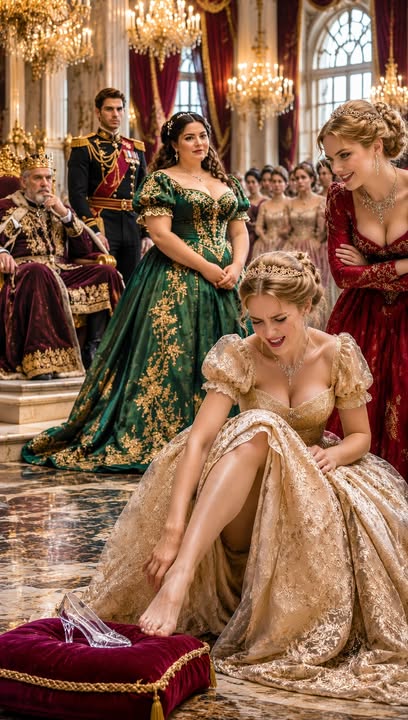
Part 2 – The Secret Beneath the Crystal
“Why does the inner seam spiral against the grain of the crystal?”
My question carried across the silent ballroom, and every eye followed my finger to the slipper’s narrow opening.
Alexander’s face changed.
It was not anger, nor the practiced indifference of a prince faced with an inconvenient question.
For one unguarded instant, he looked as though I had spoken a name he had spent years trying not to hear.
“Where did you learn to see that?” he asked.
“I didn’t learn it from anyone,” I replied, keeping my voice gentle. “I simply noticed.”
The nobles nearest the cushion leaned forward, but Alexander lifted one hand.
“Everyone, please give Lady Emma room.”
His request was quiet, yet it carried the kind of authority that made even the most curious guests step back.
Lady Beatrice’s smile had vanished.
I felt her watching me, and I knew the whole room expected me to make a fool of myself. Their silence was not kindness; it was anticipation.
Still, I kept my attention on the slipper.
The crystal seemed clear and seamless at first glance, but the inner edge caught the chandelier light differently from the outer curve.
A fine line twisted around the opening, so delicate that it might have been mistaken for a trick of reflection.
“May I hold it?” I asked.
Alexander hesitated.
That hesitation told me more than his expression had.
“I promise I won’t try to force my foot inside,” I added. “In fact, I don’t believe anyone should.”
A murmur moved through the room.
The king, seated beside the prince’s empty chair, leaned forward. “What do you mean, Lady Emma?”
“I mean it may not be safe.”
I glanced at the women who had tried the slipper. Their disappointment had been plain, but so had their discomfort.
One had rubbed her ankle after forcing her heel against the opening. Another had hidden a wince behind a smile.
The slipper had not merely refused them.
It had invited them to blame themselves.
“I believe the opening is narrower than it appears,” I continued. “And if the crystal is under tension, pressing against it could split the shell.”
“Shell?” Beatrice repeated, with a laugh that sounded less certain than before. “It is a glass slipper, not an eggshell.”
“Crystal can be strong in one direction and fragile in another,” I said. “My father’s estate has old windows that have lasted a century, but I’ve also seen a single poorly placed scratch spread across a pane like frost.”
I looked back at the slipper.
“If this seam is part of the design, the shoe may be made to open. If it isn’t, then forcing it could damage the slipper—or hurt the person wearing it.”
The last words quieted the room more effectively than any reprimand could have.
Alexander approached the cushion.
“Bring it to me,” he said to the royal attendant.
The attendant lifted the slipper carefully, holding it with both hands, and carried it to the prince.
Alexander did not take it at once.
He studied the spiral where I had pointed, his jaw tightening.
“Your Highness,” I said, “may I?”
For a moment, I thought he would refuse.
Then he placed the slipper into my hands.
It was cooler and lighter than I expected, its smooth surface so finely polished that my fingers seemed to glide over it.
I held it beneath the chandelier and tilted it slowly.
The hairline seam appeared, disappeared, then returned as a pale thread of light.
A collective breath passed through the ballroom.
“There,” I whispered. “It’s not an imperfection. It’s too regular.”
Alexander’s eyes remained fixed on the slipper.
“You’re certain?”
“No,” I answered honestly. “But I’m certain enough that I wouldn’t place it under pressure.”
A strange expression crossed his face, somewhere between relief and sorrow.
“I won’t ask anyone to try it,” he said.
The king’s brows drew together. “Alexander, the challenge—”
“Is paused,” the prince replied. “The slipper should be examined before anyone touches it again.”
A low stir ran through the crowd.
There was no triumph in my chest, only the uncomfortable awareness that the room had changed its attention from my appearance to my words.
Beatrice glanced at me.
For the first time that day, she looked less amused than uncertain.
Alexander turned to the king. “I’ll take responsibility for the delay.”
Richard studied his son, then the slipper in my hands.
“Very well,” he said at last. “No further attempts until the royal glassmaker has examined it.”
The guests began speaking again, though their whispers had altered in tone.
Some wondered aloud whether the slipper was truly made of crystal.
Others speculated that the prince had known it could not be worn.
I heard one woman say that I had deliberately embarrassed the court with a needless warning.
I tried to ignore her.
But the old instinct to make myself smaller had already woken inside me, urging me to apologize for noticing anything at all.
Alexander seemed to sense it.
“Lady Emma,” he said, “would you come with me?”
The request stirred the room anew.
Beatrice’s gaze sharpened. The king’s expression grew thoughtful, but he did not object.
“I would, Your Highness,” I said.
I set the slipper back on its velvet cushion.
Alexander offered his arm, not in the grand manner of a dance, but as a courteous guide through the crowd.
I rested my gloved fingers lightly on his sleeve.
The ballroom seemed to widen around us as we crossed it, the laughter and whispers fading behind the measured echo of our steps.
He led me through a side door into a quieter corridor lined with painted portraits.
The air there was cooler, carrying the faint scent of beeswax and old stone.
When the door closed, the silence between us felt different from the ballroom’s.
This silence had space in it.
Alexander released a breath he seemed to have been holding since I first spoke.
“You recognized it,” I said.
He looked down at the slipper, which the attendant had carried after us.
“I recognized the design.”
“Whose is it?”
His fingers curled against the seam of his coat.
“My mother’s.”
I glanced at the slipper again.
“The late queen made it?”
“She designed it,” he said. “The royal glassmaker completed it after her death.”
His voice had become formal, but the formality did not quite conceal the ache beneath it.
“I’m sorry,” I said.
He gave a faint, weary smile. “You needn’t apologize for asking a question.”
“People often say that when they want you to stop asking.”
“That may be true of people.” He looked at me. “It isn’t true of me.”
I had not expected the prince to answer so plainly.
For a moment, I forgot the ballroom, the watching nobles, and the glass slipper that had brought us there.
I saw only a man who had learned to guard something tender by placing it behind ceremony.
“Did your mother tell you why she designed it?” I asked.
“No.” He looked toward the tall window at the end of the corridor. “She told me cleverness mattered more than a perfect appearance.”
The words sounded familiar to him, but not comforting.
“She said it often?”
“Not often enough for me to understand what she meant.”
He paused, then continued.
“I was young when she died. I remember her hands covered in tiny cuts from working with glass. I remember her laughing at my attempts to draw straight lines. I remember this slipper appearing in the palace workshop one winter, wrapped in blue cloth.”
His gaze returned to the crystal.
“She told me it was meant for someone who could see what others overlooked. I thought she was speaking about an impossible bride.”
“Perhaps she was speaking about something else.”
“I’ve wondered that.” His expression grew distant. “But she left it behind without an explanation, and my father believed it might be a way to settle the question of whom I should marry.”
“Did you believe that, too?”
He met my eyes.
“No.”
The answer came too quickly to be rehearsed.
“I agreed because I was tired of being introduced to women as if we were discussing treaties,” he said. “And because I thought a strange enough challenge might make the court stop trying to decide my life for me.”
“Instead, it gave them another reason to judge the women who came.”
“I see that now.”
There was no excuse in his tone, only regret.
I wondered how many people had ever told him plainly that a royal decision could hurt someone without meaning to.
“I didn’t intend for anyone to feel humiliated,” he added. “But intentions don’t undo what happened.”
That honesty unsettled me more than a perfect apology might have.
“Then perhaps the challenge should not continue until you understand what the slipper is for,” I said.
“I was thinking the same thing.”
A pause opened between us.
The corridor’s windows looked out onto the palace gardens, where bare branches traced fine dark lines against the gray afternoon sky.
“I’m sorry for what they said to you,” Alexander said.
“They have said worse things before.”
“That doesn’t make it acceptable.”
“No,” I agreed. “But after long enough, one learns not to be surprised.”
He studied my face as if he could hear the words I had not spoken.
“Does it still hurt?”
I looked down at my hands.
“Of course it does.”
He did not tell me I should rise above it, or that I was beautiful in a way that made the insult irrelevant.
He simply let my answer stand.
It was a small courtesy, but it felt rarer than the pearls in the ballroom.
“I’ve spent a great deal of my life learning how to be useful,” I said after a moment. “I can take measurements, mend a gown, balance a household account, and find a pattern in a piece of fabric. Those things have never made me interesting to the people who decide what a woman ought to be.”
“Perhaps they should.”
“Perhaps,” I said. “But the court rarely changes its mind because someone asks it politely.”
“No,” he said. “It usually changes when someone shows it what it has failed to see.”
His gaze rested on the slipper.
“Is that what you did?”
“I don’t know yet.”
The royal attendant had remained by the door, holding the velvet cushion.
Alexander turned to him. “Please have the slipper taken to my mother’s private study. No one is to attempt to open it or fit it until we understand its construction.”
The attendant bowed and waited.
“Would you like to examine it there?” Alexander asked me.
The invitation carried no command, no audience, and no promise of favor.
It was simply a question.
“I would,” I answered.
He nodded to the attendant, who lifted the cushion and followed at a respectful distance.
The queen’s study occupied a quiet wing of the palace.
Its tall windows were shuttered against the winter air, and the shelves held books on architecture, astronomy, music, and the properties of colored glass.
A pale blue shawl still hung over the back of a chair.
The room had been kept much as it was, though its owner had been gone for years.
Alexander stopped just inside the doorway.
“I don’t come here often,” he said.
“I understand.”
“I thought leaving everything as she arranged it would make it feel as though she were still here.”
He brushed his fingers over the edge of the nearest desk.
“Instead, it sometimes feels as though I’m afraid to touch anything.”
I felt the truth of that more than I could explain.
“You don’t have to change it to remember her,” I said. “And you don’t have to keep it untouched to prove you remember.”
His eyes lifted to mine.
It was the first time I had spoken to him without thinking about his title.
He seemed to notice.
“Thank you,” he said.
The attendant set the slipper on a broad worktable near the window and withdrew.
Alexander closed the door.
For several minutes, neither of us spoke.
I walked around the table, careful not to touch the slipper until I had studied it from every side.
The spiral seam was most visible where the inner arch curved toward the heel.
I saw faint grooves along its edge, almost invisible beneath the polish.
“May I turn it over?” I asked.
“Please.”
I placed one hand beneath the sole and the other around the upper curve, then rotated it slowly.
The crystal gave a tiny note, clear as a distant bell.
Alexander went still.
“Did it always make that sound?” I asked.
“I’ve never heard it.”
I set it down at once.
The note lingered in the room, or perhaps I only imagined that it did.
There were small, carefully spaced marks along the seam, like the teeth of a hidden latch.
I leaned closer without touching them.
“Someone designed this to come apart,” I said.
Alexander’s face lost what little color it had regained.
“Could you open it?”
“Not without understanding the mechanism. The seam is too fine, and if I mistake one of those marks for a release point, I could crack it.”
He nodded. “Then we won’t risk it.”
“You may need a glassmaker.”
“I’ll send for the palace craftsman in the morning.”
“Good.”
I stepped away from the table, though my mind remained with the slipper.
It was a beautiful object, but not in the manner the court had praised.
Its beauty lay in its precision, in the patient hand that had shaped its curves and concealed its purpose.
“You knew your mother made it,” I said. “Why did you still use it for the challenge?”
“I knew she designed it, but I didn’t know it had a seam.” He looked down at the crystal. “I had never held it close enough to notice.”
“Perhaps no one had.”
“That is not a defense.”
“No,” I said. “But it may be why the mistake was easy to make.”
He studied me, then gave a quiet laugh that held more surprise than amusement.
“You’re very careful with other people’s guilt.”
“I know what it is to have someone decide what you meant before asking.”
A silence passed between us, gentle but weighted.
Alexander moved to the windows and unlatched one shutter.
A little daylight entered, spreading across the floorboards and catching the blue shawl.
“My mother used to sit there,” he said. “She would tell me stories about women she had met at court—women who were always expected to smile, even when the room made them uncomfortable.”
He looked back toward the table.
“She hated that they were praised for enduring things they should never have been asked to endure.”
I glanced at the slipper.
“Then she may have left more than a riddle behind.”
His eyes followed mine.
The thought seemed to trouble him, but also to offer him something he had not possessed before: a direction.
“Do you think the slipper was meant to test the women?” he asked.
“I think it was meant to be understood.”
“And what happens when the court misunderstands it?”
I could not answer.
The question seemed larger than either of us, and it carried the weight of every woman who had stood in the ballroom and tried to make herself fit.
“I don’t know,” I said. “But perhaps the first step is not to make anyone try again.”
He nodded slowly.
“I’ll tell my father the challenge is suspended until we know more.”
“Will he agree?”
“I don’t know.”
There it was again: an honest answer, without royal certainty to dress it up.
I looked at him with new attention.
He was handsome, certainly, with the broad shoulders and composed bearing the portraits had made familiar.
But beneath the prince’s careful posture, I saw a son who still wondered what his mother had meant.
“Your Highness,” I said, “if you want to understand the slipper, I can help.”
He seemed taken aback.
“Why?”
“Because someone should. And because I would like to know why she made it.”
His gaze softened.
“Then I hope you’ll help me.”
The words did not sound like an order or an offer of reward.
They sounded like trust, newly given and not yet certain of its place.
For the first time since I had entered the ballroom, I felt no need to hide my hands or soften my voice.
We returned to the table.
I bent over the slipper once more, following the spiral with my eyes.
The seam was so fine it seemed to vanish where the crystal thickened near the heel.
Then the late afternoon light shifted.
A hairline glimmer appeared beneath the arch, thinner than a strand of silver thread.
“Alexander,” I said.
He stepped beside me.
The seam caught the light again, and this time it did not disappear.
Along its curve, hidden under the crystal’s polished surface, lay a tiny inscription.
Not a name.
Not a date.
Only two words, written in a hand so delicate I could barely make them out.
Alexander leaned close, his breath catching as he read them.
“For the one…”
He stopped.
The rest of the inscription vanished beneath the heel, concealed by a narrow band of silvered crystal.
I straightened, my heart beginning to beat faster.
“Then we’ll need to see the rest,” I said.
Alexander stared at the slipper as if it had just opened a door into a room he had spent his life avoiding.
“Tomorrow,” he said, “we find the person who knows how.”
**–END OF PART 2–CLICK “NEXT” AT THE BOTTOM OF THE PAGE TO CONTINUE READING**
* * *
[NEXT: PART 3](https://storyly.idolsgift.com/blog/part-3-the-secret-beneath-the-crystal-052)
✓ Lynn R. Adams
Part 2 – The Secret Beneath the Crystal “Why does the inner seam spiral against the grain of the crystal?” My question carried across the silent ballroom, and every eye followed my finger to the sli…