PART 2: The Secret Beneath the Boat 057
Part 2 – The Secret Beneath the Boat
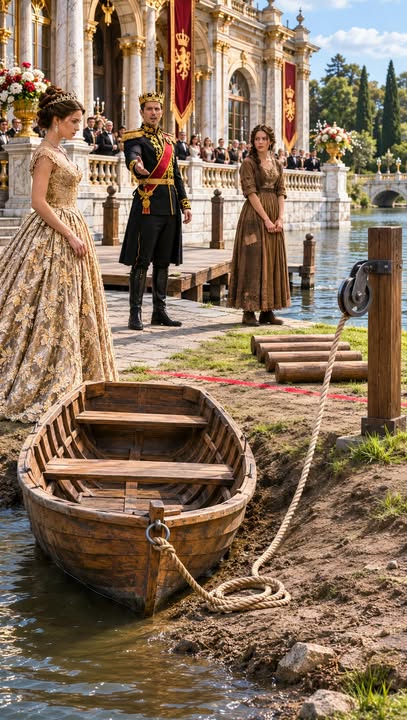
The rope tightened against the pulley, and the maid leaned into the pull.
The boat shifted a few inches, then stopped with a low scrape against the muddy bank.
A murmur passed through the spectators.
The noblewoman folded her arms, though the flush in her cheeks had not yet faded.
“Is that all?” she asked.
The maid did not look up.
“No,” she said quietly. “It’s only the beginning.”
She eased the rope so the boat would not slide backward, then studied the ground between the water and the marked shore.
The pulley had changed the direction of her pull, allowing her to stand on firm ground and use her weight more effectively, but it had not made the boat lighter.
Its keel still pressed into the soft bank, and the wet earth clung to it like a hand refusing to let go.
The prince watched her closely.
“Can you move it?” he asked.
“I think so, Your Highness.”
She glanced toward the smooth wooden rollers nearby.
“But not by pulling harder.”
The words carried no boast, only certainty.
That seemed to unsettle the noblewoman more than a challenge would have.
The maid slipped the rope around the wooden post to keep it taut, then crouched beside the boat’s bow.
Her faded brown skirt brushed the damp earth.
A royal guard shifted as if to stop her, but the prince lifted one hand.
“Let her work.”
The maid placed both palms against the hull and tested its movement.
It rocked slightly, then settled back into the mud.
“Could someone pass me the first roller?” she asked.
For a moment, the guards and aristocrats looked at one another, unsure whether they had heard an order or a request.
Then the prince bent, picked up one of the smooth wooden cylinders, and offered it to her.
The maid blinked at the sight of the heir to the throne holding a workman’s tool.
“Thank you, Your Highness.”
He gave her a small, encouraging nod.
She slid the roller beneath the bow, then positioned a second one a short distance behind it.
The wood vanished partly under the boat’s weight.
She returned to the rope and pulled again.
This time the hull advanced with a slow, creaking groan.
The crowd fell silent.
The boat rolled forward a little, its bow rising from the deepest part of the muddy slope.
But after a few feet, the first roller slipped out behind the hull, and the boat halted once more.
The maid released the tension carefully.
“It’s catching,” the prince observed.
“The first roller has done its work,” she answered, “but it has to be moved forward again.”
She went to the back of the boat and drew the loose roller free.
Her fingers were already streaked with mud.
The noblewoman watched, her expression caught between irritation and reluctant interest.
“You have done this before,” she said.
The maid lifted the roller with both hands.
“Not with a boat.”
“That is not what I asked.”
The maid paused, then turned the roller in her hands.
“I have watched people move heavy things.”
The answer seemed to satisfy no one, least of all the noblewoman.
The prince looked toward the dockworkers gathered near the edge of the terrace.
“Have you ever helped them?”
The maid’s eyes moved briefly to the workmen.
Then she looked down.
“Sometimes.”
A faint ripple of surprise traveled through the crowd.
The prince did not press her.
Instead, he said, “Show us what you’ve learned.”
The maid set the roller in front of the boat’s advancing keel.
Then she returned to the rope.
Again she pulled, slowly and steadily, keeping the line taut as the boat climbed.
The wood creaked over the roller.
The hull moved forward.
When the boat had passed it, she stopped and retrieved the roller, placing it farther up the slope.
The task was repetitive, but not simple.
She had to judge the boat’s balance, keep the rollers aligned, and make sure the rope did not slacken so quickly that the hull slid back.
Each time the boat moved, its weight seemed to settle more stubbornly onto the earth.
Each time, the maid adjusted her position and tried again.
The prince remained beside the post, ready to help but careful not to take over.
The noblewoman stood at the edge of the marked shore, her jeweled shoes planted well away from the mud.
At first, she seemed to be waiting for the maid to fail.
Then, without announcing it, she moved closer.
“Your left roller is crooked,” she said.
The maid looked.
The cylinder had turned at an angle, its far end pointing toward the water.
“If it stays there, the boat may slide sideways.”
The maid inspected the alignment and nodded.
“You’re right.”
She corrected the roller.
The noblewoman’s mouth tightened, as though the simple acknowledgment had cost her something.
The next pull brought the boat forward another few inches.
A sound like a held breath moving through the crowd accompanied it.
“Steady,” the prince called.
The maid kept her gaze on the hull.
“I am.”
The prince smiled faintly.
“I meant the boat.”
“I know.”
For the first time, a few people in the crowd laughed softly.
The maid’s cheeks warmed, but she did not stop pulling.
The boat’s bow climbed over a patch of gravel.
One roller bumped against a stone, and the hull lurched.
The prince stepped forward, ready to catch the rope.
The maid lifted her hand.
“Wait.”
She eased the tension rather than tightening it, allowing the hull to settle without turning.
Then she shifted the roller and pulled again.
The boat moved.
A brief, astonished cheer rose from the terrace.
The maid looked back at the people, startled by their applause.
She had expected silence, perhaps mockery.
Admiration was harder to face.
She lowered her eyes and returned to her work.
The noblewoman’s gaze remained on her, unreadable.
“Why did you ask to try?” she said.
The maid worked the next roller free.
“Because the boat needed to be moved.”
“That is not an answer.”
“It’s the one I have.”
The noblewoman seemed about to reply, but the prince spoke first.
“Let her finish.”
There was no command in his voice, only a gentle reminder.
The maid placed the roller ahead of the hull.
For a moment, she stared at the slope, measuring the distance to the marked shore.
Then she leaned into the rope once more.
The pulley groaned against its wooden support.
The boat rolled forward, inch by inch.
The muddy bank gave way to gravel beneath the keel.
As the hull passed the last of the loose stones, the maid adjusted the rope’s angle and drew it forward another careful length.
The boat reached the boundary of the marked section.
Then the bow crossed it.
A guard stepped closer to confirm the position.
“It is completely ashore,” he announced.
The cheering that followed was louder than the maid had expected.
Several of the aristocrats applauded.
Some of the dockworkers joined them, exchanging delighted glances.
The maid stood with the rope in her hands, breathing hard.
Mud marked her sleeves and the side of her dress.
A lock of dark hair had fallen across her face.
She brushed it away, then looked at the boat as if she still could not quite believe it had moved.
The prince approached.
“You succeeded.”
The maid’s grip loosened on the rope.
“We succeeded,” she corrected.
His eyes brightened.
“Who helped?”
“You gave me the roller.”
“That was hardly enough.”
“It was enough to begin.”
The prince considered her answer.
Then he turned toward the crowd.
“Let the record show that the maid brought the boat ashore by using the pulley and rollers.”
An older court official stepped forward with a ledger.
“And her name?” he asked.
The maid hesitated.
“Lina, Your Highness.”
The official wrote it down.
“Lina,” the prince repeated, as if making sure he would remember.
The sound of her name in his voice made her look up.
For a moment, the people around them seemed to disappear.
Then the noblewoman cleared her throat.
“An ingenious solution,” she said.
Her words were perfectly polite, but something tight remained beneath them.
Lina inclined her head.
“Thank you, my lady.”
“You should not mistake good fortune for expertise.”
The prince’s expression changed, though his voice stayed calm.
“She did not.”
The noblewoman looked at him.
“She knew where the rollers were.”
“Because she had seen them used,” the prince replied.
The noblewoman’s gaze returned to Lina.
“And where did a palace maid learn to move cargo?”
Lina felt the question settle on her like another weight.
She looked toward the workers by the dock.
“They do difficult work every day,” she said. “I learned by watching.”
“Only watching?” the prince asked.
Lina brushed mud from her palm.
“Not always.”
The prince waited.
The noblewoman did too, though her attention had sharpened.
Lina had not meant to say more.
She could still retreat behind a courteous smile and a vague answer, the way she had learned to do whenever someone above her asked a question that might become dangerous.
But the prince had not mocked her.
He had listened.
And the crowd, for all its fine clothes and startled faces, had applauded what she had done.
“I help when I can,” she admitted.
“After your household duties?” he asked.
“Yes, Your Highness.”
The answer opened a door she had spent years keeping shut.
She could see the palace’s lower yard in her mind: the old dockworkers guiding crates across uneven stones, their shoulders bent with effort, their hands rough from rope and timber.
She remembered standing in the shadows after her cleaning was done, watching them improvise ways to move what seemed too heavy to lift.
At first, she had only carried small tools.
Then she had learned to place a wedge, steady a wheel, and judge when a load might tip.
The workers had shown her things when they thought no one important would notice.
“You have a good eye,” one of them had told her once.
She had carried the words with her for years.
The prince’s voice brought her back.
“Why did you never tell anyone?”
Lina swallowed.
“I didn’t think anyone would ask.”
Something in his face softened.
“Then I am glad I asked.”
The noblewoman looked away toward the lake.
The contest had been her chance to show the court her strength, her polish, her suitability for the crown.
Now people were speaking Lina’s name.
Lina noticed the change in her posture and felt a flicker of sympathy she could not explain.
The noblewoman had lost the challenge, but losing in front of the court was never only about the challenge.
“You both showed more than the result,” the prince said.
The noblewoman’s eyes returned to him.
“Meaning?”
“You showed persistence,” he answered. “Lina showed ingenuity.”
The compliment was fair.
It was also a reminder that the contest had not unfolded as the court expected.
The noblewoman gave a small, formal smile.
“I hope the next trial is less muddy.”
A few people laughed, grateful for the chance to release the tension.
Lina managed a smile too.
As the crowd began to disperse, the prince stayed beside the boat.
“Would you walk with me to the dock?” he asked Lina. “I would like to understand how you thought through the problem.”
Her first instinct was to glance toward the head housekeeper, who stood near the guards with a disapproving look.
A maid did not stroll beside a prince.
Even when he invited her, the rules of the palace did not vanish.
“Only if it does not interfere with my duties,” Lina said.
“I will make sure it does not.”
The housekeeper’s expression remained troubled, but the prince had given his word.
Lina followed him along the bank.
He kept a respectful distance between them, speaking not as though he were entertaining a servant, but as though he were curious about her thoughts.
“What did you notice first?” he asked.
“That the rope was pulling straight toward the shore, but the boat’s weight was pressing down and backward.”
“And the pulley?”
“It let me stand where the ground was firmer and pull in a direction I could control.”
“Yet it did not make the boat lighter.”
“No.”
She glanced at the rollers.
“They helped because the boat could roll over them instead of scraping along the earth.”
The prince looked at her with growing admiration.
“You explain it simply.”
“It was simple once I could see it.”
He smiled.
“And before you could see it?”
“Then it was just a boat that would not move.”
The prince laughed, warm and unguarded.
Lina was surprised by the sound.
He seemed younger when he laughed, less like the distant figure in gold and black who appeared on palace balconies, and more like a man who had been waiting to hear something genuine.
“What would you do if the rollers were not here?” he asked.
“I would look for something round and sturdy.”
“Barrels?”
“Possibly, though they might split.”
“Wheels?”
“If they could be secured.”
He nodded as if storing each answer away.
“Have you ever studied engineering?”
The word struck so close to the hidden part of her life that she stopped walking.
The prince noticed.
“Forgive me,” he said. “I did not mean to pry.”
Lina looked down at the scuffed leather of her shoes.
“No one taught me to study it.”
“But you wanted to?”
She had never said the truth aloud in the palace.
Not to the workers, who might pity her.
Not to the housekeeper, who might consider the thought foolish.
Not even to herself, except in the quiet hours before sleep.
“I did,” she said.
The prince did not interrupt.
Lina’s fingers tightened around the edge of her apron.
“When I was younger, I used to draw things I thought might make work easier. Pulleys, lifting arms, little carts with better wheels.”
“You drew designs?”
“Only sketches.”
“That is how many good designs begin.”
A small, fragile smile touched her face.
“I used to think I might study engineering one day.”
The prince’s expression became still, not with pity but with attention.
“What changed?”
“My father died, and our household fell into debt.”
The words came carefully.
She had learned to speak of hardship without making it sound like a plea.
“My family had no means to keep me in school. A palace position meant regular meals and a roof, so I came here.”
“I’m sorry,” he said.
Lina nodded.
“So am I.”
The lake shimmered beyond the dock, its surface broken by the boat’s reflection.
For a time, neither of them spoke.
Then the prince said, “Do you still draw?”
“Sometimes.”
“Do you still have your sketches?”
A shadow crossed her face.
“I kept them.”
“Where?”
“At home.”
She turned her gaze to the water.
“My mother says they take up too much space, but she has never thrown them away.”
The prince smiled, though there was sadness in his eyes now.
“Then perhaps they are worth keeping.”
Lina did not know what to say.
She had expected curiosity to become amusement or polite dismissal.
Instead, he spoke as though her old dream mattered.
A voice behind them interrupted.
“Your Highness, the council is ready.”
One of the guards had approached, careful not to intrude too quickly.
The prince’s shoulders lifted with a quiet sigh.
“Of course.”
He turned back to Lina.
“I would like to speak with you again, if you are willing.”
Lina felt the housekeeper’s gaze from across the bank.
The prince seemed to understand the difficulty of his request.
“About your ideas,” he added. “And how you learned to use the tools.”
“That would be all right, Your Highness.”
“Good.”
He inclined his head, then walked back toward the waiting officials.
Lina remained beside the dock for a moment.
The noblewoman stood nearby, speaking with two members of her family.
Their conversation seemed calm, but the noblewoman’s eyes moved once toward Lina.
There was no open anger in them.
Only a guarded expression, as if Lina had become a question the noblewoman did not yet know how to answer.
The housekeeper approached.
“You should return to your work,” she said.
“Yes, ma’am.”
“And avoid giving the court more to discuss.”
Lina lowered her eyes.
“I will.”
The housekeeper studied the mud on Lina’s sleeves.
“Change before dinner, at least.”
“I will.”
Lina started toward the service passage, but the prince’s question remained with her.
Do you still have your sketches?
She did.
In a small wooden box beneath the loose lining of her old travel trunk, she had kept the pages she had drawn before leaving home.
The paper had softened at the edges.
Some of the ink had faded.
But the sketches were still there: a pulley fixed to a beam, a lever balanced on a stone, a set of rollers arranged beneath a cart.
One page held a drawing she barely remembered making.
A boat rested on a sloping shore, its weight carried by rollers while a rope ran through a wheel above it.
The drawing was rough and unfinished.
She had made it years before she saw the palace dockworkers use such a method.
Lina had always thought it was only a child’s idea.
Yet when she had stood beside the boat that afternoon, the shape of it had returned to her as clearly as if she had drawn it yesterday.
She had never told anyone about that page.
Not the workers.
Not her mother.
Not the prince.
Because there was something else in the box with the sketches.
A folded note from her father, written in his careful hand, whose words she had never been able to understand.
That night, after finishing her duties, Lina returned to her small room beneath the eastern servants’ stair.
She lit a stub of candle and pulled the wooden box from beneath her trunk.
The familiar smell of old paper and cedar rose as she lifted the lid.
Her sketches lay exactly where she had left them.
She touched the drawing of the boat, tracing the faint pencil marks with one finger.
Then she unfolded her father’s note.
His handwriting was still difficult to read.
She had tried many times to make out the faded lines, but the page had been creased and stained before it came into her possession.
Tonight, she could see only the words at the bottom.
“Keep this safe until the truth is ready to be heard.”
Lina stared at the sentence, her candle trembling in the draft.
She had always believed her father had been writing about the sketches.
But beneath the note, hidden in the folds of the paper, she felt the raised edge of something small and hard.
She turned it over.
A brass token slipped into her palm, worn smooth at the edges and stamped with the royal dock’s emblem.
On its back, almost erased by time, was a name she had never seen before.
Her father’s.
**–END OF PART 2–CLICK “NEXT” AT THE BOTTOM OF THE PAGE TO CONTINUE READING**
* * *
[NEXT: PART 3](https://storyly.idolsgift.com/blog/part-3-the-secret-beneath-the-boat-057)
✓ Lynn R. Adams
Part 2 – The Secret Beneath the Boat The rope tightened against the pulley, and the maid leaned into the pull. The boat shifted a few inches, then stopped with a low scrape against the muddy bank. …