PART 2: The Secret Behind the Silver Balance 057
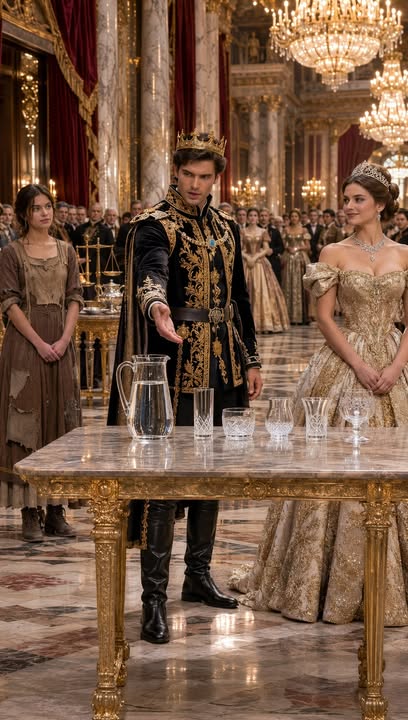
The first thin stream of water fell into the glass, while the maid watched the balance as carefully as a musician listens for a note that has slipped out of tune.
She had placed the empty glass on one pan and, on the other, set a metal weight whose mass she knew.
Then she added water a little at a time, pausing whenever the beam trembled.
The nobles leaned closer, their laughter fading into the rustle of silk and the faint clink of jewelry.
When the balance settled, the maid lifted the glass and poured its water back into the pitcher.
The prince’s eyes narrowed with interest.
“Why return it?” he asked.
“Because, Your Highness, I need to know how much water the glass itself weighs before I can measure the water inside it.”
She set the empty glass back on the scale and waited for the beam to rest.
Then she placed a metal weight on the opposite pan, not to measure the whole glass, but to establish a difference.
“I will weigh each empty glass first,” she explained. “Then I will add water until the balance reads exactly two hundred grams more than the glass did when it was empty.”
The prince glanced at the pitcher.
“And that will give you two hundred milliliters?”
“Yes, Your Highness. Water weighs one gram for each milliliter, so two hundred grams of water is two hundred milliliters.”
A murmur passed through the crowd.
The noblewoman’s smile had disappeared, though she had not yet looked away.
The maid took the first empty glass from the pan, poured a measured portion from the pitcher, and returned the glass to the scale.
She added small amounts until the beam settled at the difference she had described.
Then she set the filled glass aside.
No water had spilled.
No measuring cup had been used.
The process was not quick, but it was steady, and every movement seemed to quiet the room around her.
She weighed the second glass empty, taking care to use the balance in precisely the same way.
Its thick, rounded base was heavier than the first glass, but the maid did not seem troubled by that.
She added the water until the scale showed the same two-hundred-gram increase.
The third glass had a curved waist.
The fourth was so broad near the rim that it seemed almost impossible to judge by sight.
The fifth was narrow at the bottom and flared dramatically at the top.
For each one, the maid began again with its empty weight.
For each one, she added water until the difference was exactly the same.
The pitcher’s level sank gradually, but there was enough water for every glass.
By the time the maid set the fifth glass down, the pitcher stood empty.
Five portions rested on the marble table, each one holding the same amount despite their different shapes.
The prince stepped forward and examined the balance.
“Your method is sound,” he said.
He checked each glass in turn, repeating the comparison himself with the weights and the scale.
The beam settled at the same difference every time.
For a few breaths, no one spoke.
Then the room broke into a wave of astonished whispers.
The noblewoman looked from the five glasses to the maid.
Her face was warm with embarrassment, but there was no anger in it now, only the discomfort of someone recognizing that she had been wrong in more ways than one.
The prince turned to the gathered nobles.
“The challenge was to fill each glass equally without spilling a drop,” he said. “She has done so.”
His gaze returned to the maid.
“You solved the problem with patience and a clear understanding of what the scale could tell you.”
The maid lowered her eyes.
“I only used what was already here, Your Highness.”
“And you have shown us that a tool can be more useful when we ask it the right question.”
A few of the nobles began to applaud.
The sound spread, hesitant at first, then warmer, until the hall filled with it.
The maid’s shoulders drew in at the noise, as if she would rather have slipped quietly back through the servants’ entrance than stand in the center of such attention.
The noblewoman glanced toward the crowd, then took a small step forward.
“I mocked you before you had even begun,” she said.
Her voice was composed, but the words cost her something.
“I was certain your work would be foolish simply because you are a servant.”
The room grew quiet again.
The maid looked at her.
The noblewoman did not lower her gaze or pretend she had meant something else.
“I was wrong,” she continued. “I am sorry.”
The maid studied her for a moment, then gave a small, sincere nod.
“Thank you for saying so, my lady.”
There was no triumph in her answer.
That seemed to unsettle the noblewoman more than any sharp reply could have.
The prince dismissed the gathering only after the glasses and scale had been returned to the servants’ station.
The nobles drifted away in clusters, talking over one another, but their attention followed the maid.
She waited until they had turned toward the doors before she reached for the pitcher.
“Leave it,” the prince said.
She paused.
“The servants can clean it, Your Highness.”
“Then I will ask them to do so.”
His tone was not unkind, though it carried the habit of being obeyed.
The maid seemed uncertain what to do with an invitation not to work.
At last, she folded her hands in front of her.
The prince studied her face, no longer as a puzzle to be solved but as a person whose thoughts he had begun to value.
“Where did you learn to use a balance?”
“My mother taught me.”
“Was she a palace servant?”
“She worked in the kitchens here, before I was old enough to remember much of it.”
The prince’s expression softened.
“Your mother is still here?”
The maid’s fingers tightened together.
“No, Your Highness. She died several years ago.”
“I am sorry.”
“So am I.”
She said it quietly, without looking for comfort, and the prince did not offer an empty phrase in its place.
Instead, he asked, “What did she teach you about weighing?”
The maid glanced toward the five glasses, now shining under the chandeliers.
“She said a scale was useful because it did not care whose hand held the bowl. If everyone measured carefully, then no one had to guess who deserved more.”
The prince was silent.
“My mother used to portion flour, oil, and dried fruit when supplies were low,” she continued. “She said the kitchen had a duty to serve every household in the palace, not just the important ones. She believed a little fairness, repeated every day, could keep people from feeling forgotten.”
The prince looked toward the great doors through which the nobles had left.
“That is a wiser lesson than many I have heard in council.”
The maid gave him a faint smile.
“She said most useful lessons were learned before anyone thought to write them down.”
He seemed to consider that.
“And what would she have said about today?”
“She would have told me not to be pleased with myself merely because I had proved a point.”
“Did she often say things like that?”
“Only when I was proud of myself.”
The prince laughed softly, and some of the tightness left the maid’s posture.
Outside the ballroom, evening light lay across the palace gardens in long golden bands.
The prince walked with her along a passage near the servants’ corridor, keeping enough distance that no one might mistake the conversation for a command.
“How long have you worked in the palace?” he asked.
“Almost five years.”
“And your mother served here before you?”
“Yes, Your Highness.”
“Did she tell you much about her time in the kitchens?”
The maid hesitated.
“Some things.”
“Would you mind telling me more?”
She looked at him carefully, as if she wanted to know whether the question came from curiosity or obligation.
“My mother told me about the women who taught her to bake without wasting a handful of flour, and the old cook who could tell whether a stew needed salt by the sound of the spoon against the pot.”
The prince smiled.
“And the balance?”
“She said the kitchen scale had belonged to the palace for generations. She learned to use one from her own mother, and she taught me when I was small enough to stand on a stool and watch.”
The maid’s voice warmed as she spoke of her mother.
Then it softened again.
“She had a way of making a hard day feel less heavy. Even when there was little food, she could make everyone believe we would find a way.”
The prince turned his attention to her.
“Did you have enough to eat when you were growing up?”
“Not always.”
The answer was simple, but it carried the echo of years.
“After she died, things became harder,” she added. “I learned to make a meal last, and I learned that some people in the palace were hungrier than I was.”
The prince waited.
She drew a breath.
“I have been sharing portions from my own meals with the younger servants. The kitchen staff know, though I asked them not to make a fuss about it.”
“Why did you ask them not to tell anyone?”
“I do not want charity to become a performance,” she said. “The children should not have to feel watched while they eat.”
The prince’s expression changed.
“Do you have enough for yourself?”
“Usually.”
“That was not quite an answer.”
“It is the answer I can give, Your Highness.”
He did not press her, but his gaze lingered on the worn cuffs of her faded dress and the careful way she kept her hands folded.
“How many younger servants?”
“Four, at the moment.”
“And you have been giving them part of your own meals?”
“When I can.”
“Even when you have little?”
She looked down the passage.
“My mother taught me that fairness begins with noticing who is missing from the table.”
The prince stopped walking.
For a moment, the great palace seemed quieter than it had any right to be.
He had spent his life surrounded by people who knew how to make their needs sound urgent and their ambitions sound noble.
The maid spoke of food as if it were not a symbol or a favor, but something simple that ought to reach whoever needed it.
“I would like your help,” he said.
She looked back at him.
“The royal kitchens have warned me that supplies may run short before winter. The harvest from the southern farms has been poor, and the roads are already difficult. I want someone to help oversee the kitchens, not merely to count stores, but to make sure the portions are fairly planned.”
The maid’s eyes widened.
“Your Highness, I am only a maid.”
“You are someone who noticed the different shapes of five glasses and found a fair way to fill them. You have also been feeding younger servants without asking for praise.”
“That does not mean I know how to oversee a royal kitchen.”
“No,” he replied. “It means you know the people who will depend on it. The head cook knows the work. I would like you to help them plan it.”
Her uncertainty did not vanish, but beneath it appeared a small, cautious hope.
“Would I be allowed to speak if I thought a plan was unfair?”
“That is why I am asking you.”
She held his gaze for a breath.
Then she bowed her head.
“I will try, Your Highness.”
“Good.”
He did not call the choice a favor, nor did he promise that the work would be easy.
The maid seemed to appreciate that.
They reached the kitchen passage, where the air smelled faintly of warm bread and wood smoke.
The prince’s steward was waiting beside the doorway with a folded packet of supply accounts.
The prince accepted it but did not open it.
“Tomorrow morning, then,” he told the maid. “We will meet with the head cook and review what is available.”
“Yes, Your Highness.”
She started to turn away.
“Wait,” he said. “I did not ask your name.”
She gave it to him.
He repeated it carefully, as though he meant to remember it.
She thanked him and disappeared into the busy warmth of the kitchen.
The prince remained in the passage, still holding the unopened accounts.
At the far end of the hall, the noblewoman had not yet left the palace.
She had been speaking with a lady-in-waiting, but her attention had turned when she saw the maid and the prince together.
She heard no words, only the calm intimacy of a conversation in which neither person seemed to be performing for the court.
It unsettled her.
Not because the prince had asked for the maid’s help, exactly, but because he had listened to her as though her thoughts mattered.
The noblewoman remembered the first time she had seen the maid’s expression across the ballroom, steady and watchful beneath the ridicule.
She remembered how easily she had mistaken quietness for ignorance.
The maid passed by with her head bowed, carrying no visible sign that the prince had entrusted her with anything.
As she went, the noblewoman noticed a thin chain at the base of her neck.
A small silver token rested against the faded fabric of her dress.
The token was old and dulled by years of wear, yet a royal crest had been etched into its face: a small crown above a branch of three leaves.
The noblewoman’s breath caught.
She had seen that crest before.
For a moment, the hall seemed to tilt beneath her feet.
Her grandmother had kept a silver token in a velvet-lined box, hidden among letters and pieces of lace.
The same crown.
The same three-leaf branch.
The noblewoman had been told it was a family keepsake, though no one had ever explained how it came to belong to them.
She watched the maid disappear through the servants’ door.
Then she looked down at her own hand, where the memory of her grandmother’s token seemed to linger against her palm.
And for the first time that evening, the noblewoman wondered whether the maid’s story had begun long before either of them entered the ballroom.
**–END OF PART 2–CLICK “NEXT” AT THE BOTTOM OF THE PAGE TO CONTINUE READING**
* * *
[NEXT: PART 3](https://storyly.idolsgift.com/blog/part-3-the-secret-behind-the-silver-balance-057)
✓ Lynn R. Adams
The first thin stream of water fell into the glass, while the maid watched the balance as carefully as a musician listens for a note that has slipped out of tune. She had placed the empty glass on on…