PART 2: The Secret Behind the Chime 069
Part 2 – The Secret Behind the Chime
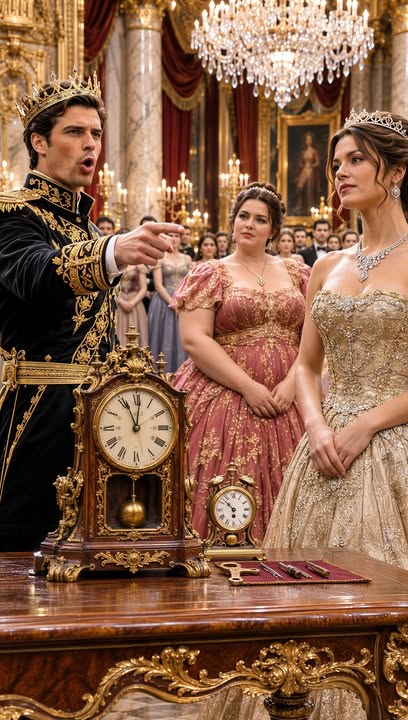
…she began to move the screw toward the narrow opening.
“Wait,” the prince said.
His voice was firm, but not unkind.
The young woman stopped at once, the screw resting between her fingers.
“If you please, Your Highness,” she said, “I would rather not put it back until I understand why it was removed.”
The silence in the ballroom deepened.
The noblewoman in champagne gold lifted her chin.
“You are suggesting someone here tampered with the clock?”
“I’m saying the screw doesn’t belong beneath it,” the young woman replied. “And it looks newer than the others.”
Prince Adrian studied the screw, then the clock’s open rear panel.
For the first time since the contest began, he seemed to forget that the ballroom was full of people watching him.
“Everyone, step back from the table,” he said.
The guests obeyed, though their murmurs drifted after them like silk across a floor.
Adrian looked to the young woman.
“What do you recommend?”
“Let me inspect the mechanism without anyone touching the winding key,” she answered. “If the clock has been altered, forcing it further could make it harder to understand what happened.”
He glanced at the small brass key lying beside the tools.
“Agreed.”
A footman moved toward the clock, but Adrian raised a hand.
“No one touches it.”
The footman stopped.
The prince’s eyes returned to the young woman, and she felt the weight of the room settle upon her again.
“Your name?” he asked.
“Elara, Your Highness.”
“Then, Elara, you may inspect the clock.”
She drew a quiet breath and stepped closer.
She did not hurry.
That was the first thing Adrian noticed.
While the other contestants had approached the clock as if a clever gesture might impress the court, Elara leaned in with the patience of someone who had spent long afternoons listening to the small, stubborn complaints of old machines.
She examined the pendulum first, following its line to the anchor that guided its swing.
Then she studied the gears behind the open panel, careful not to brush them with her sleeve.
The ballroom seemed to hold its breath with her.
“May I have the lamp?” she asked.
Adrian took a polished hand lamp from the table and passed it to her.
Their hands did not quite touch, but Elara noticed how carefully he held it, angling the light exactly where she asked.
She saw consideration in the gesture.
It unsettled her more than the sharpness of his earlier questions.
“Here?” he asked.
“A little lower, please.”
He adjusted the lamp.
Light slipped behind the striking mechanism, revealing a slim, shadowed gap in the clock’s wooden casing.
Elara held up the screw beside it.
“This may fit there,” she said. “But the question is why it was taken out.”
“Can you tell?” Adrian asked.
“Not yet.”
She leaned nearer.
A thin line of dust traced the inside edge of the concealed opening, except where something had recently disturbed it.
Elara glanced again at the bright screw.
Its brass caught the lamplight with a sharp, almost new gleam.
The surrounding fittings were dull, their surfaces darkened by time and careful handling.
“This screw was polished recently,” she said. “The rest of the mechanism wasn’t.”
The champagne-gowned noblewoman folded her arms.
“A screw can be polished for any number of reasons.”
“Of course,” Elara replied, without looking away from the clock. “But if it had belonged in this mechanism for years, it would likely have the same wear as the others.”
A few guests shifted in place.
Adrian’s gaze sharpened.
“Can you determine whether it fits without forcing it?”
“I can try it gently, Your Highness. If there’s resistance, I’ll stop.”
He nodded.
Elara brought the screw to the narrow opening.
It rested against the edge, then slid into place with a delicate click.
Not the click of a gear catching.
A latch releasing.
Elara paused.
“Did you hear that?” she whispered.
“I did,” Adrian said.
The noblewoman’s arms fell to her sides.
Elara did not turn the screw.
Instead, she looked to Adrian.
“There may be something behind this panel. May I open it?”
“Go ahead.”
She turned the screw only a fraction.
A slim wooden plate shifted inward, barely wider than a finger.
Something pale showed in the dark.
Elara held still.
Adrian leaned closer, his expression suddenly grave.
“Is it part of the clock?”
“I don’t think so.”
With two careful fingers, she drew out a narrow strip of folded paper.
The ballroom’s murmurs rose and then died away again.
Elara placed the paper on the table, away from the tools.
It was old, its edges softened and browned, though a small corner bore a faint mark made in dark ink.
Adrian looked at the clock as if it had become a different object.
“Who put that inside?” he asked.
“I don’t know,” Elara said. “But it wasn’t there by accident.”
She unfolded the strip only enough to see that it contained writing.
The ink had faded, and the paper was creased several times over.
She did not touch the words.
“Your Highness,” she said, “perhaps this should be examined by someone who can preserve it.”
Adrian’s expression eased, though the worry in it remained.
“You’re right.”
He turned to the steward standing near the ballroom doors.
“Lord Vale, have the room secured. No one leaves until we know who has handled the clock and when.”
The steward, a silver-haired man in a dark formal coat, looked toward the paper.
“Your Highness, surely that is unnecessary. The clock was inspected by palace staff this afternoon.”
“Then it should be easy to establish what they found,” Adrian replied.
Lord Vale’s mouth tightened.
The music had stopped some time earlier, yet the chandeliers still shone as brightly as before.
Their golden light made every face look composed, even as unease passed from guest to guest.
Elara became aware of how many people were looking at her.
She lowered her eyes to the clock, suddenly wishing she could return to a quiet workshop where no one mistook a careful question for an accusation.
Adrian noticed.
“You’ve done nothing wrong,” he said quietly.
The words were meant for her alone, though the nearby guests might have guessed their meaning.
Elara looked up.
“I hope so, Your Highness.”
“You found something that was hidden. That matters.”
His sincerity caught her off guard.
She had expected a prince to value appearances, especially with a dozen hopeful brides and half the court gathered beneath the chandeliers.
But Adrian had not asked whether the discovery would embarrass him.
He had asked what the clock was telling them.
A palace attendant arrived with a pair of archival gloves and a small wooden tray.
Adrian instructed him to place the folded paper inside without opening it further.
Lord Vale watched the process with a stillness Elara could not quite read.
When the paper was safely set aside, Adrian returned his attention to her.
“Can the clock be made to strike now?”
Elara glanced at the opening behind the striking mechanism.
“Perhaps. But I don’t know what the paper has to do with the clock, or what else might have been disturbed.”
“Then the contest is postponed,” he said.
A ripple of surprise passed through the assembled guests.
The champagne-gowned noblewoman took a step forward.
“Your Highness, you cannot suspend the challenge because one contestant found a scrap of paper.”
“I can, and I have,” Adrian said. “The rules require us to make the clock strike without damaging it. Until I know whether it has been tampered with, continuing would not be fair to anyone.”
The noblewoman’s lips pressed into a thin line.
“Of course,” she said, though her voice suggested she thought otherwise.
Adrian turned to the guards stationed by the doorway.
“Please ask each contestant and member of staff who approached the table to remain available for questions.”
The guards moved with calm efficiency.
No one was threatened or roughly handled.
Still, the ballroom’s elegant ease had vanished.
Elara stepped away from the clock and clasped her hands together, careful not to show that they had begun to tremble.
Adrian noticed that, too.
“You’ve worked with clocks before,” he said.
“My father taught me.”
“Was he a clockmaker?”
“He repaired whatever people brought to our door,” she replied. “Clocks, watches, music boxes, sometimes a stubborn kitchen timer that had outlived its owner’s patience.”
A faint smile touched Adrian’s face.
“And what did he teach you about this one?”
“To listen before repairing.”
She looked back at the silent clock.
“It’s easy to decide what a machine needs when you’re impatient. But a sound can tell you where something is catching. A pause can tell you what has stopped. My father said that if I made up my mind too early, I might fix the wrong thing.”
Adrian absorbed her words.
“Is that why you didn’t turn the key?”
“Yes. The first contestant forced it, and the pendulum stopped. I didn’t want to repeat the same mistake before I understood what had happened.”
“I saw you watching the screw,” he said. “What made you notice it?”
“Everything else in the opening had gathered dust. That screw hadn’t. It was too bright.”
She hesitated.
“Then the noblewoman stopped smiling.”
The words were quiet, but the champagne-gowned woman heard them.
Her face colored.
“I stopped smiling because you accused me without evidence,” she said.
“I didn’t accuse you,” Elara answered. “I asked who prepared the clock.”
Adrian’s expression turned thoughtful.
“An important distinction.”
The noblewoman looked away.
Lord Vale approached with a sheet of paper in his hand.
“Your Highness, the staff who prepared the ballroom say the clock arrived already set upon its table. They were instructed not to open it.”
“By whom?”
“By the palace office.”
“Which member of the palace office?”
Lord Vale glanced down at his notes.
“I will need to confirm that.”
Adrian’s gaze remained steady.
“Please do.”
The steward bowed and withdrew.
Elara watched him go, uncertain why the exchange had made the room feel colder.
Perhaps it was simply the strain of the gathering.
Perhaps it was the knowledge that a hidden piece of paper had been tucked inside a clock for reasons no one yet understood.
A palace physician offered to examine the guests’ hands for brass dust, but Adrian declined.
“We are not looking for a culprit by spectacle,” he said. “We will ask questions and follow the facts.”
The firmness in his voice quieted the murmurs.
Elara felt a small knot in her chest loosen.
He did not seem eager to make an example of anyone.
He seemed determined to understand.
As the guards escorted the other contestants to a neighboring salon to wait, Adrian remained beside the table.
The champagne-gowned noblewoman was the last to leave.
For a brief moment, she looked at Elara.
There was resentment in her expression, but beneath it lay something less certain.
Then the doors closed behind her.
The grand ballroom felt suddenly enormous.
Only Adrian, Elara, Lord Vale, two guards, and a handful of attendants remained.
Adrian turned to her.
“You may go if you wish. You’ve already given us more help than the contest could have required.”
Elara glanced at the paper, resting in its wooden tray.
“If I leave, will someone know how to examine the mark?”
“I can arrange for the royal archivist.”
“Then I’ll stay until they arrive.”
“Why?” Adrian asked.
It sounded like a genuine question, not a test.
“Because whoever hid that paper wanted it to remain hidden,” Elara said. “And if it has something to do with the clock, I want to understand what I found.”
Something in his face softened.
“Then we’ll wait together.”
He dismissed the nearby attendants, keeping only one guard by the door.
For the first time that evening, there was no audience between them.
Adrian removed his gloves and set them beside the tools.
“I should thank you,” he said.
“You already said I’d done nothing wrong.”
“That isn’t the same as thanking you.”
Elara glanced toward the silent clock.
“You don’t need to thank me yet. I haven’t fixed anything.”
“You noticed what the rest of us missed.”
“That’s not the same as fixing it.”
“Perhaps not,” he said. “But sometimes it is the beginning.”
She had no answer ready.
A soft, almost embarrassed laugh escaped her.
“My father would say that’s true of most repairs. First you have to know what you’re looking at.”
“And you learned that from him?”
“I learned more than repairs. He taught me not to pretend I know something when I don’t. People trust you more if you admit what you haven’t figured out.”
Adrian lowered his gaze to the key lying beside the clock.
“That sounds like advice a prince could use.”
Elara studied him, surprised by the openness in his voice.
“Do people expect you to know everything?”
“They expect me to have an answer before they’ve finished asking the question.”
“That must be tiring.”
“It can be.”
For a moment, neither spoke.
The quiet between them did not feel empty.
It felt like a room in which both had set down something heavy.
The royal archivist arrived not long afterward, an elderly woman named Mistress Wren, carrying a leather case and a magnifying lens.
She examined the paper in its tray without disturbing the folds.
“The mark is faint,” she said. “But it may be a maker’s stamp rather than a royal seal.”
Elara leaned closer, careful to keep her hands behind her back.
A small pattern had been pressed into the corner: a circle divided by three short lines, with a tiny crescent beneath.
Her breath caught.
She knew that mark.
It appeared in a repair journal that had belonged to her father, stamped beside notes on a dozen clocks he had worked on throughout his life.
She remembered sitting beside him at the workbench as a child, tracing the mark in the margin while he explained that old workshops often used their own symbols to identify parts and repairs.
“Do you recognize it?” Adrian asked.
Elara looked at him.
“I think so.”
The archivist glanced up.
“From where?”
“My father’s repair journal. He had several pages about a clockmaker who used a mark like this.”
“Do you know the name?”
“Not yet. The journal is at home.”
Adrian’s attention sharpened.
“Could the mark belong to the person who repaired this clock?”
“It could,” Elara said. “Or to whoever made one of its parts. I wouldn’t want to guess.”
Mistress Wren examined the paper again.
“There is more writing inside, but the fold is delicate. I’ll need time to open it safely.”
Adrian nodded.
“Take whatever time is necessary.”
Elara looked at the clock’s face.
Its hands had stopped at seven minutes past eight.
For twenty years, it had remained silent in the palace, and now it had offered them a clue wrapped in a secret.
The shape of the hidden compartment seemed to draw her eye.
She remembered her father’s workshop, the smell of oil and cedar shavings, the steady tap of his tools.
He had once told her that an old mechanism could be quiet for reasons that had nothing to do with failure.
She had been too young then to understand what he meant.
Adrian followed her gaze.
“Do you think it can still strike?”
“I think it was built to,” she said. “Whether it should, and how, are different questions.”
He gave a small nod.
“That seems wise.”
The archivist carefully lifted the paper with a pair of fine tweezers.
As she opened the first fold, the mark became clearer.
Elara leaned forward, her heart beating a little faster.
Beneath the symbol were several faded letters.
She could not read the entire name, but one detail stood out: a small initial followed by a surname beginning with the same letter as the mark in her father’s journal.
Mistress Wren adjusted her lens.
“I believe this says ‘M. Bellweather,’ though the last letters are difficult to make out.”
Elara went still.
“That’s the name in my father’s journal.”
Adrian looked from her to the paper.
“What did your father write about him?”
“I don’t remember everything. Only that Bellweather repaired complicated clocks for noble households. My father kept the journal because he admired the work.”
She swallowed.
“But I never knew this clock had anything to do with him.”
The archivist turned the paper slightly beneath the light.
“The writing continues on the inner fold.”
A faint breeze stirred the candle flames along the wall.
Elara felt, with a certainty she could not explain, that the paper had been waiting for someone who would recognize its mark.
Adrian’s voice softened.
“Then perhaps your father’s journal can help us understand why it was hidden.”
Elara nodded, though her thoughts had begun to race ahead.
She had entered the ballroom hoping to prove that the skills learned in a modest workshop mattered as much as wealth and polish.
She had not expected to find a message connecting her father’s work to the royal clock.
Nor had she expected the prince to listen when she spoke.
The archivist unfolded one more crease.
A few lines of cramped writing appeared, blurred at the edges but still legible in places.
Mistress Wren read silently, her brow furrowing.
“What does it say?” Adrian asked.
“I can make out a date,” she replied. “And a reference to the striking spring.”
Elara’s attention fixed on the clock.
“What about it?”
The archivist leaned closer, then looked up at the prince.
“It appears to say the spring was disengaged by request of the late queen.”
Adrian’s face changed.
The room seemed to grow quiet around him.
“By my grandmother?”
Mistress Wren nodded slowly.
“There is more writing, but I cannot yet read it.”
The clock remained silent beneath the chandeliers.
And in the narrow space behind its striking mechanism, Elara had just found a secret bearing her father’s mark—and the late queen’s name.
**–END OF PART 2–CLICK “NEXT” AT THE BOTTOM OF THE PAGE TO CONTINUE READING**
* * *
[NEXT: PART 3](https://storyly.idolsgift.com/blog/part-3-the-secret-behind-the-chime-069)
✓ Lynn R. Adams
Part 2 – The Secret Behind the Chime …she began to move the screw toward the narrow opening. “Wait,” the prince said. His voice was firm, but not unkind. The young woman stopped at once, the screw…